Running out of SNAP money before the end of the month is the single most common frustration I hear from readers who write in to the calculator. A household gets $291 on the third of the month, swings through the warehouse club on the seventh to stock up on staples, and then wakes up on the twenty-second with twelve dollars left on the EBT card and nine days until the next deposit.
It is a miserable feeling, and it is also a problem that almost every SNAP household faces at some point. The good news is that the households who make it to the end of the month with money left over are not luckier or smarter than the ones who do not. They have just picked up a handful of specific habits that compound, week over week, into real savings.
This guide walks through the strategies that consistently work for households trying to stretch a SNAP benefit across a full month. Some of these are about how you shop. Some are about how you cook. Some are about how you coordinate SNAP with other programs you may already qualify for.
None of them require extreme couponing, none of them require giving up foods you actually like, and none of them take more than a few minutes of planning per week. The goal is not to suffer through the last ten days of the month on rice and beans. The goal is to plan the month so that day twenty-eight looks the same as day three.
Table of Contents
- 1Know Your Real Monthly Benefit First
- 2Build Your Month Around Cheap Staples
- 3Shop the Perimeter, but Shop It Smart
- 4Plan Your Meals Around What You Already Have
- 5Coordinate SNAP With Other Programs
- 6Cook Once, Eat Twice (or Three Times)
- 7What to Do When You Still Run Out
- 8The Bottom Line
- 9Frequently Asked Questions
Know Your Real Monthly Benefit First
Before you can stretch your benefit, you need to know exactly what you are working with. A surprising number of households plan their month around the wrong number. They remember the headline figure from their approval letter, but they forget that the first month is almost always prorated from the approval date.
They forget that the annual Thrifty Food Plan adjustment every October changes the dollar amount. They forget that a recent income change may have shifted their benefit downward. If you have not looked at your actual current benefit in the last three months, the first step is to log into your state's EBT portal and confirm the exact dollar amount that landed on your card this month.
Once you have the real number, the math becomes simple. If your household receives $420 per month in SNAP and your deposit lands on the third of every month, you have roughly $14 per day to feed your household. That per-day number is the one to plan around, not the monthly total.
A $14 daily food budget is generous for one person and tight for a family of four, but either way it gives you a concrete target. When you walk into a grocery store with $14 in your head, the shopping decisions get a lot easier.
If your current benefit feels lower than it should be, the most common reason is unclaimed deductions. The seven SNAP deductions that raise your benefit include the shelter deduction, the medical expense deduction for seniors and disabled households, the childcare deduction, and the excess shelter deduction.
Many households qualify for several of these and never claim them, leaving real money on the table every month. If you have not reviewed your deductions with your caseworker in the last year, it is worth a phone call.
Build Your Month Around Cheap Staples
The single biggest lever in any food budget is the ratio of staples to prepared foods. Staples are the foods that cost very little per serving and form the base of most meals: rice, dried beans, lentils, pasta, oats, flour, potatoes, onions, eggs, peanut butter, and frozen vegetables.
A household that builds meals around these foods spends two to four dollars per person per day on food. A household that builds meals around prepared foods, frozen entrees, and snacks spends eight to twelve dollars per person per day on food. The difference, over a month, is hundreds of dollars.
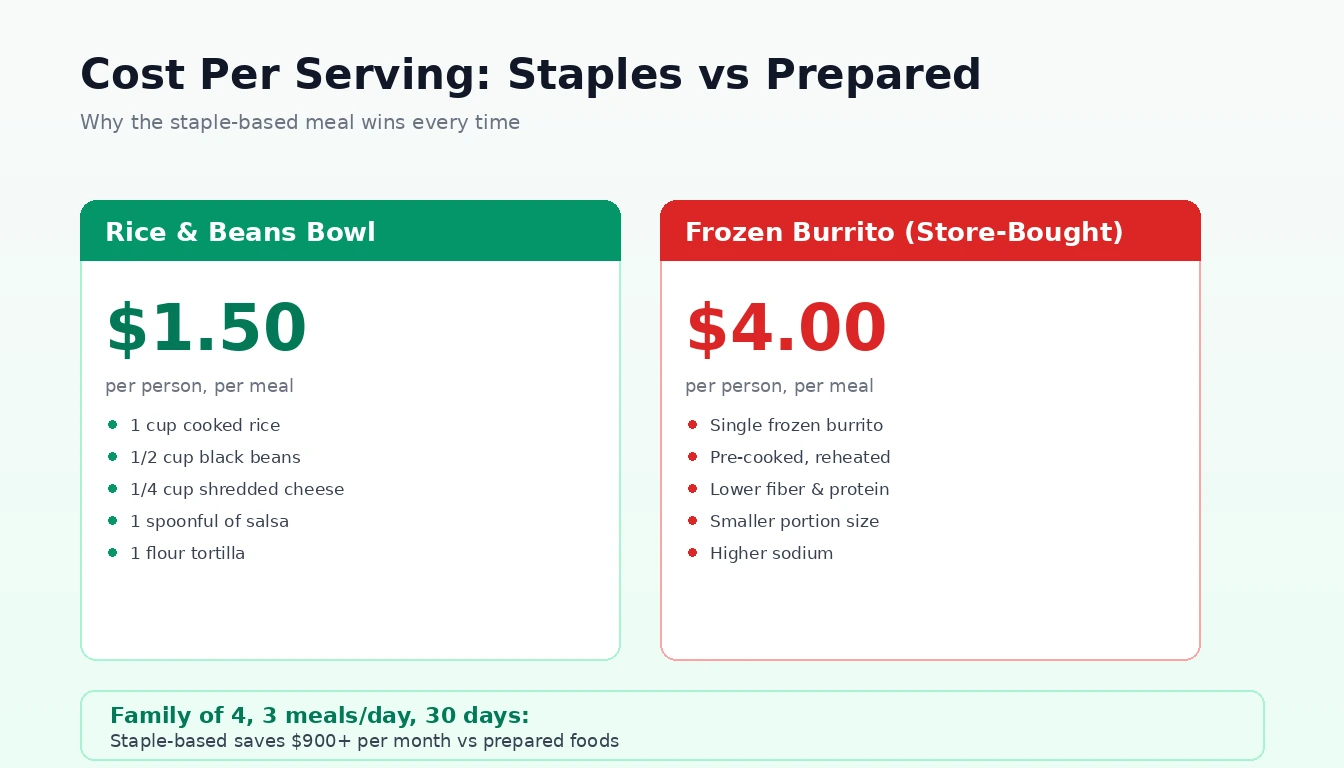
This does not mean eating only rice and beans. It means making rice and beans the base of the meal, then layering on flavor and variety with smaller amounts of more expensive ingredients. A bowl of rice and black beans with a quarter-cup of shredded cheese, a spoonful of salsa, and a tortilla is a complete meal that costs about $1.50 per person.
The same meal built around a frozen burrito from the convenience section costs $4.00 per person and is less filling. Multiply that difference by four people and three meals a day and thirty days, and the staple-based household saves hundreds of dollars a month without eating less.
The practical move is to spend the first shopping trip of the month stocking up on staples. Buy the ten-pound bag of rice. Buy the two-pound bag of dried beans. Buy the large container of oats. Buy the bulk bag of frozen mixed vegetables.
These purchases eat a large chunk of the first week's budget, but they set up the rest of the month. By week two, the staple pantry is full and the weekly grocery run shrinks to fresh produce, dairy, and a few proteins to round out the meals.
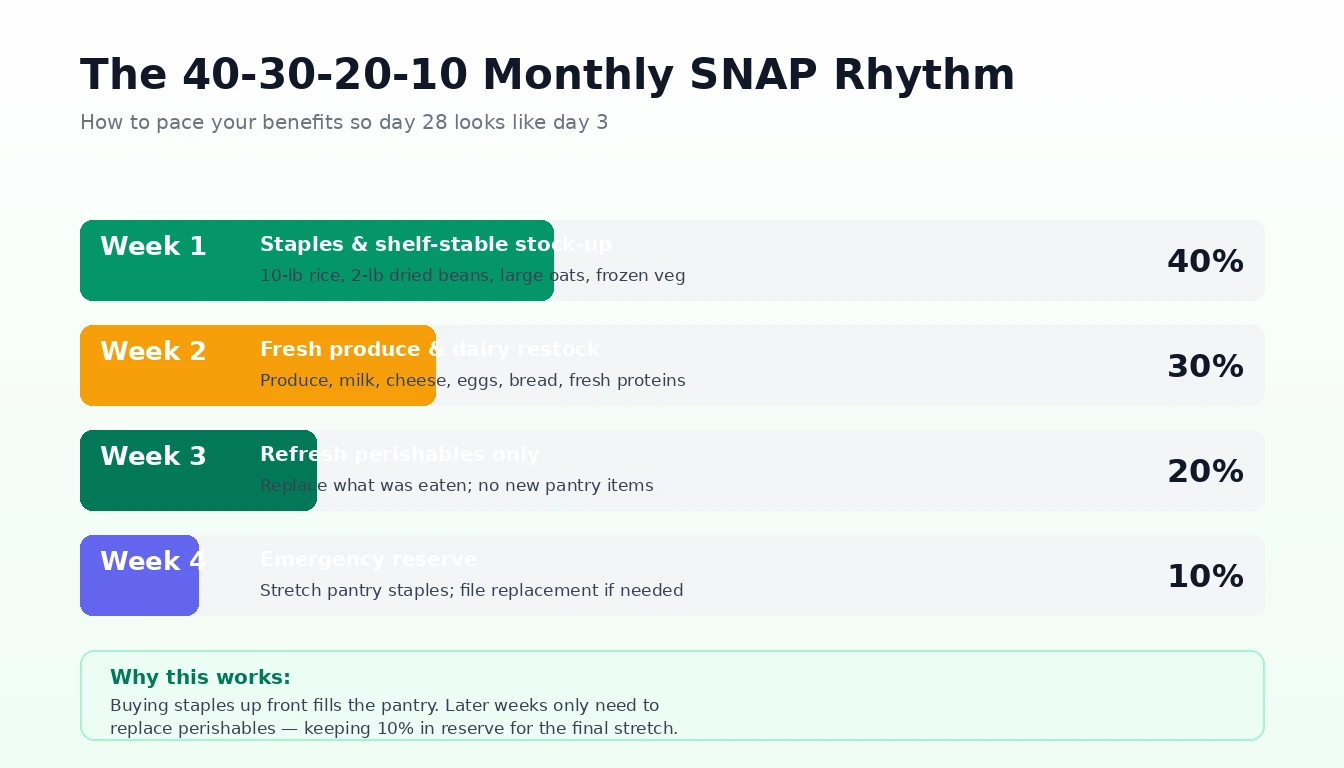
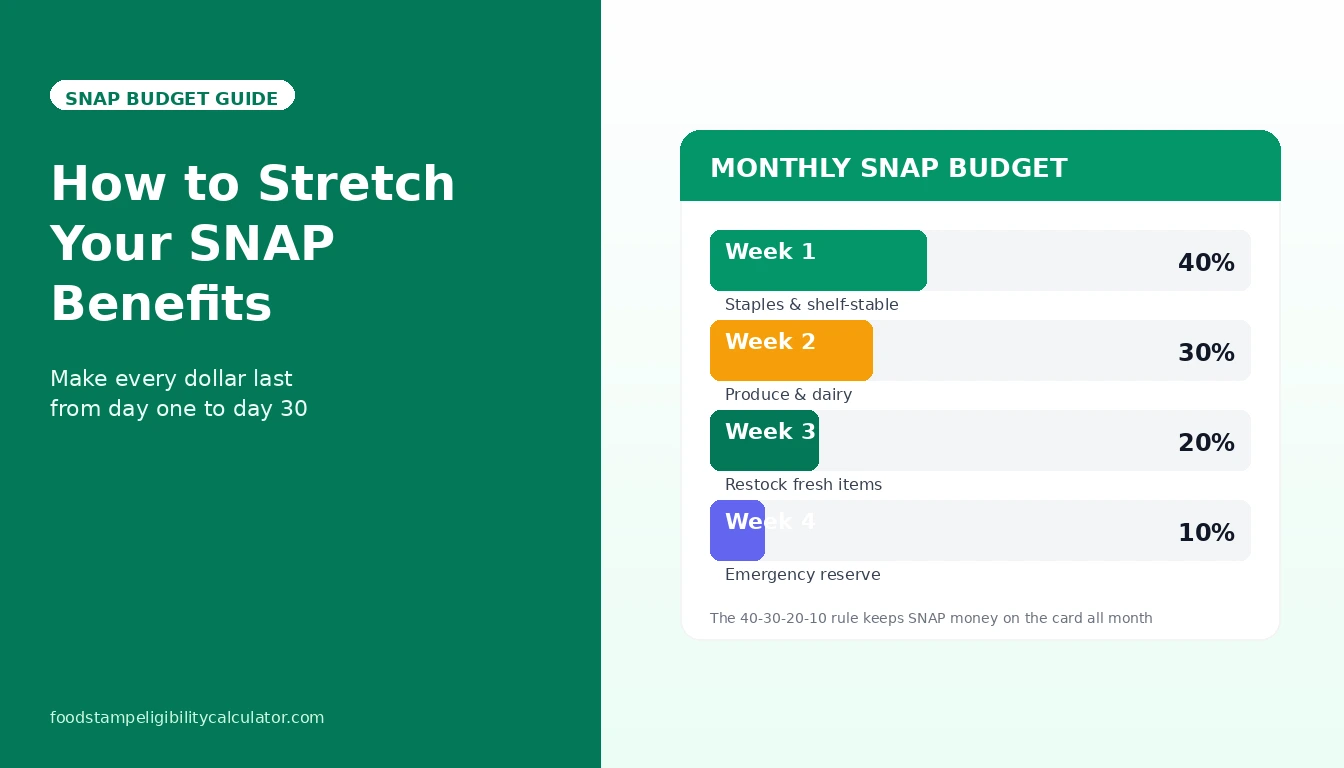
The math behind this rhythm is straightforward. A household receiving $420 per month would spend $168 in week one on staples like rice, dried beans, oats, peanut butter, and frozen vegetables. Week two would spend $126 on fresh produce, dairy, and bread. Week three would spend $84 on restocking perishables.
Week four would reserve $42 for emergencies and any loss replacements. The week-four reserve is not a starvation budget — it is the buffer that keeps the household from running out entirely if something unexpected happens, like a school closure or an extra guest at dinner.
Shop the Perimeter, but Shop It Smart
The old advice to shop the perimeter of the grocery store is mostly correct. The perimeter is where the produce, dairy, meat, and bakery sections live, and these tend to have the highest nutritional value per dollar.
But the perimeter is also where the highest-priced items live, and a SNAP budget does not have room for premium cuts of meat or out-of-season produce. The trick is to shop the perimeter with a list of cheap, high-yield items and skip everything else.
In the produce section, the cheapest items per serving are bananas, cabbage, carrots, onions, potatoes, sweet potatoes, and seasonal greens like collards or kale. In the dairy section, large tubs of plain yogurt and blocks of cheese beat individual cups and pre-shredded bags by a wide margin.
In the meat section, whole chickens, pork shoulder, ground turkey, and eggs beat steaks, chops, and pre-marinated items. Frozen vegetables, often in the next aisle over, are nutritionally equivalent to fresh and cost roughly half as much per serving.
One of the most overlooked savings opportunities is the EBT matching programs at farmers markets. Many farmers markets run Double Up Food Bucks or similar programs that double the value of SNAP benefits spent on fresh produce.
A ten-dollar SNAP swipe becomes twenty dollars of fresh fruits and vegetables. If you live within a reasonable distance of a participating market, this is essentially free money for your household.
Plan Your Meals Around What You Already Have
Most SNAP households throw away food every month, and the food they throw away is money they could have spent on something else. The Department of Agriculture estimates that the average American household wastes between thirty and forty percent of the food it buys.
For a SNAP household on a tight budget, that waste is the difference between making it to the end of the month and running out in week three.
The simplest way to cut waste is to plan meals around what is already in the kitchen before shopping for new food. Before each weekly shopping trip, open the refrigerator and the pantry and write down what is there. Then plan the next week's meals to use up what you have.
The half-bag of spinach that is about to wilt becomes the base for a frittata. The leftover rice from Tuesday becomes fried rice on Wednesday. The end of the peanut butter jar becomes the sauce for a noodle dish. Every item used from the existing pantry is an item not bought at the store.
This habit takes about ten minutes per week and saves most households between fifteen and twenty-five dollars per week. Over a month, that is sixty to a hundred dollars — money that stays on the EBT card for the last week of the month instead of going into the trash.
Coordinate SNAP With Other Programs
SNAP is one of several food assistance programs, and many households qualify for more than one. The mistake is treating SNAP as the only program and then stretching it to cover foods that another program could pay for.
If you have children under five, you may qualify for WIC, which covers infant formula, baby food, and specific staple items. WIC foods are packaged separately at the register and do not come out of your SNAP balance. A household with an infant on formula can save $80 to $120 per month by routing formula through WIC instead of SNAP.
School-age children in households receiving SNAP are automatically eligible for free school meals, and in many states for the Summer EBT program, which loads an additional $120 per child onto a separate card for the summer months.
These benefits are not deducted from your SNAP allotment. They are separate programs with separate funding streams, and using them frees up SNAP dollars for the rest of the month.
For households with seniors or disabled members, the medical expense deduction can raise your SNAP benefit by allowing out-of-pocket medical costs to be subtracted from your income before the benefit is calculated.
Many senior households do not realize this deduction exists, and the paperwork is straightforward. The deduction can mean the difference between a $100 monthly benefit and a $250 monthly benefit for an otherwise identical household.
Cook Once, Eat Twice (or Three Times)
Cooking in batches is the most effective way to reduce both food cost and time spent in the kitchen. A pot of chili that costs $12 in ingredients yields six servings at $2 per serving.
The same ingredients cooked as individual meals would cost closer to $4 per serving, because the per-meal overhead of cooking oil, seasonings, and energy use does not scale down efficiently. Batch cooking also reduces the temptation to grab a convenience meal when you are tired, because the reheatable portions are already in the refrigerator.
The practical approach is to pick two or three "anchor meals" per week — meals that cook well in large batches and reheat well the next day. Chili, soups, stews, pasta bakes, rice and bean bowls, and sheet-pan roasted vegetables with a protein all work.
Cook the anchor meal on Sunday, eat it Sunday and Monday, then cook a second anchor meal on Tuesday that covers Tuesday and Wednesday. By Thursday, you have used most of the week's groceries, and the remaining two days can be filled with quick meals from pantry staples.
For households with limited refrigerator space, the freezer is your friend. Cooked rice, cooked beans, soups, and stews all freeze well in single-serving containers.
A Sunday cooking session that produces twelve single-serving containers of soup or stew gives you two weeks of ready lunches at a cost of about $1.50 per serving. The same approach works for breakfast burritos, oatmeal muffins, and even sandwich components.
What to Do When You Still Run Out
Even with good planning, some months are harder than expected. An unexpected medical bill, a school closure that means three extra lunches per child per week, or a freezer failure that destroys a month of frozen food can blow a budget wide open. SNAP has specific provisions for these situations, and knowing them in advance saves time and stress when the moment arrives.
If you lose food purchased with SNAP in a power outage, fire, flood, or appliance breakdown, you can request SNAP replacement benefits within ten days of the loss.
The replacement is capped at one month of your regular allotment and is loaded onto your existing EBT card. This is a separate process from D-SNAP, which is for households not currently receiving SNAP, and it is one of the most underused provisions in the program.
If your benefit has dropped and you do not know why, the most common reasons are an unreported income change, a missed recertification, or a child aging out of an eligibility category. The guide to why SNAP benefits go down walks through each scenario and the steps to fix it.
If the drop was caused by a missed recertification, you can usually file the paperwork and get the benefit reinstated within a few weeks. If the drop was caused by an income increase, you may still qualify for a smaller benefit, and it is worth re-running the numbers through the calculator.
If you are in immediate need and cannot wait for the next deposit, expedited SNAP benefits can be issued within seven days for households that meet the income and resource thresholds.
This is not extra money — it is your regular benefit issued early — but it bridges the gap when the month has run out and the next deposit is still weeks away. Local food banks and pantries are also available in almost every county, and using them is not a failure of planning. They exist for exactly this situation.
The Bottom Line
Stretching SNAP is not about deprivation. It is about planning. The households who make it to the end of the month with money left over are not eating less than the households who run out in week three. They are eating the same foods, in similar quantities, but they are buying those foods at lower prices, in larger quantities, with less waste, and with the help of the other programs they qualify for.
The strategies in this guide are not new and they are not secret. They are the practices that food banks, extension offices, and SNAP educators have been teaching for decades. The only reason more households do not use them is that no one has explained how the pieces fit together.
Start with the simplest changes first. Confirm your current benefit amount. Claim every deduction you qualify for. Spend the first shopping trip of the month on staples. Plan meals around what is already in the kitchen. Cook in batches. Use the farmers market matching program if one is available. Coordinate with WIC and school meals if you have children.
File a replacement request if you lose food in a disaster. None of these strategies is dramatic on its own, but together they add hundreds of dollars per month to the food a household can put on the table. That is the difference between a stressful last week of the month and a calm one, and it is the difference between a SNAP benefit that runs out and a SNAP benefit that lasts.
Frequently Asked Questions
About the author
Marcus Thompson
SNAP Outreach Specialist & Household Budget Counselor
Marcus spent eight years running a food security outreach program at a regional food bank in the Midwest, where he helped more than 4,000 households enroll in SNAP and coordinate benefits with WIC, school meals, and local pantries.
He writes about practical budgeting strategies that real families use to make SNAP last the full month, and he fact-checks every dollar figure against current USDA Food and Nutrition Service guidance.
B.S. Nutrition Sciences, Purdue University, 2014; certified SNAP Outreach Counselor through the National Community Action Partnership