
Pennsylvania Food Stamp Eligibility Calculator 2026
Use our free Pennsylvania food stamp eligibility calculator to instantly check if you qualify for SNAP benefits. Get an estimate of your monthly food stamp amount based on the latest 2026 USDA guidelines for Pennsylvania.
Pennsylvania SNAP Eligibility Calculator
Enter your household details to check your pennsylvania food stamp eligibility and estimate your monthly SNAP benefit.
Include yourself and everyone who lives with you and shares meals
Total income before taxes and deductions for all household members
Childcare, adult daycare, or other dependent care expenses
Legally obligated child support you pay to someone outside your household
Out-of-pocket medical costs for household members who are 60+ or disabled (amounts over $35 are deductible)
Monthly rent or mortgage payment for your primary residence
Electricity, gas, water, phone, and other utility expenses
Include bank accounts, cash, and other countable resources. Your home and vehicle are usually excluded.
On This Page — Pennsylvania SNAP Guide
Three rivers, 67 counties, and one rulebook out of Harrisburg
Name's Greta. Fifty-four years old.
Born at Braddock General Hospital on Talbot Ave, the summer of 1971, on the same third-floor nurses' station where my mother would later work the night shift. Braddock sits on a bend in the Monongahela River, nine miles upstream from where the Allegheny and the Mon come together. The two rivers meet under the yellow Three Sisters suspension bridges and give birth to the Ohio.
Somebody named each span for a hometown legend: the Roberto Clemente closest to PNC Park, the Andy Warhol in the middle, the Rachel Carson out toward the Point. The fountain at the Point runs in front of the old Fort Duquesne blockhouse.
Three rivers feeding one valley, sixty-seven counties spread across three distinct regions of the commonwealth. One rulebook for food-stamp allotments comes out of Harrisburg.
Same rulebook for Philadelphia, for Erie, and for the strip-mine towns up in Greene County. Different everything else.
A mill family, and how I ended up on this side of the desk
Pap worked the Edgar Thomson Works for 31 years. That's the US Steel plant on the river side of North Braddock, the one Andrew Carnegie built in eighteen seventy-five. It still runs today, the last integrated steel mill standing inside the Pittsburgh city limits.
Pap ran the overhead crane in the basic oxygen shop. Came home smelling like hot metal every night.
Died in two thousand eleven from the same lung trouble that took half his crew.
Mami was a nurse's aide at UPMC Braddock hospital, on Hawthorne Avenue behind the high school. UPMC bought the place from the Forbes Health System in nineteen ninety and tore it down in 2010. After that she cleaned houses in Squirrel Hill until her knees quit.
I worked at UPMC Braddock too, on the same Hawthorne Avenue floors where Mami worked. Nine years.
Certified nurse's aide, three-twelve shift, every other weekend. They announced the closure on an October morning in two thousand eight.
That day, 230 of us walked out of a town hall meeting at the Braddock Area High School gym on Sixth St. We figured out what to do next from there.
I was 37. I'd had a mortgage and a kid in fourth grade.
I signed up for SNAP the next month. Used it for six months.
Found a retraining program at the Braddock Civic Association. Got certified as a community health worker.
Hired on at the regional distribution center as a benefits outreach coordinator in 2012. Been doing benefits outreach ever since.
How the commonwealth is built, and why the identical rulebook fits all of it
the commonwealth is three hundred and ten miles wide if you drive I-80 from the Delaware Water Gap to the Ohio line. Every mile of it runs on Eastern time.
Sixty-seven counties. Philadelphia County has 1.5 million people.
Forest County, up in the northwest, has seven thousand. Cameron County has four thousand eight hundred.
Same Department of Human Services in Harrisburg writing the policy. Same COMPASS portal.
Same commonwealth card. Same county assistance offices running the intake.
What changes from county to county is what's around the office. The bus fare.
Wait time. The language at the front desk. Whether there's a worker who's been there long enough to know the rules by heart.
One system, sixty-seven front doors
An application filed at the CAO on Fifth Ave in Pittsburgh hits the same state system as one filed on North Broad in Philadelphia. So does an application dropped off on State Street in Erie. Everything lands in Harrisburg.
Caseworker training is identical.
Forms are identical. Interview script is the same. What's different is the chair you sit in while you wait, and the kind of day the intake worker on the other side of the desk is having.
The Mon Valley, and the years after the mills thinned out
Monongahela Valley was steel country for a hundred and twenty years. From Homestead to McKeesport to Duquesne to Clairton to Braddock to Rankin to Turtle Creek to West Mifflin, the mills lined both sides of the river. Thirty straight miles of steel.
At peak, in 1979, US Steel alone employed 40,000 people in the valley. By 1983, that number was eighteen thousand.
By two thousand, it was eight thousand. The National Tube Works in McKeesport shut down in 1987, taking eight thousand jobs with it.
The Duquesne Works and the Homestead Works went dark in the mid-eighties, and the last heat of steel got poured out on a gray Friday afternoon in August.
The Carrie Furnace went cold around the same stretch. The Edgar Thomson Works, where Pap ran the crane, is the only one still running. It runs thinner now, with about a thousand workers where there used to be five.
What a century of steel left behind
What that left behind is a string of boroughs with shrinking tax bases and empty storefronts on the main street. The people who stayed still labor hard for not much money. SNAP is a fact of life in the Mon Valley.
Isn't a stigma. It's a piece of the household budget, the same as the gas bill. The parking pass at Kennywood, the old amusement park on the West Mifflin side of the Mon, costs about as much.
I grew up watching neighbors trade garden tomatoes for hamburger, and watching my mother fill out the same Form PA-600 at the kitchen table. A Pirates game murmured from the radio on KDKA-AM 1020. Greg Brown called the plays from the booth at PNC Park on the North Shore of the Allegheny.
Our two-story frame house on Talbot Avenue sits six doors down from the old Polish National Alliance hall. That hall holds the corner of Braddock Ave and Sixth, and I still live in the house.
Math on the page never scared us. What scared us was the wait, and the look on the intake worker's face when she pulled up your file.
By the numbers: Pennsylvania SNAP in 2026
Commonwealth, not state. That's the legal designation, written into the Constitution of seventeen seventy-six.
What that means for SNAP is mostly nothing. The federal program treats Pennsylvania the same as Texas or California. What it means for workers is mostly letterhead. The paperwork reads "Commonwealth of Pennsylvania Department of Human Services" at the top. The ACCESS card wears the state coat of arms with two black horses supporting a shield.
Why I'm writing this page
Everything I know about this program I learned on both sides of the intake desk. Mami used it in 1983, after Pap's hours got cut at the mill.
I used it for six months in 2008, after the hospital closed. My brother David Wojcik used it for four months in 2015, after US Steel's Clairton coke works laid off a third of the shift, including him.
My niece Sofia Wojcik used it through her senior year at the University of Pittsburgh School of Nursing. My neighbor Mary Kostelnik used it after her husband Ed passed at sixty-eight, from black lung.
This isn't an abstraction to me. This is the kitchen table.
The plan for this page is to walk you through how the program actually runs here in 2026. Income limits, deductions, the intake form, the work rules, the commonwealth card, the renewal, the algorithm on the calculator above.
Real numbers from real families I've sat with at folding tables all over the southwest. The basement of the Braddock Library. The back room of the Hays Manor Senior Housing complex in McKees Rocks, on Chartiers Ave just off Pine Hollow Road.
The community room in the Westgate housing complex in Washington, Pennsylvania. The First Presbyterian Church on Main St in Brownsville, the stone building across the street from the Flatiron Building that's stood on that corner since eighteen sixteen. What the Harrisburg rulebook says.
What really happens when you walk into the CAO on Fifth Avenue at eight 45 on a Tuesday morning. Those two things aren't the same.
Where Harrisburg draws the 2026 SNAP income line, and the countable pay check underneath
How Pennsylvania handles the gross earnings test
Pennsylvania runs a BBCE program. Broad-Based Categorical Eligibility, in the commonwealth's own phrasing.
What that means in plain English is that the gross earnings cap is set at 200% of the federal poverty line, not 130%. That's a higher ceiling than the federal floor. It's the reason plenty of working households here qualify who wouldn't qualify in a state running the standard test.
Other thing BBCE does in Pennsylvania is drop the asset test for most families. Your savings account, your second car, your retirement fund, the house you own.
None of those count against you. Income does.
Assets don't. That's the rule I write on the back of every outreach brochure. Most families don't believe it until I show them the policy manual.
I see folks every Tuesday at the Braddock Library who assume they're disqualified because they've a paid-off truck or two thousand dollars in savings. They aren't.
Sit down at my table. We'll do the calculation together. Nine times out of ten, the only thing between them and approved paperwork was the assumption they made before they ever called the CAO on Fifth Avenue.
The 2026 numbers, by family size
| Household size | Gross monthly cap (200% FPL, BBCE) | Max benefit |
|---|---|---|
| 1 person | $2,610 | $298 |
| 2 people | $3,526 | $546 |
| 3 people | $4,442 | $785 |
| 4 people | $5,360 | $994 |
| 5 people | $6,276 | $1,183 |
| 6 people | $7,192 | $1,421 |
| 7 people | $8,110 | $1,571 |
| 8 people | $9,026 | $1,789 |
Each additional person adds $916 to the gross cap and $218 to the max allotment. Those numbers come from the USDA SNAP allotment matrix for fiscal year 2026, which runs October twenty twenty-five through September 2026.
DHS publishes the same chart on the COMPASS portal. Numbers on the wall at every county assistance office match the chart above, to the dollar.
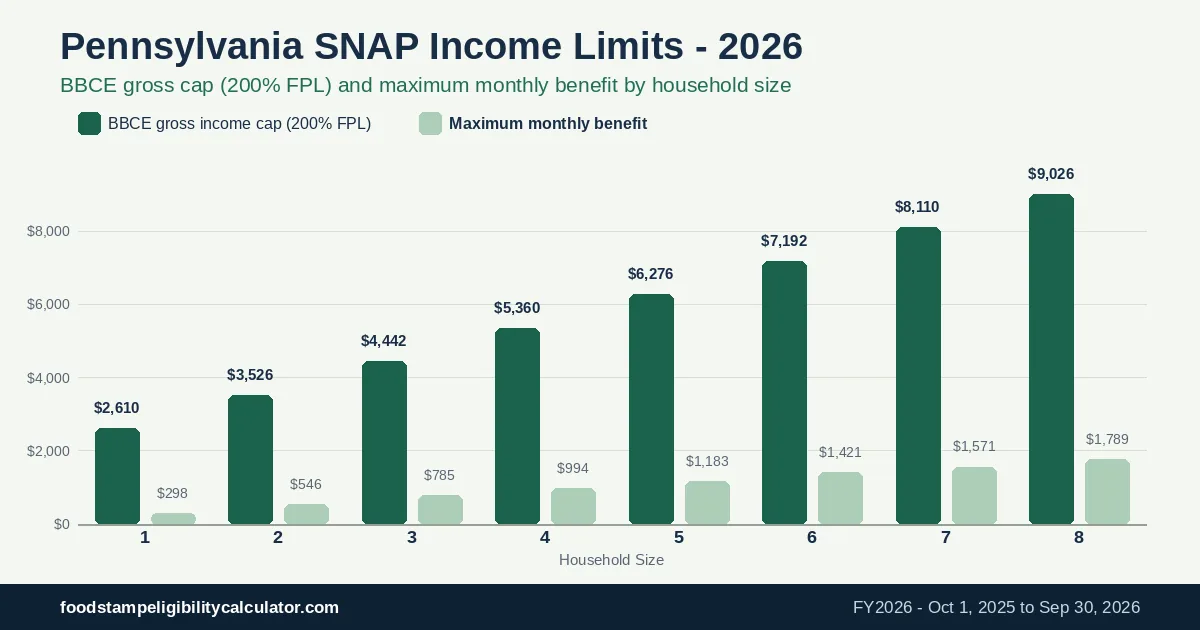
If your household runs larger than eight, add $916 to the income column and $218 to the benefit column for every extra member. The calculator handles that arithmetic, but the wall chart works the same way.
The second check: countable pay at 100% of poverty
Here's the part most families miss. After DHS runs the gross earnings test at 200%, they run a second test on your countable earnings.
Net income is what's left after all your deductions come off the gross. That second test caps your countable earnings at 100% of the federal poverty line for your family size.
One person, $1,305 a month. Two people, $1,763. Three people, $2,221.
Four people, $2,680. If your countable earnings is over that line after deductions, you don't qualify, even if your gross was well under the 200% cap.
Most families never hear about the second check because the intake worker doesn't usually explain it. They just see approved or denied on the letter.
But it's the reason a family at one hundred ninety percent of poverty with no rent deduction can still get denied. Math underneath is doing more work than the headline number suggests.
When you're right at the line, run the calculator above with your real deductions. Net income test catches people who assume the gross number is the only number. It isn't.
Households with elderly or disabled members
If anyone in your household is sixty or older, or receives Supplemental Security Income or disability benefits, the rules bend in your favor. DHS skips the gross earnings test entirely for those households.
They only run the countable earnings test. They also let you deduct medical expenses over thirty-five dollars a month, which is a deduction most younger households can't touch. That combination is the reason my neighbor Mary, who's sixty-seven and on dialysis, qualified at a gross earnings that'd have disqualified her next-door neighbor.
Pennsylvania SNAP increase: what changes on October 1, 2026
Federal benefits get a cost-of-living adjustment every October, and the USDA locked the fiscal 2027 figures in August 2026. Pennsylvania adopts them the day they take effect, and current recipients don't have to file anything to get the raise.
A one-person household sees its maximum move from $298 to $306. A family of four goes from $994 to $1,023, which works out to twenty-nine extra dollars a month at the register.
The deduction figures rise on the same schedule. The standard deduction hits $217 for one- and two-person households, the shelter cap moves to $769, and the two-person minimum benefit reaches $25.
Pennsylvania's BBCE ceiling rises with the same tide. Based on the 2026 poverty guidelines, the 200% gross cap lands near $2,660 for one person and near $5,500 for a family of four. COMPASS cases adjust automatically, and any recertification processed after October 1 uses the new figures.
| Household size | FY2026 max benefit | FY2027 max benefit | Monthly increase |
|---|---|---|---|
| 1 person | $298 | $306 | +$8 |
| 2 people | $546 | $562 | +$16 |
| 3 people | $785 | $808 | +$23 |
| 4 people | $994 | $1,023 | +$29 |
| 5 people | $1,183 | $1,217 | +$34 |
| 6 people | $1,421 | $1,463 | +$42 |
| 7 people | $1,571 | $1,616 | +$45 |
| 8 people | $1,789 | $1,841 | +$52 |
| Each additional | +$218 | +$225 | +$7 |
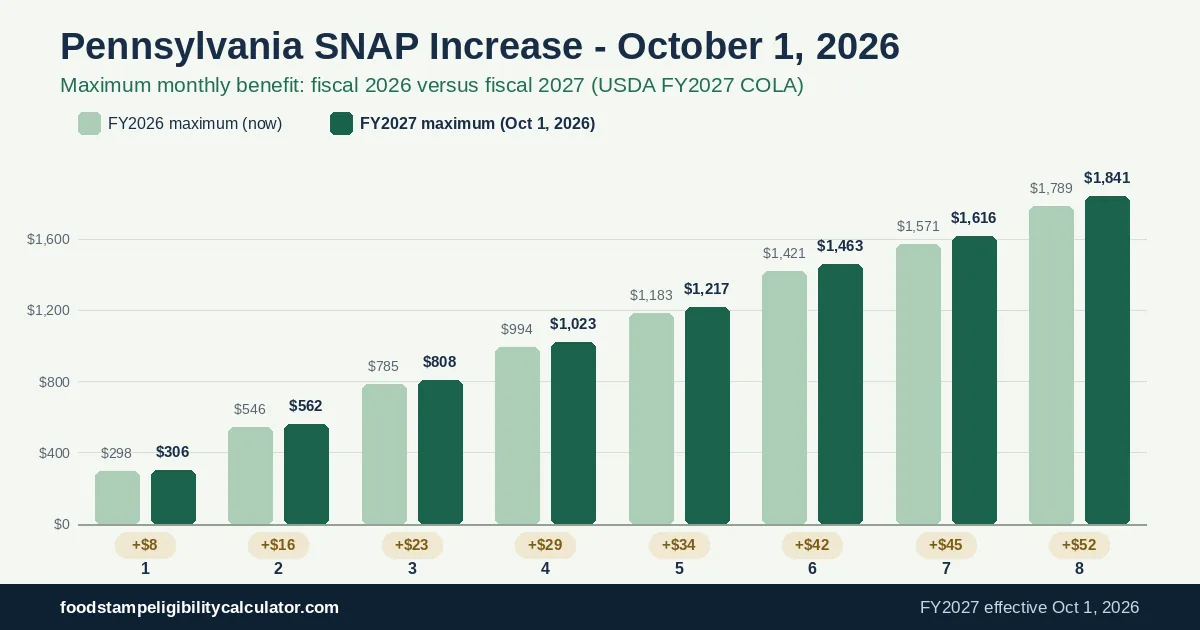
Every figure in the table comes from the USDA's FY2027 cost-of-living memo for the forty-eight states and the District of Columbia. The numbers on this page get checked against that memo the same week it publishes, so the chart and the calculator stay in step with what Harrisburg pays.
Eight things your worker can shave off gross pay before the SNAP formula runs
The deductions that move the math
DHS doesn't run the allotment formula on your gross pay. They run it on what's left after eight flat write-offs come off.
Some of these you've to ask for. Some you've to document.
Some DHS applies automatically. Knowing which is which is the difference between a allotment you can live on and a benefit that doesn't cover a week of groceries at Giant Eagle.
Health costs, childcare, and the write-offs that need paperwork
The deduction that does the most work in Pennsylvania
In Pittsburgh, from the West End Bridge on the Ohio side, through the Three Sisters bridges in the middle, to the Highland Park Bridge on the Allegheny, and across the western half of the state, excess shelter write-off plus the standard utility allowance is the combination that bends the math the hardest. Rents in Allegheny County have climbed hard the last five years.
A two-bedroom on Butler St in Lawrenceville runs nineteen hundred. The old mill-workers' neighborhood now pours craft breweries, from Roundabout Beer Company on Liberty Ave to Helltown Brewing out in Mount Pleasant. A two-bedroom on Murray Ave in Squirrel Hill, the old Jewish neighborhood by Carnegie Mellon, runs sixteen.
A two-bedroom on Talbot Avenue in Braddock, three doors from where the original Braddock Hospital stood, runs seven hundred. Braddock pays for it in property taxes, the burden of a town that lost eighty percent of its population. Combination of high rent and high utility costs is what pushes most working households into eligibility here.
The same story in Philadelphia, with bigger numbers
In Philadelphia it's the same story, just bigger numbers. A one-bedroom on Frankford Ave in Fishtown runs seventeen hundred.
A one-bedroom on Powelton Ave near Drexel runs thirteen hundred. A one-bedroom on Chelten Ave in Germantown runs eleven.
Cap on the shelter deduction, $744 for non-elderly families, is the single biggest reason some families qualify and some don't. The cap doesn't scale with local cost of living.
That's a federal rule. DHS can't change it.
When you're paying child support, list it. When you're paying for daycare so you can work, list it.
When you're sixty or older and have medical bills over thirty-five dollars a month, list every single one. Most denied applications I see got denied because the family didn't list the deductions they were entitled to.
COMPASS, the county assistance office, and the chair by the window that's always taken
Three doors into the system
There's three ways to file a benefits application in Pennsylvania, and only one of them requires you to leave the house. The fastest, by far, is the online portal at compass.state.pa.us.
Portal takes 20-30 minutes if you've got your documents scanned or photographed. Portal is in English and Spanish. Portal saves your application if you walk away and come back, which is important because the intake form's long and most people get interrupted.
Second door is the phone line. Dial one-eight-hundred-six-nine-two-seven-four-six-two from any phone in the state.
That's the state-wide Customer Service Center. They can mail you a paper application, or take one over the phone. They can also transfer you to a community partner like me who walks people through it.
Line is staffed in English and Spanish, with translation services for more than a hundred other languages.
Third door is the County Assistance Office, what locals call the CAO. There's one in every county.
The Allegheny County CAO occupies the eleventh floor of the State Office Building on Fifth Avenue in Pittsburgh. It has looked out over the old Greyhound station on Liberty Avenue since the nineteen seventies. Waiting room has about thirty chairs.
On a Monday morning in October, the line is out the door by eight 45. They open at nine. When you go, bring a snack, bring water, bring a book, and bring every document you think they might need, plus two you don't.
The six steps, start to finish
Documents DHS will ask for
List is shorter than people think. Pay stubs for the last 30 days, or a letter from your employer if you're getting paid in cash.
Proof of unearned income, meaning Social Security, child support, unemployment, veteran's benefits, worker's comp. Proof of rent or mortgage.
Proof of utilities, if you're paying them separately. Proof of child support paid out, if you're paying it.
Proof of daycare costs, if you're paying them so you can work. Proof of medical expenses over thirty-five dollars a month, if anyone is sixty or older or disabled.
Identification for the applicant, which can be a driver's license, a state ID, a passport, a PennDOT photo card, or a school record. You don't need a Social Security number for yourself to apply for your kids, but you do need SSNs for everyone in the household who's got one.
For a deeper walkthrough of the application itself, read our how to apply for SNAP guide. It covers the phone call and what to do after a denial letter. It covers every state, including Pennsylvania, and goes into more detail than I can fit on this page.
Twenty hours a week, the ABAWD clock, and the September 2025 switch Pennsylvania did not get to dodge
The 80-hour rule, in plain English
If you're between eighteen and 54 years old, you don't have a child under eighteen in your home, and you aren't pregnant, SNAP files you as an ABAWD. Able-bodied adult without dependents.
ABAWDs have to prove 80 hours a month of work, volunteer shifts, job training, or some combination of the three. That works out to about twenty hours a week. Since September 2025, DHS makes you report your hours every month through COMPASS or the Statewide Customer Service Center.
Miss 80 hours without an exception, and SNAP shuts off after three countable months in a 36-month window. That is not a Harrisburg policy choice. It is federal law, and every county in Pennsylvania now runs it.
Since November 1, 2025, the clock also stretches through age 64, and parents whose youngest child has turned fourteen fall under it. Veterans and former foster youth lost their exemptions that same day, which is the change caseworkers around here talk about most.
The exceptions still cut wide. Anyone pregnant, anyone sixty or older, anyone collecting disability benefits, anyone medically unable to work, and any parent with a child under fourteen all sit outside the clock. If you think one of those boxes fits you, tell the CAO and claim it in writing.
What changed in September 2025, and why no county is exempt anymore
For most of the last decade, Pennsylvania ran a statewide waiver that suspended the time limit in all sixty-seven counties. That era ended on September 1, 2025, when the federal budget law passed the previous summer took effect and rewrote the waiver standards.
DHS states it flatly on its own SNAP work requirements page: Pennsylvania no longer qualifies for waivers of these rules by county or municipal jurisdiction. The clock is live in Philadelphia and in Forest County alike.
There is no address-based escape hatch anymore. Every ABAWD case carries the same three-month meter, and DHS mails a warning notice before benefits stop.
Months where you hit the count get banked, and a later month with 80 documented hours can switch benefits back on. Partial months and partial weeks count too, which matters for folks juggling two part-time jobs.
If you're an ABAWD and you aren't working, get yourself into a SNAP Employment and Training slot now. Hours spent in E and T count toward the eighty, and Pennsylvania runs the program through regional providers with PA CareerLink offices in every corner of the commonwealth.
Questions about your status go to the Statewide Customer Service Center at 1-877-395-8930, or to the HR1 FAQ line DHS set up at 1-877-883-6383. Keep copies of your schedules and pay stubs. Reported hours are the only hours that count.
If you hit the three-month limit
Once you've burned three countable months, the meter resets only if you complete 80 hours in a single month or qualify for an exception. Do the hours, and benefits resume for as long as you keep them up. Stop reporting, and SNAP stops with you until the 36-month window closes.
Pennsylvania's E and T program offers job search assistance, training, and subsidized work placements through regional providers. Provider will help you document your hours and report them to DHS every month.
Most of the folks I work with in the Mon Valley use PA CareerLink, the statewide workforce system.
The PA CareerLink Allegheny West office in McKeesport is the one I send people to. It sits on Fifth Avenue across from the old Penn-McKee Hotel, boarded up since two thousand twelve but still wearing its original 1924 yellow-brick face. The one in Washington on West Chestnut St is the next closest for the south-side counties.
Pennsylvania's ACCESS card, the last-digit deposit schedule, and where it swipes from Erie to Manayunk
The card itself
The Pennsylvania EBT card goes by the official name ACCESS card. Looks like a debit card.
Has the Commonwealth seal on the front, the letters EBT across the top, your name embossed at the bottom. Works at any point-of-sale terminal that accepts SNAP, which is most grocery stores, most pharmacies, most big-box stores, and a growing number of farmers markets. The card doesn't work at restaurants unless you're part of the Restaurant Meals Program, which Pennsylvania doesn't currently operate.
The card doesn't show your balance. Receipt does.
Every time you swipe, the receipt prints the remaining balance for that transaction type. SNAP allotments and cash benefits, if you've got both, print on separate lines.
You're also able to check your balance by calling the number on the back of the card, 1-888-328-7366. That same line handles PIN resets and lost cards. Just call it.
When the money lands
DHS staggers ACCESS card deposits across the first ten business days of the month. Your day comes from the last digit of your seven-digit case record number, not your Social Security number.
Case record ending in 1 means the first business day. Ending in 2 means the second, and so on through digit 0 on the tenth business day.
Two neighbors on the same block can land a week apart, and the gap repeats every single month.
The schedule never shifts with your caseworker, your county, or the weather.
Holiday weekends are the only wrinkle. When a deposit day lands on a weekend or a state holiday, the money posts the next business day.
Rent is due the first for most people, which makes the wait feel longer than it is.
Plan groceries around your day instead of the calendar month, and the cycle gets easier to live with.
Nothing posted by the end of the tenth business day? Call the EBT line at 1-888-328-7366. Something is wrong, and a real person can trace the file.
Where the card swipes
Every major chain in Pennsylvania takes the EBT card. That means Giant Eagle, Giant, Weis Markets, Wegmans, Acme, ShopRite, Redner's, and Food Lion. It also covers Aldi, Trader Joe's, Whole Foods, Sprouts, Walmart, and Target.
Costco takes it through their online pickup service in some locations, and Sam's Club does too.
Bottom Dollar, Sharp Shopper, Price Rite, all the smaller regional chains. Most independent corner groceries in the old mill towns take it too, though the selection is smaller and the prices can be higher.
Farmers markets in Pittsburgh, Philadelphia, Erie, Harrisburg, and Allentown participate in Food Bucks. The Food Trust runs the program and matches SNAP dollars spent on fresh produce one for one, up to a daily cap. Swipe your EBT card for ten dollars of produce, get twenty dollars worth.
Program runs June through October in most markets. Worth the trip.
When you're living near a state border, your commonwealth-issued card works across state lines. SNAP is a federal program.
The card is federal. A family in Erie can swipe at the Walmart in Ashtabula, Ohio.
A family in Philadelphia can swipe at the ShopRite in Camden, New Jersey. A family in Easton can swipe at the Walmart in Phillipsburg, New Jersey.
A family in Chester can swipe at the Acme in Wilmington, Delaware. A family in Morgantown's southern suburbs can swipe at stores across the West Virginia line.
Shopping out of state and want to compare eligibility rules? See our pages on Ohio SNAP eligibility, New York food stamp rules, and New Jersey benefit guidelines.
Border towns lean on those states daily. Our West Virginia SNAP income limits, Maryland SNAP eligibility, and Delaware SNAP rules guides cover the rest.
What you can and can't buy
Card buys groceries for the family. Meat, dairy, produce, bread, canned goods, frozen food, snacks, seeds and plants that produce food.
The card doesn't buy alcohol, tobacco, vitamins, hot prepared food, household supplies, paper products, pet food, or anything sold to eat in the store. Hot-food rule is the one that catches people, because the rotisserie chicken at Giant Eagle smells really good and the card will decline it.
Cold rotisserie chicken in a sealed package is fine. Hot isn't.
For more on what the card covers, what it doesn't, and edge cases like birthday cakes and seafood and energy drinks, see our frequently asked SNAP questions page.
The numbers underneath: what the calculator above really computes for Pennsylvania households
The four-step math the calculator runs
The calculator above this article takes your family size, gross monthly income, shelter costs, and a handful of other details. Then it runs the same four-step math DHS runs. Step one, check gross earnings against the two hundred percent cap.
Step two, subtract the flat write-off, the twenty percent earned income deduction, and any other deductions you entered. Step three, subtract the excess shelter write-off, capped at $744 for non-elderly families.
Step four checks countable pay against the one hundred percent of poverty cap. Then comes the benefit formula: thirty percent of your countable income, subtracted from the maximum allotment for your family size.
When the result is zero or below, you qualify for the maximum benefit. When the result hits the maximum or above, you don't qualify.
Everything in between is a sliding scale. Math is the identical math DHS's computer runs.
The numbers on the screen are an estimate, not a guarantee. Estimate can be off if your actual deductions are different from what you entered, or if your caseworker interprets a deduction differently than the calculator does.
Reading the slider result
When the slider says you qualify for $250, that means the calculator ran the math and landed at two hundred fifty. Your actual benefit, after DHS runs identical math with verified documents, will be close to that number.
Within twenty or thirty dollars, usually. If DHS's number is significantly lower than the calculator's, the most common reason is that a deduction you claimed got denied for lack of documentation. Bring every receipt, every time.
If the slider says you don't qualify but you think you'd qualify, run it again with different deductions. Add the medical write-off if you're sixty or older.
Add the daycare write-off if you pay for daycare. Add the homeless shelter allowance if you don't have fixed housing.
Each one of those can flip a denial into an approval. Math doesn't change. What you put into it does.
For more on how the calculator works under the hood, see our calculator methodology page. It publishes the source data, the exact benefit formula, and the deduction caps, alongside our Why Trust Us review standards.
SNAP by region, and how the program got here
Approximate figures, from DHS county reports for FY 2025. Southeastern PA holds the largest concentration. Northcentral PA has the smallest caseload, due to low density across Cameron, Elk, Forest, McKean, Potter, and Clinton.
Pennsylvania SNAP timeline, 1964 to 2026
A Wednesday in Braddock: the Greater Pittsburgh Community Food Bank truck pulls in before dawn
The pantry at the Braddock Library
There's a pantry in the basement of the Braddock Carnegie Library, four blocks from my house, that opens at ten on Wednesday mornings. Library was the first one Andrew Carnegie built with his own money in the United States, back in eighteen eighty-eight. Four years later he started funding libraries in towns across the country, and the Carnegie Corporation he set up in 1911 kept the work going.
Basement has been a bathhouse, a boxing gym, a basketball court, and now a pantry. Truck from Greater Pittsburgh Community Food Bank's refrigerated Peterbilt tractor-trailer pulls in at five 45 in the morning, while it's still dark.
Volunteers start lining the pallets up the ramp at six. Clients start lining up on the sidewalk at seven thirty. By ten, the line is sixty people long.
One Wednesday line, six decades of stories
First Wednesday in October, I'm there at six to do SNAP outreach. Mrs.
Kowalczyk is at the front of the line. No relation to me, although half of Braddock is some flavor of Kowalczyk or Wojcik or Mazur or Zielinski.
She's seventy-four. Lives alone in the same row house her husband bought in 1970-one.
Her son Mark lives in North Huntingdon, works at the Sony plant in Westmoreland County when it's open, and visits on Sundays. Her Social Security is $1,040 dollars a month.
A small pension from the Westinghouse turbine plant in Turtle Creek adds another $210. She did inventory there for thirty years, on the old corporate campus by Gateway Memorial Boulevard, until Westinghouse sold the unit to Siemens in 1998.
Total income, twelve fifty. She never applied for SNAP because she thought her pension disqualified her.
Three out of four never applied
Mrs. Kowalczyk's case isn't unusual.
It's typical. Three out of four elderly households I see at that pantry on Wednesday mornings qualify for SNAP and never applied.
Reasons are the same. They thought their Social Security was too high.
They thought they'd had too much in the bank. They thought their paid-off house disqualified them.
They thought the application was too long, or the interview was in English only, or they'd have to be a citizen to apply. None of those are true.
The Mon Valley and the pantry network map
Greater Pittsburgh Community Food Bank runs out of a huge warehouse on the old US Steel Duquesne Works site, fifteen miles down the Mon from Braddock. You reach it just off Route 837, the old Duquesne-McKeesport highway along the river's south bank. They cover eleven counties in southwestern Pennsylvania.
Allegheny, Beaver, Butler, Armstrong, Indiana, Westmoreland, Washington, Fayette, Greene, Lawrence, and Mercer. They distribute about 40 million pounds of food a year through four hundred partner agencies, including church pantries from SS.
Those partners range from SS Cyril and Methodius on Polish Hill to Memorial Presbyterian in Bloomfield. The old Slovak parish holds on with a congregation of about ninety families.
The network also runs school backpack programs in Wilkinsburg and senior center distributions in Homestead.
I run the SNAP outreach division for them. The job means folding tables in church basements, library back rooms, hospital waiting areas, and senior centers. My route runs from the McKeesport Heritage Center out to the Waynesburg Senior Center on Greene County's High Street.
On the second Tuesday of February I drove out to Brownsville with a folding table, a clipboard, and a hotspot. The stack of Form PA-600 applications came in English and Spanish.
The town sits in Fayette County, on the east bank of the Monongahela across from West Brownsville in Washington County. Set up at the Senior Center on Market St, across from the Flatiron Building.
Saw eleven families between nine and noon. Nine of them qualified.
Eight of them had never applied. The ninth had applied and been denied, for a reason we fixed in twenty minutes.
She'd listed her Pell Grant as income. Pell Grants aren't income.
We re-filed. She was approved three weeks later.
If you're reading this and on the fence
For anyone reading this who's been on the fence about applying, call one-eight-hundred-six-nine-two-seven-four-six-two from any phone in Pennsylvania. Or go to compass.state.pa.us and start the application.
Or call Greater Pittsburgh Community Food Bank's main number at four-one-two-four-six-zero-three-six-six-three extension one-five-seven and ask for the SNAP outreach team. We cover southwestern Pennsylvania, but every regional food distribution network in the commonwealth has a SNAP outreach team that does the same work I do.
Philabundance in Philadelphia. Central Pennsylvania Food Bank in Harrisburg, on Rachel Carlson Street near the state Capitol.
Weinberg Northeast Pennsylvania Regional Food Bank in Scranton, on Pittston Avenue. Second Harvest Food Bank of the Lehigh Valley in Allentown, on Brockton Street off Route 22.
Helping Harvest in Reading, on Rockland Street near the Fairgrounds Farmers Market. Community Food Warehouse of Mercer County in Sharpsville. Call the one nearest you.
Se habla español. Translation services for one hundred other languages through the Customer Service Center.
Application takes thirty minutes. Interview takes fifteen.
Math takes care of itself. Don't wait.
Don't talk yourself out of it. Don't assume you earn too much or own too much to bother asking.
You probably don't. Call.
I've never once met somebody who regretted picking up that phone. I've met hundreds who regretted waiting.
Thanks for reading. See you on the other side of the paperwork.
Pennsylvania Food Stamp FAQ
These are the questions folks bring to my outreach table most, answered with the same numbers the calculator above runs.
1. How much does a family of 4 get in food stamps in Pennsylvania?
A family of four can receive up to $994 a month in fiscal 2026, rising to $1,023 on October 1, 2026. Most families land below the max because the benefit drops thirty cents for every dollar of countable net income. The calculator above runs your numbers in about two minutes.
2. What is the income limit for food stamps in Pennsylvania?
Pennsylvania's BBCE rules set the gross ceiling at 200% of the federal poverty line. That works out to $2,610 a month for one person and $5,360 for a family of four in 2026. Net income after deductions also has to clear the federal net limit.
3. If I make $1,800 a month, can I get food stamps in Pennsylvania?
At $1,800 gross, a single renter clears the 200% test easily, so the net test decides everything. With the standard deduction and a utility allowance applied, many one-person households at that pay level qualify for a small benefit. Add daycare or medical costs and the number climbs fast, so run the calculator with your real bills.
4. Will Pennsylvania food stamps increase in October 2026?
Yes. The USDA's FY2027 cost-of-living adjustment lifts the maximum for one person from $298 to $306, and a family of four goes from $994 to $1,023. Pennsylvania adopts the new figures on October 1, and no case action is needed to receive them.
5. Does Pennsylvania have an asset limit for SNAP?
No. Pennsylvania's BBCE policy eliminates the resource test, so bank accounts, a second car, and retirement savings don't count against you. Income decides eligibility here, which is why homeowners with modest savings still qualify.
6. How long does it take to get approved for food stamps in Pennsylvania?
DHS has thirty days from your filing date to decide a regular application, and most decisions land within two to three weeks. Households facing an emergency can get expedited benefits within seven days. The clock starts the day you file, not the day your documents arrive.
7. What is the ABAWD work requirement in Pennsylvania now?
Able-bodied adults without dependents, ages 18 through 64, must log eighty hours a month of work, volunteering, or training and report those hours to DHS. The statewide waiver ended September 1, 2025, so the three-month time limit applies in every county. Parents with a child under fourteen stay exempt.
8. Can I check my Pennsylvania EBT balance online?
Yes. Log into compass.state.pa.us, check your latest grocery receipt, or call the ACCESS card line at 1-888-328-7366. Many checkout registers also print the remaining balance after a purchase.
Related SNAP Guides
SNAP income limits explained
Federal poverty level charts and BBCE 200% thresholds, household size by household size.
SNAP asset limits by state
Why Pennsylvania and other BBCE states eliminated the asset test, and what still counts.
SNAP recertification guide
When and how to renew, what to bring to the county assistance office, simplified reporting rules.
Emergency SNAP expedited benefits
Seven-day processing for households under $150 monthly income or with housing costs above income.
EBT card guide and PIN protection
How the Pennsylvania EBT card works, chip-lock feature, replacement process, and skimming protections.
SNAP and WIC coordination
How Pennsylvania families stack WIC for infants, pregnant women, and young children alongside SNAP.
SNAP work requirements (ABAWD)
How the 80-hour rule works in Pennsylvania since enforcement began in September 2025, who stays exempt, and how monthly reporting counts.
What can you buy with food stamps
Eligible items at Pennsylvania retailers, what is restricted, and the SNAP online purchasing pilot at Walmart and Amazon.
Pennsylvania SNAP Eligibility Details & Rules
Income Limits & BBCE Rules in Pennsylvania
Pennsylvania runs BBCE, which sets the gross income cap at 200% of the federal poverty line. What the state does through BBCE is eliminate the resource test, meaning your bank accounts, savings, and retirement funds aren't counted against you.
Your car, your paid-off house, your second vehicle, none of that disqualifies you. Income does.
Assets don't. The rule is designed to help working families who have a steady paycheck but no cushion in the bank.
Even when your gross pay looks too high on paper, don't count yourself out early. DHS allows eight deductions that can substantially lower your countable income. Working households get the 20% earned income deduction, and every household gets the standard deduction based on size. Excess shelter costs come off up to a monthly cap, alongside dependent care expenses and legally obligated child support payments. Households with elderly or disabled members can also subtract out-of-pocket medical expenses over $35 a month.
Many Pennsylvania residents are surprised to find they qualify after deductions are applied. Our Pennsylvania SNAP calculator automatically factors in all these deductions, so you'll see your real eligibility picture, not just a surface-level estimate.
Extra Help That Rides Along With Pennsylvania SNAP
Not sure if you qualify for SNAP in Pennsylvania? The calculator above runs a quick, reliable estimate off the same 2026 limits and deduction rules Harrisburg uses.
It's free, fast, and private, with no personal information stored on our servers. If the results show you may be eligible, the next step is submitting an application through Pennsylvania DHS at compass.state.pa.us.
Pennsylvania also participates in SNAP Employment and Training programs designed to help recipients gain skills and find work that can lead to financial independence. The state funds SNAP-Ed nutrition education, which runs cooking classes, cheap-meal planning sessions, and plain advice for eating well on a tight budget. Both cost nothing for SNAP households, and they help a lot when a family is learning to cook more meals at home.
EBT Benefit Schedule
In Pennsylvania, your SNAP benefits are deposited onto your ACCESS card once a month over the first ten business days. The exact day comes from the last digit of your case record number, so two neighbors on the same street can land days apart.
This staggered schedule keeps grocery stores stocked and checkout lines shorter. Whatever you don't spend rolls over to next month. You can check your EBT card balance by calling the number on the back of the card, logging into compass.state.pa.us, or reading your last grocery receipt.
Additional Programs
With Pennsylvania BBCE rules eliminating the asset test, the income limits for SNAP are more generous than many people expect. Even if you've got a moderate income, deductions for housing, medical expenses, and childcare could bring your net income within qualifying range. The calculator above factors all of this in, so enter your information and see what your estimated benefit would be.
Pennsylvania SNAP Resources & Local Information
Local DHS Offices in Pennsylvania
Pennsylvania has DHS offices throughout all sixty-seven counties, including locations in Philadelphia, Pittsburgh, Allentown, Erie, Reading, Scranton, Lancaster, and Harrisburg. Walk-in service's available at most offices, but the compass.state.pa.us online portal is typically the fastest way to apply. To find your nearest office and confirm their hours, dial 1-800-692-7462 from any phone in Pennsylvania.
State-Specific SNAP Programs
Through Pennsylvania DHS, SNAP recipients have access to additional programs beyond the basic benefit. These include nutrition education through SNAP-Ed and Double Up Food Bucks matches at participating farmers markets. DHS also partners with regional food banks across the state, from Philabundance in Philadelphia to the Greater Pittsburgh Community Food Bank in Duquesne. In between sit the Central Pennsylvania Food Bank in Harrisburg and the Weinberg Northeast Regional Food Bank in Scranton. Second Harvest of the Lehigh Valley covers Allentown, Helping Harvest covers Reading, and Second Harvest of Northwest Pennsylvania covers Erie. The Community Food Warehouse of Mercer County rounds out the map from Sharpsville. Both exist to stretch benefits further and put healthier food within reach of the families who need it.
EBT Card Information
EBT cards are accepted at grocery stores, supermarkets, and farmers markets throughout Pennsylvania. Benefits get deposited based on the last digit of your case record number, spread across the first ten business days of the month.
If your card is lost, stolen, or damaged, contact the EBT card help desk at 1-888-328-7366 immediately to report it and order a replacement. You'll receive your new card within five to seven business days.
Food Banks & Emergency Food
The food bank network in Pennsylvania runs corner to corner. The Greater Pittsburgh Community Food Bank covers the west from Duquesne, and Philabundance covers the southeast from Philadelphia. Harrisburg has the Central Pennsylvania Food Bank, Scranton the Weinberg Northeast Regional Food Bank. Allentown runs Second Harvest of the Lehigh Valley, and Reading runs Helping Harvest. Erie runs Second Harvest of Northwest Pennsylvania, and Sharpsville runs the Community Food Warehouse of Mercer County. These distribution centers serve hundreds of local food pantries, soup kitchens, and shelters.
They work alongside SNAP to make sure nobody in Pennsylvania goes hungry. If your benefits don't stretch far enough one month, or if you're waiting for your application to be processed, reach out to a local food pantry. Using their services doesn't affect your SNAP eligibility at all.
Application Tips for Pennsylvania Residents
To apply for SNAP in Pennsylvania, go to compass.state.pa.us and complete the online application. You're also able to apply in person at a county DHS office, by mailing Form PA-600, or by dialing 2-1-1 from any phone in the state.
Having your documents ready before you start (ID, income proof, rent or mortgage info, utility bills) will make the process much smoother. The COMPASS portal lets you save and return to your application if you need more time.
Serving Pennsylvania Communities
This calculator is tailored to Pennsylvania using the state's 2026 SNAP guidelines. That includes the 200% FPL gross income test through BBCE, the asset-test elimination, and every deduction rule that applies here. Type your numbers into the calculator above and get a free, instant read on your monthly benefit. It runs about two minutes and hands you a number you can lean on while you decide.

Wasim Akram
Founder & Lead Researcher · Food Stamp Eligibility Calculator
Wasim Akram is the founder and lead SNAP benefits researcher at FoodStampEligibilityCalculator.com. Every income limit, deduction, and benefit figure on this page is reviewed against the official USDA Food and Nutrition Service Handbook for the 2026 fiscal year. He also publishes broader U.S. public benefits content at Digitalwasim.com.