
North Carolina Food Stamp Eligibility Calculator 2026
Check if you qualify for North Carolina food stamps in under two minutes. Enter your household size, income, and expenses below to see your estimated monthly FNS benefit. It applies the same 2026 limits the state uses — $2,610 for one person, $5,360 for a family of four.
North Carolina SNAP Eligibility Calculator
Enter your household details to check your North Carolina food stamp eligibility and estimate your monthly SNAP benefit.
Include yourself and everyone who lives with you and shares meals
Total income before taxes and deductions for all household members
Childcare, adult daycare, or other dependent care expenses
Legally obligated child support you pay to someone outside your household
Out-of-pocket medical costs for household members who are 60+ or disabled (amounts over $35 are deductible)
Monthly rent or mortgage payment for your primary residence
Electricity, gas, water, phone, and other utility expenses
Include bank accounts, cash, and other countable resources. Your home and vehicle are usually excluded.
How SNAP Works in North Carolina
North Carolina runs its SNAP program through the NCDHHS. Locally, everyone calls it Food and Nutrition Services, or FNS.
Roughly 1.4 million North Carolinians — about one in eight residents — rely on FNS benefits in any given month. The average works out to around $167 per person each month. A retiree with no other income may draw the full $298, while a part-time worker draws far less.
North Carolina also runs one of the more generous eligibility setups in the country. Through BBCE, the gross income ceiling stretches to 200% of the federal poverty level. The asset test disappears too, so savings and retirement funds never block your application.
Your FNS dollars stretch further here, too. Double Up Food Bucks Carolinas doubles every produce dollar you spend at participating farmers markets. Online shopping covers Walmart, Amazon, Food Lion, Aldi, and other approved retailers statewide.
North Carolina EBT Card
FNS benefits load onto a North Carolina EBT card each month. The card swipes like a debit card at grocers, convenience stores, and participating online retailers.
SNAP Benefit Formula
Your benefit equals your household's maximum allotment minus 30% of net income after all deductions. Call 1-888-622-7328 to check your EBT balance or report a lost card. The 1-800-662-7030 Care Line handles application and eligibility questions.
NC SNAP Hotline
Apply Online
Apply online through ePASS, in person at any of North Carolina's 100 county DSS offices, or review program details at ncdhhs.gov/divisions/social-services/food-nutrition-services-fns before you start.
North Carolina SNAP Income Limits 2026
The SNAP income limits in North Carolina for 2026 are based on federal poverty guidelines. Because North Carolina participates in BBCE, the effective gross income limit is 200% of the federal poverty level — significantly higher than the 130% baseline.
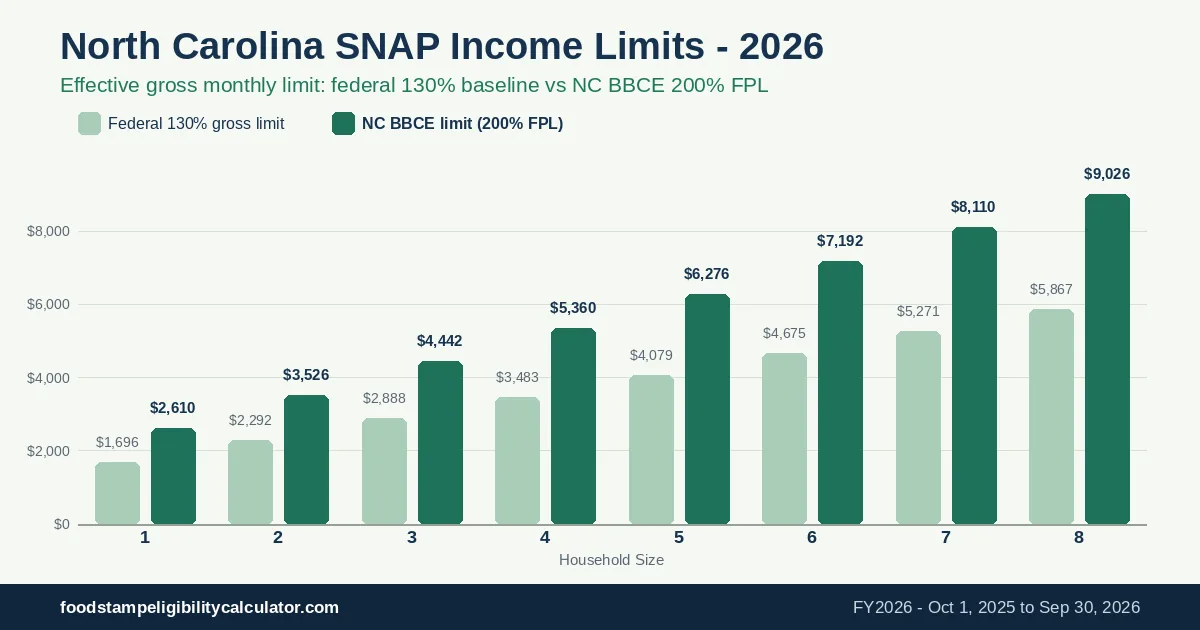
For a single person in North Carolina, the effective gross monthly income limit is $2,610 under BBCE 200% FPL. For a family of four, that number jumps to $5,360. That BBCE threshold lets working families well above the federal 130% line still qualify.
That's a huge difference, and it's why so many working families in North Carolina who assumed they wouldn't qualify actually do. The deductions available — housing costs, childcare, medical expenses for elderly members — can lower your countable income substantially. Our North Carolina SNAP calculator handles all of these deductions automatically, so you'll get an accurate estimate without having to do the math yourself.
FY2026 Income Limits and Maximum Benefit Table
The table below shows the exact income limits and maximum benefit amounts for each household size in North Carolina for 2026. These are based on the federal Thrifty Food Plan and apply to the 48 contiguous states (Alaska and Hawaii have different amounts).
When you use our North Carolina food stamp eligibility calculator, it automatically references these same numbers. That gives you an accurate estimate of your potential monthly benefit.
| Household Size | Gross Monthly Limit | NC BBCE Limit (200% FPL) | Net Monthly Limit | Max Benefit |
|---|---|---|---|---|
| 1 Person | $1,696 | $2,610 | $1,305 | $298 |
| 2 People | $2,292 | $3,526 | $1,763 | $546 |
| 3 People | $2,888 | $4,442 | $2,221 | $785 |
| 4 People | $3,483 | $5,360 | $2,680 | $994 |
| 5 People | $4,079 | $6,276 | $3,138 | $1,183 |
| 6 People | $4,675 | $7,192 | $3,596 | $1,421 |
| 7 People | $5,271 | $8,110 | $4,055 | $1,571 |
| 8 People | $5,867 | $9,026 | $4,513 | $1,789 |
| Each additional person | + $596 | + $918 | + $459 | + $218 |
North Carolina SNAP Maximum Allotment 2026
The most a single person can receive in North Carolina SNAP is $298 per month in 2026. You would only draw that full amount with zero net income after every deduction. A household of four can reach up to $994 monthly.
USDA sets these caps nationally using its Thrifty Food Plan, a baseline estimate of diet costs. The Thrifty Food Plan was re-evaluated in 2021 and benefits increased permanently. That is why today's maximums are significantly higher than they were a few years ago.
How the North Carolina Benefit Formula Works
Here's how the math works. North Carolina takes the maximum allotment for your household size, then subtracts 30% of net income. A single person with $800 net income gets $298 minus $240, which comes out to $58.
That might not sound like much. It adds up over the year — and if your income drops or your expenses increase, your benefit goes up too.
The average SNAP recipient in North Carolina gets about $167 per month. Your actual amount could be anywhere from the minimum of $24 up to the full maximum.
Your real monthly benefit depends entirely on your net income after all allowable deductions are applied. The formula is straightforward: Maximum Allotment − (30% × Net Income) = Your Monthly Benefit.
Households with elderly or disabled members often receive higher benefits because they can deduct medical expenses over $35 per month. Folks paying a lot for rent or utilities also tend to get more because of the shelter deduction. Our calculator walks you through all of this step by step and gives a personalized estimate.
💡 Understanding Your North Carolina SNAP Benefit Amount
Your actual monthly benefit in North Carolina depends on your net income after all allowable deductions. Even if you earn income, you may still qualify for partial SNAP benefits.
The calculator above applies the official USDA formula to whatever numbers you enter. Maximum Allotment − (30% × Net Income) = Your Monthly Benefit. Deductions for housing, childcare, or medical costs can raise your final amount significantly.
Eligible households of one or two people receive at least $24 per month in North Carolina. That federal floor keeps the smallest households from walking away empty-handed.
North Carolina SNAP Increase October 2026 (FY2027 Numbers)
SNAP benefits are rising across North Carolina on October 1, 2026. The federal fiscal year 2027 cost-of-living adjustment takes effect that day.
USDA finalizes these numbers each August, and the new maximums apply to every state, including North Carolina. The update matters because benefit amounts follow the Thrifty Food Plan, which gets repriced annually.
A single person's maximum will climb from $298 to $306 per month. A family of four will see the ceiling move from $994 to $1,023, an extra $29 monthly. Larger households gain the most in raw dollars, with the eight-person maximum reaching $1,841.
FY2027 Maximum Benefit Table (Effective October 1, 2026)
| Household Size | FY2026 Max Benefit | FY2027 Max Benefit | Monthly Increase |
|---|---|---|---|
| 1 Person | $298 | $306 | +$8 |
| 2 People | $546 | $562 | +$16 |
| 3 People | $785 | $808 | +$23 |
| 4 People | $994 | $1,023 | +$29 |
| 5 People | $1,183 | $1,217 | +$34 |
| 6 People | $1,421 | $1,463 | +$42 |
| 7 People | $1,571 | $1,616 | +$45 |
| 8 People | $1,789 | $1,841 | +$52 |
| Each additional person | +$218 | +$225 | +$7 |
Recertifications scheduled after October 1 will use the new figures automatically. Anyone whose benefit already sits near the maximum will notice the bump first.
North Carolina's BBCE income ceiling rises with the same adjustment. The 200% FPL gross limit should land near $2,660 monthly for one person.
A family of four's ceiling should reach about $5,500 under the same math. Standard deductions, the shelter cap of $769, and the minimum benefit of $25 for small households also tick upward.
These figures come from the USDA's official FY2027 cost-of-living adjustments announcement, published in August 2026. County DSS offices will apply them automatically, so no action is needed from current FNS households.
Our SNAP income limits guide explains how the yearly formula works. Check the USDA FNS COLA page for the official tables.
Allowable Deductions in North Carolina
Deductions decide how much FNS money actually reaches your household. Each one trims your countable income, and every dollar trimmed raises the benefit at the end of the formula. Skip a deduction you deserve and the state's math quietly works against you.
Enter every qualifying expense in the calculator above — it applies each deduction the way a county caseworker would. Here is the full NC list:
Standard Deduction
Every FNS household claims the standard deduction automatically — no receipts required. For fiscal 2026 the amount sits at $209 for one to three people and $223 for four. Households of five get $261, and six or more members receive $299 before anything else is counted.
Earned Income Deduction
Working households keep more of what they earn through the 20% earned income deduction. A worker making $2,000 a month gross gets $400 off the top before any other math, which covers commuting, uniforms, and other job costs.
Dependent Care Deduction
Childcare that makes work possible is deductible too. Daycare tuition, after-school programs, babysitters, and even the drive to the provider all count. The care must let you hold a job, search for one, or attend training.
Medical Deduction
Seniors and disability beneficiaries get a medical deduction worth knowing about: anything above $35 a month counts. Prescriptions, copays, dental work, insurance premiums, and even mileage to appointments reduce the income your household reports.
Child Support Deduction
Court-ordered child support you pay comes straight off your gross income. The order can come from a North Carolina court or from another state.
Shelter Deduction
Shelter costs — rent or mortgage, property tax, insurance, and utilities — are deductible beyond half your adjusted income. Most renters never touch the ceiling, but the 2026 cap sits at $744 monthly for households with heavy housing burdens.
How to Apply for Food Stamps in North Carolina
Applying for SNAP in North Carolina is easier than you might think. The NCDHHS manages the process.
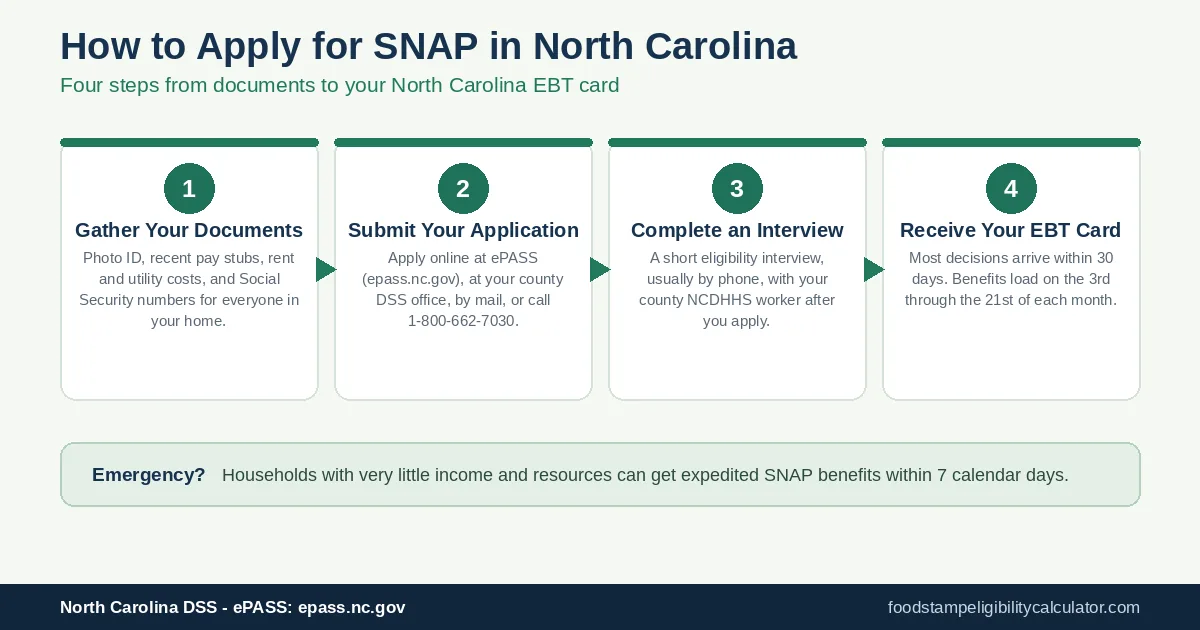
You can submit your application through the epass.nc.gov website, in person at a local office, or by calling the hotline at 1-800-662-7030. Online applications are typically processed faster.
Get Your Documents Ready First
Round up four document groups before you sit down to apply. Complete files move through county review noticeably faster than partial ones. Keep every document in one folder so the county interview goes smoothly.
- Identity: a driver's license, state ID, or passport
- Income: recent pay stubs, Social Security award letters, or self-employment records
- Expenses: rent or mortgage statements, utility bills, childcare receipts, and medical bills for anyone elderly or disabled
- Household: names, dates of birth, and Social Security numbers for everyone you eat and prepare food with
You'll also need to do a short interview — most of the time this is done over the phone. The North Carolina Department of Health and Human Services (NCDHHS) will contact you to schedule it after you submit your application.
Households in a genuine emergency — almost no income and almost no cash — should ask about expedited service the moment they apply. Federal law obligates North Carolina to deliver benefits within 7 calendar days for qualifying households. Verification can wait; the application cannot, so file first and gather papers after.
Call NCDHHS at 1-800-662-7030 if you need emergency food assistance right away. They can connect you with the Food Bank of Central and Eastern North Carolina. The Second Harvest Food Bank of Metrolina also helps while your application is pending.
Gather Your Documents
Bring proof of identity, income, expenses, and household details for every member. County reviewers move much faster when your file is complete.
Submit Your Application
Apply online through ePASS, in person at your county DSS office, or by mail. The NCDHHS FNS page lists every option with direct links.
Complete an Interview
Expect a call about your eligibility interview, usually by phone, after you apply. Every applicant completes this step before a decision is made.
Receive Your EBT Card
If approved, your EBT card will be mailed to you within a few days. Benefits load between the 3rd and 21st of each month, based on the last digit of your Social Security number.
If Your North Carolina Application Is Denied
A denial letter stings, but it is not the end of the road. The notice must explain exactly why you were turned down and list your appeal rights in plain language. Sometimes the fix is as simple as returning a missing document the county never received.
You can request a fair hearing within 90 days by phone, by mail, or through ePASS. Some households keep receiving benefits during the appeal if they file before their reduction date. Legal aid offices across North Carolina also help SNAP applicants at no cost.
⚡ Need Benefits Fast? Expedited SNAP in North Carolina
Households with under $150 monthly income and $100 or less in cash qualify for expedited SNAP. These emergency benefits must be provided within 7 calendar days. Contact the NC Care Line at 1-800-662-7030 or your county DSS office for immediate help.
You can apply for expedited benefits before gathering every document. Verification can come later in the process.
North Carolina SNAP Eligibility Requirements
Qualifying for SNAP in North Carolina comes down to a few key criteria. The NCDHHS evaluates your household size, income (both gross and net), countable resources, and compliance with any applicable work requirements. Let's break each one down.
North Carolina's biggest eligibility booster is Broad-Based Categorical Eligibility, or BBCE. It lifts the gross income limit to 200% of the federal poverty level, about $5,360 monthly for four. The asset test drops too, so a savings account or retirement fund never disqualifies anyone.
Receiving SSI, TANF, or certain other benefits makes you categorically eligible. That status means you automatically meet the income and asset tests.
Beyond income and assets, North Carolina has a few other requirements. You need to be a resident of the state. Most able-bodied adults between 18 and 64 without dependents need to meet work requirements (more on that below).
Immigration status matters too — U.S. citizens and many lawfully present non-citizens can qualify. Undocumented immigrants generally cannot, though children born in the U.S. may receive benefits regardless of their parents' status. Many mixed-status families never realize that second point.
Gross Income Test
Must be at or below 200% FPL via NC BBCE ($2,610/mo for 1 person)
Net Income Test
Must be at or below 100% of federal poverty level after all allowable deductions
Asset Test
North Carolina waives the asset test under BBCE; where federal rules apply, limits are $3,000 ($4,500 for elderly or disabled households)
Work Requirements for SNAP in North Carolina
Able-bodied adults without dependents (ABAWD) face a 3-month time limit within any 3-year period. North Carolina applies this rule to recipients between 18 and 64 years old. Meeting it means working 20 hours a week, 80 a month, or joining approved training or service.
If you don't meet these requirements, your benefits can be cut off after the 3-month window. Under the One Big Beautiful Bill Act, that upper age climbed from 54 to 64 as of November 1, 2025. Applicants between 55 and 64 who were previously exempt now need to meet these rules.
ABAWD Exemptions and E&T Programs in NC
There are plenty of exemptions to the ABAWD rule in North Carolina. You don't have to meet the work requirement if you're pregnant or medically unable to work. The same applies if you care for a child under 14 or an incapacitated person.
Federal changes in 2025 removed exemptions for veterans, homelessness, and young adults aging out of foster care. Confirm your status with your caseworker before assuming you're exempt.
If you think you might be exempt, definitely tell your caseworker — don't just assume you'll be cut off. Federal law now limits those waivers to areas where unemployment runs unusually high.
SNAP Employment and Training (E&T) programs in North Carolina help you satisfy work rules while building real skills. Options include job search help, vocational training, work experience placements, and education programs. Hours spent in an approved E&T track count toward your 20-hour weekly requirement.
NCDHHS can also connect you with local resources in Charlotte, Raleigh, and other communities. If you're struggling to find work, ask about E&T programs before letting benefits lapse.
What Can You Buy with EBT in North Carolina
✅ What You CAN Buy with NC EBT
- • Breads, cereals, and grains
- • Fresh, frozen, and canned fruits and vegetables
- • Meat, poultry, and fish
- • Dairy products (milk, cheese, yogurt)
- • Seeds and plants that produce food
- • Snack foods and non-alcoholic beverages
- • Baby food and infant formula
❌ What You CANNOT Buy
- • Alcohol, beer, wine, or liquor
- • Tobacco and cigarettes
- • Hot prepared foods (with exceptions)
- • Pet food and supplies
- • Household and cleaning products
- • Vitamins, medicines, and supplements
- • Non-food items (soap, paper products)
Online grocery shopping changed the game for rural North Carolina. Your EBT card works at virtual checkout through the USDA's approved online purchasing program. Delivery or pickup options really help when the nearest supermarket is a drive away.
Farmers markets across the state take EBT too, and the Double Up Food Bucks Carolinas match stretches produce dollars further. The match works in Charlotte, Raleigh, Durham, and plenty of smaller towns. Fresh, local, and paid for with benefits — it works.
North Carolina has not joined the USDA Restaurant Meals Program, unlike a handful of states. Prepared restaurant food stays off the table even for seniors, disabled recipients, or homeless participants. Hot grocery items like a rotisserie chicken are excluded for the same reason.
North Carolina SNAP Calculator — Estimate Your Food Stamp Benefits
Need to know how much you might get from SNAP in North Carolina? Our North Carolina SNAP eligibility calculator uses the exact 2026 income limits and deduction formulas that the NCDHHS uses. Enter your information above and you'll see an estimated monthly benefit amount right away.
People search for this using all kinds of terms — NC SNAP calculator, North Carolina food stamp estimator, North Carolina EBT calculator. But it all leads here.
Two Real North Carolina Examples
Two questions dominate our inbox. People ask how much they will receive and whether $1,800 a month can qualify.
The truth is, your benefit amount depends on much more than just your paycheck. Your rent or mortgage, utility costs, dependent care expenses, and whether anyone is elderly or disabled all affect the calculation.
Here is a real example you can reproduce above: $1,800 income, $850 rent, $320 utilities, one person. The calculator estimates about $95 per month after standard, earned income, and shelter deductions. Earning $3,000 puts a single person over the $2,610 BBCE limit, so benefits are unlikely.
A family of three has a $785 maximum. A family of four with childcare costs and high rent can still qualify even at $4,000 gross. Run your own numbers and find out.
Here is a bigger household worked the same way: three people earning $3,200 a month with $1,200 rent, $350 in utilities, and $500 in childcare. After the standard, earned income, childcare, and shelter deductions, the calculator lands on roughly $417 per month. The 30% haircut on net income is what shrinks the check — more deductions mean a smaller haircut and a bigger benefit.
North Carolina Food Stamp FAQ
Recertification in North Carolina
SNAP benefits in North Carolina are never permanent, so plan for periodic recertification. Most households see a certification period of 6 to 12 months before renewal.
Elderly or disabled individuals might be certified for up to 24 months. You'll get a notice in the mail (or through your online account on epass.nc.gov) before your certification period ends.
Don't ignore that notice — if you miss the recertification deadline, your benefits will stop, and you'll have to reapply from scratch. That can mean weeks without benefits, which nobody wants to deal with.
Recertification keeps your FNS case active after your certification period ends. You will fill out a recertification form, share updated income and expense proof, and complete another phone interview.
The county already has your basic details, so this round usually moves faster than the first application. Submit everything through epass.nc.gov, by mail, or at your local office.
Pro tip: submit your recertification as early as possible — you can usually start the process 30 to 45 days before your deadline. Don't wait until the last minute.
Change Reporting Rules in North Carolina
Between recertifications, you must report certain changes to NCDHHS within 10 days. Simplified reporting usually only triggers when income crosses your household's gross limit. ABAWD recipients must also report when work hours drop below 20 per week.
Still, report significant changes like a new job, a new household member, or shifting expenses. Accurate reporting keeps your benefit amount at the right level. Overpayments can happen when changes go unreported, and the state eventually recovers that money.
Additional North Carolina Resources
FNS is not the only food lifeline here. Second Harvest Food Bank of Metrolina alone moves groceries through hundreds of pantries around Charlotte. Partner banks across Raleigh, Greensboro, and Durham do the same work.
Your nearest food bank or pantry can help immediately while your application moves through the system. You do not need an FNS case to receive emergency food.
🏛️ North Carolina Department of Health and Human Services (NCDHHS)
SNAP (Food and Nutrition Services - FNS) Administrator
Website: www.ncdhhs.gov/divisions/social-services/food-nutrition-services-fns
Phone: 1-800-662-7030
🍞 North Carolina Food Banks
Emergency Food Assistance
Food banks help anyone who walks in — no immigration questions, no FNS enrollment required. Several also keep application assistants on staff who can help you file for benefits on the spot.
🥬 North Carolina Benefit Doubles Programs
Maximize Your SNAP Benefits
Double Up Food Bucks and Market Match both stretch produce money at participating markets: every FNS dollar spent on fruits and vegetables gets matched. The extra buying power lands on your table and flows back to North Carolina growers.
👶 WIC Program in North Carolina
Women, Infants, and Children
Families with young children should also look at WIC. Pregnant members, new mothers, and kids under five receive packages of specific healthy foods. WIC runs on its own income scale, separate from FNS eligibility rules.
Also Check: North Carolina Neighboring State SNAP Calculators
Living near the South Carolina, Virginia, Tennessee, or Georgia border changes your comparison math. Neighboring states run their own SNAP rules, limits, and benefit schedules. Below are links to our eligibility calculators for every state bordering North Carolina:
North Carolina SNAP Eligibility Details & Rules
Income Limits & BBCE Rules in North Carolina
BBCE sets North Carolina's gross income limit at 200% of the federal poverty level, far above the standard 130% threshold. A family of four can therefore earn up to $5,360 monthly and still potentially qualify.
The BBCE rules in North Carolina also eliminate the asset test for most households. You won't be penalized for having some savings or a retirement account.
These expanded rules open FNS to working families who would fail a 130% test. Most people underestimate how far the 200% threshold stretches in North Carolina.
Gross income over the limit is not always the final word. The 20% earned income deduction, the standard deduction, and excess shelter costs all pull countable income down.
Dependent care, medical costs over $35 for seniors or disabled, and child support trim it further. Families turned away on gross income alone are often eligible once the full math runs. The calculator above factors in every deduction, so you see your real eligibility picture.
Deductions That Can Increase Your North Carolina SNAP Benefits
Deductions are the reason many North Carolina households qualify after assuming they earn too much. Each deduction lowers the income the state counts, from the standard deduction to shelter costs.
That includes 20% off earned income, dependent care, child support, and medical costs over $35. Claim each one you qualify for, because unclaimed deductions are the most common reason estimates come in low.
Two deductions deserve a closer look. The shelter deduction can reach $744 monthly, which matters in cities where rent plus utilities routinely cross that line.
Households with a member who is 60 or older or disabled can also subtract medical costs above $35. That covers prescriptions, dental work, and even rides to medical appointments. Both deductions stack with the rest, so two families with identical gross incomes can receive different benefits.
EBT Benefit Schedule
North Carolina issues benefits from the 3rd through the 21st of every month. Your day depends on the last digit of your Social Security number. Households without a Social Security number receive benefits on the 3rd of the month.
Benefits that go unspent roll over to the following month, but long stretches of card inactivity can lead the state to remove them. It pays to use at least a small amount regularly.
Check your balance anytime through the cardholder portal, by phone, or on your last store receipt.
North Carolina EBT Deposit Schedule (2026)
| Last Digit of SSN | Benefits Available |
|---|---|
| 1 | 3rd of the month |
| 2 | 5th of the month |
| 3 | 7th of the month |
| 4 | 9th of the month |
| 5 | 11th of the month |
| 6 | 13th of the month |
| 7 | 15th of the month |
| 8 | 17th of the month |
| 9 | 19th of the month |
| 0 | 21st of the month |
Additional Programs
SNAP in North Carolina connects to other support worth knowing about. SNAP Employment and Training helps recipients build skills and move into steadier work. SNAP-Ed offers free cooking and meal-planning classes, and WIC covers pregnant members and children under five.
Food banks fill the gap while applications are still pending. The Food Bank of Central and Eastern North Carolina alone serves dozens of counties.
North Carolina SNAP Quick Facts (2026)
| Program Detail | North Carolina Information |
|---|---|
| State SNAP Agency | North Carolina Department of Health and Human Services (NCDHHS) |
| Agency Website | www.ncdhhs.gov |
| EBT Hotline | 1-888-622-7328 |
| Online Application | ePASS — epass.nc.gov |
| EBT Card Name | North Carolina EBT Card |
| BBCE (Higher Income Limit) | Yes (200% FPL) |
| Asset Test | No asset limit (BBCE) |
| ABAWD Time-Limit Waiver | Some counties |
| Number of Counties | 100 |
| Benefit Issuance Schedule | 3rd through 21st of month, based on last digit of Social Security number |
| State Minimum Wage (2026) | $7.25/hour (federal) |
Program details above come from the NCDHHS website and USDA Food and Nutrition Service reports. Income limits, deduction amounts, and the benefit formula are set by federal law nationwide. Only the administrative details above vary from state to state.
North Carolina SNAP Resources & Local Information
Local SNAP Offices in North Carolina
North Carolina splits SNAP administration across 100 county departments of social services, so the office handling your case is local. Walk-in hours vary by county, so call the NC Care Line at 1-800-662-7030 before driving over, or skip the trip entirely by applying on ePASS.
State-Specific SNAP Programs
Beyond the core benefit, the state layers in programs that make the money go further. SNAP-Ed runs free cooking and nutrition classes through NC Extension partners statewide.
Double Up Food Bucks matches produce purchases at markets from the mountains to the coast. The state's two largest food banks anchor the emergency food network.
EBT Card Information
The North Carolina EBT card works at every authorized retailer statewide, from supermarket chains to corner stores. Online portals like Walmart, Food Lion, and Amazon accept it for delivery or pickup orders.
Benefits land between the 3rd and 21st depending on the last digit of your SSN. If the card goes missing, call 1-888-622-7328 right away. Report it quickly and a replacement usually arrives within a few business days.
Food Banks & Emergency Food
The emergency food network runs deep here. The Food Bank of Central and Eastern North Carolina branches across Raleigh, Greenville, and Wilmington. Second Harvest Food Bank of Metrolina covers Charlotte and the western Piedmont region.
MANNA FoodBank serves the mountain counties around Asheville. Between them, hundreds of pantries and meal sites operate — no FNS case required. Using their services never affects your SNAP eligibility at all.
Application Tips for North Carolina Residents
A practical way to speed things up: start on ePASS, save as you go, and upload documents the same day you gather them. Complete first submissions move through county queues faster than partially verified ones. The NC Care Line can confirm exactly which proofs your county requires.
Questions come up for almost everyone during a first application. The SNAP hotline at 1-800-662-7030 walks you through the process step by step.
Serving North Carolina Communities
Everything here — the calculator, income table, and deduction walkthrough — targets North Carolina's own 2026 rules. BBCE eligibility, the asset-test waiver, and the SSN-based deposit schedule are all built in. The county administration model means your estimate matches what a caseworker would calculate.

Wasim Akram
Founder & Lead Researcher · Food Stamp Eligibility Calculator
Wasim Akram is the founder and lead SNAP benefits researcher at FoodStampEligibilityCalculator.com. Every income limit, deduction, and benefit figure on this page is reviewed against the official USDA Food and Nutrition Service Handbook for the 2026 fiscal year. He also publishes broader U.S. public benefits content at Digitalwasim.com.