
California Food Stamp Eligibility Calculator 2026
Use our free california food stamp eligibility calculator to instantly check if you're eligible for SNAP benefits. Get an estimate of your monthly food stamp amount based on the latest 2026 USDA guidelines for California.
California CalFresh Eligibility Calculator
Enter your family details to check your california food stamp eligibility and estimate your monthly SNAP benefit.
Include yourself and everyone who lives with you and shares meals
Total income before taxes and deductions for all family members
Childcare, adult daycare, or other dependent care expenses
Legally obligated child support you pay to someone outside your family
Out-of-pocket medical costs for family members who are 60+ or disabled (amounts over $35 are deductible)
Monthly rent or mortgage payment for your primary residence
Electricity, gas, water, phone, and other utility expenses
Include bank accounts, cash, and other countable resources. Your home and vehicle are typically excluded.
CalFresh is SNAP's California name, and the rulebook bends in your favor
California renamed SNAP "CalFresh" back in 2010. Same federal program, same EBT card, same USDA rules. The name is the only thing that changed.
The biggest California bend is BBCE — broad-based categorical eligibility. It throws out the asset test entirely and lifts the gross income cap from 130% to 200% of the federal poverty level.
Your savings, your car, and your paid-off house do not count against you. Income does.
The second bend: California ended its SSI cash-out in June 2019, so people receiving SSI can qualify for CalFresh alongside their federal payment. Third bend: all 58 counties run their own welfare departments under rules set in Sacramento.
Scale matters here. More than five million Californians receive CalFresh — the largest caseload of any state — and the average benefit lands near $189 per person each month.
The 2026 income limits: two tests, and the first one has a 200 percent ceiling
CalFresh runs two income tests. The county checks gross income first, before any deductions, against the 200% FPL cap that BBCE gives California. Pass that, and your income after deductions faces a second, tighter test.
| Household size | Gross monthly cap (200% FPL, BBCE) | Max benefit |
|---|---|---|
| 1 person | $2,610 | $298 |
| 2 people | $3,526 | $546 |
| 3 people | $4,442 | $785 |
| 4 people | $5,360 | $994 |
| 5 people | $6,276 | $1,183 |
| 6 people | $7,192 | $1,421 |
| 7 people | $8,110 | $1,571 |
| 8 people | $9,026 | $1,789 |
| Each additional person | +$918 | +$218 |
Each additional person adds $918 to the gross cap and $218 to the maximum benefit. Figures come from the USDA allotment table for fiscal year 2026 (October 2025 through September 2026), and the state CalFresh portal publishes the same chart.

The second check: net income at 100% FPL
After the gross test, the county subtracts your deductions and runs what is left against 100% of poverty. For 2026 that net line sits at $1,305 for one person, $1,763 for two, and $2,680 for four.
It climbs $459 per additional person, topping out at $4,513 for eight. The full 130% and 100% charts sit on USDA's SNAP eligibility page.
A household earning well under the 200% ceiling can still fail this test if its deductions are small. High rent and childcare are usually what pull families under.
Close to the line? Run the calculator above with your real rent, utilities, and childcare costs. In California, deductions decide most cases.
What if I make $1,800 a month in California?
$1,800 a month clears the gross test for every household up to three people. A single renter sits $810 under the $2,610 ceiling, and a family of three sits more than $2,600 under its $4,442 cap. Passing the gross test is not the whole story, though — the net test still applies.
Take a single renter in Sacramento earning exactly $1,800. The 20% earned income deduction drops countable income to $1,440, and the $209 standard deduction brings it to $1,231. With $1,250 rent plus the utility allowance, the shelter deduction maxes out at $744, leaving net income of $487 and a benefit near $152.
A family of three on the same $1,800 draws roughly $639 instead — the $785 maximum for three, minus 30% of a similar net income. Household size moves the answer more than the paycheck does. Even $2,500 can still qualify for one person when rent is high, because the net test, not the gross test, usually decides.
Households with a member 60 or older, or disabled, skip the first test
When someone in the household is 60 or older or receives disability benefits, the county skips the gross income test entirely. Only the net test applies, and the medical expense deduction opens up. That combination is why senior households qualify at incomes their younger neighbors cannot.
The SSI rule matters here too. Since June 2019, receiving SSI no longer blocks CalFresh. If an older relative was told years ago that SSI disqualifies them, that answer expired in 2019.
Deductions that move the math
The county never calculates your benefit from raw wages — it calculates from what remains after deductions. Some you must claim yourself. Here is the full list.
Denied applications share one pattern more than any other: the household never claimed a deduction it deserved. List everything at the interview, and if you are 60 or older, list every medical bill from the past year.
The 30 percent rule: how your net income becomes a monthly CalFresh grant
Pass both income tests and one question remains: what actually lands on the EBT card each month. The formula fits on a napkin. Your monthly benefit equals the maximum allotment for your household size, minus thirty percent of your net income.
If thirty percent of your net income exceeds the maximum allotment, the benefit drops to the $24 minimum; if your net income is zero, you get the full amount. Here is the formula worked out for two real California households, using the numbers a caseworker in Los Angeles or San Diego would pull up.
Example one: a family of three in Los Angeles
Maria works full-time at a Boyle Heights warehouse and earns $2,850 a month in gross wages. She pays $1,575 in rent for a two-bedroom in East LA, plus her share of the electric bill. Her household is three people: her and two kids.
| Step | What the county does | The math |
|---|---|---|
| 1. Gross income test | Wages before taxes, against California's 200% FPL cap for three (BBCE) | $2,850 < $4,442 — pass |
| 2. Earned income deduction | Twenty percent of gross wages comes straight off the top | $2,850 − $570 = $2,280 |
| 3. Standard deduction | Flat amount for a household of three | $2,280 − $209 = $2,071 |
| 4. Excess shelter deduction | Rent plus utilities, minus half of adjusted income, capped at $744 | ($1,575 + $500) − $1,035 = $1,040, capped at $744 |
| 5. Net income | Adjusted income minus the shelter deduction | $2,071 − $744 = $1,327 |
| 6. Monthly benefit | Max allotment for three, minus 30% of net income | $785 − $398 = $387 |
Maria lands at $387 a month. The shelter cap did most of the damage — her real housing costs run $1,040 over the threshold, but the formula only counts $744. That cap is the biggest reason working families get less than the maximum; our shelter deduction walkthrough explains it in depth.
Example two: a parent and one child in San Diego
Devon works part-time in City Heights and brings home $2,200 a month. His rent is $1,400 for a one-bedroom, and he pays utilities separately. His household is two people: him and his daughter.
| Step | What the county does | The math |
|---|---|---|
| 1. Gross income test | Against the 200% FPL cap for two | $2,200 < $3,526 — pass |
| 2. Earned income deduction | Twenty percent of gross wages | $2,200 − $440 = $1,760 |
| 3. Standard deduction | Flat amount for a household of two | $1,760 − $209 = $1,551 |
| 4. Excess shelter deduction | Shelter costs minus half of adjusted income, capped | ($1,400 + $450) − $776 = $1,074, capped at $744 |
| 5. Net income | Adjusted income minus shelter | $1,551 − $744 = $807 |
| 6. Monthly benefit | Max allotment for two, minus 30% of net income | $546 − $242 = $304 |
Devon gets $304 a month. Notice that both households hit the $744 shelter cap — between them, the cap shrinks benefits more than any other rule in the formula.
The parts that move from county to county
The utility allowance in these examples is a stand-in. Real allowances change with your county and whether you pay heating or cooling separately from rent; the current figures live on the CDSS CalFresh page.
One more wrinkle: households with a 60+ or disabled member face no shelter cap at all, which is why their grants often run higher. For the national version of this math, see our benefit formula walkthrough and SNAP deductions cheat sheet; the ceilings come from the USDA SNAP allotment page.
How to apply: four doors, one filing date
The fastest door is GetCalFresh.org, a nonprofit site run by Code for America that takes about ten minutes on a phone, in English or Spanish. It saves your progress if you stop halfway.
The official state portal is BenefitsCal.com — slower, but it handles uploads, change reports, and the SAR7 for existing cases. Third door: the phone at 1-877-847-3663, the CDSS line, with translation in over a hundred languages. Fourth: your county welfare office, where walk-ins are welcome.
Whichever door you use, file before you feel ready. Your filing date starts the benefit clock, and missing documents can follow within ten days.
You do not need a Social Security number yourself to apply for your children, and you do not need to be a citizen to apply on their behalf. For the full packet walkthrough, see our SNAP application guide.
Expedited CalFresh: seven calendar days, not thirty
You qualify for expedited service with less than $100 in cash and under $150 in gross monthly income. Rent plus utilities exceeding your gross income for the month qualifies too. Migrant and seasonal farmworker households with under $100 in cash qualify too.
Identity is the only thing the county can demand before the seven-day clock starts — income and residency get verified in the background. If the worker does not offer it, say the words "expedited service" out loud. Your first month is prorated from the filing date and lands on a card within seven calendar days, weekends included.
Work rules: the ABAWD clock and the student exemption
Able-bodied adults without dependents must show 80 hours a month of work, training, volunteering, or a combination. OBBBA widened the age range in 2025 to run from 18 through 64. Miss the hours for three months in a 36-month period and the benefit stops until they resume.
Plenty of households never face this clock: if someone in the home is under 18, 60 or older, pregnant, or living with a disability, BBCE generally exempts the household. Most Central Valley counties — Fresno, Kern, Kings, Tulare, Madera, Merced, Stanislaus, plus Imperial — also run under a federal unemployment waiver for 2026. Bay Area counties generally do not.
College students and the exemption nobody claims
Students enrolled at least half-time must qualify for an exemption on top of the income tests. That means working 20 hours a week, an approved work-study award, CalWORKs participation, or single parenthood with a child under 12.
The one community college students miss most is EOPS or CARE — acceptance qualifies you, but only if a one-line letter from the EOPS office proves it. Former foster youth qualify under a California waiver into their mid-twenties.
The income math works at minimum wage. Twenty hours a week at California's $16.90 minimum wage (raised January 1, 2026) pays about $1,464 a month. That sits well under the $2,610 gross cap for one person.
Document the hours with pay stubs or an employer letter. If the first application is denied anyway, the denial letter names the exemption to claim on reapplication.
Your EBT card: deposits, Market Match, and the chip card
When benefits land
California spreads deposits across the first ten days of the month, based on the last digit of your seven-digit case number — not your Social Security number. A case ending in 3 loads on the 3rd; a zero loads on the 10th. Nothing by the end of the tenth day means something is wrong, so call the county.
Where the card works, and what it buys
Every major chain accepts the card — Safeway, Vons, Ralphs, Save Mart, Walmart, Target, Aldi, Trader Joe's, Grocery Outlet — along with Valley staples like Cardenas, Vallarta, and Northgate. CalFresh also works online at Walmart, Amazon, and other approved retailers, and the card swipes in any state because SNAP is federal.
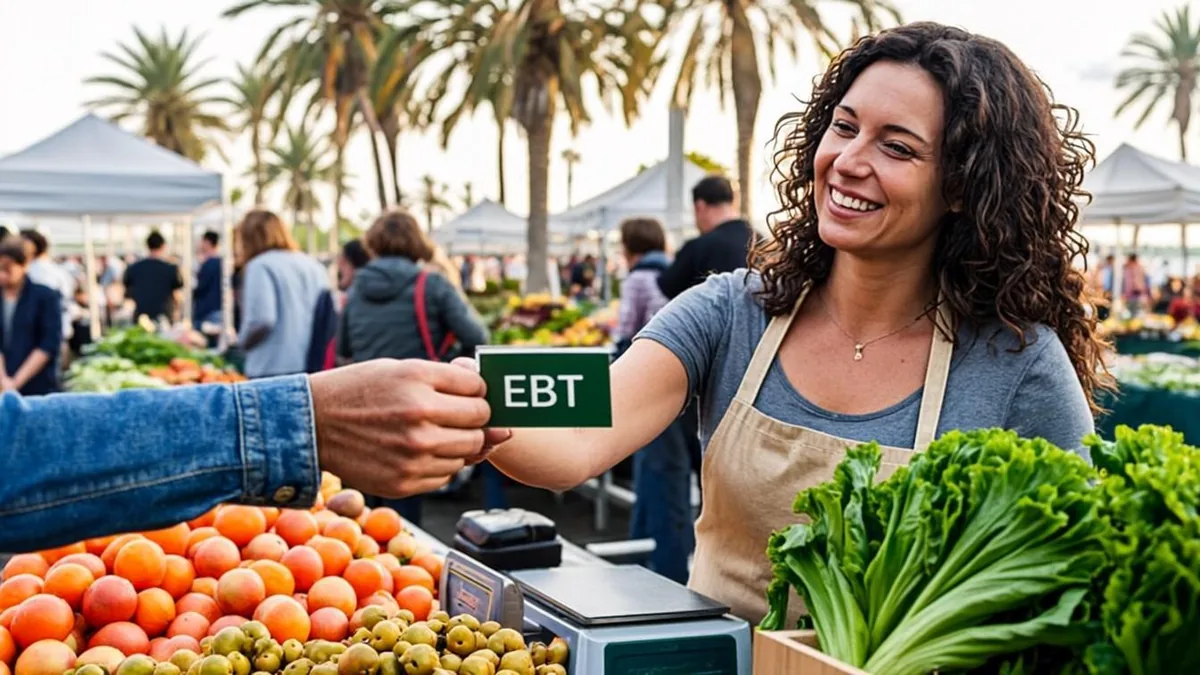
The card buys groceries: produce, meat, dairy, bread, seeds, and plants that grow food. It never buys alcohol, tobacco, vitamins, pet food, household supplies, or hot prepared food — for edge cases, see our SNAP FAQ. At participating farmers markets, the Ecology Center's Market Match doubles your first produce dollars, turning a $10 swipe into $20.
Sun Bucks: $120 per child every summer
California's Summer EBT program, SUN Bucks, adds $120 per school-age child when school is out. Children on CalFresh or CalWORKs are certified automatically, while other families apply — the deadline usually falls in late August. Funds expire 122 days after loading, so spend them down.
Lost cards, skimming, and the chip deadline
Report a lost or stolen card to 1-877-328-9677 or replace it online at ebt.ca.gov; the new card arrives in 5 to 7 business days. California has now switched every cardholder to chip-enabled cards, and the last magnetic-stripe cards stopped working on April 19, 2026. The Governor's office credits the rollout with cutting benefit theft by 83%.
If benefits are stolen anyway, file a theft claim with the county within 10 days of discovery. Skimming losses are replaceable under federal rules, but the claim clock is short.
The Restaurant Meals Program now reaches every county
Under AB 942, the Restaurant Meals Program now operates statewide — federally approved restaurants can participate in all 58 counties. Three groups qualify: cardholders 60 or older, receiving disability benefits, or homeless.
Your card must be coded for RMP first, so ask your county to enable it. Participating spots — Subway, El Pollo Loco, Jack in the Box, plus hundreds of local diners — display the RMP sticker, and CDSS keeps a statewide locator.
The SAR7 and recertification: two envelopes that decide everything
Six months after approval, the county mails the SAR7, a two-page report asking what changed — income, household size, address, shelter costs. It has a due date, a 10-day grace window, and then benefits stop with no second notice.
More California cases close to an unopened SAR7 envelope than to any income increase. Open county mail the day it arrives, and file through BenefitsCal for a confirmation number.
At twelve months comes the recertification packet — a shorter re-application with fresh documents and a new interview. Households where every member is 60+ or disabled recertify every 24 months instead. Between reports, tell the county within 10 days when income crosses the threshold printed on your approval letter, when someone moves in or out, or when you move.
Immigrant families: what changed in April 2026, and what did not
Federal eligibility for non-citizens narrowed on April 1, 2026 under the OBBBA law. Lawful permanent residents, Cuban-Haitian entrants, COFA citizens, and veterans or active-duty members with their spouses and children remain eligible. Several humanitarian categories — refugees, asylees, parolees, trafficking survivors — lost federal SNAP eligibility after decades.
California answers part of that gap with the California Food Assistance Program (CFAP), a state-funded mirror of CalFresh with the same rules and application. The county screens every applicant for both at once — if federal CalFresh closes to your status, ask whether CFAP covers you.
The public charge question, straight
CalFresh is not counted in public charge determinations under the 2022 rule still in effect. Non-cash benefits never were. Using CalFresh does not affect a green card renewal, a visa petition, or naturalization.
Mixed-status households
In a mixed-status family, citizen children are eligible and parents apply on their behalf without disclosing their own status. The parents' income counts toward the test because everyone eats from the same kitchen, and the benefit is sized to the eligible members.
A family of five with three eligible kids draws a benefit sized for three people. That can reach $785 a month, loaded on a card issued in the child's name.
Five reasons applications get denied, and the appeal that fixes most of them
Most denials trace back to five fixable problems. Read your notice closely — it states the reason and the deadline in writing.
1. Income counted that you never received. The county counts court-ordered child support even when unpaid, and tax-return income even when business slowed. Bank deposits and current pay stubs can change the figure at a hearing.
2. A missed interview. The worker calls once; the notice gives you 30 days to reschedule. Call the county yourself and the denial usually reverses.
3. Missing documents. One absent lease closes the case ten days after the request. Send everything asked for and request a reopen within 30 days — most counties will, without a new application.
4. An undocumented student exemption. Claiming EOPS, work-study, or the 20-hour week without attached proof produces a fast denial. Attach the letter and reapply — the second pass moves quickly.
5. Household composition disputes. Roommates who buy and cook food separately are separate households even under one roof — grocery receipts in your name prove it.
Disagree with the outcome and you have 90 days to request a state hearing with CDSS — online at cdss.ca.gov/hearings or by phone at 1-800-952-5253. The hearing happens by phone with an administrative law judge, and applicants who arrive organized win often enough to make it worth trying. Win, and benefits issue retroactively to your application date.
Your county office is the one that answers the phone
Your county takes the application, runs the interview, and issues the card. These are the main lines for the ten counties where most Californians live; the statewide number routes everyone else.
| County | CalFresh Office | Phone |
|---|---|---|
| Los Angeles | DPSS Customer Service | 1-866-613-3777 |
| San Diego | HHSA Customer Service | 1-866-262-9881 |
| Orange | SSA Customer Service | 1-800-281-9799 |
| Riverside | DPSS Customer Service | 1-877-410-8827 |
| San Bernardino | TAD Customer Service | 1-877-410-8829 |
| Santa Clara | SSA Customer Service | 1-408-755-7400 |
| Sacramento | DHA Customer Service | 1-916-874-2000 |
| Fresno | DSS Customer Service | 1-855-832-8082 |
| Kern | DSS Customer Service | 1-877-861-7711 |
| San Francisco | SFHSA Customer Service | 1-855-355-5757 |
On the fence? Apply anyway
Every week, households that qualify talk themselves out of CalFresh — the pension is too high, the paid-off house disqualifies them, the paperwork is English-only. None of that is true under BBCE. The application is free, the interview is fifteen minutes, and a denial costs nothing but the stamp.
Start at GetCalFresh.org, call 1-877-847-3663, or dial 2-1-1 to reach an outreach team near you. Regional food banks from Los Angeles to the Bay Area and San Diego all staff CalFresh teams. Waiting costs a family far more than applying.
California CalFresh Eligibility Details & Rules
Income Limits & BBCE Rules in California
California runs BBCE, which sets the gross income cap at 200% of federal poverty guidelines and eliminates the resource test entirely. Your bank accounts, savings, and retirement funds aren't counted against you.
Your car, your paid-off house, your second vehicle — none of that disqualifies you. Income does; assets don't. The rule is built for working households with a steady paycheck but no cushion in the bank.
Even if your wages seem too high, don't count yourself out. CDSS applies a range of deductions that can substantially lower your countable income.
The list runs from the 20% earned income deduction and the standard deduction to excess shelter costs, dependent care, and child support. Medical expenses over $35 monthly count for elderly or disabled members.
Many California residents are surprised to find they qualify once deductions are applied. Our California CalFresh calculator factors all of them in automatically, so you see your real eligibility picture, not a surface-level estimate.
Deductions That Can Increase Your California CalFresh Benefits
Not sure if you qualify? The calculator above runs the same 2026 income limits and deduction rules California uses, free and private, with nothing stored on our servers. If the result looks good, the next step is filing through the county at BenefitsCal.com.
CalFresh Employment and Training (E&T) helps recipients build skills and find steadier work, while SNAP-Ed adds free cooking classes and budget meal-planning. Both are free to participants and useful for families cooking more meals at home.
EBT Benefit Schedule
In California, your CalFresh funds are deposited once monthly across the first ten days of the month, based on the last digit of your case number. A case number ending in 1 loads on the 1st, 2 on the 2nd, and so on through 0 on the 10th. Benefits carry over month to month if you don't use them all.
Check your balance by calling the number on the back of the card, logging into BenefitsCal.com, or reading your last grocery receipt.
Additional Programs
With BBCE eliminating the asset test, California's income limits are more generous than many expect. Deductions for housing, medical costs, and childcare can pull a moderate income into qualifying range — the calculator above shows your estimate in two minutes.
California CalFresh Resources & Local Information
Local CDSS Offices in California
County welfare offices operate in all 58 California counties, from Los Angeles and Fresno to Bakersfield, Oakland, and Stockton. Most take walk-ins, though the BenefitsCal.com portal is usually faster. To find your nearest office and confirm hours, dial 1-877-847-3663.
State-Specific SNAP Programs
Through California CDSS, CalFresh recipients have access to additional programs beyond the basic benefit: SNAP-Ed nutrition education, Market Match dollar-matching at participating farmers markets, and partnerships with regional food pantry networks.
Those networks include the Los Angeles Regional Food Bank, San Francisco-Marin Food Bank, Second Harvest of Silicon Valley, Redwood Empire Food Bank, and Central California Food Bank, among others. They exist to help you stretch benefits further.
EBT Card Information
EBT cards are accepted at grocery stores, supermarkets, and farmers markets statewide, with deposits landing across the first ten days based on your case number. If your card is lost, stolen, or damaged, call 1-877-328-9677 immediately; a replacement arrives within 5 to 7 business days.
Food Banks & Emergency Food
California's food pantry network runs alongside SNAP: hundreds of local pantries, soup kitchens, and shelters supplied through regional food banks statewide. If your benefits don't stretch far enough one month, reach out to a local food pantry. Using their services does not affect your CalFresh eligibility at all.
Application Tips for California Residents
To apply, complete the application at BenefitsCal.com, at your county welfare office, by mailing Form CF 285, or by dialing 2-1-1. Having ID, income proof, and rent or utility numbers ready makes the process smoother. The portal saves your packet if you need more time.
Serving California Communities
This calculator is tailored to California using 2026 CalFresh guidelines — the 200% FPL gross test, asset-test elimination, and the full deduction stack. Enter your information above for a free, two-minute estimate you can rely on as you decide whether to apply.
California CalFresh Frequently Asked Questions
Nine questions Californians ask most, answered in plain English with the 2026 CDSS figures.
1. How do I apply for food stamps in California?
The fastest way to apply is the BenefitsCal portal at benefitscal.com. You can also apply at a county welfare office, by mailing Form CF 285, or by dialing 2-1-1.
Have ID, income, and housing expense records ready. Standard processing takes 30 days; extremely low-income households are fast-tracked to 7 calendar days.
2. What is the income limit for food stamps in California?
The gross monthly income limit for a single person in California is $2,610 in 2026; for a family of four, $5,360. Because California runs BBCE, the cap sits at 200% of the federal poverty level, so a family of four can earn up to roughly $5,360 and still qualify after deductions.
Net income after deductions must also fall within federal limits. Use our California CalFresh calculator to check your specific eligibility.
3. How much does a single person get in food stamps in California?
The maximum monthly allotment for a single person in California is $298 in 2026, and the average benefit runs around $189 per person. Your actual amount depends on net income after deductions like housing, medical costs, and childcare. Use our California CalFresh calculator for a personalized estimate.
4. Can I check my California EBT balance online?
Log into BenefitsCal.com, visit the cardholder portal at ebt.ca.gov, call the number on the back of your card (1-877-328-9677), or check your latest grocery receipt. Many registers also display the remaining balance after a purchase.
5. How long does it take to get approved for food stamps in California?
Standard applications are processed within 30 days; households with very little income and resources qualify for expedited benefits within 7 calendar days. After applying, you complete a phone interview and provide verification documents. CDSS notifies you of the decision by mail.
6. What can I buy with California EBT benefits?
The card buys breads and cereals, fruits and vegetables, meat, fish, poultry, dairy, and seeds or plants that produce food. You cannot buy alcohol, tobacco, hot prepared foods (unless your card is coded for the Restaurant Meals Program, now statewide under AB 942), pet food, or household supplies. California also participates in SNAP online purchasing at retailers like Walmart and Amazon.
7. If I make $1,800 a month, can I get CalFresh in California?
Yes — in most cases $1,800 sits under the 200% gross cap for every household size up to three. After the 20% earned income deduction, the standard deduction, and shelter costs, net income usually lands inside the net limit too. A single renter earning $1,800 typically draws $130 to $160 a month, while a family of three typically draws $600 or more.
8. What is the CalFresh income limit for a family of 3?
A family of three can earn up to $4,442 per month in gross income in 2026 — that is 200% of the federal poverty level under California's BBCE rules. After deductions, net income must fall under $2,221, and the maximum benefit for three people is $785 per month. High rent or childcare costs can pull a family close to the gross line into qualifying range.
9. Do CalFresh benefits roll over to the next month?
Yes. Unused benefits stay on your EBT card and carry over month to month for at least 365 days after they load. If the card goes a full year without a single purchase, old benefits are expunged, so swipe it at least occasionally even for small buys.

Wasim Akram
Founder & Lead Researcher · Food Stamp Eligibility Calculator
Wasim Akram is the founder and lead SNAP benefits researcher at FoodStampEligibilityCalculator.com. Every income limit, deduction, and benefit figure on this page is reviewed against the official USDA Food and Nutrition Service Handbook for the 2026 fiscal year. He also publishes broader U.S. public benefits content at Digitalwasim.com.