Filing for bankruptcy is stressful enough without worrying about whether you will still be able to feed your family while you rebuild. The good news, plain and simple, is that filing bankruptcy does not affect your SNAP benefits.
Your monthly food stamp allotment is protected by a federal exemption that has been on the books for decades. Your EBT card balance stays yours. The debts that get wiped out in bankruptcy are not counted as income for SNAP.
That said, bankruptcy does touch a few edges of the SNAP calculation in ways worth understanding. Your bank balances on the day you file matter for the asset test. The Chapter 7 versus Chapter 13 choice changes how your disposable income looks on paper.
Bringing the right paperwork to your next recertification makes the conversation with your caseworker go much smoother. This guide walks through every angle. It includes real numbers and a five-step process to keep your benefits safe.
Table of Contents
- 1The Short Answer: SNAP Stays Intact When You File
- 2How Bankruptcy Law Protects Your SNAP Benefits
- 3SNAP Is Exempt From the Bankruptcy Estate
- 4What Happens to Your EBT Card Balance
- 5The Income Side: Does Bankruptcy Change Your Income for SNAP?
- 6Discharged Debt Is Not Income for SNAP
- 7Chapter 7 vs Chapter 13: What SNAP Sees
- 8Chapter 7 (liquidation)
- 9Chapter 13 (repayment plan)
- 10The Asset Side: What Bankruptcy Does to Your Asset Test
- 11Liquidated Assets May Briefly Affect Eligibility
- 12Exempt Assets Stay Exempt for SNAP Too
- 13Medical Bankruptcy and SNAP: The Most Common Pair
- 14Why Medical Bills Push Families Into Bankruptcy
- 15Using the Medical Expense Deduction After Filing
- 16Coordinating SNAP With Medicaid Coverage
- 17Reporting Bankruptcy to Your SNAP Caseworker
- 18When (and If) You Need to Report
- 19What Documents to Bring to Your Recertification
- 20Recertification paperwork checklist for bankruptcy filers
- 21Common Myths About SNAP and Bankruptcy
- 22Step-by-Step: Keeping Your SNAP Safe During Bankruptcy
- 23Special Situations
- 24Immigrants Worried About Public Charge
- 25Moving States for a Fresh Start
- 26Self-Employed Filers
- 27Seniors Filing Bankruptcy
- 28What to Do if You Got a SNAP Overpayment Notice Before Filing Bankruptcy
- 29Protecting Your EBT Card During Bankruptcy
- 30Frequently Asked Questions
The Short Answer: SNAP Stays Intact When You File
Bankruptcy and SNAP operate on completely separate tracks. Bankruptcy is a federal legal process handled in U.S. Bankruptcy Court. SNAP is a federal-state nutrition program run by your state agency under USDA rules. The two systems do not talk to each other in real time, and more importantly, the bankruptcy code explicitly shields SNAP from the bankruptcy estate.
What that means in practice: the moment your bankruptcy petition is filed, an automatic stay goes into effect that stops creditors from collecting. That stay does not touch your SNAP deposit. Your EBT card keeps reloading on your usual day next month.
It keeps reloading the month after, and every month for the rest of your certification period. The bankruptcy trustee appointed to your case cannot redirect your SNAP to pay your creditors. Your caseworker does not get a notice that you filed.
How Bankruptcy Law Protects Your SNAP Benefits
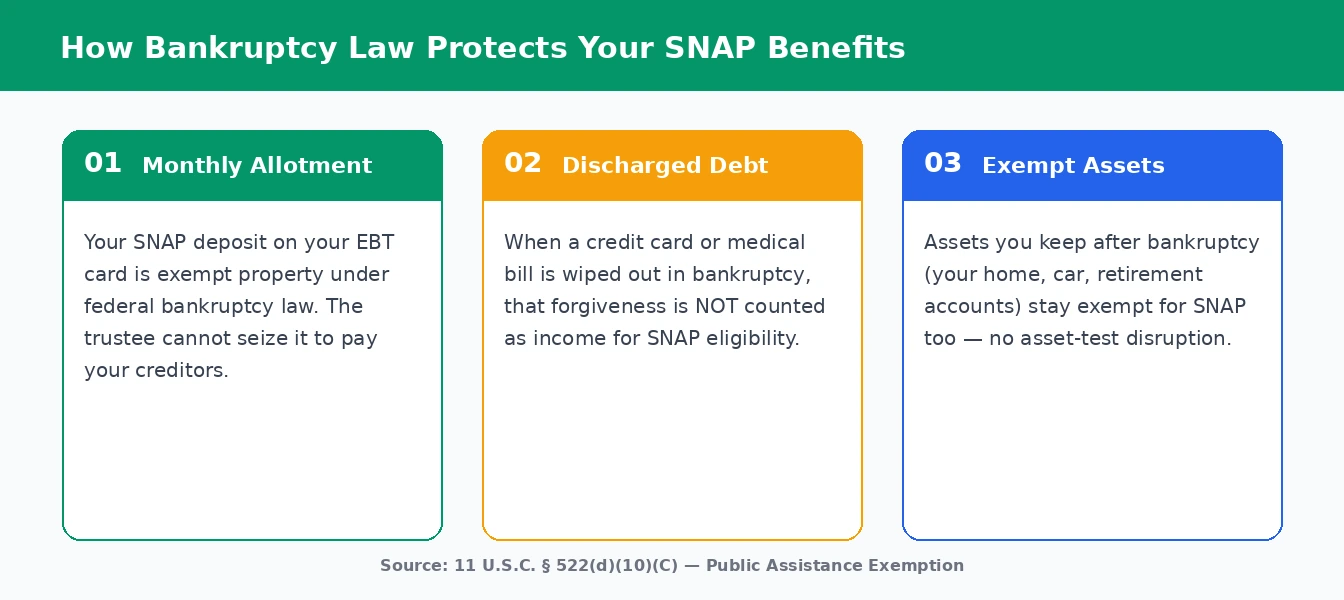
The legal protection comes from a specific line in the U.S. bankruptcy code. Section 522(d)(10)(C) of Title 11 creates a federal exemption for "a Social Security Act benefit." Courts have interpreted this to include SNAP, SSI, SSDI, TANF, and most other federal public assistance payments.
That exemption means the bankruptcy trustee cannot treat your SNAP benefits as part of the bankruptcy estate. The bankruptcy estate is the pool of property available to pay your creditors.
SNAP Is Exempt From the Bankruptcy Estate
Once SNAP lands on your EBT card, that money is legally protected. The trustee cannot freeze your EBT account. They cannot redirect the balance to creditors. They cannot require you to spend it down on allowed bankruptcy expenses before the next deposit. The exemption applies to the current month's benefit. It also applies to any reasonable balance you have carried over from previous months.
State exemption lists often add an extra layer of protection. About two-thirds of states have their own exemption statutes that explicitly name SNAP or "public assistance" as exempt property. If you live in one of those states, your SNAP is doubly protected, both by the federal code and by state law. Your bankruptcy attorney will know which list applies in your case.
What Happens to Your EBT Card Balance
Your EBT card balance sits outside the bankruptcy estate entirely. If you have $380 remaining on your card the day you file, that $380 stays on your card. If your next deposit of $292 lands three days later, that $292 also stays on your card.
The trustee does not inventory your EBT balance the way they inventory your bank accounts. You do not list EBT funds on your bankruptcy schedules as an asset.
One small wrinkle: if you have already transferred SNAP funds to a regular bank account, that money may temporarily look like a regular bank deposit. You cannot normally do this directly. Some people route refunds or replacements through a linked account, which is how it happens. Keep your SNAP on your EBT card and you avoid the question entirely.
The Income Side: Does Bankruptcy Change Your Income for SNAP?
Here is the part that confuses people the most. When a debt is discharged in bankruptcy, the creditor writes off what you owed. The IRS sometimes treats forgiven debt as taxable income. SNAP does not. From SNAP's perspective, a discharged debt is not income, and it does not show up anywhere in your monthly income calculation.
Discharged Debt Is Not Income for SNAP
The USDA's SNAP regulations at 7 CFR 273.9(b) define income as anything you receive in cash or in-kind that you can use to meet your living expenses. A debt discharge does not put cash in your pocket.
It does not change your paycheck, your gig earnings, your child support, or your Social Security. It simply removes a legal obligation to pay back a debt you previously owed. SNAP treats this removal as a non-event for income purposes.
This is different from how the IRS views discharged debt. The IRS may issue you a Form 1099-C showing the forgiven amount as cancellation of debt income. This can be taxable. Some SNAP recipients worry that the 1099-C means their SNAP income goes up. It does not. SNAP does not use 1099 forms the way the IRS does. The SNAP caseworker does not count debt forgiveness as income.
Chapter 7 vs Chapter 13: What SNAP Sees
Chapter 7 (liquidation)
A Chapter 7 wipes out most unsecured debts in about three to four months. Your income does not change because of the filing. Your SNAP eligibility stays the same. If you were eligible before filing, you remain eligible after your discharge.
The only edge case is if the trustee liquidates a non-exempt asset — for example, a second vehicle — and hands you the proceeds. That cash could briefly affect your asset test, but most Chapter 7 filers have no non-exempt assets to liquidate.
Chapter 13 (repayment plan)
A Chapter 13 puts you on a three-to-five-year repayment plan funded by your disposable income. Your monthly plan payment is calculated by subtracting allowed expenses from your monthly income, then sending the surplus to the trustee.
That plan payment does not count as a SNAP deduction, but it also does not count against your SNAP income. Your SNAP income is what you bring home from work and other sources, not what you pay to the bankruptcy trustee.
For households with unemployment benefits count as their main income source, the bankruptcy filing changes nothing about the SNAP calculation. The unemployment check still lands, still counts as unearned income, and still gets deducted at standard rates. The same is true if you receive TANF cash assistance — both benefits continue uninterrupted through bankruptcy.
The Asset Side: What Bankruptcy Does to Your Asset Test
The asset test is where bankruptcy and SNAP most clearly intersect. About 35 states use Broad-Based Categorical Eligibility. BBCE eliminates the asset test for most SNAP households.
If you live in a BBCE state, this whole section is academic. Your assets simply do not matter for SNAP. If you live in one of the non-BBCE states, the asset test still applies. The timing of your bankruptcy filing can matter.
Liquidated Assets May Briefly Affect Eligibility
If the bankruptcy trustee seizes a non-exempt asset and sells it, the cash proceeds could push your bank balance over the SNAP asset limit for that month. The federal SNAP asset limit is $3,000 for most households.
It is $4,500 for households with a senior or disabled member. Non-BBCE states set their own figures within federal guidelines. Check the asset test for SNAP for your state's exact numbers.
Practically, this scenario is rare. Most Chapter 7 filers have no non-exempt assets. That is why they qualify for Chapter 7 in the first place. Chapter 13 filers keep all their property and pay through the plan, so there is no liquidation event. The risk only materializes if you own a paid-off second car, valuable jewelry, or investment property that exceeds your state's exemption cap.
Exempt Assets Stay Exempt for SNAP Too
Bankruptcy exemptions and SNAP asset exclusions overlap heavily. Your primary residence, retirement accounts (401k, IRA, pension), one vehicle up to a state-specific value, household goods, and tools of your trade are exempt in bankruptcy. They are also excluded from the SNAP asset test. Filing bankruptcy does not turn these assets into countable resources for SNAP.
The one asset to watch is your bank account balance on the filing date. Bankruptcy trustees look at the balance the day you file. SNAP looks at the balance on the last day of the month for the asset test.
If you receive a large deposit between filing and month-end, both the trustee and the SNAP caseworker will see it. A tax refund not yet spent down is a common example. Spending down tax refunds on exempt items before month-end is the standard play. Exempt items include rent, food, and medical care.
Medical Bankruptcy and SNAP: The Most Common Pair
Medical debt is the single biggest reason Americans file bankruptcy. SNAP recipients are disproportionately represented in medical bankruptcy filings. If you lost income because of a health crisis, ran up medical bills you cannot pay, and are now considering bankruptcy, you are in good company. You also have specific SNAP tools available.
Why Medical Bills Push Families Into Bankruptcy
A single hospital stay can generate $30,000 in bills even with insurance. A chronic illness can mean years of co-pays, out-of-network charges, and lost work time. When the medical bills pile up faster than you can pay them, bankruptcy becomes a rational choice that wipes the slate clean.
Many SNAP recipients are in exactly this position. That is why coordinating Medicaid and SNAP coordination matters so much. It matters before, during, and after a bankruptcy filing.
Using the Medical Expense Deduction After Filing
Seniors and disabled SNAP recipients can claim the excess medical expense deduction. This covers out-of-pocket medical costs above $35 per month. If you are still paying co-pays, prescriptions, dental bills, or transportation to medical appointments after your bankruptcy filing, those expenses count toward the deduction.
The medical expense deduction can raise your SNAP benefit by $100 or more per month. This matters even more when your budget is stretched by bankruptcy plan payments.
Coordinating SNAP With Medicaid Coverage
If your bankruptcy was caused by medical debt and you have since enrolled in Medicaid, your SNAP eligibility actually becomes easier. Medicaid coverage means many of your medical costs are covered. Your disposable income goes further.
Several state SNAP offices treat Medicaid enrollment as a signal. They apply the standard utility allowance and other deductions more generously. The combination of Medicaid, SNAP, and LIHEAP and SNAP together can keep a household's basic needs covered while the bankruptcy runs its course.
Reporting Bankruptcy to Your SNAP Caseworker
One of the most common questions is whether you have to tell your SNAP caseworker about your bankruptcy filing. The honest answer is: usually not, but there are exceptions. SNAP simplified reporting rules require you to report changes in income, household size, and address. Bankruptcy is none of those, so most recipients never mention it.
When (and If) You Need to Report
Bankruptcy itself is not a reportable change under any state's SNAP rules. You do not need to call your caseworker the day you file. You do not need to send a copy of your petition. Your monthly benefit continues uninterrupted. The only time bankruptcy becomes relevant to SNAP is if the trustee liquidates an asset and the cash hits your bank account. That scenario is rare, as we discussed above.
The reverse situation is more common. When you go through the SNAP recertification process, your caseworker will ask for recent bank statements. Your statements may show unusual activity.
This could be large transfers, payments to a bankruptcy trustee, or a one-time deposit from a liquidated asset. Bring a short letter from your attorney explaining what the transactions represent. Proactive documentation prevents the caseworker from guessing wrong.
What Documents to Bring to Your Recertification
Recertification paperwork checklist for bankruptcy filers
- Your bankruptcy petition (Form 101 for Chapter 7 or Form 101 for Chapter 13) showing the filing date.
- The discharge order if your case has already closed, which most Chapter 7 cases do within four months.
- The Chapter 13 plan confirmation order if you are on a repayment plan, showing your monthly payment amount.
- Bank statements for the past 30 to 60 days, with any unusual transactions highlighted and explained.
- Pay stubs for the past 30 days if you are employed, or 1099 statements if you are self-employed SNAP income calculation.
- A short cover letter from your bankruptcy attorney, on letterhead, confirming that you filed and that your SNAP benefits are unaffected.
Caseworkers do not assume anything. If they see a $400 payment to "Chapter 13 Trustee" on your bank statement and you have not explained it, they may treat it as a discretionary expense. They could reduce your shelter deduction as a result. A one-page letter prevents that mistake.
Common Myths About SNAP and Bankruptcy
Myth 1: You lose your SNAP if you file bankruptcy.
False. Federal exemption 11 U.S.C. 522(d)(10)(C) protects SNAP from the bankruptcy estate. Your benefits continue uninterrupted through Chapter 7 and Chapter 13 filings.
Myth 2: You must wait until your bankruptcy is discharged to apply for SNAP.
False. You can apply for SNAP the same day you file bankruptcy, or any time before, during, or after. The bankruptcy filing is not on the SNAP application, and the caseworker does not ask about bankruptcy status. If you meet the 2026 SNAP income limits, you will be approved. If you need food immediately, request an expedited SNAP application, which can get you benefits within seven days.
Myth 3: Bankruptcy hurts your SNAP eligibility permanently.
False. Bankruptcy does not appear on your SNAP record, does not affect future applications, and does not change how your income is calculated. Once your case is closed, the bankruptcy is a closed chapter in every sense. SNAP continues for as long as you meet the eligibility tests.
Myth 4: SNAP will count your discharged debt as income.
False. SNAP does not follow IRS rules on cancellation of debt income. Discharged debt is invisible to the SNAP calculation, period.
Step-by-Step: Keeping Your SNAP Safe During Bankruptcy
The five-step process below is the same one we walk SNAP recipients through when they call about a pending bankruptcy. Follow it in order and you will not run into surprises.
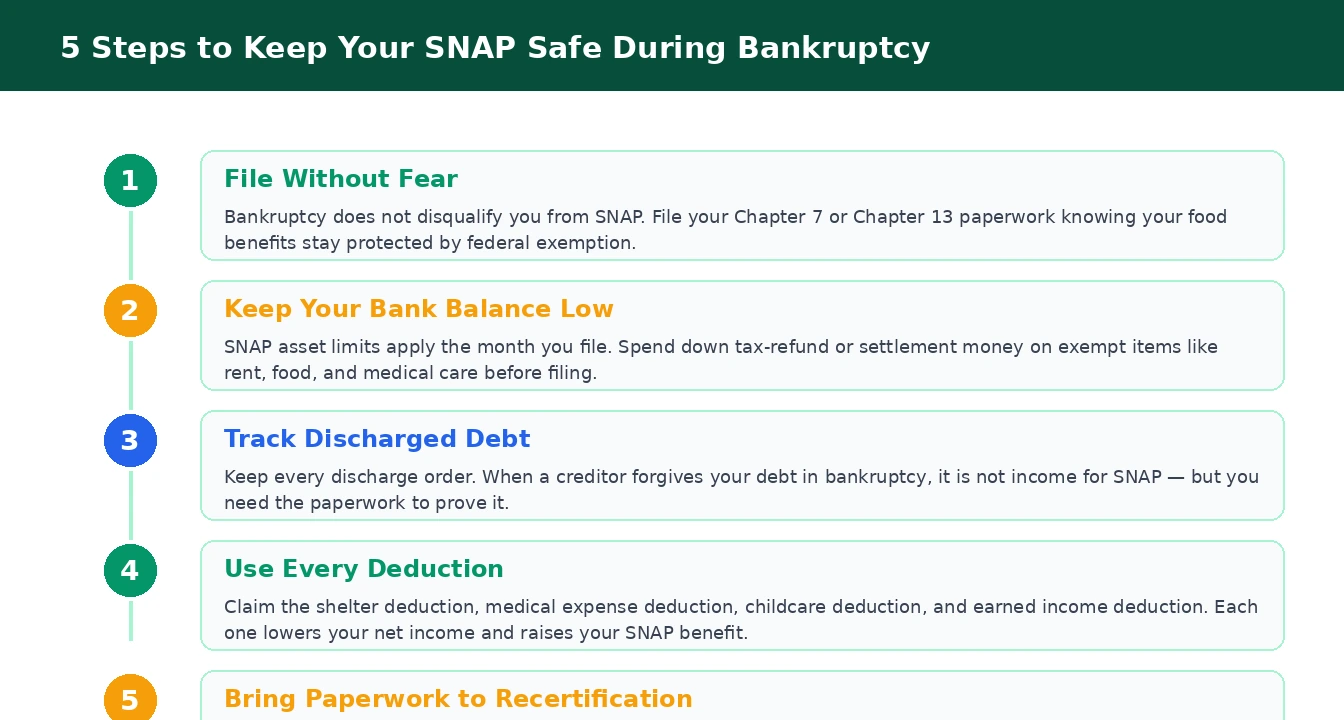
Step 1 — File without fear.
Bankruptcy does not disqualify you from SNAP. File your Chapter 7 or Chapter 13 paperwork knowing your food benefits are protected by federal exemption. Your EBT card keeps reloading on schedule.
Step 2 — Keep your bank balance low.
SNAP asset limits apply on the last day of the month. Spend down any tax refund, settlement, or liquidation proceeds on exempt items like rent, food, medical care, and utilities before month-end. This is the same rule that applies to SNAP for seniors rules, where keeping balances low is a year-round habit.
Step 3 — Track every dollar of discharged debt.
Keep every discharge order and every 1099-C form. When a creditor forgives your debt in bankruptcy, it is not income for SNAP, but you may need the paperwork to prove it if a caseworker asks. File these documents with your SNAP recertification records so they are easy to find.
Step 4 — Use every deduction you qualify for.
Claim the shelter deduction, the medical expense deduction, the childcare deduction, and the 20% earned income deduction. Each one lowers your net income and raises your SNAP benefit. The complete SNAP deductions list walks through all seven deductions, with dollar figures and documentation requirements.
If you recently lost your job and now receive your unemployment benefits count as unearned income, remember that the 20% earned income deduction only applies to wages — but other deductions still apply.
Step 5 — Bring your bankruptcy paperwork to recertification.
Take your bankruptcy petition, discharge order, and current bank statements to your next SNAP recertification. Caseworkers do not assume — show the proof. Knowing how long SNAP certification lasts in your state helps you plan when to gather the paperwork.
Special Situations
Immigrants Worried About Public Charge
Lawful permanent residents and other qualified immigrants sometimes avoid bankruptcy. They fear it will count against them in the public charge determination. It does not. Bankruptcy is a private legal matter, not a public benefit. U.S.
Citizenship and Immigration Services does not treat bankruptcy filings as a negative factor in public charge analysis. The public charge rule for SNAP page walks through which benefits do and do not count. Bankruptcy is not on either list.
Moving States for a Fresh Start
Many filers use bankruptcy as a chance to relocate. They often move to a state with lower housing costs or more job opportunities. If you are moving states with SNAP active, you will close your old case and apply in the new state.
Your bankruptcy follows you. Your SNAP eligibility restarts in the new state under that state's rules. Bring your bankruptcy paperwork to the new state's interview so the caseworker understands your bank history.
Self-Employed Filers
Business bankruptcies interact with SNAP through the income calculation. This is true for both sole proprietor and entity-level filings. If your business closes in bankruptcy and you lose that income, your SNAP benefit should go up to reflect the lower countable income.
Conversely, if you keep the business running and your income recovers, you must report the increase at recertification. The 20% earned income deduction still applies to any wages or self-employment earnings you receive during and after the bankruptcy.
Seniors Filing Bankruptcy
Seniors on fixed incomes are the fastest-growing bankruptcy demographic in the country. If you are 60 or older and filing bankruptcy over medical debt or credit card balances run up by an adult child, your SNAP eligibility is unaffected.
You still qualify for the senior-specific rules. These include no gross income test, easier asset test in BBCE states, and the excess medical expense deduction. SNAP for seniors rules are designed to keep older Americans fed regardless of financial shocks.
What to Do if You Got a SNAP Overpayment Notice Before Filing Bankruptcy
A SNAP overpayment notice is a debt you owe to the state SNAP agency. Bankruptcy can discharge that debt in some circumstances. The rules are tricky. A Chapter 7 discharge can wipe out a SNAP overpayment if the overpayment was not the result of fraud. If you lied on your application, the overpayment is non-dischargeable. You will still owe it after bankruptcy.
If the overpayment was an honest mistake, that debt can usually be discharged. For example, you forgot to report a wage increase and the state overpaid you for six months. The SNAP overpayment notice page walks through the three types of overpayments and which ones can be discharged in bankruptcy. Talk to your bankruptcy attorney about listing the SNAP overpayment on your schedules.
Protecting Your EBT Card During Bankruptcy
While we are on the subject of protection, do not forget the basics of EBT card security during the stress of a bankruptcy filing. Skimming theft has surged in 2026. SNAP recipients are prime targets. Treat your EBT card the same way you treat a debit card. Never share your PIN.
Never let a store clerk swipe it out of your sight. Check your balance weekly. If your card is skimmed, the replacement process can take weeks. That is bad timing when you are already navigating bankruptcy paperwork. The EBT card stolen protections page has the full step-by-step recovery process.