Personal injury settlements are a financial lifeline after an accident, but they create a real headache for SNAP households. A single check for $50,000 or $100,000 can push you over the resource limit in the month you receive it, even if the money is meant to cover years of future medical care. The rules around how SNAP treats settlement money are nuanced, and getting it wrong can trigger an overpayment notice months or years later.
This guide explains how SNAP classifies personal injury settlements, the difference between income and resource treatment, how lump sum and structured settlements are handled, and what steps you can take to preserve your food benefit while still receiving the compensation you are owed.
Table of Contents
- 1How SNAP Classifies Settlement Money
- 2Lump Sum vs Structured Settlements
- 3Income vs Resource Treatment
- 4Special Needs Trusts and Settlement Protection
- 5Spend-Down Strategies That Work
- 6Reporting the Settlement to Your Caseworker
- 7How Settlements Interact With Other Benefit Programs
- 8Documentation to Keep
- 9Final Thoughts on Settlements and SNAP
- 10Sources
How SNAP Classifies Settlement Money
SNAP treats settlement money as either income or a resource, depending on what the payment is for and when it is received. The distinction matters because income is counted in the month it is received and affects eligibility for that month, while resources are counted as a lump sum that affects eligibility for as long as you hold the money.
The general rule is that compensation for lost wages, lost future earnings, or punitive damages counts as income in the month you receive it. Compensation for medical expenses, pain and suffering, or property damage counts as a resource. The classification depends on the settlement agreement language, not on what you actually do with the money.
The SNAP asset limits guide explains how resources are counted in detail. For most households, the resource limit is $2,750, or $3,000 if someone in the household is elderly or disabled. A settlement deposit that pushes your bank balance above that limit makes you ineligible until you spend down the excess.
Lump Sum vs Structured Settlements
A lump sum settlement is a single payment that resolves the entire claim at once. SNAP treats a lump sum as a resource in the month received, and any portion you still hold in subsequent months continues to count as a resource until you spend it down below the limit.
A structured settlement pays out in regular installments over months or years. Each installment is treated as a resource in the month it is received. If the installment is small enough to keep your bank balance under the resource limit, you may maintain SNAP eligibility throughout the payout period.
For households that rely on SNAP, structured settlements are almost always safer. The same total compensation spread across smaller monthly payments is much less likely to cause a benefit interruption. If your attorney is negotiating a settlement, ask whether a structured option is available and how it would interact with your benefit programs.
Income vs Resource Treatment
The classification of settlement proceeds as income or resources is governed by 7 CFR 273.9. The regulation distinguishes between recurring payments, which are income, and one-time payments that compensate for a past loss, which are resources. This is where most of the confusion comes from.
Compensation for lost wages is treated as income because it replaces income you would have earned. Even if you receive it as a lump sum, SNAP may count a portion as income for the months the lost wages covered. Compensation for medical bills, pain and suffering, or future care is treated as a resource because it is not replacing earned income.
Punitive damages are almost always treated as income because they are intended as punishment rather than compensation. If your settlement includes a punitive component, your caseworker may ask for a breakdown showing how much of the total was allocated to each category.
If you also receive workers compensation or disability back pay, the same classification rules apply. Each type of compensation gets its own treatment based on what it replaces.
Special Needs Trusts and Settlement Protection
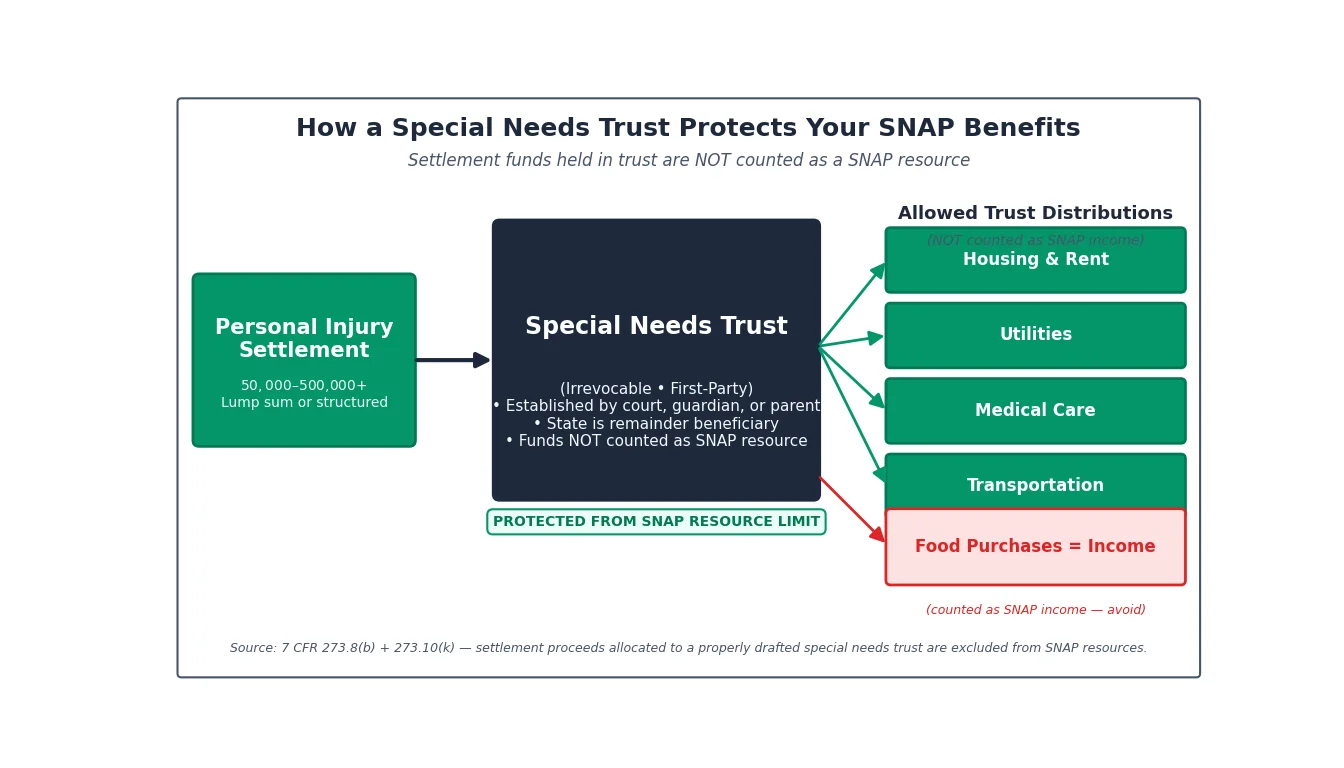
If you are elderly or disabled and expect a large settlement, ask your attorney about a special needs trust. A properly drafted first-party special needs trust can hold settlement proceeds without counting them as a resource for SNAP, Medicaid, and SSI purposes. The trust must be irrevocable, established by a parent, grandparent, guardian, or court, and must name the state as the remainder beneficiary after your death.
The trust payments for your benefit are not counted as income for SNAP as long as they are used for items SNAP does not cover, such as housing, utilities, transportation, or medical expenses not covered by insurance. Distributions for food would count as income.
Special needs trusts are not cheap to set up, typically costing $2,000 to $5,360 in attorney fees. For settlements under $50,000, the trust cost may not be worth it. For larger settlements, especially those involving a disabled child or a worker with a long-term disability, a trust is often the only way to preserve benefit eligibility.
Spend-Down Strategies That Work
If you receive a lump sum settlement and it pushes your resources over the limit, you can spend the money down on exempt items to regain SNAP eligibility. The key is that the spending must be legitimate and documented. SNAP does not penalize you for using the money, only for holding it.
Exempt spend-down categories include paying off debt, making home repairs, buying a vehicle that is exempt under your state's vehicle rule, prepaying funeral expenses, purchasing durable medical equipment, paying for education or job training, and improving your primary residence. All of these remove money from your countable resources without creating a new countable asset.
Avoid transferring the money to a friend or family member to get under the limit. SNAP has a transfer penalty that applies to resources transferred below fair market value within 3 months of applying. The penalty period is calculated based on the uncompensated value divided by the average monthly SNAP benefit for your household size.
Reporting the Settlement to Your Caseworker
Under simplified reporting, most SNAP households only have to report changes at recertification and when income drops below the SNAP gross monthly limit. A settlement is technically a resource change, not an income change, so it does not always trigger an interim reporting requirement.
However, if you are on change reporting rather than simplified reporting, you must report the settlement within 10 days of receiving it. Households on change reporting typically include those with earned income over the reporting threshold or those receiving certain types of assistance. When in doubt, report it. The penalty for over-reporting is zero, while the penalty for under-reporting can be a SNAP overpayment and disqualification.
If you receive a settlement and later get an overpayment notice, the SNAP overpayment guide walks through the appeal process. Many overpayment notices related to settlements are winnable on appeal, especially if the settlement agreement clearly allocated the proceeds to medical expenses rather than lost wages.
How Settlements Interact With Other Benefit Programs
SNAP is not the only program affected by a personal injury settlement. Medicaid has stricter resource rules in most states, and SSI counts settlement money as income in the month received and as a resource thereafter. If you receive any of these benefits, coordinate with a benefits planner before the settlement is finalized.
Medicaid often requires you to report the settlement within 10 days regardless of your reporting status. Failing to report can result in Medicaid coverage being terminated retroactively, leaving you on the hook for medical bills that insurance already paid. Coordination between SNAP and Medicaid is worth understanding before any large settlement hits your bank account.
For households that include a disabled family member receiving SSI, the rules are even tighter. SSI has a $2,000 individual resource limit, and a settlement that pushes the disabled person over that limit can suspend SSI benefits. A special needs trust is usually the only way to preserve SSI in this scenario.
Documentation to Keep
Keep a complete paper trail of your settlement. This includes the settlement agreement itself, the breakdown of what each portion of the payment covers, bank statements showing the deposit, and receipts for any spend-down. Your caseworker may request this documentation at recertification or if a question arises about your eligibility.
The verification documents checklist covers what SNAP typically asks for at application and recertification. Settlement documentation is similar. The clearer the paper trail, the less likely you are to face a dispute about how the money should be classified.
Final Thoughts on Settlements and SNAP
Personal injury settlements and SNAP can coexist, but only with careful planning. The biggest mistake households make is accepting a lump sum, depositing it into a regular checking account, and then losing SNAP, Medicaid, and SSI all at once. A few hours of planning before the check clears can preserve years of benefits.
If a settlement is on the horizon, talk to a benefits planner or legal aid attorney who understands public benefit interactions. The advice is often free through legal aid organizations, and it can save you tens of thousands of dollars in lost benefits. Use the SNAP eligibility calculator to model how a settlement deposit would affect your monthly benefit, then make an informed decision about structured payouts, trusts, or spend-down strategies.
Want to know if your income qualifies? Use our free calculator to check your SNAP eligibility in about 90 seconds — no paperwork, no commitment, just an honest answer.
Check My EligibilitySources
- USDA Food and Nutrition Service, SNAP Income and Resources Guidance
- Code of Federal Regulations, 7 CFR 273.9 (Income and Resources)
- Social Security Administration, Program Operations Manual System (POMS) on Trusts
- Congressional Research Service, Treatment of Settlements in Means-Tested Programs
- National Academy of Elder Law Attorneys, Special Needs Trusts and Public Benefits