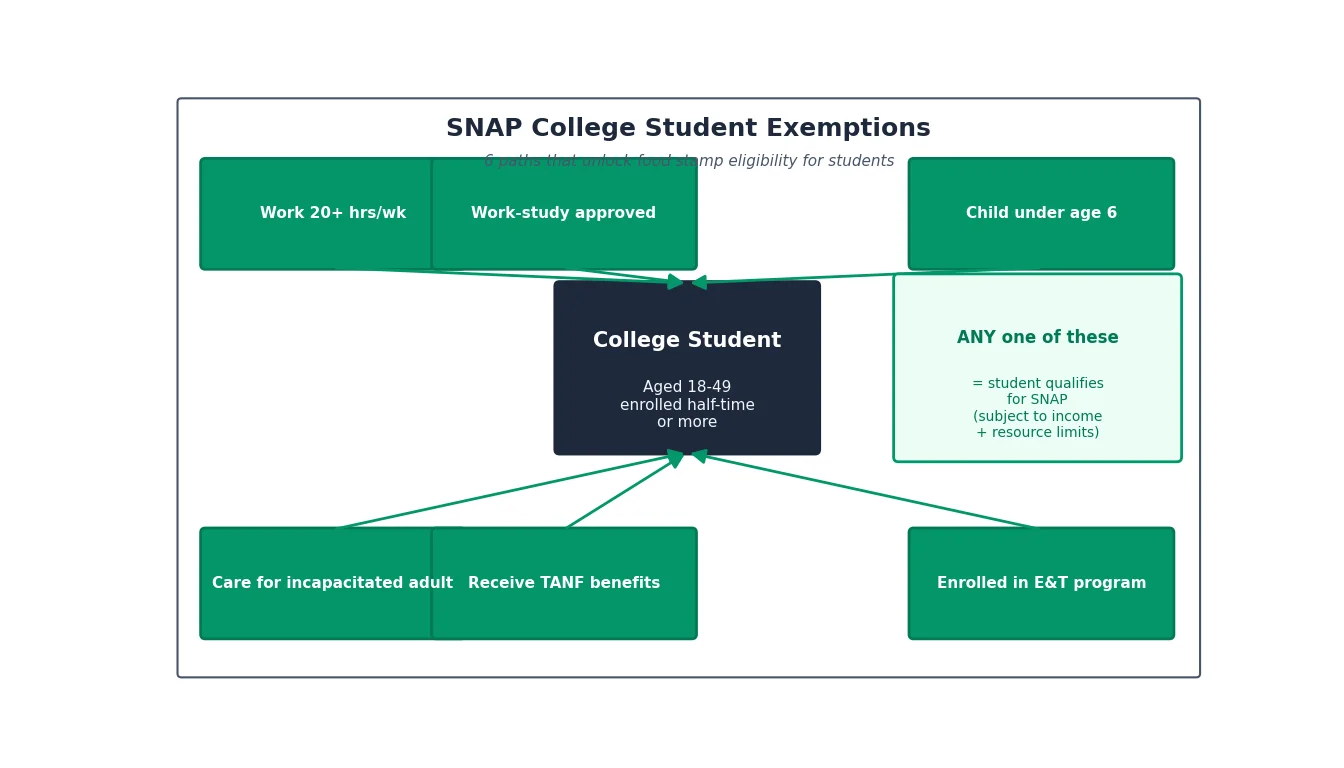
College students between the ages of 18 and 49 who are enrolled at least half-time in higher education are presumed ineligible for SNAP. The rule, set out in 7 CFR 273.5, was designed to keep students on their parents' budgets and off public assistance. But the rule comes with a list of exemptions that, taken together, cover a much larger share of real students than most people realize. A student who works 20 hours a week, a student who has a child under 6, a student who receives work-study, a student who is in a vocational program, and several others all qualify.
This guide walks through the six most common exemptions, the documentation each one requires, and the practical steps to claim an exemption on the SNAP application. The difference between an approved and denied student application often comes down to checking the right box and attaching the right paper.
Table of Contents
- 1The Half-Time Enrollment Threshold
- 2The Six Common SNAP Student Exemptions
- 3Exemption 1: Working 20 Hours Per Week
- 4Exemption 2: Approved Work-Study
- 5Exemption 3: Caring for a Child Under Age 6
- 6Exemption 4: Caring for an Incapacitated Household Member
- 7Exemption 5: Receiving TANF or TANF-Funded Services
- 8Exemption 6: Enrollment in an Employment and Training Program
- 9Less Common Exemptions Worth Knowing
- 10Documentation Each Exemption Requires
- 11How to Apply as a Student
- 12What Counts as Income for Student SNAP
- 13Real Numbers: A Worked Example
- 14Common Denial Reasons and How to Avoid Them
- 15State Variations and Pilot Programs
The Half-Time Enrollment Threshold
The student rule applies only to students enrolled at least half-time in an institution of higher education. Half-time is defined by the school, not by SNAP. For most undergraduate programs, half-time means six credit hours per semester. If a student drops below half-time, the student rule no longer applies, and the student is subject to the same SNAP rules as any other adult.
The student rule applies only to higher education. Vocational schools, adult basic education, GED programs, and English as a Second Language programs are not institutions of higher education. A student in one of these programs is not subject to the student rule at all, even if enrolled full-time. This is the first and most overlooked path to SNAP eligibility for students.
The Six Common SNAP Student Exemptions
The federal regulations list more than a dozen exemptions, but six cover the vast majority of students who actually qualify. Understanding each one and matching it to your situation is the key to a successful application.
Exemption 1: Working 20 Hours Per Week
A student who works at least 20 hours per week for minimum wage or is self-employed for at least 20 hours per week and earns at least the federal minimum wage multiplied by 20 hours each week qualifies for SNAP. The work can be on-campus or off-campus, paid or self-employment. The hours must be averaged over the month, so a student who works 80 hours in a four-week month meets the threshold even if some individual weeks dip below 20.
The gig workers guide covers self-employment in detail. A student driving for a rideshare app, delivering food, or freelancing can use self-employment income to meet the 20-hour test, provided the earnings meet the minimum wage floor.
Exemption 2: Approved Work-Study
A student who has been approved for federal or state work-study for the current academic term qualifies, even if the work-study job has not started yet. The approval is what matters. The student must accept the work-study placement when offered and begin working within a reasonable time, usually 30 days.
Work-study approval is documented by the financial aid award letter. The financial aid office can also provide a separate work-study confirmation letter. SNAP caseworkers accept either document.
Exemption 3: Caring for a Child Under Age 6
A student who is the parent or caretaker of a child under age 6 is exempt from the student rule. The exemption applies when the child lives in the same household and the student provides the primary care. The exemption recognizes that a parent of a young child cannot reasonably be expected to work 20 hours per week on top of school.
If both parents are students and one has a child under 6, only the parent who provides primary care can use this exemption. The other parent must qualify under a different exemption. The single mothers guide covers the related household composition rules.
Exemption 4: Caring for an Incapacitated Household Member
A student who provides care for an incapacitated household member qualifies for an exemption. The incapacitated person must be unable to care for themselves, and the student must be the primary caregiver. Documentation typically comes from a doctor or licensed medical professional stating that the person needs ongoing care and that the student provides it.
This exemption is similar in spirit to the child-under-6 exemption but applies to any incapacitated household member, including an elderly parent, a disabled spouse, or a disabled adult child.
Exemption 5: Receiving TANF or TANF-Funded Services
A student who receives Temporary Assistance for Needy Families (TANF) cash assistance, or who participates in a TANF-funded program that requires the student's enrollment, is exempt. Many states run TANF-funded programs that target student parents, students in vocational training, or students transitioning off welfare. The program must be TANF-funded on paper; the student does not need to receive cash directly.
Documentation is usually a letter from the TANF agency or the program operator confirming the student's participation. The SNAP and TANF guide covers the program interaction in more detail.
Exemption 6: Enrollment in an Employment and Training Program
A student enrolled in a SNAP Employment and Training program, or in a state or local employment and training program that includes SNAP-funded components, is exempt. The program must be operated under an agreement with the state SNAP agency. On-the-job training, vocational education that is part of an E&T plan, and job search programs run by state workforce agencies typically qualify.
The SNAP E&T program guide explains how these programs work. The key for students is that enrollment alone triggers the exemption; the student does not need to complete the program.
Less Common Exemptions Worth Knowing
Beyond the six common exemptions, several narrower exemptions apply in specific situations. A student who is a single parent with a child under 12, regardless of the child's age in the under-6 sense, qualifies under a separate exemption. A student who is participating in a Workforce Innovation and Opportunity Act (WIOA) program qualifies. A student who is in a substance abuse treatment program qualifies. A student who is homeless, as defined by the McKinney-Vento Act, qualifies.
The homeless individuals guide covers the homeless definition in detail. For students couch-surfing or living in shelters, this exemption can be the easiest to claim.
Documentation Each Exemption Requires
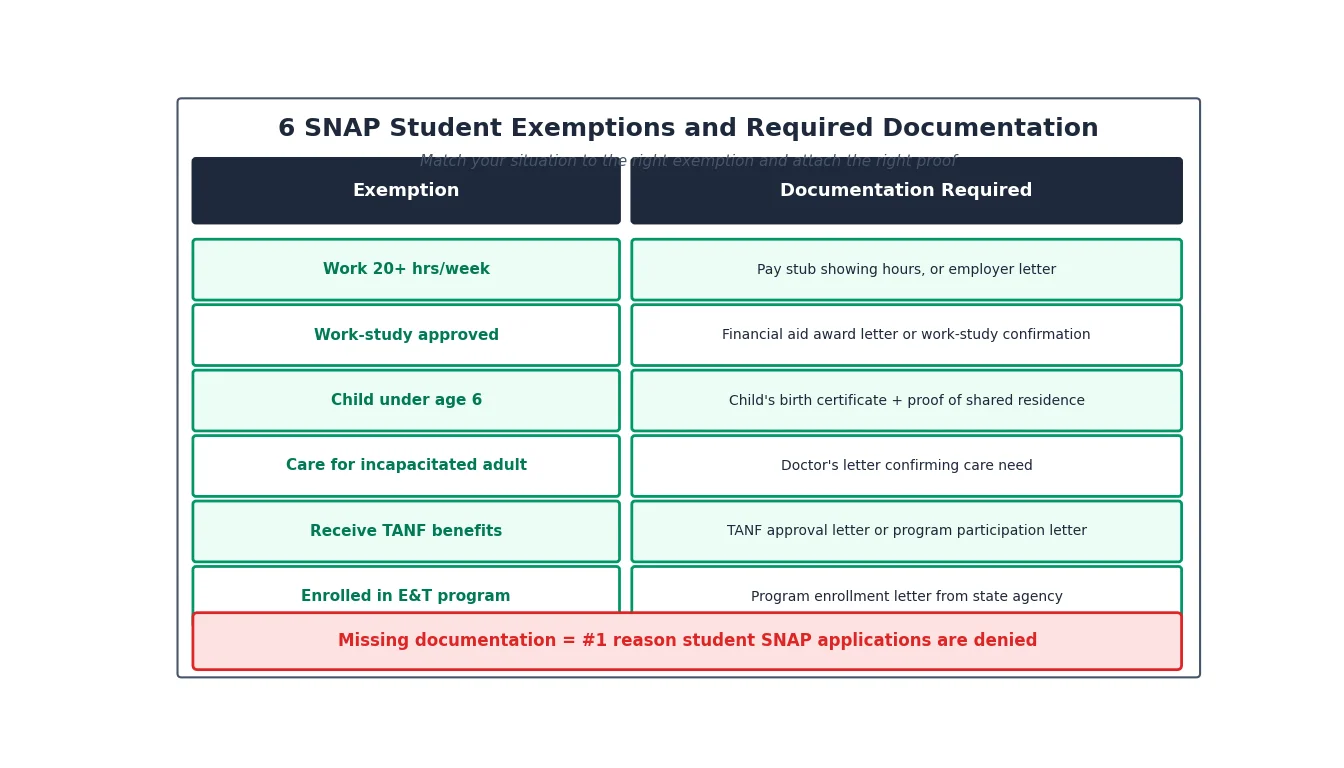
The most common reason student SNAP applications are denied is missing documentation. A student who checks the exemption box but provides no proof will be denied, even if the exemption genuinely applies. The table below maps each exemption to the document the caseworker will ask for.
For the work exemption, a pay stub showing year-to-date hours or a letter from the employer confirming the work schedule is enough. For work-study, the financial aid award letter. For the child-under-6 exemption, the child's birth certificate and proof of shared residence. For the incapacitated member exemption, a doctor's letter. For TANF, the TANF approval letter. For E&T, the program enrollment letter.
The verification documents checklist guide walks through the full list of documents SNAP applications require. Students should add exemption-specific documentation to that checklist.
How to Apply as a Student
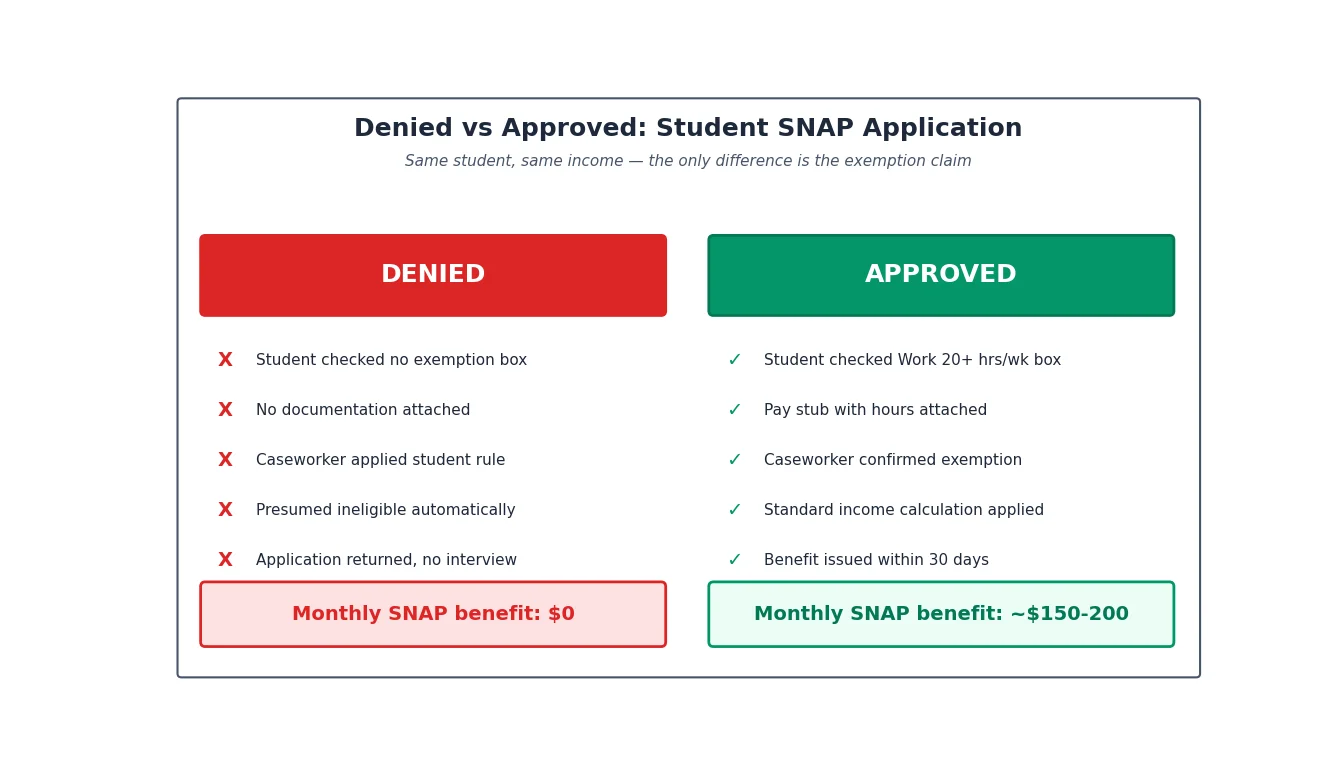
The SNAP application asks whether anyone in the household is a student. Answer yes. The application will then ask about exemptions. Check the box that applies and attach the documentation. If the application is online, you can usually upload documents as PDFs or photos.
The SNAP application guide walks through the full application. Students should follow that guide but add the exemption documentation to the standard verification packet.
If the application is denied because the exemption was not recognized, the student can request a fair hearing within 90 days of the denial notice. The how to appeal a SNAP denial guide covers the appeal process. The most common appealable student denial is one where the caseworker did not recognize a self-employment income source as meeting the 20-hour test.
What Counts as Income for Student SNAP
Once the student exemption is established, the household income is calculated the same way as any other SNAP household. The student's earned income, the parents' income if the student is part of the parents' household, and any unearned income like scholarships that cover living expenses are all considered. Scholarships that cover tuition and fees are excluded, but scholarships that cover room and board are countable income.
The direct sales income guide and the side hustle income guide cover common student income sources. Many students earn money through gig apps, tutoring, or direct sales, all of which count toward SNAP.
For students under 22 living with their parents, the parents' income is counted as part of the SNAP household. This is a frequent surprise for students who think they can apply on their own. The household composition rule for children under 22 always wins over the student rule.
Real Numbers: A Worked Example
Consider a 24-year-old community college student enrolled in 9 credit hours (above half-time), working 22 hours a week at a coffee shop earning 15 dollars an hour. Her monthly gross earned income is about 1,430 dollars. She rents a room for 600 dollars a month and pays about 150 dollars in utilities. She has no other income and no children.
She qualifies for SNAP under the work exemption because she works at least 20 hours per week. Her countable income starts at 1,430 dollars, takes the 20 percent earned income deduction (286 dollars), the standard deduction for a one-person household (around 193 dollars), and the shelter deduction (her rent and utilities minus half her income after the other deductions). Her net income is below the SNAP net income limit, and she would receive a monthly benefit of around 150 to 200 dollars.
Without the exemption, she would be denied outright. The exemption is not a minor detail; it is the difference between approval and denial for the typical working student.
Common Denial Reasons and How to Avoid Them
The first common denial is checking the wrong exemption box. A student who works 20 hours but checks the work-study box will be denied when the caseworker cannot find work-study approval on file. Read each exemption description carefully before checking.
The second common denial is providing a pay stub that does not show hours. Some employers issue pay stubs that show only earnings, not hours. If the pay stub does not show hours, request a letter from the employer confirming the work schedule, or provide a few weeks of time sheets.
The third common denial is for students under 22 living with parents who try to apply as a one-person household. The application will be processed as a household that includes the parents, which often makes the household ineligible due to parental income. There is no exemption that lets a student under 22 living with parents exclude the parents' income.
State Variations and Pilot Programs
Some states have obtained waivers to expand student SNAP eligibility beyond the federal exemptions. California, New York, and a handful of other states have piloted programs that allow students in certain vocational programs or in approved career pathways to qualify even without meeting one of the six federal exemptions. Check with the state SNAP agency or the campus financial aid office to see if any state-specific options apply.
Some campuses have a single-staff-person dedicated to SNAP enrollment assistance, often in the financial aid office or the dean of students office. That person can usually pre-screen students for exemptions and help assemble the documentation packet, which dramatically improves approval rates.
For students who are also foster youth who aged out of the system, a separate federal exemption applies regardless of work or other criteria. Former foster youth under age 26 who were in foster care on their 18th birthday are exempt from the student rule.
The student SNAP rule is restrictive on paper but flexible in practice for students who know the exemptions exist. The combination of 20 hours of work, a child under 6, work-study approval, TANF participation, E&T enrollment, or vocational-school attendance covers most working students and most student parents. The work is in documenting the exemption clearly and attaching the right proof at the time of application.