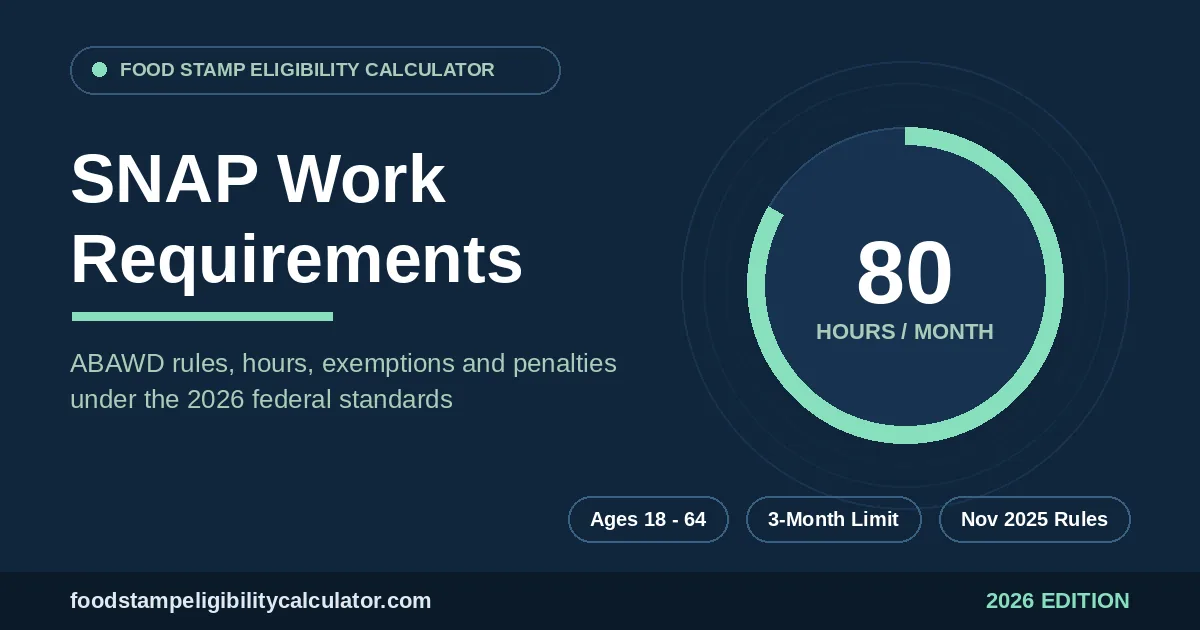
SNAP work requirements decide who must register for work and how many hours to log each month. In 2026 they also decide who keeps receiving food assistance after three months without steady work.
This guide explains both sets of rules in plain language, including the hours, the exemptions, and the penalties. Everything below reflects the federal changes that took effect on November 1, 2025.
Here is the short version for 2026. Adults 16 to 59 must follow the general work rules, and adults 18 to 64 without a child under 14 also face the stricter ABAWD time limit. That limit cuts benefits to three months in 36 unless you work or train for 80 hours a month.
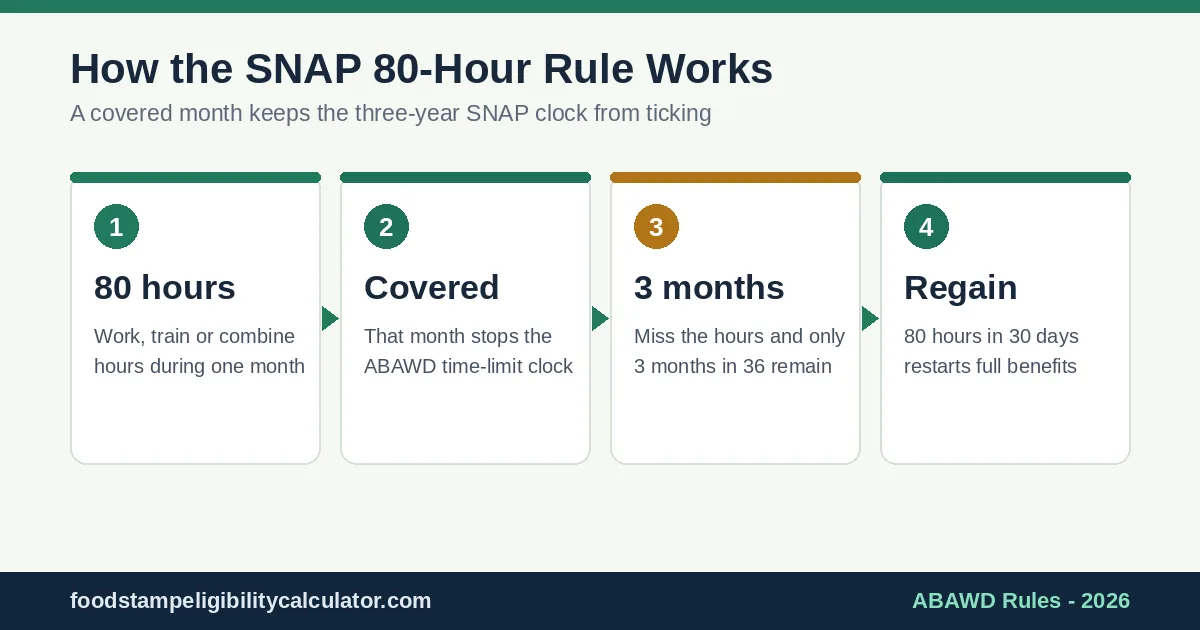
Table of Contents
- 1What Are SNAP Work Requirements?
- 2General Work Requirements for Ages 16 to 59
- 3ABAWD Rules in 2026: Who Faces the Time Limit
- 4The 3-Month Time Limit Explained
- 5Who Is Exempt from SNAP Work Requirements in 2026?
- 6Work Requirements for Special Situations
- 7How to Meet the 80-Hour Monthly Requirement
- 8What Happens If You Don't Comply?
- 9How States Verify Your Hours
- 10State Waivers and Exemptions in 2026
- 11How Broad-Based Categorical Eligibility (BBCE) Fits In
- 12How the 2025 Federal Law Changed Work Requirements
- 13Tips for Staying Compliant
- 14SNAP Work Requirements: Frequently Asked Questions
- 15Final Thoughts
What Are SNAP Work Requirements?
SNAP, the program many people still call food stamps, runs two separate sets of work rules. Every state administers them under federal standards set by the USDA Food and Nutrition Service.
The first set is the general work requirement, which covers most adults between 16 and 59. It asks you to look for work and stay in a job once you find one.
The second set is the ABAWD time limit, a stricter rule for able-bodied adults without dependents. Both sets aim to encourage self-sufficiency, but they carry very different penalties when someone falls short.
Many people who receive SNAP are already working. USDA research has repeatedly found that most working-age adults on SNAP either hold jobs or actively seek them. The rules mainly affect people who are out of work or working below the monthly threshold.
General Work Requirements for Ages 16 to 59
If you are between 16 and 59 and able to work, the general rules probably apply to you. They include the following five obligations:
- Register for work with your state SNAP agency or the local employment and training office
- Accept suitable employment if a job offer meets your state's criteria
- Do not voluntarily quit a job of 30 or more hours a week without good cause
- Do not cut your hours below 30 a week without good cause
- Participate in employment and training (E&T) or workfare programs if your state assigns you
These obligations sound demanding, but most employed recipients already satisfy them. Working 30 hours a week, or earning wages equal to 30 hours at the federal minimum wage, excuses you. At the current federal minimum wage of $7.25, that wage floor equals $217.50 a week.
Some groups are excused from the general rules altogether. The list includes parents caring for a child under six, caregivers of an incapacitated person, people in drug or alcohol treatment, and half-time students. Recipients already meeting work rules through unemployment benefits are also excused.
Breaking a general rule has real consequences. If you quit a job without good cause, benefits stop for at least a month, and repeat violations last longer. Our guide on the voluntary quit penalty covers that process in detail.
Good cause is broader than most applicants expect. Illness, a lost childcare arrangement, domestic violence situations, and agency mistakes all qualify under the federal work regulation. Tell your caseworker in writing before missing any deadline when you can.
Part-time workers below the 30-hour floor still owe registration and job-search cooperation.
ABAWD Rules in 2026: Who Faces the Time Limit
ABAWD stands for Able-Bodied Adults Without Dependents. Since November 1, 2025, it covers adults from 18 through 64 with no child under 14 in the household.
This age window has widened twice in recent years. The 2023 Fiscal Responsibility Act pushed the upper age to 54, and the 2025 law stretched it to 64.
The clock starts with your first full benefit month as a non-exempt ABAWD. Some states send a separate notice explaining the time limit before counting begins, so read every letter your agency sends.
ABAWDs who do not meet the work rules can only receive SNAP for 3 months within any 36-month period. Keeping benefits past three months requires at least 80 hours a month of work or training, about 20 hours weekly.
The hours do not all have to come from paid jobs. Approved training programs, volunteer shifts, and workfare assignments all count, as the detailed list below explains.
The 3-Month Time Limit Explained
The time limit is the most serious rule in the program. States count a month against you when you receive a full month of benefits while missing the hours.
Partial months count differently, which trips up many recipients. A month only becomes countable when you receive benefits for the full month, so late approvals and prorated first months usually stay off your record. Exempt or waived months never count at all.
Consider a 30-year-old warehouse worker named James who loses his job in January. If he finds nothing, he can receive SNAP for January, February, and March, and then his benefits stop. He regains eligibility by logging 80 hours in a 30-day span, qualifying for an exemption, or starting a new 36-month period.
The 36-month window is a fixed period, not a rolling one that erases old months. Minnesota, for example, runs its current period from January 1, 2026 through the end of 2028. Months you use there count, and moving to another state does not erase them either.
There is a clear way back. Federal regulations say an ABAWD regains eligibility by working or training 80 hours within any 30 consecutive days. Some states also allow a second set of three months in the same period.
If you are approaching the limit, call your caseworker before the cutoff rather than after. You can also check your SNAP eligibility with our calculator to see how the rules fit your household.
Who Is Exempt from SNAP Work Requirements in 2026?
Not everyone has to satisfy the ABAWD clock. The exemptions changed sharply on November 1, 2025, and several groups lost their protected status.
| Group | Before November 1, 2025 | In 2026 |
|---|---|---|
| Medically certified unable to work | Exempt | Exempt (unchanged) |
| Pregnant women | Exempt | Exempt (unchanged) |
| Parents with a child in the home | Exempt if any child is under 18 | Exempt only if the child is under 14 |
| Veterans | Exempt | Exemption removed by the 2025 law |
| People experiencing homelessness | Exempt | Exemption removed by the 2025 law |
| Former foster youth aged 24 or younger | Exempt | Exemption removed by the 2025 law |
| Adults inside the age window | Subject from 18 through 54 | Subject from 18 through 64 |
The removals are the hardest change for many households. Veterans, people without stable housing, and young adults leaving foster care now face the same clock as everyone else.
A narrow safety valve remains. Each state also holds a small pool of individual exemptions, capped near 12 percent of its ABAWD caseload. Caseworkers can apply one to people who fall through the cracks.
If you believe you qualify for an exemption, get proof into your case file. A doctor's note, pregnancy verification, or your child's birth certificate all work as evidence.
Work Requirements for Special Situations
Some situations need a closer look, because the rules interact in surprising ways. These four come up most often.
College students
Half-time enrollment exempts you from the ABAWD clock, but student SNAP eligibility is a separate puzzle. Work-study approval, caring for a young child, or twenty paid hours a week can unlock benefits under those rules.
Older adults and disability
Receiving SSI or disability benefits usually signals that you are medically unfit for work, which exempts you completely. Adults over 64 also fall outside the ABAWD window entirely. Keep disability paperwork current, because agencies recheck exemptions at every recertification.
Self-employment and gig work
Self-employment hours count when the work is real and the income meets minimum-wage math. Keep invoices, mileage logs, or platform earnings statements to prove your monthly hours. Apps that track gig work automatically make this documentation painless.
Parents of teenagers
The 2025 change here is the harshest for families. A parent whose youngest child turned 14 recently may now face the time limit after years of full exemption. Check whether a state-funded program or BBCE benefit restores a shield before your three months start.
How to Meet the 80-Hour Monthly Requirement
Paid employment is only one path. Federal rules count several activities, alone or in combination, toward the monthly total.
1. Employment
Paid work counts when it pays at least the higher of the federal or state minimum wage. Full-time jobs, part-time shifts, gig work, and seasonal or temporary work all qualify.
2. SNAP Employment and Training (E&T)
Every state runs a SNAP E&T program with free job training, GED preparation, and job-search support. Hours spent in assigned activities count fully toward your monthly total.
3. Volunteering
Volunteer shifts at a recognized nonprofit or public agency count toward the hours. A 20-hour weekly schedule at a food bank, shelter, or community garden clears the bar. Clear the placement with your caseworker first and keep a signed log of your hours.
4. Workfare
Workfare lets you offset your benefit amount through community service. Your state divides your monthly benefit by the minimum wage to set your assigned hours.
For example, $250 in benefits in a $12 minimum-wage state works out to about 21 hours a month. The math makes workfare a realistic fallback when paid jobs are scarce.
5. Combining Activities
You can mix activities freely. Ten hours a week at a part-time job plus ten approved volunteer hours satisfies the 80-hour month. Many recipients reach the total only through combinations, so explore every option before giving up.
| Activity | Monthly hours it needs | Key rule |
|---|---|---|
| Paid work | 80 | Wages at or above the higher of the federal or state minimum wage |
| SNAP E&T or another work program | 80 | Must be assigned or approved by your state agency |
| Volunteer work | 80 | Approved placement at a recognized organization |
| Workfare | Hours your state assigns | Benefit amount divided by the minimum wage |
| Any combination | 80 total | Mix freely and keep documentation for each activity |
What Happens If You Don't Comply?
Penalties depend on which set of rules you break, and they escalate with every violation.
For general work rule violations, the first failure stops benefits for at least one month. A second violation costs at least three months, and a third at least six. States can stretch every tier, and some permanently disqualify people after repeated failures.
When the violator is the household head, states can cut the entire household off for up to 180 days.
ABAWD noncompliance works differently. Missing the hours does not trigger a separate disqualification; the 3-month time limit itself is the penalty. After that, benefits stay off until you comply, become exempt, or the state opens a new period.
You always have the right to a fair hearing. Good cause defenses include unsafe workplaces, harassment, medical emergencies, and notice errors. Our walkthrough of how to appeal a SNAP denial explains the timeline and the evidence that helps.
How States Verify Your Hours
Verification has tightened alongside the expanded age range. Many states now check hours every month instead of waiting for your recertification date.
Expect requests for pay stubs, employer letters, volunteer logs, and E&T attendance sheets. Missing documents trigger an adverse action notice, which starts its own response clock.
Respond to that notice within the printed deadline, because silence converts a warning into a cutoff. A short call to your caseworker often buys extra time when documents are delayed.
Self-serve portals make uploads easier in most states, and they timestamp every submission. Save the confirmation screen whenever you submit anything important.
State Waivers and Exemptions in 2026
The ABAWD time limit is not enforced everywhere. States can waive it for areas with unemployment above 10 percent or too few jobs to absorb workers.
The waiver map has shrunk sharply since the pandemic-era blanket waivers ended. New York lost its statewide waiver on March 1, 2026, and several states now cover only scattered counties.
States must request these waivers repeatedly, and federal reviewers now scrutinize job numbers more closely. Unused individual exemptions carry over only within strict limits, so agencies budget them carefully.
Starting October 1, 2026, states that keep waivers must share part of the benefit cost for exempted ABAWDs. That new price tag is expected to push more agencies to narrow or drop their waived areas.
Check your own state's status rather than relying on older articles. Your state SNAP agency publishes its time-limit policy, and a quick call to your county office confirms your area's status.
How Broad-Based Categorical Eligibility (BBCE) Fits In
Broad-based categorical eligibility, usually called BBCE, is a state policy that connects SNAP to other benefit programs. States use it to raise income limits and drop or soften the asset test.
The connection to work rules is indirect but real. Households receiving TANF or state-funded assistance are exempt from the ABAWD time limit. Some BBCE states route residents into small state-funded benefits, which quietly protects them from the clock.
Federal policy tightened in 2023, so trivial benefits like a pamphlet or referral no longer trigger eligibility. Around 40 states use some form of BBCE today. If you live in one, ask your caseworker how it affects your income limits and your work obligations.
State SNAP websites list their BBCE policy in the eligibility section. A five-minute search for your state plus the phrase broad-based categorical eligibility usually finds it.
Our guide to the SNAP application process covers how state policies change eligibility math.
How the 2025 Federal Law Changed Work Requirements
COVID-19 suspended the ABAWD time limit nationwide from March 2020 through May 2023. Many states also paused general enforcement, and recipients grew used to the quieter rules.
That era is now fully behind us. Enforcement resumed in 2023, and the Fiscal Responsibility Act added adults up to age 54 to the ABAWD pool.
The One Big Beautiful Bill Act, signed July 4, 2025, rewrote the rules again. The law raised the ABAWD age ceiling to 64, cut the child exemption to under 14, and deleted the veteran, homelessness, and foster-care exemptions. Most states switched over on November 1, 2025, though a few needed until early 2026 to update their systems.
The newly covered groups deserve special mention. Adults 55 to 64, parents of teenagers, veterans, and people experiencing homelessness now face limits for the first time.
- March 2020 to May 2023: pandemic suspension of the ABAWD time limit nationwide
- June 2023: the Fiscal Responsibility Act begins raising the ABAWD age toward 54
- July 4, 2025: the One Big Beautiful Bill Act is signed into law
- November 1, 2025: the 18-to-64 age window, the under-14 child rule, and the removed exemptions take effect
- Early 2026: the remaining states finish implementation as old waivers expire
- October 1, 2026: state cost-sharing for waived-area ABAWD benefits begins
The USDA's SNAP work requirements page still shows the older baseline, so treat your state agency's notices as operating truth. The federal statute and the time-limit regulation hold every detail cited above.
Tips for Staying Compliant
The rules feel heavy, but a few habits prevent almost every disqualification.
- Keep a written log of hours, pay dates, and supervisor contacts. Written records settle most disputes in a single phone call.
- Report changes the week they happen. Late reporting turns small problems into overpayment claims.
- Confirm your exemption paperwork is on file. A missing doctor's note can flip an exempt case into a timed-out one.
- Explore every qualifying activity, not just jobs. Training, volunteering, and workfare all feed the same 80-hour total.
- Open every notice from your SNAP office the day it arrives. Missed deadlines are the most common cause of automatic cutoffs.
- Appeal quickly if a decision looks wrong. Hearings can restore benefits while the dispute is pending.
Many states now verify hours monthly rather than waiting for recertification. Pay stubs, signed volunteer logs, and E&T attendance records are the documents agencies request most.
SNAP Work Requirements: Frequently Asked Questions
Do you have to work to get food stamps?
Often, yes. Adults 16 to 59 must follow the general work rules. Adults 18 to 64 without a child under 14 must also average 80 hours a month to stay on benefits.
How many hours do you have to work to get SNAP?
The ABAWD threshold is 80 hours a month, which averages about 20 hours a week. General work rules ask for 30 hours a week if you are already employed.
Who is exempt from SNAP work requirements in 2026?
People medically unable to work, pregnant people, and parents of children under 14 are exempt. Half-time students and people in drug or alcohol treatment are exempt too.
What happens when the three months run out?
Your benefits stop, but you can regain eligibility quickly. Working or training 80 hours within any 30 days turns eligibility back on for the rest of the period.
Does volunteering count toward SNAP work requirements?
Yes, when the placement is at a recognized organization and your caseworker approves it. Keep a signed log, because agencies verify volunteer hours the same way they check pay stubs.
Can I be in school and still meet the requirements?
Half-time enrollment in school or a training program exempts you from the ABAWD time limit. College students face separate SNAP eligibility rules, which our student SNAP eligibility guide explains.
Do the work rules apply in every state?
Not always. States can waive the time limit in high-unemployment areas, though the waiver map has shrunk every year since 2023.
Can I get SNAP while receiving unemployment benefits?
Yes, and collecting unemployment also excuses you from the general work requirements. Inform both agencies, because overlapping claims must be reported on each application.
Final Thoughts
SNAP work requirements reward steady activity more than any single job title. A mix of shifts, training hours, and approved volunteering keeps benefits flowing through rough patches.
The 2025 law made the margins thinner than they were a year ago. Documentation and early communication with your caseworker now matter more than ever.
If you are unsure how these rules treat your household, use our free SNAP eligibility calculator before the clock starts. A five-minute check today can prevent a three-month surprise later.