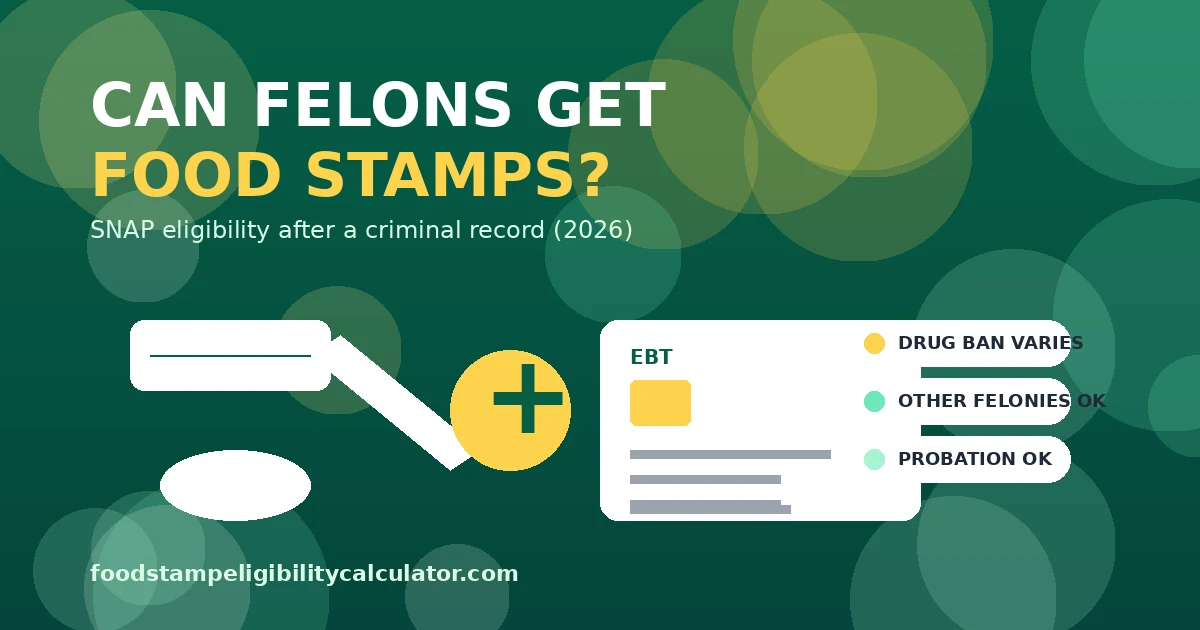
Walking out of prison with a felony on your record limits where you can live. It limits what jobs you can apply for. It limits how landlords will screen you. The last thing you need is to be told you also can't feed yourself.
The good news, in most cases, is that a felony conviction does not automatically disqualify you from the Supplemental Nutrition Assistance Program. The bad news is that one specific kind of felony — a drug-related offense — still carries a federal ban that a small number of states have not lifted.
This guide walks through what the rule actually says, which states still enforce it, how other types of felonies are treated, and what to expect if you apply for SNAP after release.
We'll also cover probation and parole, the work requirements that catch people off guard, and the steps that get an application approved fastest. If you have a record and you're trying to figure out whether food assistance is on the table, this is the article for you.
Table of Contents
- 1The Short Answer: Most People with a Felony Can Get SNAP
- 2The 1996 Federal Drug Felon Ban — What It Actually Says
- 3State-by-State: Where Drug Felons Are Still Barred
- 4Other Felony Convictions Don't Affect SNAP
- 5Probation, Parole, and SNAP: What to Know
- 6Work Requirements for People with Records
- 7Your Income Matters More Than Your Record
- 8Applying for SNAP After Release: Step-by-Step
- 9Common Mistakes That Delay Approval
- 10SNAP While Reentering Society — Why It Matters
- 11What If Your Application Is Denied?
- 12Frequently Asked Questions
The Short Answer: Most People with a Felony Can Get SNAP
Here's the quick version. If your felony was for a violent crime, a property crime, or a white-collar offense, your conviction does not affect SNAP. The same is true for any felony that did not involve drugs.
You apply like anyone else. You get approved based on your income, your household size, and the standard eligibility rules. Your record is not on the application. Your caseworker is not going to ask about it.
If your felony was for a drug-related offense — possession with intent to distribute, trafficking, manufacture, or similar — there's a federal law from 1996 that says you are barred from SNAP for life. But that law, written into the Personal Responsibility and Work Opportunity Reconciliation Act, includes a clause that lets individual states opt out of the ban or modify it.
Most states have done one or the other. As of 2026, only one or two states still enforce something close to a lifetime ban, and even those have wiggle room depending on the offense and whether you completed treatment.
The 1996 Federal Drug Felon Ban — What It Actually Says
In 1996, Congress passed a sweeping welfare reform law. It included a section that barred anyone with a drug felony from getting SNAP benefits. The provision is at 21 U.S.C. 862a. It was originally written as a permanent, lifetime ban with no exceptions. If you had a drug felony on your record, you were out — for life, no matter how long ago the conviction was, no matter what you had done since.
Almost immediately, states pushed back. The law included an escape hatch. States could opt out of the ban entirely. Or they could modify it with their own conditions. By the early 2000s, a majority of states had taken some form of opt-out.
Today, the federal ban is mostly a paper tiger — it sits on the books, but most states have passed their own laws saying they don't enforce it. A handful still do, and that's where the confusion comes from.
State-by-State: Where Drug Felons Are Still Barred
The state-by-state landscape changes year to year, but the general pattern is stable. Roughly forty states and the District of Columbia have either lifted the ban entirely or modified it so that most people with drug felonies can qualify.
The remaining states enforce some version of the ban with conditions — usually requiring completion of a substance abuse program, parole or probation compliance, or a clean record for a specified period.
Modified-ban states grant SNAP if you meet one of several conditions. You may need to complete a court-ordered treatment program. Or you may need to be in one now. Compliance with probation or parole can also qualify you.
Some states let possession felonies through but not trafficking ones. Some states apply the ban only to trafficking convictions and let people with possession felonies through. A few states still apply the ban more broadly but allow waivers on a case-by-case basis.
Because the rules shift — legislatures pass new opt-out bills almost every session — the safest move is to check your state's SNAP rules before you apply.
Your local SNAP office, the state's online eligibility portal, or a legal aid lawyer can confirm whether the ban is still in effect where you live and what the conditions are. Don't assume the worst based on something you heard from a cellmate or saw on a forum. The rules in your state may have changed last year.
Other Felony Convictions Don't Affect SNAP
This is the part that surprises people. A conviction for assault, robbery, burglary, fraud, theft, weapons charges, or sex offenses has zero impact on SNAP. The same is true for any other non-drug felony. No federal law bars people with violent felony convictions from food assistance.
No state law does it either. The program looks at your income, your resources, your household size, and a few other eligibility factors. It does not look at your criminal record, except for the narrow drug-felon exception.
That means if you're reentering society after serving time for a non-drug felony, you walk into the SNAP office on the same footing as everyone else. You fill out the same application. You bring the same documents. You go through the same interview. The caseworker doesn't pull your rap sheet. They don't ask about your conviction. They don't hold it against you, because the rules don't let them.
This matters because a lot of people with records assume they're barred from every government program and never apply. They go hungry, or they lean on family members who are already stretched thin, or they end up in situations that increase the risk of going back inside.
SNAP is one of the few federal benefits that doesn't punish you for the underlying felony. If you're eligible based on income, you should be getting it.
Probation, Parole, and SNAP: What to Know
Being on probation or parole does not disqualify you from SNAP. No federal rule says you have to be off paper first. No state rule says it either. You can apply the day you're released, while you're on intensive supervision, while you're wearing an ankle monitor, while you're living in a halfway house. The conditions of your supervision are separate from your eligibility for food assistance.
Where probation and parole do come into play is in the documentation you bring to the SNAP interview. Your release paperwork and supervision agreement can prove who you are. A letter from your probation officer can prove your address.
Together, they cover what the caseworker needs. If you're in a halfway house or a residential treatment program, the staff there can usually write a letter confirming your residence. That letter, combined with a photo ID, is often enough to satisfy the address requirement.
One thing to watch: some probation conditions require you to report any government benefit you receive. SNAP counts. Tell your probation officer you've applied, give them the documentation if they ask, and move on.
It's not a violation. It's not a red flag. It's a routine part of reentry that the probation office sees every day. If your P.O. gives you a hard time, ask a reentry service provider or your local legal aid office to help you push back.
Work Requirements for People with Records
SNAP has a work requirement that catches a lot of people with records off guard. The rule is called ABAWD. It applies to adults age 18 through 54. To qualify, you must not have dependents. You must not have a disability.
If you fall into that group, you're limited to three months of SNAP in a three-year period. You can avoid the limit by working 20 hours a week. Or you can be in a qualifying training program. A combination of work and training also counts.
The work requirement doesn't care about your felony. It applies the same way to everyone in the ABAWD age range. But people with records often have a harder time meeting it, because employers are slower to hire them and because they may have gaps in work history that disqualify them from certain training programs. If you're going to hit the three-month limit, you need to know in advance.
There are exemptions. If you're physically or mentally unable to work, if you're pregnant, if you're caring for an incapacitated person, or if you live in an area that's been waived from the requirement because of high unemployment, the three-month clock doesn't run.
Some states also offer qualifying work slots through their reentry programs that count toward the 20-hour requirement. Read up on the ABAWD work requirements before you apply, so you know whether you're subject to the limit and what counts as compliance.
Your Income Matters More Than Your Record
For the vast majority of applicants with a felony, eligibility comes down to income, not the conviction. SNAP has two income tests. One is for gross monthly income. The other is for net income. Both are based on household size.
The gross income limit is 130 percent of the federal poverty level. The net income limit is 100 percent. Most households must meet both. Households with a senior or a person with disabilities only have to meet the net income test.
If you're recently released and you're working a low-wage job, you'll likely qualify. If you're between jobs, you'll likely qualify. If you've just started a new job that pays above the limit, you may not — but you should check the current numbers, because the SNAP income limits are adjusted every October and a small raise can push you over or pull you under the line.
Resources matter too, but only in states that still run an asset test. Most states have eliminated the test under Broad-Based Categorical Eligibility, so your bank account balance and your car value don't count against you.
In the states that still apply the test, the limit is $3,000 for most households and $4,500 for households with a senior or disabled member. Your felony doesn't change these numbers. Read up on what counts as a SNAP asset if you're in a non-BBCE state.
Applying for SNAP After Release: Step-by-Step
The application process is the same with or without a record. The five steps below walk you through what to do, in order, so you can move from release day to your first EBT swipe without wasted weeks.
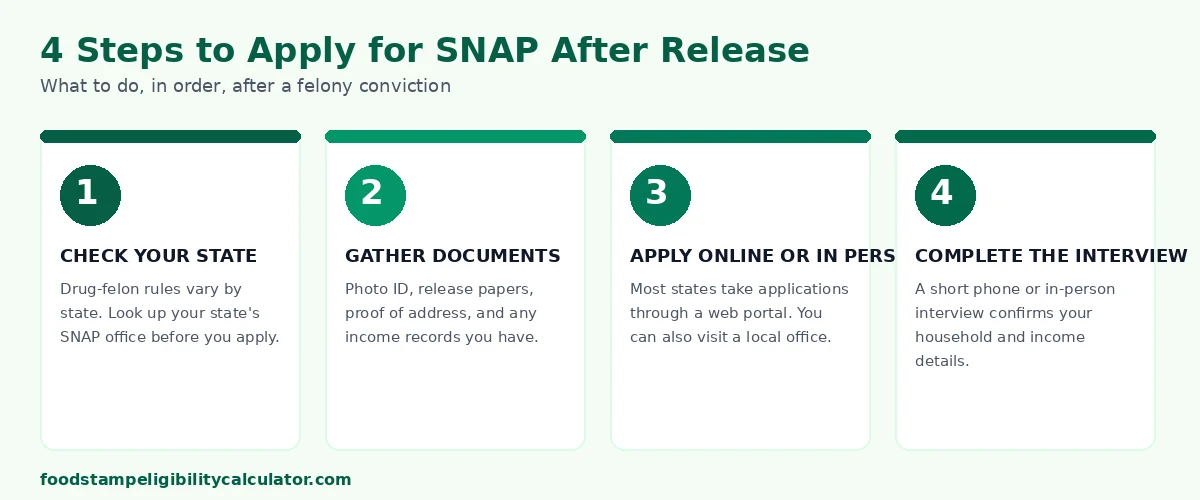
1. Find out your state's drug-felon rule.
If your felony was drug-related, check whether your state lifts, modifies, or enforces the ban. Your state's SNAP office website is the authoritative source. If you can't find the answer, call the office and ask — they answer this question every day.
2. Gather your documents.
You'll need a photo ID, your Social Security number, proof of address (a lease, a shelter letter, a utility bill, or a letter from your halfway house), and proof of any income you have. If you have no income, write a short statement saying so. If your felony was drug-related and you completed treatment, bring the completion certificate.
3. Apply online or in person.
Most states accept online applications through a portal. You can also apply in person at the local office or by mailing a paper application. If you're homeless or don't have a fixed address, you can still apply — the SNAP office is required to take your application. Read our complete SNAP application guide for the details.
4. Complete the interview.
A caseworker will call you, or you'll be asked to come in. The interview is short — usually 15 to 20 minutes — and covers your household, your income, your expenses, and your living situation. Our SNAP interview guide walks through every question you'll be asked so you can walk in prepared.
5. Get your EBT card and start using benefits.
If approved, your card comes in the mail within a week or two. Benefits are loaded monthly. If you applied with no income and an urgent need, ask about expedited SNAP benefits, which can land within seven days of application.
Common Mistakes That Delay Approval
Most SNAP applications from people with records don't get denied. They get delayed. The delay is almost always because of paperwork that wasn't brought to the interview or a question that wasn't answered clearly. Here are the four most common mistakes and how to avoid them.
1. Not bringing proof of address.
If you're couch-surfing or in a halfway house, you may not have a lease. If you're staying with family, you may not have a utility bill in your name. A letter from the person you're staying with, on letterhead from a shelter, or from your halfway house will work. Bring it to the interview.
2. Forgetting to mention drug-felon status when it applies.
If your felony was drug-related and your state asks about it, hiding it doesn't help. The state has access to criminal records. Disclose, document the treatment you completed, and apply under the modified-ban rules if your state allows it.
3. Missing the interview call.
Caseworkers call from blocked numbers. If you miss the call, they'll try a couple more times and then close your application for non-cooperation. Answer unknown numbers during the application window, and call back immediately if you miss one.
4. Not reporting changes after approval.
Once you're approved, you must report certain changes within 10 days. A new job counts. A change in household size counts. An address change counts too. Failing to report can lead to an overpayment you'll have to pay back. Read up on the penalty rules so you don't get caught off guard.
SNAP While Reentering Society — Why It Matters
Hunger is one of the strongest predictors of reoffending. People who can't afford to eat are more likely to return to the survival economy that got them locked up in the first place.
Studies from the Bureau of Justice Statistics show a clear pattern. Access to public benefits in the first months after release lowers recidivism. Several state corrections departments have found the same thing. SNAP is one of those benefits.
The amount of money involved is modest. A single adult with no income gets about $291 a month in 2026. That works out to about $9.50 a day for food.
That's not enough to live comfortably, but it's enough to keep a person from having to choose between shoplifting a sandwich and going hungry. It buys rice, beans, eggs, frozen vegetables, peanut butter, bread — the building blocks of a survivable diet while you look for work.
SNAP unlocks other things too. With an EBT card, you can get discounted phone service through Lifeline. Some states offer reduced utility bills through LIHEAP. Many cities offer transit discounts too. If you have a veteran discharge on top of a felony or a recent job loss, the SNAP card can be the front door to a stack of other programs.
What If Your Application Is Denied?
If your application is denied and you believe the denial is wrong, you have the right to appeal. The denial letter tells you the reason. It also tells you the deadline. You usually have 90 days from the date of the letter.
File the appeal in writing, by fax, online, or in person at the SNAP office. You don't need a lawyer, but having one helps. Legal aid societies in most states handle SNAP appeals for free.
Wrongful denials happen in several common ways. The caseworker may apply the federal ban when the state has opted out. They may apply the ban to a non-drug felony. They may deny the whole household when only one member is barred. Or they may treat a sealed conviction as still active. All of those are appealable. Read our guide on how to appeal a SNAP denial before you file.
One more thing. If you're denied and the denial is upheld on appeal, you can reapply when your circumstances change. A new job can reopen the door. A change in household size can too. Completing a treatment program helps. A successful expungement helps as well. SNAP eligibility is not a one-shot decision. It's a snapshot of your situation at the time you apply.