Life changes fast. You get a raise at work, a roommate moves out, your hours get cut, or you start receiving child support you didn't expect. When you're receiving SNAP benefits, most of these changes are supposed to be reported to your caseworker — and failing to do so can lead to serious consequences.
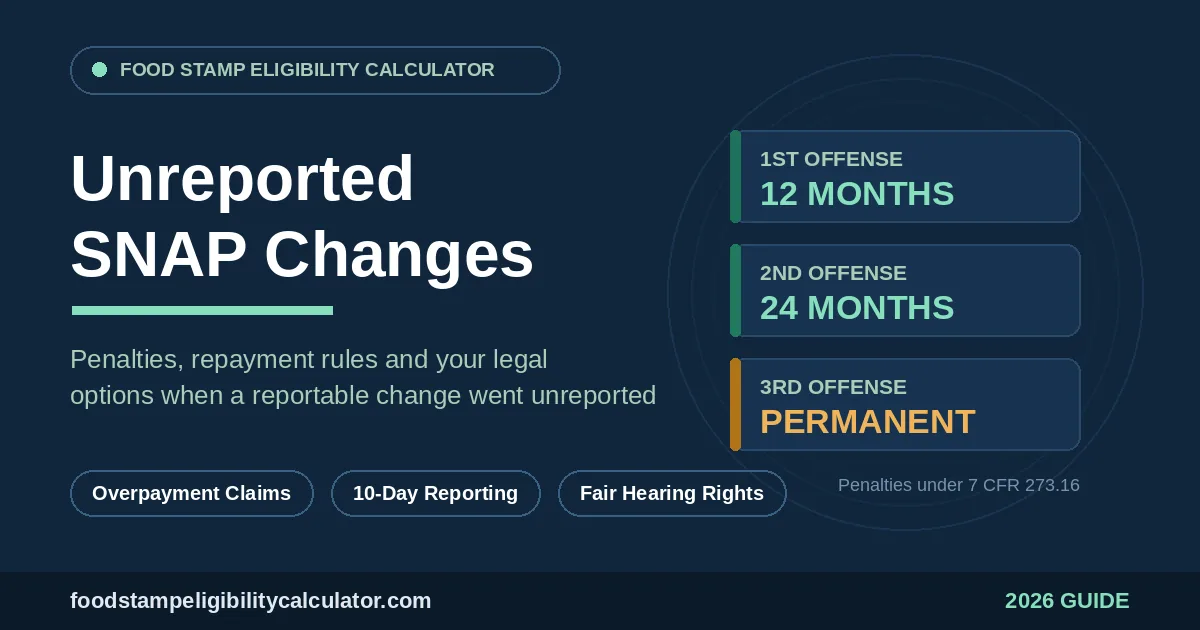
What happens if you don't report a change to SNAP? An honest mistake usually ends in an overpayment bill, not jail. Repay it through a small monthly reduction or a payment plan and your case stays administrative. Hide a change on purpose, though, and SNAP can disqualify you for 12 months, 24 months, or permanently.
But here's the thing: the SNAP reporting system is confusing, the rules vary by state, and honest mistakes happen all the time. Understanding what happens when changes go unreported, what the penalties look like, and how to fix things if you've made a mistake is critical for anyone receiving food assistance.
Whether you missed a deadline, received an overpayment notice, or simply worry about what comes next, this guide walks through it in plain terms. You will know exactly where you stand and what your options are.
Table of Contents
- 1What Changes Must Be Reported to SNAP?
- 2The 10-Day Reporting Deadline
- 3SNAP Overpayment: What It Is and How It Happens
- 4Repayment: How SNAP Recovers Overpayments
- 5How Far Back Can SNAP Go on an Overpayment?
- 6Disqualification Periods: The Escalating Penalty System
- 7Can You Go to Jail for Not Reporting Income to SNAP?
- 8Fraud vs. Honest Mistake: Why the Distinction Matters
- 9IPV Hearings: Your Right to Due Process
- 10How to Self-Report Late Changes
- 11Negotiating a Repayment Plan
- 12Protecting Yourself Going Forward
- 13Frequently Asked Questions
- 14Related SNAP Guides
What Changes Must Be Reported to SNAP?
Before we talk about penalties, let's make sure we're clear on what you actually need to report. The reporting requirements depend on your state and whether or not your case uses traditional reporting or simplified reporting. Most SNAP households are now on simplified reporting, which means you only need to report certain changes between recertification periods.
Changes You Must Report (All States)
Regardless of your reporting type, some changes must always be reported:
- Income changes: If your household's gross income crosses 130% of the federal poverty level for your household size, you must report it even on simplified reporting. For a household of two in FY2026, that threshold is $2,292 per month.
- Household composition changes: Anyone moving in or out of your household who buys and prepares food with you should be reported.
- Address changes: You need to update your address so your benefits and correspondence go to the right spot.
- Lump sums and windfalls: Lottery or gambling winnings, an inheritance, or a retroactive payment usually must be reported quickly.
- Deduction changes: A jump in rent, utilities, or child care costs can raise your benefit, so reporting them works in your favor.
- Work requirement changes: If you're an Able-Bodied Adult Without Dependents (ABAWD) and your work hours drop below 20 hours per week, you must report this.
Changes to Report Under Traditional Reporting
If your state uses traditional reporting, you need to report virtually everything that touches your case. That includes income changes, job changes, shelter costs, new benefits like unemployment or Social Security, and resource changes such as bank accounts or vehicles. Check with your local office if you're unsure which system your case uses.
The 10-Day Reporting Deadline
When a reportable change occurs, you generally have 10 calendar days from the date the change happened to report it to your SNAP office. This timeline applies in most states, though some states may have slightly different windows.
The 10-day period starts when the change occurs, not when you find out about it — although caseworkers often have some discretion when there's a reasonable explanation for a delay.
There are several ways to report changes:
- Calling your local SNAP office
- Submitting a change report form online through your state's benefits portal
- Mailing or faxing a written change report
- Visiting your local office in person
Always keep a record of when and how you reported any change. If you call, note the date, time, and the name of the person you spoke with. If you submit online, save a screenshot or confirmation email.
This documentation can be invaluable if there's ever a dispute about whether you reported on time. For more on keeping your case current, see our SNAP recertification guide.
How Reporting Rules Differ by State
The 10-day rule is the federal baseline, but states run their own reporting systems on top of it. Some check in twice a year, others only when your income climbs past a limit. Knowing which system your case uses tells you exactly when a missed report becomes a real problem.
| State | How Reporting Works | Key Deadline |
|---|---|---|
| Most states | Change reporting — you report qualifying changes when they happen | Within 10 days of the change |
| Ohio | Change reporting under state rule 5101:4-7; ABAWD households also report when hours drop below 20 a week | 10 days from the change |
| California | Semi-annual SAR 7 report; mid-period you only report when income crosses your IRT (130% of poverty) | Within 10 days of crossing the IRT |
| Texas | Report the month after a change hits, through YourTexasBenefits or by phone | By the 10th day of the following month |
| New York | Six-month reporting households skip most mid-period reports entirely | Report only when gross income tops the limit |
Simplified-reporting cases share one federal trigger: gross income above 130% of the poverty level. In FY2026 that line sits at $1,696 a month for one person and $2,292 for two. Our SNAP gross income test guide lists every household size.
SNAP Overpayment: What It Is and How It Happens
An overpayment means you received more SNAP benefits than you were entitled to based on your actual circumstances. Overpayments can happen for several reasons:
- You didn't report an increase in income on time
- A household member moved out and you didn't report the change
- You received benefits based on incorrect information (even if it was the agency's mistake)
- You started receiving other benefits that affect your SNAP calculation
How Overpayment Is Calculated
When the SNAP office determines you've been overpaid, they go back and recalculate what your benefits should have been for each month you received the incorrect amount. The difference between what you received and what you should have received is the overpayment total.
For example, say you started a job in March that paid $800 more per month, and you reported it in June. The agency recalculates March, April, and May using the higher income. If your benefits should have been $200 less per month during that period, your total overpayment would be $600.

Agency Error Overpayments
Sometimes the SNAP office causes the mistake instead of you. Wrong income entries or a reported change that never got processed both count as an agency error.
You still have to repay the overpayment in most cases, but you won't face disqualification or fraud charges for an agency error. You also have stronger appeal rights for agency error overpayments.
Repayment: How SNAP Recovers Overpayments
If you've been overpaid, the SNAP office will attempt to recover the funds. There are several ways this can happen:
Recoupment from Current Benefits
The most common method is benefit recoupment, where a portion of your current monthly SNAP benefit is withheld to repay the overpayment.
Federal law limits the amount that can be recouped — for unintentional overpayments, the maximum recoupment is 10% of your household's monthly allotment or $10 per month, whichever is greater. For intentional program violations (more on that below), the recoupment rate can be up to 20% or $20 per month, whichever is greater. Both caps come from the federal claim rules at 7 CFR 273.18(g).
Say you receive $250 per month with an unintentional overpayment. The most that can be withheld is $25 — 10% of $250 — leaving you $225 while the debt gets repaid.
Each claim type carries its own repayment ceiling under federal rules:
| Claim Type | What It Means | Monthly Withholding Cap |
|---|---|---|
| Agency error (AE) | The office made the mistake — no disqualification applies | Greater of $10 or 10%, only with your agreement |
| Household error (IHE) | An honest mistake — missed deadline, misunderstood question, math slip | Greater of $10 or 10% of your allotment |
| IPV claim | Knowingly broke the rules — false statements or hidden income | Greater of $20 or 20% of your allotment |
Lump-Sum Repayment
If you're no longer receiving SNAP benefits, the agency may request a lump-sum repayment. They'll send you a notice demanding payment and may work with you to set up a repayment plan.
If you can't afford to repay the full amount, contact your SNAP office to negotiate a payment schedule. Most agencies are willing to work with you as long as you're making a good-faith effort to repay.
Treasury Offset Program
In more serious cases, the agency may refer your overpayment to the federal Treasury Offset Program. TOP can intercept your federal tax refunds, some federal wages, and certain other federal payments until the debt clears.
Federal rules let states skip claims of $125 or less while a household still participates, so most tracked debts start above that line. Delinquent claims get handed to Treasury for offset, and many states also withhold state tax refunds. An old SNAP balance can resurface during tax season.
How Far Back Can SNAP Go on an Overpayment?
Federal claim rules limit how far a recalculation can reach. For ordinary household or agency errors, the agency must look back at least 12 months before it discovered the mistake. Intentional violations get traced to the very first month the act occurred.
Nothing older than six years can be counted toward the claim, whatever the error type. That six-year ceiling comes from 7 CFR 273.18 and caps the math even in fraud cases.
Collection itself can drag longer. Claims delinquent for three years are usually written off unless Treasury keeps pursuing them. States may also compromise a debt when your finances clearly cannot cover it within three years.
Disqualification Periods: The Escalating Penalty System
If the SNAP office determines that you intentionally provided false information or withheld information to get benefits you weren't entitled to, you can face disqualification from the program. The penalties escalate with each offense:
First Offense: 1-Year Disqualification
A first-time Intentional Program Violation (IPV) results in disqualification from SNAP for 12 months. During this period, your entire household doesn't lose benefits — only the person who committed the violation is removed from the benefit calculation.
The household's benefit amount is recalculated without the disqualified member, which typically reduces the benefit but doesn't eliminate it entirely.
Second Offense: 2-Year Disqualification
A second IPV results in a 24-month disqualification. The same recalculation process applies — the disqualified member is removed from the household calculation but the rest of the household can still receive benefits.
Third Offense: Permanent Disqualification
A third IPV means permanent disqualification from SNAP. This is the most severe administrative penalty and effectively bars you from ever receiving SNAP benefits again. There are very limited circumstances under which a permanent disqualification can be reversed, typically involving significant new evidence or procedural errors in the original hearings.
Additional Criminal Penalties
In addition to administrative disqualification, intentional SNAP fraud can result in criminal prosecution. Depending on the amount involved and state law, criminal penalties can include fines, probation, and even jail time.
Most criminal prosecutions involve large-scale fraud or organized schemes rather than individual recipients who made poor decisions, but the possibility exists and should be taken seriously.
Federal prosecutors can charge benefit trafficking under 7 USC 2024(b). Cases involving $5,000 or more carry fines up to $250,000 and prison terms up to 20 years. Smaller amounts fall into lower tiers, but even a minor conviction leaves a permanent record.
Can You Go to Jail for Not Reporting Income to SNAP?
For an honest reporting mistake, no — jail is not on the table. Overpayments caused by confusion, missed deadlines, or paperwork slips are civil debts, not crimes. The agency gets repaid and the case stays administrative.
Criminal cases require intent. Prosecutors must prove you knowingly lied on an application, hid income on purpose, or traded benefits for cash. Honest people who report late almost never reach that stage.
The realistic worst case for a missed change is an overpayment claim, or in rare disputed cases an IPV hearing. Attend the hearing, bring your documents, and tell your story. That process exists to separate honest mistakes from deliberate fraud.
Fraud vs. Honest Mistake: Why the Distinction Matters
This is perhaps the most important distinction in SNAP enforcement. The penalties for an honest mistake are vastly different from the penalties for intentional fraud, and understanding the difference helps you protect yourself.
What Counts as an Intentional Program Violation (IPV)
An IPV means you knowingly and willfully made a false statement or misrepresented your situation to get benefits. Examples include reporting lower income than you actually receive, claiming children who don't live with you, or hiding a working household member. Using someone else's identity to apply for benefits counts too.
What Counts as an Inadvertent Household Error (IHE)
An IHE means you provided incorrect information but didn't intend to defraud the program. This might include misunderstanding a question on the application, forgetting to report a change within the deadline, or making an honest math error when reporting your income. IHEs result in overpayment but don't result in disqualification.
The burden of proving an IPV falls on the SNAP agency. They must demonstrate that you intentionally provided false information or deliberately concealed facts.
If you made a genuine mistake, you should explain this clearly and provide any supporting documentation. A caseworker may still establish an overpayment, but you shouldn't face disqualification for an honest error.
IPV Hearings: Your Right to Due Process
If the SNAP office accuses you of an intentional program violation, you have the right to an administrative hearing before any disqualification is imposed. This is a critical protection, and you should take it seriously. Here's what to expect:
- Written notice: You'll receive a written notice explaining the alleged violation and the proposed penalty.
- Opportunity to respond: You can request a hearing, usually within 90 days of the notice. If you don't request a hearing, the disqualification will be imposed by default.
- Hearing process: At the hearing, you can present evidence, call witnesses, and question the agency's evidence. you have the right to be represented by an attorney or other representative, and many legal aid organizations provide free representation for SNAP hearings.
- Decision: The hearing officer will issue a written decision. If you disagree with the outcome, you may have the right to appeal to state court.
Even if you believe you made a mistake, attend the hearing. Explaining your side can get the violation reclassified from an IPV to an IHE, which means no disqualification at all. For more on the appeals process, see our detailed appeal guide.
How to Self-Report Late Changes
If you realize you've missed a reporting deadline, the best thing you can do is self-report the change immediately. Self-reporting a late change looks far better than having the agency discover it through their own investigation. Here's how to handle it:
First, contact your SNAP office and explain the situation honestly. Tell them what change occurred, when it happened, and why you didn't report it on time. Common legitimate reasons include not understanding the reporting requirements, being in the hospital, dealing with a family emergency, or simply forgetting in the chaos of daily life.
Second, provide any documentation that supports your explanation. If you were hospitalized, bring medical records. If you were dealing with a family crisis, explain the situation.
The more context you provide, the more likely the caseworker is to treat the situation as an inadvertent error rather than intentional concealment.
Third, be prepared for a benefit adjustment. You may have received an overpayment that will need to be repaid, but self-reporting greatly reduces the risk of disqualification or fraud accusations. In many cases, self-reporting before the agency discovers the issue can mean the difference between a simple overpayment recoupment and a full IPV investigation.
Negotiating a Repayment Plan
If you've received an overpayment determination, you've options for managing the repayment. Here's how to approach it:
- Verify the amount is correct. Request a detailed breakdown of how the agency calculated each month's overpayment, then check the math yourself. Calculation errors happen more often than you'd expect.
- Request a compromise settlement. Federal rules let states compromise a claim when your finances make repayment unrealistic. It never hurts to ask for this option in writing.
- Set up an affordable plan. Most agencies accept small, consistent payments instead of a lump sum. Agree only to a schedule you can genuinely sustain.
- Know your recoupment caps. Withholding from an active benefit is capped at $10 or 10% for honest errors. If more comes out, contact a legal aid office right away.
Protecting Yourself Going Forward
The best way to avoid overpayment problems is to stay on top of your reporting obligations. Here are some practical tips:
- Keep a benefits folder: Store all SNAP correspondence, pay stubs, change reports, and notes from phone calls in one place.
- Set calendar reminders: When you start a new job, get a raise, or experience any reportable change, set a reminder to report it within 10 days.
- Report in writing when possible: Written reports create a paper trail that protects you if there's ever a dispute about when or what you reported.
- Attend all recertification appointments: Recertification is when your entire case is reviewed, and it's your best opportunity to make sure everything is accurate and up to date.
- Ask questions: If you're not sure whether something needs to be reported, ask your caseworker. There's no penalty for asking, and it could save you from an overpayment down the line.
Check our SNAP income limits guide to understand the thresholds for your household size, and review the recertification process so you're never caught off guard.
Frequently Asked Questions
What happens if I accidentally forgot to report a change to SNAP?
If you unintentionally failed to report a change, it's typically classified as an Inadvertent Household Error (IHE), not fraud. You'll likely need to repay any overpayment through benefit recoupment (usually 10% of your monthly benefit), but you won't face disqualification.
Self-report the change as soon as you realize the mistake — this shows good faith and reduces the chance of the agency treating it as intentional.
Can I go to jail for not reporting changes to SNAP?
Criminal prosecution for individual SNAP recipients is rare and typically reserved for large-scale, organized fraud schemes. However, it's legally possible in cases of significant intentional fraud.
Most unreported changes result in administrative penalties like overpayment recoupment and disqualification rather than criminal charges. If you're facing criminal charges, contact a criminal defense attorney immediately.
How long does SNAP have to collect an overpayment?
Federal rules cap the claim math at six years of overpaid benefits. Collection can stretch past that: claims delinquent for three years are usually written off unless the state keeps chasing them through the Treasury Offset Program. Responding to a claim notice beats waiting it out.
Can I still get SNAP benefits while I'm repaying an overpayment?
Yes. If you're currently eligible for SNAP, you can receive benefits even while repaying an overpayment. The agency will recoup a portion of your monthly benefit (up to 10% for unintentional overpayments or 20% for IPVs), but you'll still receive the remaining balance.
Being disqualified is different from having an overpayment — disqualification means you can't receive benefits at all for a specified period.
Will I go to jail for a first-time SNAP reporting mistake?
Almost certainly not. First mistakes are handled as inadvertent household errors — you repay any overpayment, usually through a small monthly reduction. Jail exposure exists only in intentional fraud cases that prosecutors actually pursue.
How far back can SNAP verify my income?
Caseworkers routinely review pay stubs, employer records, and bank statements when a claim is established. A claim calculation must reach at least 12 months back, and nothing older than six years can be included. Our SNAP bank statement verification guide explains what to expect.
Do I have to repay SNAP if the agency made the mistake?
Usually yes, but the terms are softer. Agency error overpayments are still federal debts, yet disqualification is off the table and involuntary withholding is capped at $10 or 10% of your monthly benefit. You also keep stronger appeal rights.
How many days do I have to report a change to food stamps?
In most states you have 10 calendar days from the date the change happens. Simplified-reporting households in states like California only report mid-period when income crosses the 130% poverty threshold, while Texas households report by the 10th day of the following month.
Related SNAP Guides
These guides cover the pieces of the puzzle this article touches most often:
- SNAP overpayment notice explained — types, amounts, and your four response options
- SNAP fair hearing process — challenge any caseworker decision on the record
- SNAP gross income test — how the 130% FPL gate decides who qualifies
- SNAP bank statements verification — what caseworkers look for and why
- SNAP work requirements 2026 — the 80-hour rule, time limits, and exemptions
- SNAP recertification guide — keeping your case current between reviews
- SNAP income limits — the full FY2026 breakdown for every household size
- How to apply for SNAP benefits in your state
- View All Articles →