The SNAP benefit formula is the same in every state, but it can feel like a black box. You tell the caseworker your income, you tell them your rent, and a few weeks later a number shows up on your EBT card. Sometimes that number is exactly what you expected.
Sometimes it is way off, and you have no idea why. This guide breaks the formula open so you can estimate your own benefit before you apply, and so you can spot a short deposit if your caseworker makes a mistake.
We are not going to drown you in regulation citations. We are going to walk through the four-step formula in plain English, run a real worked example with real 2026 numbers, and show you the deductions that move the needle most.
If you want to skip the math entirely, you can use our free SNAP eligibility calculator on the homepage and get an answer in about 90 seconds. The rest of this guide explains what that calculator is doing under the hood.
Table of Contents
- 1The SNAP Benefit Formula in 4 Steps
- 2Worked Example: Family of 3 Earning $2,400 a Month
- 3The 7 Deductions That Lower Your Countable Income
- 4What Counts as Income for the SNAP Calculator
- 5How Household Size Affects Your Calculation
- 6State-By-State Differences That Affect Your Estimate
- 7Common Calculator Mistakes That Throw Off Your Estimate
- 8How to Verify Your Benefit After Approval
- 9Special Situations That Change the Math
- 10What to Do If Your Benefit Comes Back Lower Than the Calculator Says
- 11Frequently Asked Questions
- 12Wasim Akram
The SNAP Benefit Formula in 4 Steps
The SNAP benefit formula has four steps, and they always run in the same order. Skipping a step or doing them out of order is the most common reason people mis-estimate their benefit. Once you understand the sequence, you can run the math yourself in about two minutes with a calculator and a pay stub.
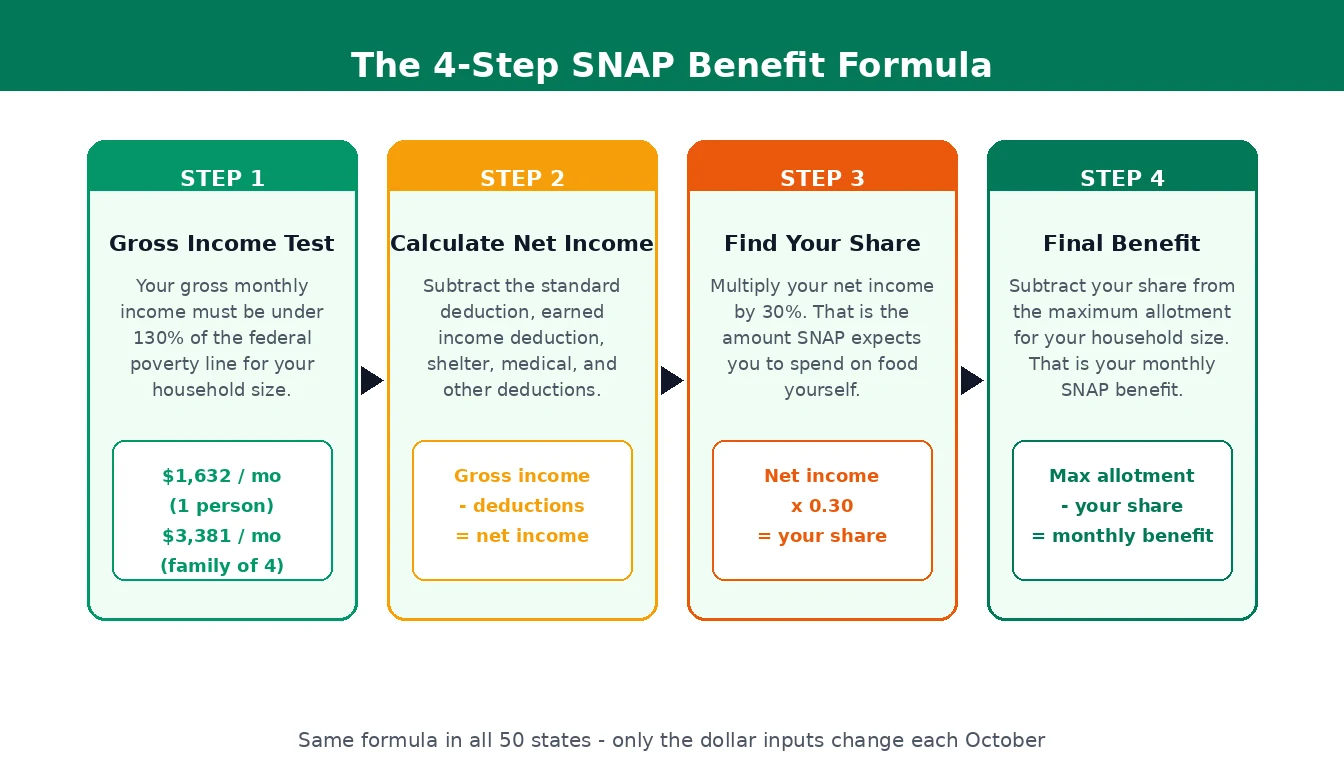
Step one is the gross income test. Your gross monthly income must be under 130 percent of the federal poverty line for your household size. For a single person in fiscal year 2026, that cutoff is $1,696 per month.
For a family of four, it is $3,483 per month. If your gross income is above the cutoff, you do not pass go, and your benefit is zero, unless your state uses BBCE to lift the limit to 200 percent of poverty. Most states do.
Step two is calculating your net income. You start with your gross income and subtract every deduction you qualify for.
The standard deduction is automatic, the earned income deduction is 20 percent of your wages, and then come the shelter, medical, dependent care, and child support deductions. Your net income is what is left after all those subtractions. We list every deduction in detail further down this page.
Step three is finding your share. SNAP expects you to spend 30 percent of your net income on food yourself. So you multiply your net income by 0.30. That number is your expected food contribution. If your net income is $1,000, your share is $300. If your net income is $500, your share is $150. The lower your net income, the lower your share, and the more SNAP kicks in.
Step four is the final subtraction. Take the maximum allotment for your household size, subtract your 30 percent share, and the result is your monthly SNAP benefit. If your share is bigger than the maximum allotment, your benefit is zero.
The formula never produces a negative number. If you want the full chart of maximum allotments for every household size from one to eight, our SNAP income limits reference page has them side by side with the income limits.
Worked Example: Family of 3 Earning $2,400 a Month
Let us run the formula with real numbers. Take a family of three in a mid-cost state. The household has one working adult earning $2,400 gross per month, pays $1,200 in rent, and uses the standard utility allowance of $556. We will walk through every step and end up with a specific dollar benefit.
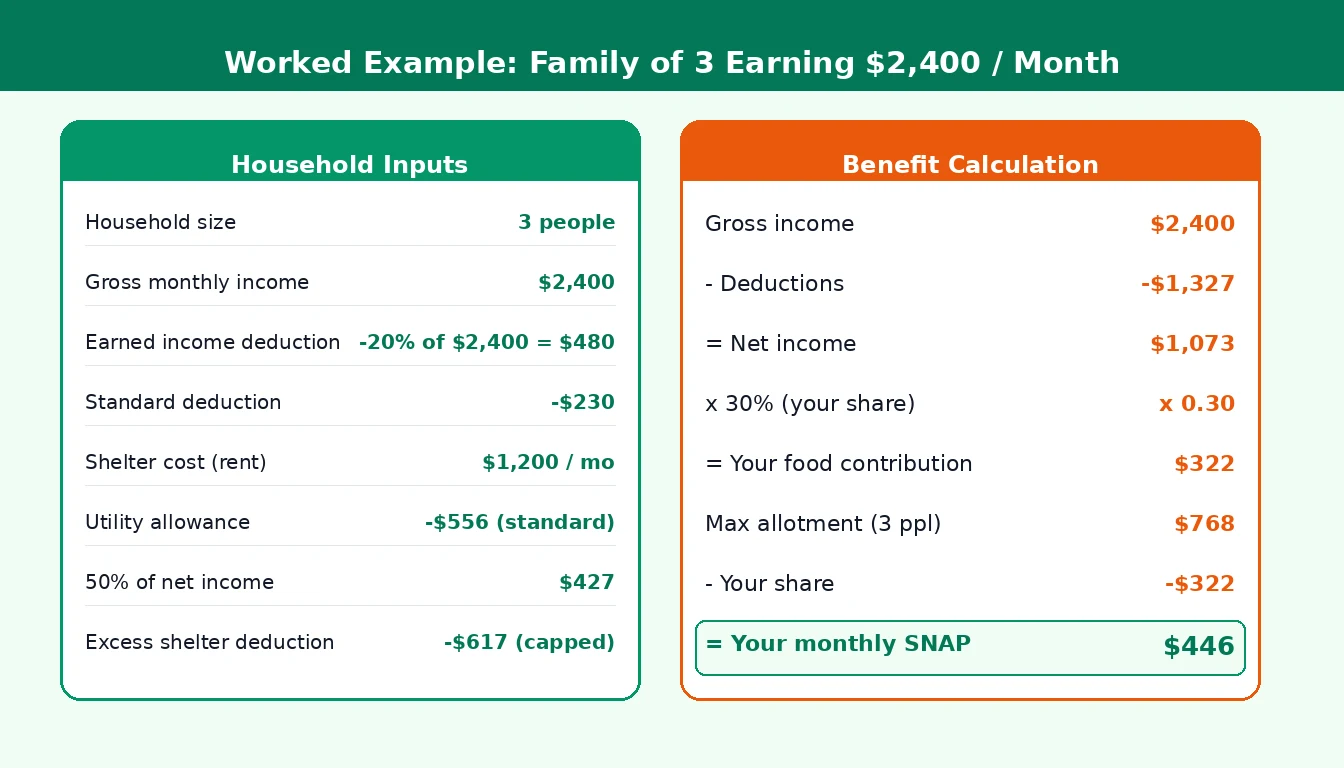
Step one: gross income test. Gross income is $2,400. The 2026 gross income limit for a household of three is $2,797 per month, so the household passes. If your state has BBCE, the limit jumps to 200 percent of poverty, which is $4,304 for a family of three, so you would pass with even more breathing room. Either way, this household clears the first hurdle.
Step two: net income. Start with $2,400. Subtract the 20 percent earned income deduction of $480, leaving $1,920. Subtract the standard deduction of $230 for a household of three, leaving $1,690. Now calculate the excess shelter deduction. Your shelter costs are rent $1,200 plus utility allowance $556, totaling $1,756.
Half of your countable income after the standard deduction is $845. Your excess shelter is $1,756 minus $845, which is $911, but the cap is $712 for households without an elderly or disabled member, so you can only deduct $712. Your net income is $1,690 minus $712, which is $978.
Step three: your 30 percent share. Multiply $978 by 0.30 to get $293. That is the amount SNAP expects you to spend on food out of your own pocket. Step four: maximum allotment minus your share. The 2026 maximum allotment for a family of three is $768 per month. Subtract your $293 share and you get $475. Round down to the nearest dollar and your monthly SNAP benefit is $475.
This is exactly what our calculator does. Plug the same numbers into the homepage tool and you will see the same answer, give or take a dollar depending on rounding. If your real benefit comes back much lower than this, something is off and you should call your caseworker.
The 7 Deductions That Lower Your Countable Income
Deductions are where most of the magic happens in the SNAP formula. Every dollar you can deduct from your gross income lowers your net income, which lowers your 30 percent share, which raises your benefit. Households that claim every deduction they qualify for can see benefits 30 to 50 percent higher than households that only claim the standard deduction.
The standard deduction is automatic and applies to every household. For fiscal year 2026 it is $230 per month for households of one to three people, with slightly different amounts for larger households.
You do not need to bring any paperwork for this one, your caseworker applies it automatically. If you want a deeper dive into how this deduction fits with the others, our SNAP deductions cheat sheet lists all seven with the paperwork you need for each.
The earned income deduction is 20 percent of your wages, salaries, and self-employment net income. If you earn $2,000 a month from a job, your earned income deduction is $400. This deduction exists to reward work and to keep the SNAP effective tax rate from being too punishing as your income rises.
The medical expense deduction is available only to households with someone age 60 or older or receiving disability benefits. Out-of-pocket medical costs over $35 per month are deductible, including Medicare premiums, prescriptions, dental work, eyeglasses, and transportation to medical appointments.
This is the single most under-claimed deduction in the entire SNAP program. Seniors who track their medical receipts often see their benefit jump by $50 to $170 per month. Our medical expense deduction guide walks through every qualifying expense.
The dependent care deduction covers what you pay for childcare so you can work, look for work, or attend school. Daycare, before-school programs, after-school programs, and summer day camps all count, up to $200 per month for children under age 2 and $175 per month for older dependents.
Bring your receipts or your daycare provider's invoice to your interview. If you want the full breakdown of what counts, our childcare costs deduction page has it.
The child support deduction covers legally obligated child support payments you make to someone outside your household. If you pay $300 a month in court-ordered child support, you can deduct $300 from your gross income.
The payment must be legally obligated, meaning a court order or formal agreement, not just informal cash you send your ex. Our SNAP and child support guide explains the documentation you need.
The excess shelter deduction is the big one for renters and homeowners. You can deduct shelter costs that exceed half of your countable net income, including rent, mortgage, property taxes, insurance, condo fees, and the standard utility allowance.
Households without an elderly or disabled member are capped at $712 per month for fiscal year 2026. Households with someone 60 or older or receiving disability benefits have no cap, which is why seniors in high-rent areas sometimes get the maximum allotment. Our SNAP and housing guide covers every type of shelter cost.
The utility allowance can be the standard allowance, which is a flat monthly amount based on your state's average utility costs, or the actual utility allowance, which requires you to submit 12 months of utility bills.
In most cases the standard allowance is higher and easier to claim. The standard allowance varies by state and county, ranging from about $300 in low-cost states to over $700 in cold-climate states.
What Counts as Income for the SNAP Calculator
The SNAP calculator starts with your gross income, which means income before any taxes or deductions. But not every dollar that comes into your household counts. Knowing exactly what to include is the difference between an accurate estimate and one that is off by a hundred dollars or more.
Money that counts includes wages and salaries from a job, self-employment net income after business expenses, unemployment benefits, Social Security retirement and disability benefits, veterans benefits, workers compensation, alimony you receive, pension and annuity payments, rental income, and cash payments from friends or family on a regular basis.
If you want the full list with line-by-line explanations, our gross versus net income guide covers every category.
Money that does not count includes federal SSI in many states, child support you receive for a child who lives outside your household, federal student aid like Pell grants, loans you have to repay, in-kind income like free rent from a friend, one-time reimbursements for expenses, and certain benefits for specific groups like some Native American households.
The list is long and the rules are detailed, so check the official USDA handbook if you are unsure about a specific income source.
Self-employment income is treated a little differently. You report your gross business revenue minus your business expenses, which gives you net self-employment income. That net number is what goes into the SNAP formula.
The 20 percent earned income deduction applies on top, so a self-employed person effectively gets a double deduction. Our SNAP for self-employed people guide walks through how to document business expenses and how the formula treats irregular income.
How Household Size Affects Your Calculation
Household size is one of the three biggest inputs in the SNAP formula, alongside gross income and shelter cost. A bigger household means a higher gross income limit, a higher maximum allotment, and usually a higher standard deduction. Getting your household size right is critical because reporting it wrong can swing your benefit by hundreds of dollars.
A SNAP household is everyone who lives together and shares food. Spouses who live together are always one household. Parents and children under 22 who live together are one household. Adult siblings over 22 who live together but buy and prepare food separately can be separate households. Roommates who do not share meals are separate households. The rule is about shared food, not shared walls.
If you have a child in joint custody, the child counts as a household member for the parent who provides more than half of the child's meals during the month. The other parent cannot also claim the child.
If custody is exactly 50/50, most states default to the parent who applies first or who claims the child on their taxes. Our joint custody and shared households guide walks through every scenario.
Elderly parents who live with you can be a separate SNAP household if they buy and prepare food separately, which can be advantageous if their income and medical expenses would otherwise drag down your household benefit.
Conversely, if they have high medical expenses and low income, including them in your household can boost your benefit through the uncapped shelter deduction and the medical expense deduction.
State-By-State Differences That Affect Your Estimate
The SNAP formula is federal, but three things vary by state and can affect your estimate. The first is the BBCE option, which lifts the gross income limit to 200 percent of poverty in most states.
About 40 states use BBCE, which means a single person can earn up to $2,506 per month and still pass the gross income test. The handful of states that have kept the strict 130 percent limit have a much tighter income cutoff.
The second is the standard utility allowance, which is set by each state based on average utility costs in that state. The allowance ranges from about $300 per month in mild-climate states like California to over $700 per month in cold-climate states like Maine and Minnesota.
A higher utility allowance means a bigger shelter deduction, which means a higher benefit. You cannot choose which state's allowance applies; it is set by the state where you live.
The third is whether your state still applies the asset test. Under BBCE, the asset test is waived, which means your savings account, retirement accounts, and vehicle value do not count.
In the few states that still apply the test, the limit is $3,000 for most households and $4,500 for households with an elderly member. If you live in one of those states, your savings could disqualify you even if your income is well under the limit.
If you want to see the specific rules in your state, our SNAP benefits by state page lists the BBCE status, asset test status, standard utility allowance, and average monthly benefit for all 50 states and DC. You can also check our state-by-state deposit schedule to find out which day of the month your benefit will load once approved.
Common Calculator Mistakes That Throw Off Your Estimate
Even with a perfect formula, people make the same handful of mistakes when running their own numbers. The first is forgetting the 20 percent earned income deduction. If you earn $2,000 a month, you do not put $2,000 into the formula. You put $1,600, because $400 comes off the top for the earned income deduction. This single mistake can drop your estimated benefit by $100 or more.
The second mistake is using net pay instead of gross pay. SNAP looks at gross income, meaning income before taxes, Social Security, Medicare, and any other payroll deductions.
If your paycheck shows $1,800 net but your gross is $2,400, you put $2,400 into the formula. The good news is that the 20 percent earned income deduction roughly cancels out payroll taxes, so the math usually works out close to net pay, but you must start with gross.
The third mistake is forgetting the standard utility allowance. Many people only count rent or mortgage as a shelter cost and skip utilities entirely. In most states, the standard utility allowance is $400 to $700 per month, and that can be the difference between a $200 benefit and a $400 benefit. Always claim the utility allowance, even if your actual utility bills are lower.
The fourth mistake is missing the medical expense deduction for seniors and disabled households. If you are 60 or older and you spend more than $35 a month out of pocket on medical costs, you should be claiming this deduction.
Medicare Part B premiums alone are about $185 a month, which would translate to roughly $55 more in monthly SNAP benefits. Our SNAP for seniors guide has a full breakdown of qualifying expenses.
The fifth mistake is forgetting to report income changes. SNAP is not a one-time calculation. If your income drops because you lose a job or your hours get cut, you should report it to your caseworker right away because your benefit should go up.
If your income rises and you do not report it, you may end up with an overpayment that the state will recover by cutting your future benefit by 10 percent or more. Our unreported changes penalties page explains the rules.
How to Verify Your Benefit After Approval
Once your case is approved, your state is required to send you an approval letter that lists your monthly benefit amount, your deposit day, and your certification period. Read that letter carefully. The benefit amount on the letter should match what the calculator estimated. If it does not, you have a right to know why.
The most common reason for a mismatch is that your caseworker used a different shelter cost or utility allowance than you entered in the calculator.
Compare the numbers on the approval letter to your actual rent and utility bills, and if the caseworker used a lower number, ask them to update it. SNAP rules require your caseworker to use your actual verified shelter costs unless you refused to provide documentation.
If your benefit is much lower than expected and the approval letter does not explain why, you have 90 days from the date of the decision to request a fair hearing to appeal. You do not need a lawyer for a fair hearing. You can bring your pay stubs, rent receipts, utility bills, and a printout of your calculator result, and the hearing officer will compare your numbers to the caseworker's numbers.
Once you are approved, your benefits will load on the same day every month unless your state moves the deposit for weekends or holidays. You can check your EBT balance online or through your state's mobile app, and you can see every transaction going back several months. If a deposit is missing or short, call the customer service number on the back of your card right away.
Special Situations That Change the Math
Several special situations change the standard formula. The first is having an elderly or disabled household member, which removes the cap on the shelter deduction and unlocks the medical expense deduction. If you have a parent over 60 living with you and paying high rent, your benefit can jump significantly just by including them in the household and claiming their medical expenses.
The second is being self-employed. Self-employment income is averaged over the year, which can work in your favor if your income is irregular. A contractor who earns $4,000 in one month and $0 in the next can average to $2,000 per month, which keeps them under the gross income limit both months.
If your income shifts month to month and you want to know how that affects your benefit, our guide to fluctuating income and SNAP walks through averaging, reporting changes, and what happens when your income spikes.
The third is having a side hustle on top of a W-2 job. Side hustle income counts, but only your net profit after business expenses, and the 20 percent earned income deduction still applies. Our SNAP and side hustle income guide walks through how to track and report gig economy income so it does not wreck your benefit.
The fourth is receiving unemployment benefits. Unemployment compensation counts as unearned income, which means it goes into the gross income calculation but does not get the 20 percent earned income deduction.
A household that loses a job and goes on unemployment may see their SNAP benefit drop because the income is treated less favorably than wages. Our SNAP and unemployment guide explains the math.
The fifth is having a child tax credit payment. The monthly child tax credit payments that some families receive do not count as income for SNAP, so they will not lower your benefit. They do count as a resource for the asset test in states that still apply it, but most states have BBCE and skip the asset test entirely. Our SNAP and child tax credit guide has the details.
What to Do If Your Benefit Comes Back Lower Than the Calculator Says
If your actual benefit is lower than what the calculator estimated, do not assume the calculator is wrong. The calculator uses the same formula your caseworker uses, so a mismatch almost always means your caseworker used different inputs. The fix is to find out what inputs they used and ask them to correct any that are wrong.
Start by requesting a copy of your case file. Federal law requires your state agency to give you a copy of every document in your file, including the budget worksheet your caseworker used to calculate your benefit. Look at the gross income figure, the shelter cost, the utility allowance, and the deductions applied. Any of those could be wrong, and any wrong number will cascade through the formula.
If your caseworker used a shelter cost that is lower than your actual rent, bring your current lease. If they used the standard utility allowance when your actual utility costs are higher, ask them to switch to the actual utility allowance, which requires 12 months of bills but is often worth the paperwork.
If they missed a deduction like medical expenses or child support, bring the documentation and ask them to add it.
If your caseworker refuses to correct an obvious error, you have the right to a fair hearing. The hearing officer is independent of your caseworker and can order the agency to recalculate your benefit with the correct inputs.
The process takes 30 to 45 days in most states, and if you win, the agency has to pay you back for any months your benefit was short. Our SNAP overpayment guide covers what to do if the agency claims you were overpaid instead.
The bigger picture is that SNAP is a math problem, not a judgment call. Your benefit is determined by a formula, and the formula is published in federal law.
If you understand the four steps and you have your numbers right, you can predict your benefit within a few dollars before you ever apply. That is the whole point of this guide, and that is what our homepage calculator does for you in 90 seconds.
Frequently Asked Questions