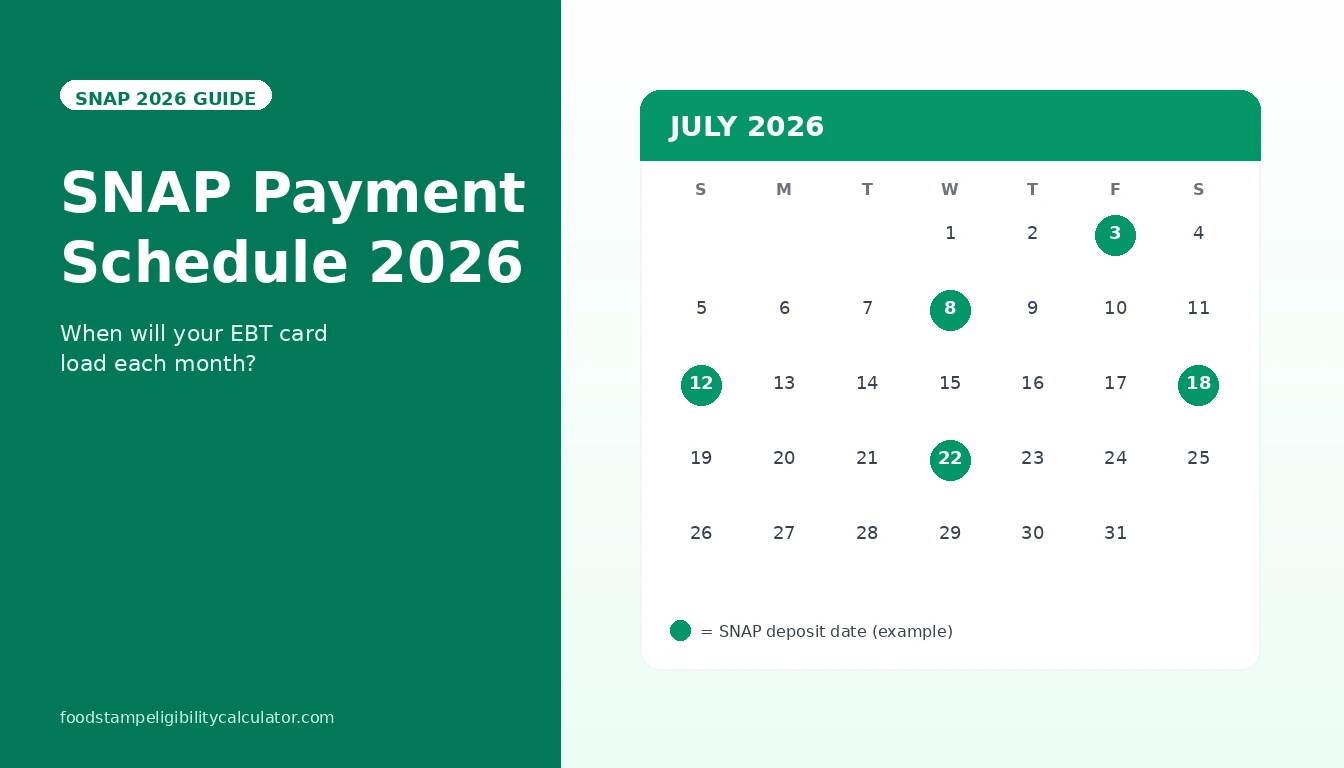
Waiting for your SNAP benefits to land on your EBT card can feel like watching the mailbox for an important letter. The date your benefits load each month is not random. Every state runs a set schedule, and once you know the rule your state uses, you can predict your deposit day down to the calendar. This guide, updated for September 2026, includes the complete deposit calendar for all 50 states and DC, explains how each state picks your day, and shows you how to find your exact deposit date without calling your caseworker.
SNAP benefits do not load on the first of the month for everyone. Federal rules give states the flexibility to spread deposits across the first three weeks of the month, and most states use that flexibility to keep grocery stores and EBT systems running smoothly. The deposit day you get assigned stays the same almost every month, with a few exceptions we will cover below.
Table of Contents
- What the SNAP Payment Schedule Actually Is
- How States Pick Your Deposit Day
- Why States Stagger Deposits Across the Month
- September 2026 Payment Schedule: All 50 States and DC
- How the Biggest States Assign Deposit Days in 2026
- What Changed in 2026: Amounts, Work Rules, and Participation
- October 2026 and the New Benefit Year
- First-Month Deposit: Why It Looks Smaller
- Why Your Deposit Date Might Change
- What to Do If Benefits Do Not Load
- How to Find Your Exact Deposit Date
- Common Mistakes That Cost Families Money
- Special Rules for Seniors and Disabled Households
- Checklist: Track Your SNAP Payment Like Clockwork
- Frequently Asked Questions
What the SNAP Payment Schedule Actually Is
The SNAP payment schedule is the calendar your state uses to load benefits onto EBT cards each month. The federal government sets the rules for what counts as an eligible household and how the benefit is calculated, but the day your card gets loaded is set by your state agency. That is why a household in California might get benefits on the 3rd while a similar household in Texas gets them on the 11th.
Behind the scenes, your state's EBT processor runs a batch job every business day. On each assigned day, it loads benefits for every household whose deposit rule matches that date. If your assigned day falls on a weekend or federal holiday, some states move the deposit to the previous Friday, while others hold it until the next business day. The exact behavior depends on your state, and we list the most common patterns below.
Understanding this schedule matters for one big reason: budgeting. If you know your deposit lands on the 8th of every month, you can plan your grocery runs, your rent payment, and your utility bills around that date. Families who treat their SNAP deposit as a fixed calendar event report far fewer cash-flow crunches than families who wait for a text alert that may or may not arrive on time.
How States Pick Your Deposit Day
States use one of four common rules to assign a deposit day to each household. The rule your state uses is listed in your approval letter and is also visible in your online EBT portal. Once you know the rule, you can predict your deposit day for the entire year.
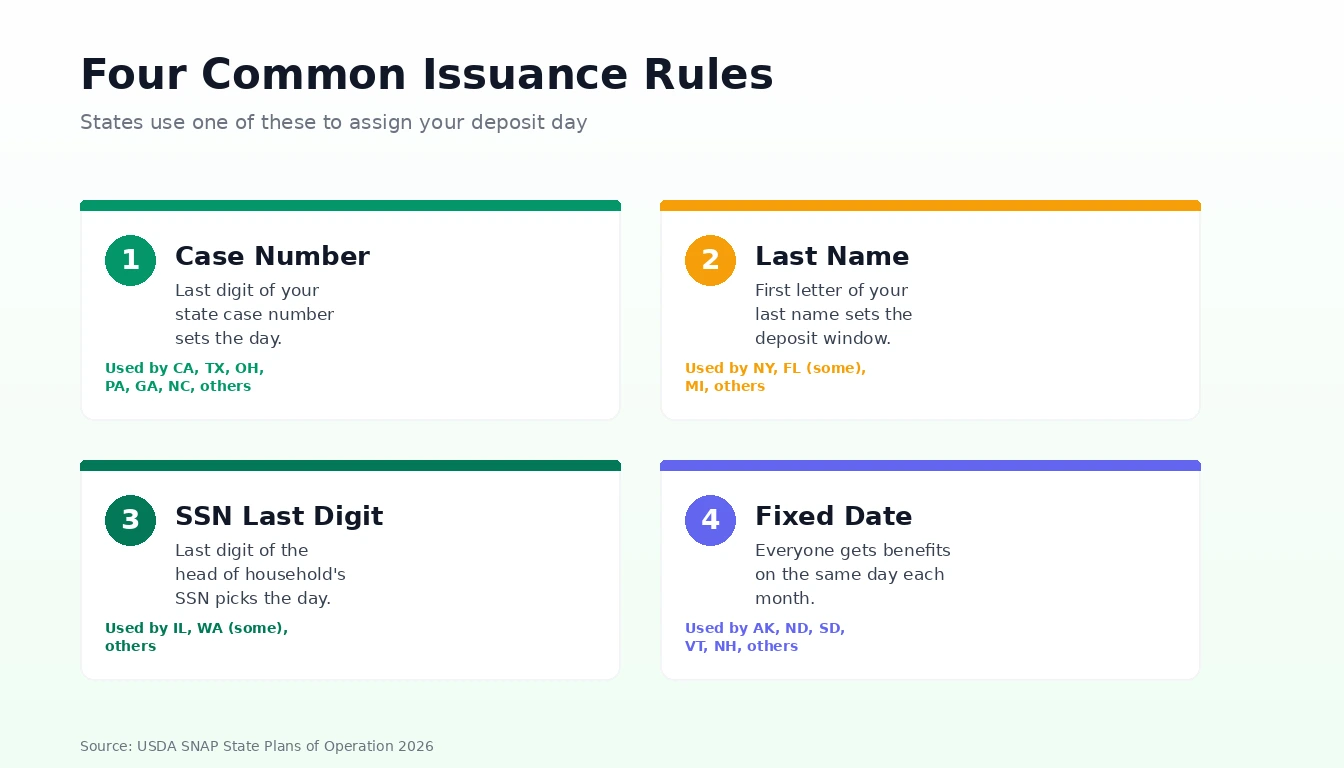
The first rule is the case number method. Your state assigns your case a number when you apply, and the last digit of that number sets your deposit day. A case number ending in 0 might mean the 1st of the month, while a case number ending in 9 might mean the 10th. California, Texas, Ohio, Pennsylvania, Georgia, and North Carolina all use this method, and it is the most common nationwide.
The second rule is the last name method. States that use this rule publish a chart that maps the first letter of your last name to a specific deposit day. For example, last names starting with A through D might load on the 1st, while last names starting with W through Z load on the 9th. New York, parts of Florida, and Michigan use this rule.
The third rule is the Social Security Number method. The last digit of the head of household's SSN picks the deposit day. Illinois and parts of Washington use this method. The fourth rule is the fixed date method, where everyone in the state gets benefits on the same day each month. Alaska, North Dakota, South Dakota, Vermont, and New Hampshire use this approach because their caseloads are small enough that staggering is unnecessary.
Why States Stagger Deposits Across the Month
Staggering is not a bureaucratic quirk. It serves a real operational purpose. If every SNAP household in a state loaded their benefits on the 1st, grocery stores would be overrun that day, EBT transaction systems would slow down under the load, and food banks would struggle to keep shelves stocked for non-SNAP shoppers. Spreading deposits across the first three weeks of the month keeps the system stable.
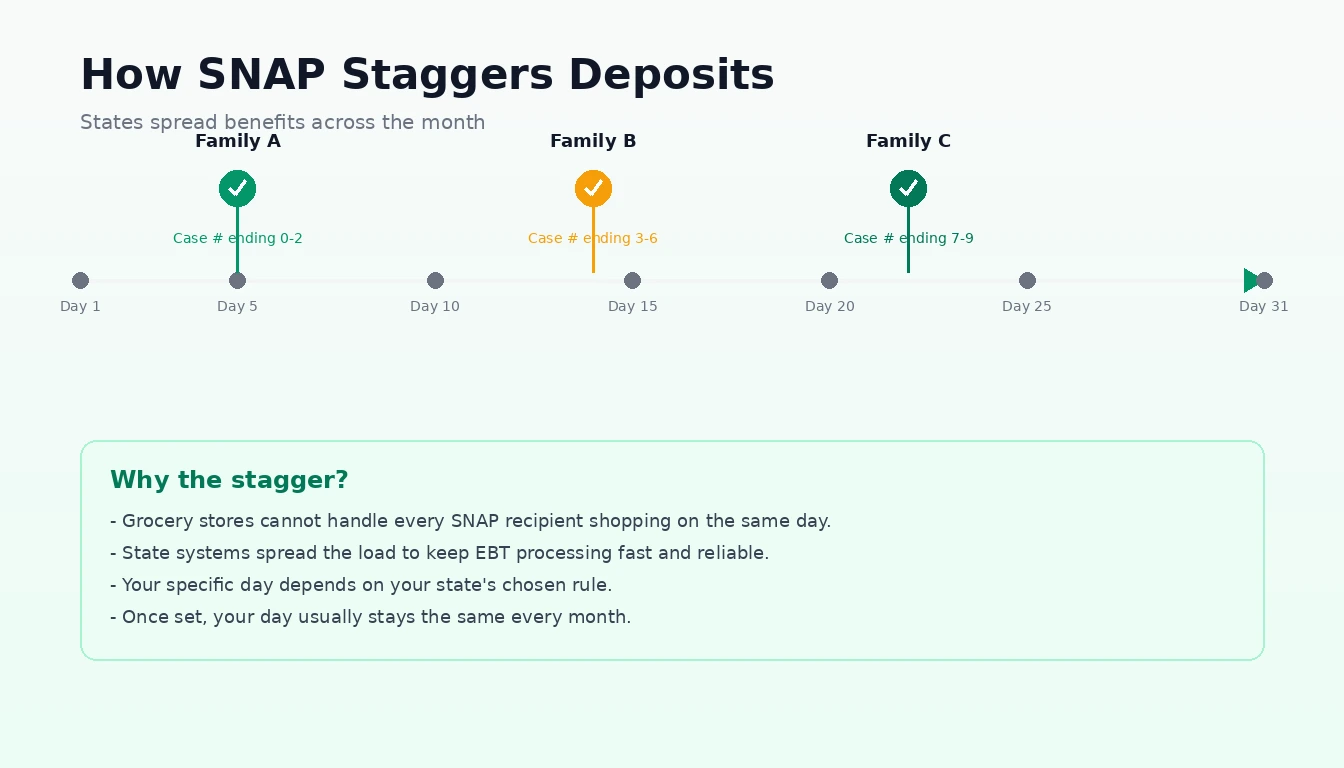
One side effect of staggering is that two neighbors with identical income and household size can have deposit days two weeks apart. This surprises new recipients who expect their benefits to arrive at the same time as their neighbor's. Once you understand that the rule depends on your case number, last name, or SSN, the difference makes sense.
September 2026 SNAP Payment Schedule: All 50 States and DC
This is the complete September 2026 deposit calendar for every state, the District of Columbia, and the territories. Find your state in the left column, note the September window in the middle, then use the rule in the right column to pin down your exact day. A household in Ohio with a case number ending in 7, for example, can expect its September 2026 deposit on a different day than a neighbor whose case number ends in 2, even though both fall somewhere between September 2 and September 20.
One date to circle this month: September 7, 2026 is Labor Day. Most states stamp EBT deposits with the assigned calendar day even when it lands on a weekend or federal holiday, and the funds are usually available overnight either way. A handful of states roll weekend and holiday deposits to the next business day, so if your assigned day is September 5, 6, or 7, check your balance on the morning of September 8 before assuming anything went wrong. If you are not sure which rule your household falls under, the EBT customer service number for your state connects you to a live agent who can read your deposit day straight from the system.
| State | September 2026 Window | How Your Exact Day Is Picked |
|---|---|---|
| Alabama | September 4–23 | Last digit of your case number |
| Alaska | September 1 | Everyone is paid on the 1st |
| Arizona | September 1–13 | First letter of your last name |
| Arkansas | September 4–13 | Last digit of your SSN |
| California | September 1–10 | Final digit of your county case number |
| Colorado | September 1–10 | First letter of your last name |
| Connecticut | September 1–3 | Last two digits of your client ID |
| Delaware | September 2–23 | First letter of your last name |
| District of Columbia | September 1–10 | First letter of your last name |
| Florida | September 1–28 | 8th and 9th digits of your case number |
| Georgia | September 5–23 | Last two digits of your client ID |
| Hawaii | September 3–5 | First letter of your last name |
| Idaho | September 1–10 | First letter of your last name |
| Illinois | September 1–20 | Last digit of your case number |
| Indiana | September 5–23 | Last digit of your case number |
| Iowa | September 1–10 | First letter of your last name |
| Kansas | September 1–10 | First letter of your last name |
| Kentucky | September 1–19 | First letter of your last name |
| Louisiana | September 1–23 | Last digit of your SSN |
| Maine | September 10–14 | First letter of your last name |
| Maryland | September 4–23 | First letter of your last name |
| Massachusetts | September 1–14 | Last digit of your SSN |
| Michigan | September 3–21 | First letter of your last name |
| Minnesota | September 4–13 | Last digit of your case number |
| Mississippi | September 4–21 | Last digit of your SSN |
| Missouri | September 1–22 | First letter of your last name |
| Montana | September 2–6 | First letter of your last name |
| Nebraska | September 1–5 | First letter of your last name |
| Nevada | September 1–10 | First letter of your last name |
| New Hampshire | September 5 | Everyone is paid on the 5th |
| New Jersey | September 1–5 | Last digit of your case number |
| New Mexico | September 1–20 | Last digit of your SSN |
| New York | September 1–9 | Last digit of your case number |
| North Carolina | September 3–21 | Last digit of your SSN |
| North Dakota | September 1 | Everyone is paid on the 1st |
| Ohio | September 2–20 | Last digit of your case number |
| Oklahoma | September 1–10 | First letter of your last name |
| Oregon | September 1–9 | Last digit of your SSN |
| Pennsylvania | September 3–14 | Last digit of your case number |
| Rhode Island | September 1 | Everyone is paid on the 1st |
| South Carolina | September 1–19 | Last digit of your case number |
| South Dakota | September 10 | Everyone is paid on the 10th |
| Tennessee | September 1–20 | Last two digits of your SSN |
| Texas | September 1–28 | Last digit of your EDG number |
| Utah | September 5, 11, and 15 | First digit of your case number |
| Vermont | September 1 | Everyone is paid on the 1st |
| Virginia | September 1–7 | Last digit of your case number |
| Washington | September 1–20 | Last digit of your case number |
| West Virginia | September 1–9 | First letter of your last name |
| Wisconsin | September 1–15 | Last digit of your case number |
| Wyoming | September 1–4 | First letter of your last name |
Territories run their own schedules as well: Guam staggers deposits across September 1–10, Puerto Rico's Nutritional Assistance Program pays between September 4 and September 22, and the U.S. Virgin Islands loads everyone on September 1. Five states pay their entire caseload on a single day, which is why Alaska, North Dakota, Rhode Island, and Vermont all show September 1 and South Dakota shows September 10. If you recently moved, remember that these dates belong to the state that issued your card; your deposit day always resets to the new state's schedule when you reapply there.
These windows repeat month after month with only cosmetic differences, so the September table doubles as your October and November reference. When a state does shift its calendar, it usually announces the change on its EBT portal a few weeks ahead, which is one more reason the balance-checking habits we cover below are worth building now.
How the Biggest States Assign Deposit Days in 2026
California runs the most familiar formula in the country: CalFresh benefits load across the first ten days of the month, and the final digit of your county case number is your day. A case number ending in 5 means the deposit lands on the 5th of every month, including September. Los Angeles, San Diego, and every other county follow the same digit-to-day mapping, so the rule is identical no matter where in the state you live.
Texas staggers Lone Star Card deposits across the longest window in the nation: September 1 through September 28, keyed to the last digit of your EDG number (the Eligibility Determination Group number printed on your approval paperwork). Florida also spreads payments across September 1–28, using the eighth and ninth digits of the case number, which is why two Florida neighbors can receive benefits almost four weeks apart. New York compresses its massive caseload into just September 1–9 by reading the last digit of the case number, one of the fastest full-state turnarounds in the country.
Pennsylvania assigns days by the last digit of the case number between September 3 and September 14. Illinois stretches September 1–20 on the same case-number rule, with the first digit of the case number also factored into older Chicago-area cases. Ohio pays between September 2 and September 20 by case-number digit. Georgia reads the last two digits of your client ID to place payments between September 5 and September 23, and North Carolina uses the last digit of the household head's SSN across September 3–21, which is why the exact day can differ from a spouse's if the case was opened under a different member's number. Michigan maps the first letter of your last name to a day between September 3 and September 21, so an Alvarez household is paid days before a Wilson household.
The corrected windows above matter because older summaries of this schedule circulate with shortened ranges, and a household that budgets around the wrong date can end up with an empty fridge for a week. If your deposit has not arrived by the last day of your state's September window, move straight to the troubleshooting steps below instead of waiting for October.
Smaller states tend to use shorter windows because their caseloads are smaller. Vermont loads every recipient on the 1st. Alaska loads everyone on the 1st as well. Hawaii spreads deposits across the 3rd through the 5th. If you want to see exactly how your state's benefit amounts compare, our page on monthly SNAP benefit amounts by state breaks down maximum allotments, deductions, and issuance windows for all 50 states.What Changed in 2026: Payment Amounts, Work Rules, and Participation
The deposit calendar is stable, but nearly everything around it moved in 2026. For fiscal year 2026, which runs October 1, 2025 through September 30, 2026, the maximum monthly allotment in the 48 contiguous states and Washington, D.C. is $298 for a one-person household, $546 for two people, $785 for three, and $994 for a family of four. Alaska, Hawaii, Guam, and the U.S. Virgin Islands set higher maximums of their own. Most households receive less than the maximum, because the benefit formula subtracts 30 percent of net income after deductions from the allotment for your household size; the full breakdown lives in our 2026 SNAP allotment chart.
National participation has fallen quickly. Preliminary USDA data shows about 37.0 million people received SNAP in April 2026, down from 42.8 million in January 2025, a drop of roughly 5.8 million people, or about 13.6 percent. The average benefit that month was $186.87 per person and $342.80 per participating household, with nearly $7 billion in benefits issued nationwide. Fewer households on the rolls has not changed any state's issuance calendar, but it has made hotlines and county offices noticeably easier to reach.
The biggest policy shift behind those numbers is the July 4, 2025 reconciliation law that expanded SNAP's time-limited work requirement. Affected adults now generally need to work or participate in qualifying activities for at least 80 hours a month to keep benefits beyond three months in a three-year period, the age range was extended from 18–54 up through age 64, and some parents whose youngest child is 14 or older were brought into the requirement as well. Exemptions that previously covered veterans, people experiencing homelessness, and some former foster youth were removed. Our SNAP work requirements guide and the ABAWD rules for single adults walk through who is exempt, how hours are counted, and what happens if the requirement is missed.
October 2026 and the New Benefit Year
October 1, 2026 starts fiscal year 2027, and that is when USDA's annual cost-of-living adjustment takes effect. The 48-state maximum allotment for a one-person household rises from $298 to $306, with the other household sizes stepping up proportionally, so households at or near the maximum will see slightly larger October deposits. Income limits also adjust each October with the new federal poverty guidelines; the current thresholds are tracked in our SNAP income limits chart.
Your deposit day does not change just because the benefit year does. Texas households will still be paid on their EDG-digit day, California on its case-digit day, and single-day states will still load everyone at once. The only routine events that move a deposit day are the recertification cycle issuing a new case number, a household moving states, or a state agency deliberately rebalancing its calendar, and each of those comes with written notice. If you want to confirm your own day before October begins, the four lookup methods in the next section take under five minutes.
First-Month Deposit: Why It Looks Smaller
New SNAP recipients often panic when their first deposit looks smaller than the monthly amount they were approved for. This is almost always a prorated deposit, not a mistake. Your benefits start on the day your case is approved, not the day you applied. If your case was approved on the 18th of the month, your first deposit covers only the days from the 18th through the end of that month.
Full monthly deposits start the following month. So if you were approved on January 18th, your January deposit covers 13 days of benefits, and your February deposit on your assigned day is the full monthly amount. The math is straightforward, but it catches people off guard because they expected the larger number they saw on their approval letter.
If you applied for expedited SNAP benefits in seven days, the same proration rule applies, but the timeline is shorter. Your first deposit lands within seven days of your application date, and that deposit is prorated from the approval date forward. Full monthly deposits start the next month on your regular deposit day.
Why Your Deposit Date Might Change
Once assigned, your deposit day rarely changes. But there are a few situations where it can shift. The most common is recertification. When you complete your SNAP recertification deadline paperwork, your caseworker may issue you a new case number, which can change your deposit day under the case number rule. Always check your recertification approval letter for a new deposit date.
Moving within the same state usually does not change your deposit day, but moving to a new state always does. Each state runs its own SNAP program, so when you move, you close your old case and apply in the new state. The new state assigns you a new case number and a new deposit day based on its own rule. Our guide on moving to a new state walks through the close-and-reapply process step by step.
A third scenario is a case number reissuance. Some states periodically reissue case numbers when they update their computer systems, and that reissuance can shift your deposit day. If this happens, you will get a notice in the mail explaining the change. If you do not get a notice and your deposit day shifts, call your caseworker to confirm what happened.
What to Do If Benefits Do Not Load
If your deposit day arrives and your benefits do not load, the first step is to check your EBT balance online through your state's portal or the mobile app. Sometimes the deposit lands late in the day, and calling your caseworker before checking the balance wastes everyone's time. Wait until the end of the day on your assigned deposit day before raising an alarm.
If the day ends with no deposit, the most common cause is a missed recertification. If your certification period ended and you did not file the paperwork, your case closed and your card will not load. Check any recent mail from your state agency, then call your caseworker to confirm the case status. If the case closed, you may need to reapply, but some states offer a reinstatement window if you file within 30 days.
A second common cause is an unreported change. If your income went up and you did not report it, your case may have been closed for noncompliance. Our page on unreported changes and penalties explains which changes you must report, when, and what happens if you miss the deadline.
A third cause is a benefit reduction. If your income or household size changed and your benefit was recalculated to zero, your card will not load even though your case is still technically open. If this happens, you should have received a notice explaining the change. Our page on what to do when your SNAP benefits went down walks through the appeal options if you disagree with the recalculation.
If none of these apply and your deposit simply did not arrive, your state's EBT system may have had a processing error. Call the customer service number on the back of your card to file a missing deposit report. If the funds were issued but never posted to your account, you can request replacement SNAP benefits through your state agency.
How to Find Your Exact Deposit Date
You do not need to call your caseworker to find your deposit date. There are four faster ways to confirm it. The first is your approval letter, which lists your deposit day in the benefit details section. The second is your state's EBT portal, where your deposit schedule is shown on the account dashboard. The third is your state's SNAP agency website, which publishes the issuance schedule as a public document. The fourth is the EBT mobile app, where your next scheduled deposit appears on the home screen.
Four ways to confirm your deposit date
- Approval letter — issued when your case is approved or recertified. Lists your deposit day under benefit details.
- State EBT portal — log in to your account at your state's EBT website. Your deposit schedule is on the dashboard.
- State SNAP agency website — most agencies publish a public issuance schedule chart you can read without logging in.
- EBT mobile app — the Providers app or your state's official app shows your next scheduled deposit on the home screen.
If you are still waiting for an approval decision, you can check your SNAP application status online through your state's portal. Once the case is approved, your deposit day appears in the system within one business day, even if your first deposit is still a few days out.
Common Mistakes That Cost Families Money
1. Letting your EBT card sit unused for nine months.
Federal rule at 7 CFR 274.2(b) says if you do not use your card for nine months, the funds on it are permanently removed and returned to the state. A small purchase every few months keeps the balance active. This is separate from your certification period expiring, which is a different rule entirely.
2. Waiting until the 1st to check your balance.
If your deposit day is the 8th and you check on the 1st expecting money, you will panic for no reason. Check your balance on your deposit day, not the 1st. If you are unsure how to do this, our guide on your state's EBT card basics walks through every method, including the phone line, the online portal, and the mobile app.
3. Missing the recertification deadline because you waited for a reminder.
Most states mail a recertification packet 30 to 45 days before your certification period ends, but mail gets lost. If you do not file by the deadline, your case closes and your deposit day stops loading. Our page on how long SNAP benefits last explains how to track your certification period end date so you never miss the deadline.
4. Skipping the phone interview.
Most new applications require a SNAP phone interview with your caseworker. If you miss the scheduled call, your application is denied and no deposit is ever issued. Rescheduling is usually allowed, but only if you call back quickly. Missing the interview is one of the most common reasons new applications fail.
5. Spending benefits that were issued in error.
If your state accidentally deposits too much and you spend it, you may be hit with a your SNAP overpayment notice months later asking for repayment. If you notice a deposit that looks too large, call your caseworker before spending the extra funds.
Special Rules for Seniors and Disabled Households
Households where every adult member is elderly or disabled and has no earned income get a 36-month certification period instead of the standard 12-month period. This means less paperwork and fewer chances to miss a deadline. The deposit schedule does not change for these households, but the longer certification period makes tracking your deposit day easier because the schedule stays the same for three years instead of one.
Seniors and disabled recipients often qualify for the medical expense deduction, which can raise their monthly benefit. Our page on SNAP eligibility for seniors and disabled Americans walks through the deduction, the documentation, and how to claim it. The deposit schedule for these households is the same as for any other household in the state.
Checklist: Track Your SNAP Payment Like Clockwork
- Find your deposit day on your approval letter or in your EBT portal.
- Write your deposit day on a paper calendar and a phone calendar with a reminder.
- Check your EBT balance on your deposit day, not the 1st of the month.
- Mark your certification period end date so you do not miss recertification.
- Use your card at least once every nine months to keep your balance active.
- Save your approval letter and every recertification notice in one folder.
- Update your address with your caseworker before you move, not after.
- Report income changes within 10 days of the month after they happen.
- Call your caseworker immediately if your deposit is more than one business day late.
- Keep the EBT customer service number saved in your phone for quick access.