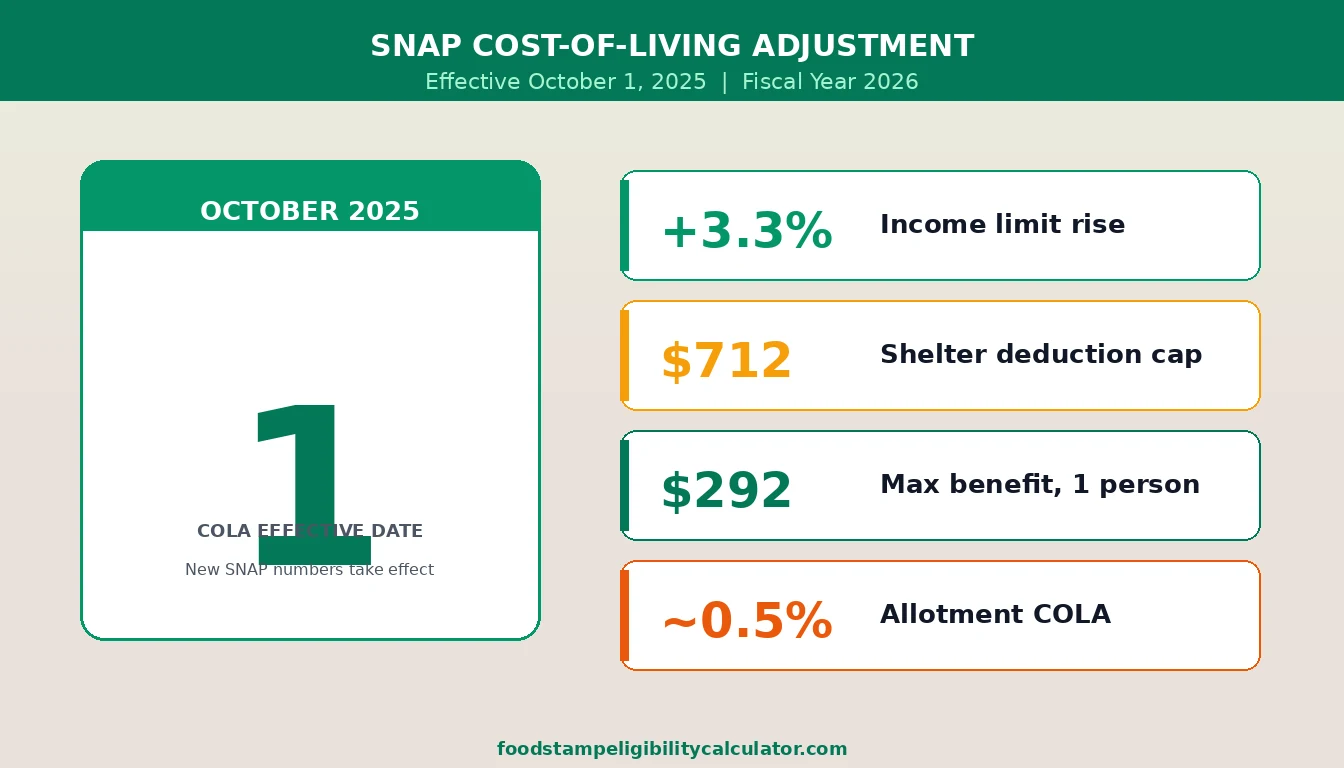
Every October 1, the SNAP program resets its numbers. The USDA calls this the cost-of-living adjustment, or COLA, and it touches four things at once: the maximum monthly benefit, the gross and net income limits, the standard deduction, and the excess shelter deduction cap.
If you only read the headlines, you might think your SNAP benefit was about to jump. The reality for fiscal year 2026, which began October 1, 2025, is more complicated.
This guide walks through every number that changed in the 2026 SNAP COLA, every number that did not, and what each change means for your household. We will not just hand you a table and walk away.
We will explain why the maximum allotment barely moved, why the income limits rose about 3.3 percent, and why the shelter deduction cap went from $672 to $712. If you want a quick estimate of your own benefit, plug your numbers into our free SNAP eligibility calculator and you will get an answer in about 90 seconds.
Table of Contents
- 1Quick Answer: Three Things That Actually Changed in the 2026 SNAP COLA
- 2Maximum Monthly Allotment: Why Benefits Stayed Almost Flat
- 3SNAP Income Limits: The 3.3 Percent Increase You Should Know
- 4Standard Deduction: Slightly Higher for Most Households
- 5Excess Shelter Deduction Cap: From $672 to $712
- 6Why the 2026 COLA Was Smaller Than the Big Jump in 2024
- 7What Did NOT Change in the 2026 SNAP Update
- 8How to Tell If Your Benefits Went Up
- 9What to Do If Your Benefits Stayed the Same
- 10State Variations: Alaska, Hawaii, Guam, and the Virgin Islands
- 11Looking Ahead: What to Expect for Fiscal Year 2027
- 12Frequently Asked Questions
- 13Wasim Akram
Quick Answer: Three Things That Actually Changed in the 2026 SNAP COLA
The October 2025 SNAP COLA was a small one compared to the double-digit increases of 2023 and 2024, but it still touched real money for real households. Three numbers moved in a meaningful way, and one number barely budged. Here is the snapshot before we go deeper.
First, the gross income limit rose about 3.3 percent, which means slightly more households now pass the income test. Second, the standard deduction went up modestly, which lowers your countable net income even if your gross income did not change.
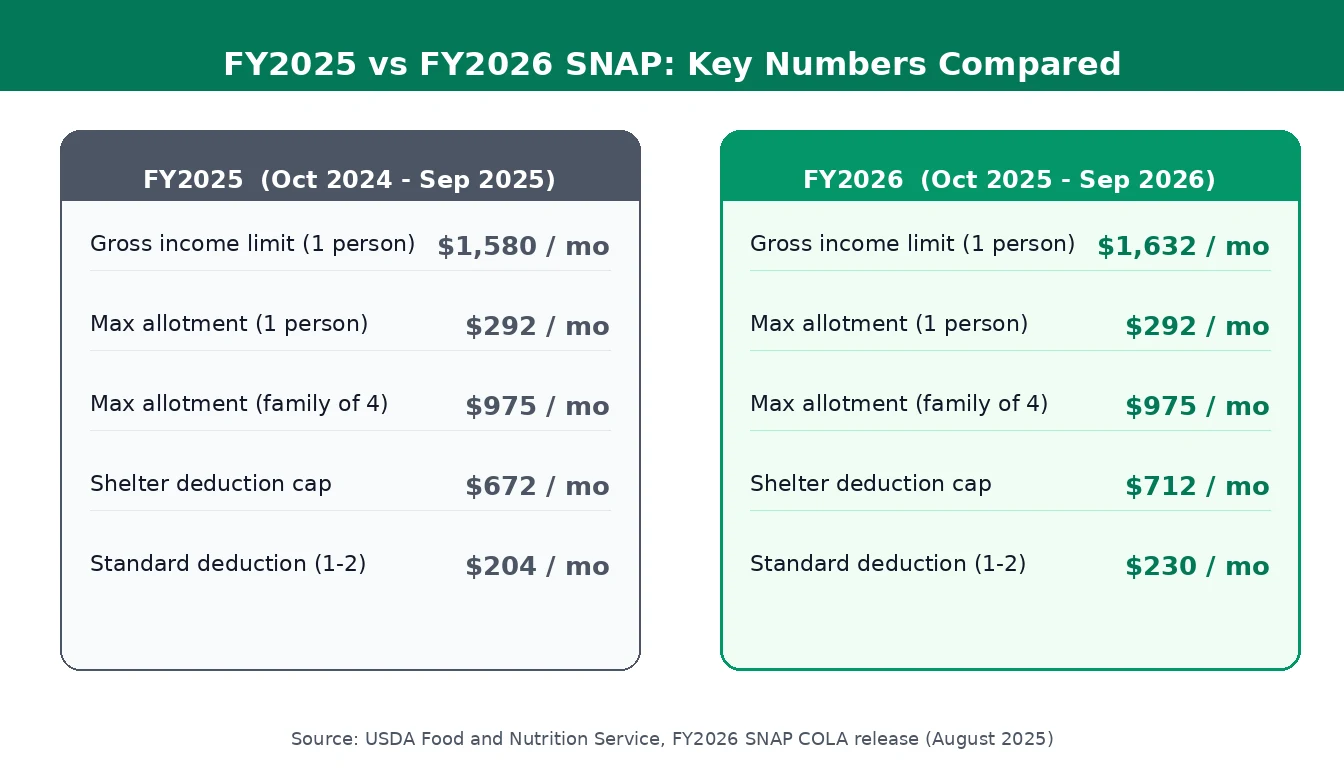
Third, the excess shelter deduction cap rose from $672 to $712 per month, which helps renters in high-cost areas. The fourth number, the maximum monthly allotment, stayed essentially flat at $292 for a single person and $975 for a family of four.
If your household is near the income limit, the 2026 COLA is good news because you may now qualify when you did not before. If you already receive the maximum allotment, the COLA did almost nothing for you this year. We explain why the two stories diverge in the sections below.
Maximum Monthly Allotment: Why Benefits Stayed Almost Flat
The maximum monthly SNAP allotment is the dollar amount the federal government will load onto an EBT card for a household with zero countable income. It is the ceiling, not the floor.
Most SNAP households get less than the maximum because their countable income, after deductions, is above zero. The allotment is set by re-costing the Thrifty Food Plan, which is a hypothetical basket of foods that a family of four on a tight budget could buy at typical grocery prices.
For fiscal year 2026, the re-costing of the Thrifty Food Plan came back with barely any change. The reason is straightforward: food inflation cooled significantly during 2024 and 2025 after the big run-up of 2022 and 2023.
The basket cost roughly the same in mid-2025 as it did a year earlier, so the maximum allotment barely moved. That is why a single person still gets up to $292 per month and a family of four still gets up to $975 per month.
That said, "essentially flat" is not "exactly flat." Some households in states with slightly higher cost adjustments, and some households at the edge of the standard deduction bump, saw a one-dollar or two-dollar change in their monthly benefit.
If you want the full chart with every household size from one to eight, our SNAP income limits reference page lists the maximum allotment, the gross income limit, and the net income limit for each size.
It is also worth noting that the allotment is the same in every one of the 48 contiguous states and the District of Columbia. Alaska, Hawaii, Guam, and the U.S. Virgin Islands get higher allotments because groceries cost more there, but for the rest of the country, the number is uniform. Your state cannot choose to pay less than the federal maximum, and it cannot choose to pay more.
SNAP Income Limits: The 3.3 Percent Increase You Should Know
While the maximum allotment barely moved, the SNAP income limits rose meaningfully. The gross income limit, which is the first test you have to pass, tracks 130 percent of the federal poverty line. The net income limit tracks 100 percent of the poverty line. Both are recalculated each October using the poverty guidelines that HHS published earlier in the year.
For a single person, the gross income limit rose from $1,696 per month to $1,696 per month, an increase of about 3.3 percent. For a family of four, the gross income limit rose from $3,483 to $3,483 per month.
The net income limit rose by the same percentage. If you were just above the cutoff last year, you may now qualify, and the only way to find out is to apply for SNAP in your state and let your caseworker run the numbers.
These income limits are not optional. Federal law requires every state to use the same dollar figures, although states have some flexibility through the Broad-Based Categorical Eligibility rule, often called BBCE.
Under BBCE, most states raise the gross income limit to 200 percent of poverty, which is roughly $2,506 per month for a single person. A handful of states have kept the strict 130 percent limit, so check your state's rule before assuming you are over the cutoff.
One easy way to see whether the new limits help you is to compare your gross and net income using a gross versus net income calculator. The difference between the two numbers is what deductions create, and deductions are the next place the 2026 COLA worked in your favor.
Standard Deduction: Slightly Higher for Most Households
The standard deduction is a flat monthly amount that SNAP subtracts from your gross income before checking the net income test. Every household gets it, no receipts required. For fiscal year 2026, the standard deduction rose modestly across most household sizes, which means your countable net income is now slightly lower even if your paycheck did not change.
For households of one to two people, the standard deduction went from $204 to $230 per month. For households of three people, it went from $220 to $230. For households of four people, it held at $275.
Larger households in some states saw a slight bump. The exact figure depends on your state because the standard deduction is set statewide based on a federal formula, but the direction is up in almost every jurisdiction.
If you want to see every deduction side by side, our SNAP deductions cheat sheet lists the standard deduction, the earned income deduction, the medical expense deduction, the dependent care deduction, the child support deduction, the excess shelter deduction, and the utility allowance.
Most households qualify for at least three of these, and every dollar you can deduct is a dollar that does not count against your SNAP eligibility or your benefit amount.
Excess Shelter Deduction Cap: From $672 to $712
The excess shelter deduction is the one that helps renters most. SNAP lets you deduct shelter costs that exceed half of your countable net income, including rent, mortgage, property taxes, insurance, and the standard utility allowance.
For households without an elderly or disabled member, the deduction is capped. For households with someone 60 or older or receiving disability benefits, there is no cap at all.
For fiscal year 2026, the cap rose from $672 per month to $712 per month. That is a $40 increase, which translates to roughly $12 to $15 more in monthly SNAP benefits for a household that was already hitting the old cap. The increase tracks HUD fair market rents, which rose modestly in most parts of the country over the past year.
If you live in a high-rent area and you are not already claiming the shelter deduction, you are leaving money on the table. Bring your lease, mortgage statement, property tax bill, and utility bills to your interview and ask your caseworker to apply the deduction.
Seniors and disabled applicants should specifically ask about the uncapped version, because that is the single biggest boost available to households on fixed incomes. If you fall into either of those groups, our guides on SNAP for seniors and SNAP benefits for disabled Americans walk through the special rules step by step.
Why the 2026 COLA Was Smaller Than the Big Jump in 2024
People who started receiving SNAP in 2023 or 2024 remember double-digit percentage increases. The October 2022 adjustment was large because food inflation was running above 11 percent that year. The October 2023 adjustment was even larger in some categories. The October 2024 adjustment was much smaller, and the October 2025 adjustment that took effect for fiscal year 2026 was smaller still.
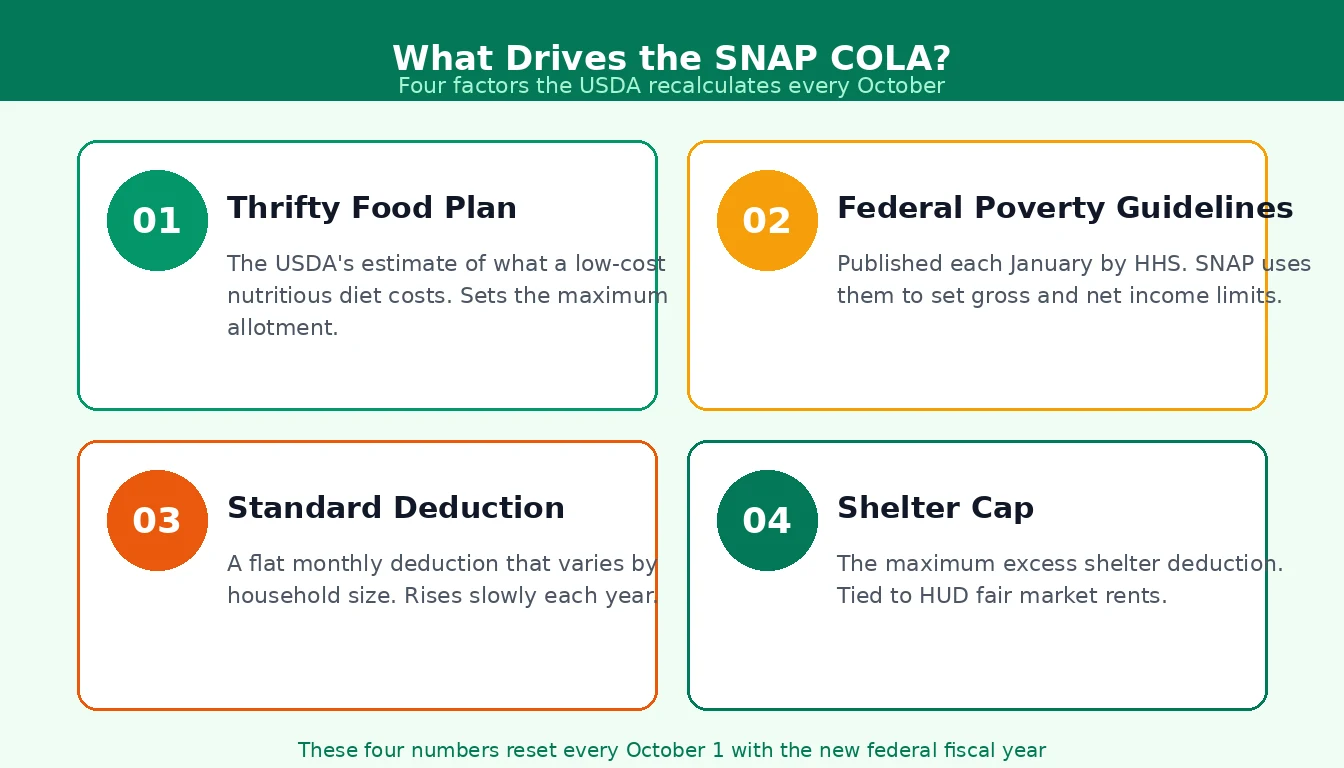
The reason is simple math. The SNAP maximum allotment is recalculated using a one-year look-back at grocery prices. When grocery prices spike, the allotment spikes the following October. When grocery prices flatten, the allotment flattens the following October. Food inflation during 2024 and 2025 was much cooler than during 2022 and 2023, so the 2026 allotment barely moved.
The income limits, on the other hand, are tied to the federal poverty guidelines, which move with a broader measure of inflation that includes housing, healthcare, and transportation.
Those costs rose faster than food, which is why the income limits went up about 3.3 percent while the allotment stayed flat. Two different inflation measures, two different outcomes, both baked into the same annual COLA.
What Did NOT Change in the 2026 SNAP Update
Just as important as what changed is what did not. The asset test threshold stayed at $3,000 for most households and $4,500 for households with someone 60 or older. Most states waive the asset test entirely through BBCE, but for the states that still apply it, those numbers are unchanged.
If your state has BBCE, you can have substantial savings and still qualify, which matters a lot for households who lost a job but have a 401(k) or an emergency fund.
Work requirements did not change either. The 80-hour-per-month rule for able-bodied adults without dependents, the time limit of three months out of every three years for non-working ABAWDs, and the state waiver rules all stayed the same.
If you are subject to the ABAWD time limit, the 2026 COLA does not give you any extra months. You can read the full set of rules on our SNAP work requirements page.
The deposit schedule also did not change. States still use the same case-number, last-name, SSN, or fixed-date rules to assign deposit days. Your benefit amount may go up a dollar or two, but your deposit day will not move. If you are not sure what day your benefits load, our SNAP payment schedule by state guide lists the rule every state uses and how to find your exact deposit day.
How to Tell If Your Benefits Went Up
The easiest way to see whether your SNAP benefit changed with the COLA is to check your EBT balance online or through your state's mobile app. Your transaction history will show the deposit that hit on or after October 1, 2025, and you can compare it to your September deposit to see the difference. Most households saw either no change or a change of less than $10 per month.
Your state is also required to send you a notice whenever your benefit amount changes. This notice usually arrives in early October, and it spells out the old amount, the new amount, and the date the new amount takes effect.
If you did not receive a notice and your benefit stayed the same, that is normal. Notices are only required when the amount actually changes by more than a small rounding threshold.
If your benefit went down and you are not sure why, the COLA is unlikely to be the cause. A benefit reduction usually comes from a change in your income, a change in your household size, a missed recertification, or a state agency correction of an earlier overpayment. Our guide to why SNAP benefits go down walks through all ten common reasons and tells you what to do about each one.
What to Do If Your Benefits Stayed the Same
If your SNAP benefit did not change with the COLA, your first move is to figure out why. The most common reason is that you are already at the maximum allotment for your household size, and the maximum allotment did not move. In that case, no amount of paperwork will raise your benefit because you are already at the federal ceiling.
The second most common reason is that your countable net income is high enough that the small bump in the standard deduction and the shelter cap was not enough to push your benefit up by a full dollar. SNAP benefits are rounded down to the nearest dollar, so a $0.40 increase disappears.
If you are within a few dollars of a higher benefit, look for deductions you are not currently claiming. The medical expense deduction for seniors and disabled households is the most commonly missed one, and it can be worth $50 to $170 or more per month.
The third possibility is that your case is up for recertification soon, and your state has not yet applied the new numbers. Some states apply COLA changes only at recertification, which means a household with a November recertification date may not see the COLA reflected until November or December.
If you are not sure when your recertification is due, log in to your state's benefits portal or call the number on the back of your EBT card.
State Variations: Alaska, Hawaii, Guam, and the Virgin Islands
The 48 contiguous states and the District of Columbia all use the same SNAP numbers we have been discussing. The four outside jurisdictions, however, run on higher figures because food costs more there. Alaska has the most variation, with three rural sub-regions getting allotments 60 percent or more above the continental standard, plus separate urban figures for Anchorage and Fairbanks.
Hawaii's maximum allotment runs about 25 percent above the continental standard, although Hawaii still uses the same income limits as the rest of the country. Guam and the U.S. Virgin Islands get a smaller bump.
The 2026 COLA applies to all four jurisdictions, but the dollar figures are different. If you live in one of these places, ask your local SNAP office for the 2026 fact sheet rather than relying on the continental numbers.
If you are planning to move, you should also know that the COLA does not travel with you. Your benefit will be recalculated in your new state using that state's standard utility allowance, that state's BBCE rules, and that state's deposit schedule. Our guide to moving SNAP across state lines walks through the process step by step, including the gap in benefits you should plan for.
Looking Ahead: What to Expect for Fiscal Year 2027
The next SNAP COLA takes effect October 1, 2026, at the start of federal fiscal year 2027. The USDA Food and Nutrition Service typically publishes the new numbers in early August 2026, after the Bureau of Labor Statistics releases the June inflation data. If food inflation picks up again during the first half of 2026, the FY2027 COLA could be larger than the FY2026 one.
Two policy changes are also worth watching. First, the farm bill reauthorization, which has been operating under short-term extensions, could change the structure of the Thrifty Food Plan and the way the COLA is calculated. Second, any change to the federal poverty guidelines in the January 2026 HHS release will flow through to the October 2026 SNAP income limits.
If you are new to SNAP and need help getting approved quickly, ask about expedited SNAP benefits within 7 days.
Households with very low income and very low resources can get their first benefit loaded onto their EBT card within a week of applying, without waiting for the full 30-day processing window. The COLA does not affect the expedited timeline, but it does affect the dollar amount you receive.
For everyone else, the practical takeaway from the 2026 SNAP COLA is this: do not expect a big bump, but do expect a small one, and make sure your caseworker is applying every deduction you are entitled to. If you want a preview of your own numbers under the new rules, the calculator on our homepage already uses the fiscal year 2026 figures.
Frequently Asked Questions