
If there is one thing that confuses people more than anything else about SNAP, it's how income is calculated. You might glance at the income limits, compare your paycheck, and decide you don't qualify. The approval letter then proves you wrong.
Or you might assume you'll get a certain amount in benefits and receive much less. The reason for this confusion comes down to the difference between gross vs net income — two terms that follow their own rulebook inside SNAP.
These terms don't mean what they mean on your paycheck. Understanding the difference is the key to your true eligibility and benefit amount. Let me break it all down for you.
Quick Answer
- Gross income is the total your household brings in before any deduction. Most households must stay under 130% of the federal poverty level — $1,696 for a one-person household in FY2026.
- Net income is what remains after all seven SNAP deductions, and it must fall at or below 100% of poverty — $1,305 for one person. Your benefit equals the maximum allotment minus 30% of that net income.
- Households with a member age 60 or older, or receiving disability benefits, skip the gross test and qualify on net income alone.
Table of Contents
- 1What Is Gross Income for SNAP?
- 2What Is Net Income for SNAP?
- 3Gross vs Net Income at a Glance
- 4FY2026 Gross vs Net Income Limits and Max Benefits
- 5All SNAP Deductions Explained
- 6Earned Income vs Unearned Income: A Detailed Look
- 7SNAP Income Calculation: Step-by-Step Examples
- 8How the 30% Benefit Reduction Works
- 9SNAP Income Limits Rise October 1, 2026 (FY2027)
- 10Self-Employment Income Calculation
- 11Common Mistakes in SNAP Income Calculation
- 12The Bottom Line
- 13Frequently Asked Questions
- 14Related SNAP Guides
What Is Gross Income for SNAP?
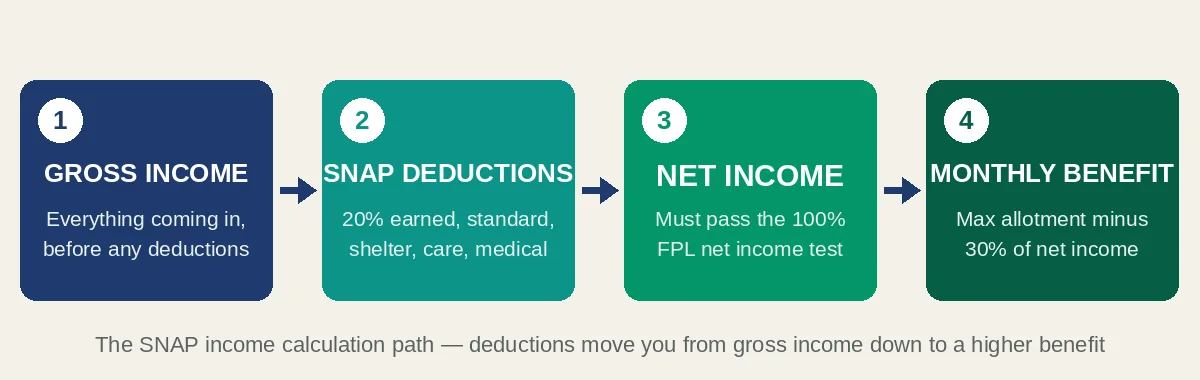
In SNAP terms, gross income is your total household income before any SNAP deductions are applied. This includes all sources of income from every member of your SNAP household. Think of it as the big top-line number — everything that comes in, before anything is taken out.
What Counts as Gross Income
Gross income for SNAP includes, per USDA's official eligibility guidance:
- Earned income: Wages, salaries, tips, commissions, self-employment income
- Unearned income: Unemployment benefits, Social Security (including SSI and SSDI), child support received, and alimony received
- Also counted: Pensions, workers' compensation, veterans' benefits, rental income, and interest or dividends

What doesn't Count as Income
Some types of money you receive are excluded from SNAP income calculations entirely:
- Federal, state, or local energy assistance (LIHEAP payments)
- Payments from the Federal Earned Income Tax Credit (EITC)
- Loans that must be repaid
- Nonrecurring lump-sum payments (one-time payments)
- Income tax refunds
- Certain educational assistance (Pell Grants, student loans, work-study)
- Payments for foster care (if the foster child is included in the SNAP household)
- Reimbursements for expenses
- Certain payments to Native Americans
- Victims' compensation payments
Excluded income and deductions are not the same thing. Excluded money, like an EITC refund, never touches the gross income test at all. Deductions only come into play after your gross income clears that first screen, trimming the amount that reaches the net test.
What Is Net Income for SNAP?
Net income is your gross income minus all the allowable SNAP deductions. This is the number that ultimately determines your eligibility (you must be at or below 100% of the federal poverty level) and your benefit amount. The lower your net income, the higher your SNAP benefits.
Most households have to land at or below 100 percent of the federal poverty level after deductions to qualify. One major exception exists.
A household with a member who is 60 or older, or who receives disability benefits, only passes this net income test. The 130 percent gross screen never applies to it. Our SNAP net income test guide walks through that rule line by line.
Several states also raise the gross screen to 200 percent of poverty through broad-based categorical eligibility. Our guide to the BBCE 200 percent FPL rule lists every state that takes that route. Either way, deductions are what move your countable income from gross to net, so the next section is where the savings live.
Gross vs Net Income at a Glance
Gross and net income are two checkpoints on the same application, not competing definitions. Gross income decides whether your case gets a full review. Net income decides whether you qualify and how much you receive.
| Category | Gross income | Net income |
|---|---|---|
| Definition | Total household income from every member, before any deductions | Income left after all seven SNAP deductions |
| Monthly limit (48 states + DC, FY2026) | 130% FPL — $1,696 for one person, $3,483 for four | 100% FPL — $1,305 for one person, $2,680 for four |
| Who must pass it | Most working-age households | Every household, no exceptions |
| Elderly or disabled households | Test skipped entirely | The only test that applies |
| BBCE states | Screen raised to 200% FPL — $2,610 for a household of three | Stays at 100% FPL |
| What lowers it | Excluded income only (EITC, LIHEAP, loans) | Every deduction you claim |
FY2026 Gross vs Net Income Limits and Max Benefits
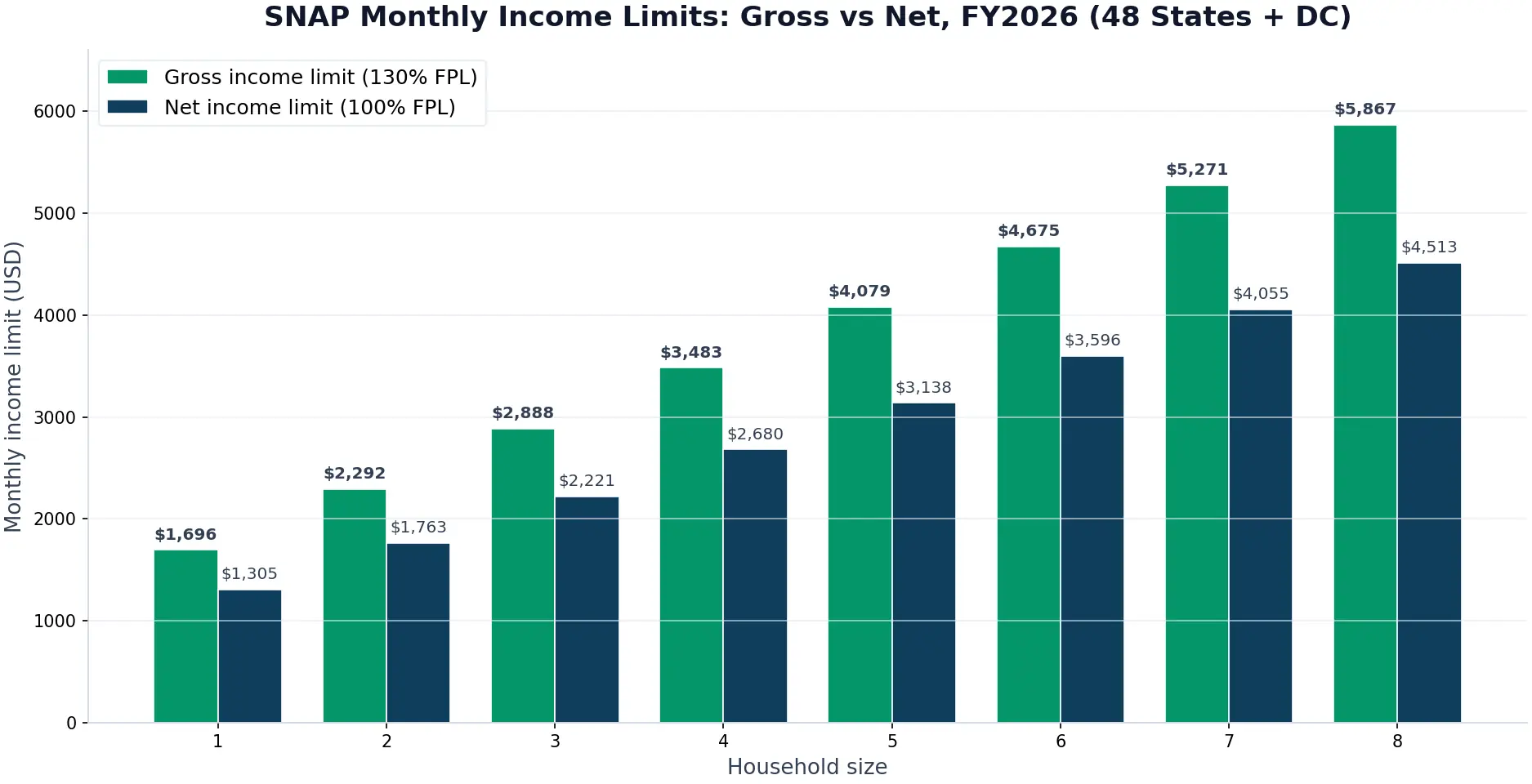
Every SNAP case runs through the same two tests, and the benefit formula then uses the allotment column. The gross limit equals 130 percent of the federal poverty level, while the net limit sits at 100 percent.
The allotment column shows the FY2026 maximums for the 48 contiguous states and Washington, DC. Find your household size and keep the three numbers side by side as you work through the deductions.
| Household Size | Gross Income Limit (130% FPL) | Net Income Limit (100% FPL) | Max Monthly Benefit (FY2026) |
|---|---|---|---|
| 1 person | $1,696 | $1,305 | $298 |
| 2 people | $2,292 | $1,763 | $546 |
| 3 people | $2,888 | $2,221 | $785 |
| 4 people | $3,483 | $2,680 | $994 |
| 5 people | $4,079 | $3,138 | $1,183 |
| 6 people | $4,675 | $3,596 | $1,421 |
| 7 people | $5,271 | $4,055 | $1,571 |
| 8 people | $5,867 | $4,513 | $1,789 |
| Each additional person | +$596 | +$459 | +$218 |
Alaska, Hawaii, Guam, and the Virgin Islands publish higher tables because their grocery prices run hotter. Households with an elderly or disabled member skip the gross income test entirely.
Households in BBCE states get a 200 percent gross screen instead of 130 percent. The USDA Food and Nutrition Service updates these figures every October through its cost-of-living adjustment.
All SNAP Deductions Explained
This is where the real impact happens. SNAP deductions can significantly reduce your countable income, and many people miss deductions they're entitled to. Let me go through each one in detail.
1. Earned Income Deduction (20%)
If you have income from working (wages, salaries, or self-employment), SNAP automatically deducts 20% of your earned income. This deduction accounts for work-related expenses like taxes, transportation, and clothing. It applies only to earned income — not to unemployment benefits, Social Security, or other unearned income.
Example: If you earn $2,000/month in wages, only $1,600 is counted as income (20% deduction = $400).
2. Standard Deduction
Every SNAP household receives a standard deduction based on household size. This deduction is applied automatically — you don't need to prove any specific expenses. For fiscal year 2026 (October 2025 through September 2026), the standard deductions are:
- 1-3 person household: $209/month
- 4-person household: $223/month
- 5-person household: $261/month
- 6+ person household: $299/month
These amounts are slightly higher in Alaska, Hawaii, and the Virgin Islands due to higher living costs. The standard deduction is the same regardless of your actual expenses — it's a flat amount that every eligible household receives.
3. Shelter Deduction
The shelter deduction is often the largest deduction available and the one most likely to meaningfully increase your benefits. Here's how it works:
SNAP lets you deduct shelter costs that exceed 50% of your income after all other deductions. Shelter costs include rent or mortgage, property taxes, insurance, and utilities.
Step-by-step calculation:
- Calculate your income after the earned income deduction, standard deduction, medical deduction, and dependent care deduction
- Multiply that amount by 50%
- Subtract 50% of your income from your total shelter costs
- The difference is your shelter deduction (subject to the cap for most households)
Shelter deduction cap: For households without an elderly or disabled member, the shelter deduction is capped at $744/month (FY2026 amount). Households with at least one elderly or disabled member face no cap on this deduction. You can deduct the full amount of excess shelter costs.
What counts as shelter costs:
- Rent or mortgage payments
- Property taxes and insurance on your home
- Utility costs (electricity, gas, water, sewage, trash, phone)
- Condominium or homeowner association fees
- Costs to repair damage from a natural disaster (if not reimbursed)
4. Medical Expense Deduction
If your household includes a member who is elderly (age 60+) or disabled, you can deduct medical expenses that exceed $35 per month. This is another deduction that many people miss. Qualifying medical expenses include:
- Health insurance premiums (Medicare Part B, supplemental insurance)
- Co-payments and deductibles
- Prescription medications
- Dental care
- Vision care (glasses, eye exams)
- Hearing aids and batteries
- Medical transportation costs
- Home health care and nursing care
- Medical equipment and supplies
- Medicare Part D premiums
Important: Only the amount exceeding $35/month is deductible. If you have $100 in monthly medical expenses, your deduction is $65 ($100 - $35).
5. Dependent Care Deduction
If you pay for child care or disabled-adult care so you can work, attend school, or train, deduct those costs. There is no cap on this deduction — you can deduct the full amount you pay.
Qualifying expenses include:
- Day care center or after-school program fees
- Babysitter or nanny costs
- Before-school care
- Summer camp (when it enables you to work)
- Care for a disabled adult while you work
- Transportation costs for the care provider
You'll need to provide documentation of these expenses, such as receipts or a statement from your care provider.
6. Child Support Deduction
If you're legally obligated to pay child support and you actually make the payments, you can deduct the full amount from your income. This includes both court-ordered child support and legally required support through a government agency. You'll need to provide documentation such as a court order and proof of payments.
Deductions follow a strict sequence in the budget worksheet, and the order matters. Caseworkers apply them in the order set by 7 CFR 273.9.
The 20 percent earned income deduction comes first, then the standard deduction, then medical expenses for elderly or disabled members, dependent care, and child support. The excess shelter calculation comes last, because its math uses the income that remains after everything before it.
7. Homeless Shelter Deduction
Households that qualify as homeless can claim a flat shelter deduction without running the excess shelter math. The FY2026 amount is $198.99 per month, but a state must elect to offer it in its SNAP state plan.
Staying in a shelter, doubled up with others, or sleeping in your car all qualify. Ask your caseworker whether your state offers it — our SNAP deductions cheat sheet lists all seven in worksheet order.
Earned Income vs Unearned Income: A Detailed Look
Understanding the difference between earned and unearned income is crucial because it directly affects how much of your income is counted. Let me provide a more detailed breakdown:
Earned Income (Gets 20% Deduction)
- Wages and salaries from employment
- Self-employment income (net profit after business expenses)
- Commission and bonus payments
- Tips and gratuities
- Income from a sheltered workshop
- Certain training stipends
Unearned Income (No 20% Deduction)
- Unemployment benefits
- Social Security retirement, SSDI, and SSI
- Child support received
- Alimony received
- Pension and annuity payments
- Workers' compensation
- Veterans' benefits
- Rental income
- Interest and dividend income
- Cash gifts (if regular and predictable)
SNAP Income Calculation: Step-by-Step Examples
Now let me put it all together with real examples so you can see exactly how the calculation works.
Example 1: Single Parent Working Part-Time
Household: Maria (32), her 6-year-old son, and her 4-year-old daughter (3-person household)
Income:
- Maria earns $14/hour, works 25 hours/week = approximately $1,517/month in wages
- She receives $200/month in child support
Step 1: Calculate gross income
- Earned income: $1,517
- Unearned income (child support): $200
- Total gross income: $1,717
Step 2: Check gross income test
- 3-person household gross income limit: $2,888/month
- $1,717 is below $2,888 — PASS
Step 3: Apply deductions to calculate net income
- Minus 20% earned income deduction: $1,517 × 20% = $303
- Minus standard deduction (3-person): $209
- Minus dependent care (Maria pays $400/month for day care): $400
Income after these deductions: $1,717 - $303 - $209 - $400 = $805
Step 4: Calculate shelter deduction
- Maria pays $950/month rent + $150/month utilities = $1,100 total shelter costs
- 50% of income after other deductions: $805 × 50% = $403
- Excess shelter costs: $1,100 - $403 = $697
- Shelter deduction (under the $744 cap): $697
Step 5: Calculate final net income
- $805 - $697 = $108 net income
Step 6: Calculate benefit amount
- SNAP expects you to spend 30% of your net income on food: $108 × 30% = $32
- Maximum monthly benefit for a 3-person household (FY2026): $785
- Maria's benefit: $785 - $32 = $753/month
Example 2: Elderly Couple with Social Security
Household: Robert (68) and Linda (65), 2-person household
Income:
- Robert receives $1,500/month in Social Security retirement
- Linda receives $900/month in Social Security retirement
Step 1: Calculate gross income
- Both are unearned income: $1,500 + $900 = $2,400
- Total gross income: $2,400
Step 2: Check gross income test
- Households with elderly members only need to meet the NET income test, not the gross income test. This is a special rule that benefits elderly and disabled households.
Step 3: Apply deductions
- Minus standard deduction (2-person): $209
- Minus medical expenses (Robert pays $120/month in Medicare Part B and prescriptions; Linda pays $80/month): Total = $200; minus $35 = $165 deductible amount
Income after these deductions: $2,400 - $209 - $165 = $2,026
Step 4: Calculate shelter deduction (no cap for elderly!)
- They pay $1,100/month rent + $200/month utilities = $1,300
- 50% of income after other deductions: $2,026 × 50% = $1,013
- Excess shelter costs: $1,300 - $1,013 = $287
- Shelter deduction (no cap since household has elderly members): $287
Step 5: Calculate final net income
- $2,026 - $287 = $1,739 net income
Step 6: Check net income test
- 2-person household net income limit: $1,763/month
- $1,739 is below $1,763 — PASS (just barely)
Step 7: Calculate benefit amount
- 30% of net income: $1,739 × 30% = $522
- Maximum monthly benefit for a 2-person household (FY2026): $546
- Robert and Linda's benefit: $546 - $522 = $24 — the minimum benefit
Example 3: Single Unemployed Adult
Household: Jamal (28), 1-person household
Income:
- Jamal receives $300/week in unemployment benefits = approximately $1,300/month
Step 1: Calculate gross income
- Unearned income: $1,300
- Total gross income: $1,300
Step 2: Check gross income test
- 1-person household gross income limit: $1,696/month
- $1,300 is below $1,696 — PASS
Step 3: Apply deductions
- Minus standard deduction (1-person): $209
- No earned income deduction (unemployment is unearned)
- No medical or dependent care deductions
Income after deductions: $1,300 - $209 = $1,091
Step 4: Calculate shelter deduction
- Jamal pays $600/month rent + $100/month utilities = $700
- 50% of income after other deductions: $1,091 × 50% = $546 (rounded)
- Excess shelter costs: $700 - $546 = $154
- Shelter deduction (under the $744 cap): $154
Step 5: Calculate final net income
- $1,091 - $154 = $937 net income
Step 6: Calculate benefit amount
- SNAP expects you to spend 30% of net income on food: $937 × 30% = $281
- Maximum monthly benefit for a 1-person household (FY2026): $298
- Jamal's benefit: $298 - $281 = $17 — under the $24 minimum, so he receives $24/month
This shows how unemployment income being counted at full value (no 20% deduction) meaningfully lowers the SNAP benefit. If Jamal earned the same $1,300 in wages, his benefit would look much better. The 20% earned income deduction would shave $260 off his countable income.
How the 30% Benefit Reduction Works
Once your net income is calculated, SNAP uses a simple formula to determine your benefit amount:
Monthly SNAP Benefit = Maximum Monthly Allotment - (30% of Net Income)
The idea behind this formula is that SNAP expects you to spend about 30% of your net income on food. The program then makes up the difference between what you can afford and the maximum benefit amount. This is why lower net income means higher benefits — there is a bigger gap for SNAP to fill.
Handy shortcut: every $100 of net income moves your benefit by about $30. When net income falls by $100, expect roughly $30 more in benefits.
When it climbs by $100, expect about $30 less. That is the 30 percent rule working in both directions.
The FY2026 maximum allotments run from $298 for one person to $1,789 for eight. The full column appears in the income limits table above.
SNAP Income Limits Rise October 1, 2026 (FY2027)
USDA's FY2027 cost-of-living adjustment takes effect October 1, 2026, and both tests move with it. The gross limit for one person climbs from $1,696 to $1,729, and the net limit rises from $1,305 to $1,330. Maximum allotments, the standard deduction, and the shelter cap all rise too.
| Household Size | Gross Limit FY2026 | Gross Limit FY2027 | Net Limit FY2026 | Net Limit FY2027 |
|---|---|---|---|---|
| 1 | $1,696 | $1,729 | $1,305 | $1,330 |
| 2 | $2,292 | $2,345 | $1,763 | $1,804 |
| 3 | $2,888 | $2,960 | $2,221 | $2,277 |
| 4 | $3,483 | $3,575 | $2,680 | $2,750 |
| 5 | $4,079 | $4,191 | $3,138 | $3,224 |
| 6 | $4,675 | $4,806 | $3,596 | $3,697 |
| 7 | $5,271 | $5,421 | $4,055 | $4,170 |
| 8 | $5,867 | $6,037 | $4,513 | $4,644 |
The standard deduction moves from $209 to $217 for households of one to three, and the shelter cap rises from $744 to $769. The minimum monthly benefit for one- and two-person households goes from $24 to $25. In BBCE states that screen at 200 percent of poverty, a household of three now faces a gross cutoff of $2,660 instead of $2,610.
Benefits issued from October 2026 through September 2027 use the new numbers. If your case sits within a few dollars of either limit, the October adjustment alone can flip a denial into an approval. Our SNAP income limits guide carries the full FY2027 table, including Alaska, Hawaii, Guam, and the Virgin Islands.
Self-Employment Income Calculation
Self-employment income requires special handling for SNAP. Here's how it works:
Step 1: Calculate Gross Self-Employment Income
Add up all the money your business brings in before any expenses are deducted.
Step 2: Subtract Business Expenses
Deduct your legitimate business expenses (supplies, inventory, advertising, vehicle costs for business, etc.) to get your net self-employment income. Some expenses that are tax-deductible are not deductible for SNAP. Depreciation and the home office deduction, for example, may not be allowed.
Step 3: Apply the 20% Earned Income Deduction
Your net self-employment income is treated as earned income, so you get the 20% deduction on top of your business expense deductions.
Example: If your business earns $3,000/month and you have $1,200 in business expenses, your net self-employment income is $1,800. After the 20% earned income deduction, only $1,440 is counted as income for SNAP.
For the full self-employment walkthrough, see our guide for self-employed SNAP applicants.
Common Mistakes in SNAP Income Calculation
These are the most common mistakes that trip up SNAP households during the income calculation:
Mistake 1: Not Reporting All Deductions
The single biggest mistake is failing to claim deductions you're entitled to. Many people only report their income and rent, forgetting about utilities, child care, medical expenses, and child support payments. Every deduction reduces your net income and increases your benefits.
Mistake 2: Using Paycheck "Net" Instead of SNAP Net
Your paycheck's net (take-home) pay is after taxes, insurance, and retirement contributions. SNAP doesn't use this number.
SNAP starts with your gross pay, then applies its own deductions. Don't self-disqualify based on your take-home pay.
Mistake 3: Not Including All Household Members
Your SNAP household includes everyone you buy and prepare food with. If you have a roommate who buys food separately, they may not be part of your SNAP household.
But if you share meals, they should be included — and their income counts too. This can work for or against you depending on their income.
Mistake 4: Forgetting About the Shelter Deduction Cap Exception
If your household has an elderly or disabled member, there is no cap on the shelter deduction. This can make a huge difference for seniors with high housing costs. If you're in this situation, make sure your caseworker knows about the uncapped deduction.
Mistake 5: Not Reporting Utility Costs Separately
Some people only report their rent and forget to include utility costs in their shelter expenses. Utilities can add hundreds of dollars to your shelter costs and meaningfully increase your shelter deduction. Report every utility you pay — electricity, gas, water, phone, trash collection.
The Bottom Line
Understanding SNAP income calculations can feel like learning a new language, but it's worth the effort.
Knowing how gross and net income work, which deductions you're entitled to, and how your benefit is calculated puts you in control. Don't self-disqualify after a quick glance at the income limits. Deductions make an enormous difference, and many people who expect nothing actually qualify.
If you're ready to apply, head over to our SNAP application guide to get started. Or skip the math entirely — our free SNAP calculator runs this exact formula on your own numbers in under a minute. And for more specific information, check out our guides on SNAP income limits, self-employment and SNAP, and SNAP and housing costs.
Frequently Asked Questions
What is the difference between gross and net income for SNAP?
Gross income is your total household income from all sources before any deductions. Net income is your gross income minus every allowable SNAP deduction. Those deductions cover the 20% earned income deduction, standard deduction, shelter deduction, medical expenses, dependent care, and child support.
Your gross income must land at or below 130% of the federal poverty level. Net income must sit at or below 100% of the poverty level to qualify.
Does SNAP count my take-home pay or my gross pay?
SNAP starts with your gross pay (before taxes and other deductions from your paycheck) and then applies its own set of deductions. Your paycheck's 'take-home' or 'net' pay isn't used for SNAP calculations.
This matters because SNAP deductions differ from tax deductions. Some people who think they earn too much actually qualify once SNAP deductions are applied.
What is the shelter deduction and how does it work?
The shelter deduction allows you to deduct housing costs (rent, mortgage, property taxes, insurance, and utilities) that exceed 50% of your income after other deductions. For most households, this deduction is capped at $744/month (FY2026).
However, households with an elderly or disabled member have no cap on the shelter deduction. This is often the largest deduction and can notably increase your SNAP benefits.
How does SNAP calculate my monthly benefit amount?
Your monthly SNAP benefit equals the maximum allotment for your household size minus 30% of your net income. Example: for a 2-person household, the allotment is $546 and your net income is $800.
Your benefit works out to $546 - ($800 x 30%) = $546 - $240 = $306. If your net income is very low or zero, you receive the maximum benefit amount.
What is the 30 percent rule in SNAP?
SNAP assumes your household can spend 30 percent of its net income on food. Your benefit equals the maximum allotment minus that 30 percent share, rounded to the nearest dollar. A net income of zero earns the full allotment, and every $100 of net income trims roughly $30 from the monthly benefit.
How much can I make and still get SNAP in 2026?
For FY2026, most households must stay under the 130 percent gross income limit before deductions. That limit runs from $1,696 a month for one person up to $5,867 for eight.
Deductions can pull you under the limit even when your gross pay looks too high on paper. Households with an elderly or disabled member only need to pass the net income test, and BBCE states use a 200 percent screen instead.
Do elderly or disabled households have to pass the gross income test?
No. Federal rules exempt households with a member age 60 or older, or a member receiving disability benefits, from the 130 percent gross income test. Those households qualify on net income alone, and their shelter deduction is uncapped, so both rules work in their favor.
Why did my SNAP benefits change even though my income stayed the same?
Benefit amounts reset every October when USDA publishes new cost-of-living adjustments for allotments and deductions. A recertification can also change your deduction totals, which moves your net income. Because benefits swing about $30 for every $100 of net income, even a small deduction change is easy to notice on your EBT deposit.
Will SNAP income limits change in October 2026?
Yes. FY2027 starts on October 1, 2026. It lifts the gross limit for one person from $1,696 to $1,729 and the net limit from $1,305 to $1,330.
The standard deduction, shelter cap, and maximum allotments all rise too. A case that barely failed the test in September can pass in October.
Can I qualify if my gross income is above the limit?
Possibly. Households with a member age 60 or older, or receiving disability benefits, skip the gross test and qualify on net income alone.
In most states, broad-based categorical eligibility raises the gross screen to 200 percent of poverty. That is $2,610 per month for a household of three in FY2026.
What is the 20 percent earned income deduction?
SNAP ignores 20 percent of the money you earn from work before any other deduction applies. Earn $2,000 in wages and SNAP counts only $1,600.
The deduction covers taxes, commuting, and other work costs, and it only applies to earned income — unemployment and Social Security never get it.