The first time I sat with a single mother at the Houston food bank and helped her sign up for SNAP, she asked me a question I did not have a good answer to: "Now that I have this EBT card, what else can I do with it?" I told her about the grocery stores that accepted it, but I forgot to mention half a dozen other programs that would have saved her hundreds of dollars a year.
That conversation stuck with me, and a big part of why I work on this site now is to make sure other people do not miss what she missed.
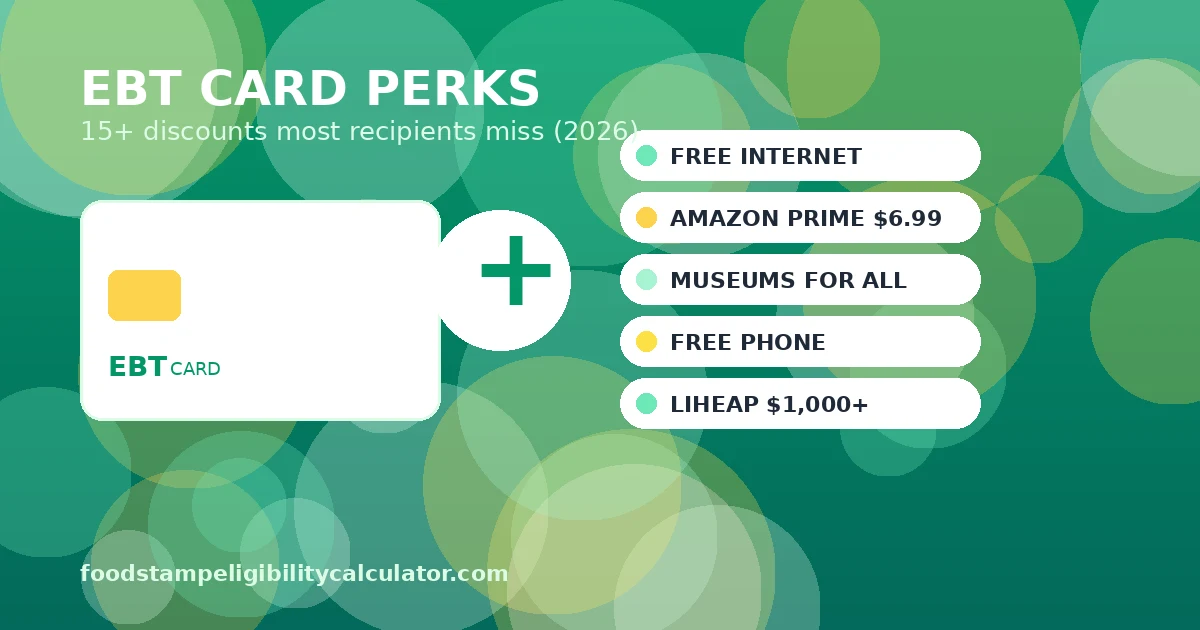
Here is the truth that almost no one tells you: an EBT card is not just a food benefit. It is also a key that unlocks free or discounted home internet, a $6.99 Amazon Prime membership, $3 admission at more than 1,400 museums, free cell phone service, up to $1,000 in heating and cooling bill help, doubled dollars at farmers markets, free school meals for your kids, $120 per child in summer grocery money, free tax filing, free legal aid, and a long list of state and city perks that almost no one advertises.
According to the National Lifeline Association, fewer than 40 percent of eligible households are enrolled in Lifeline alone. The numbers for the other programs are even worse.
This guide walks through every perk I have personally verified is active in 2026, exactly how to apply for each one, and the income or paperwork rules that gate them. If you have an EBT card today, you almost certainly qualify for at least eight of these. Read the whole list, claim the ones you qualify for, and bookmark this page so you can come back when you need the application links.
Table of Contents
- 1How EBT Perks Work (and Why Most People Miss Them)
- 2The 15+ EBT Perks You Should Claim in 2026
- 31. Amazon Prime Access — $6.99/month (Saves ~$78/year)
- 42. Lifeline — Free or $0–$10/month Home Internet
- 53. Free Smartphone + Monthly Service (Also Lifeline)
- 64. Museums for All — $3 Admission at 1,400+ Museums
- 75. LIHEAP — Up to $1,000+ in Heating and Cooling Bill Help
- 86. Free School Meals for Your Kids (Direct Certification)
- 97. SUN Bucks — $120 per Child for Summer Groceries
- 108. Double Up Food Bucks — Double Your SNAP at Farmers Markets
- 119. Free Tax Filing Through VITA (Saves $200+ vs Paid Preparers)
- 1210. Free Legal Aid Through LSC
- 1311. YMCA and Boys & Girls Club Scholarships (30–75% Off)
- 1412. Discounted or Free Public Transit
- 1513. Free National Parks Access (for 4th Graders and Some Adults)
- 1614. Internet Essentials & Low-Income Broadband Plans
- 1715. Head Start and Childcare Subsidies
- 1816. State-Level and City-Level Perks
- 19Quick Reference Table: Perks, Eligibility, and Where to Apply
- 20How to Verify Perks in Your State
- 21Final Thoughts
- 22Frequently Asked Questions
- 23What discounts can I get with an EBT card?
- 24Do I need a separate application for EBT discounts?
- 25Is Amazon Prime really only $6.99 with an EBT card?
- 26Can I get free internet with an EBT card?
- 27What is Museums for All and how do I use it?
- 28Does every state offer the same EBT perks?
- 29Related Articles
How EBT Perks Work (and Why Most People Miss Them)
The first thing to understand is that almost every perk on this list is run by a different agency or company. The federal Lifeline program is run by the Universal Service Administrative Company under the FCC. LIHEAP is run by the Administration for Children and Families under HHS.
Museums for All is run by the Association of Children's Museums. Amazon Prime Access is run by Amazon. SUN Bucks is run by USDA. None of them automatically enroll you when you get an EBT card. You have to apply separately for each one.
The reason most SNAP recipients miss these perks is not that they do not qualify. It is that no one tells them the perks exist. Caseworkers are trained to get you approved for SNAP, not to walk you through 15 side programs. The SNAP approval letter you receive does not mention any of them.
The EBT card itself arrives in a plain envelope with no insert. So people use the card at the grocery store and never find out they could also be saving $80 a year on Amazon Prime, getting free internet at home, and taking their kids to the zoo for $3.
The 15+ EBT Perks You Should Claim in 2026
1. Amazon Prime Access — $6.99/month (Saves ~$78/year)
Amazon offers a discounted Prime membership called Prime Access for anyone with a valid EBT card or Medicaid card. The price is $6.99 per month, billed monthly, with no annual commitment. A regular monthly Prime membership costs $14.99, so Prime Access saves you about $96 per year.
You get the same benefits as a regular Prime account: free two-day shipping on eligible items, Prime Video streaming, Prime Music, unlimited photo storage, and access to Amazon Fresh grocery delivery in participating cities.
To sign up, go to amazon.com/primeaccess, click "Get started," and follow the prompts to verify your EBT card. Amazon will ask for your card number and the name on the card. You will need to re-verify every 12 months. If you ever lose SNAP eligibility, you keep Prime Access for the rest of the current month and then your account converts to a regular Prime membership, which you can cancel.
2. Lifeline — Free or $0–$10/month Home Internet
The federal Lifeline program gives you a $9.25 per month benefit ($34.25 on tribal lands) that you can apply to home broadband, a mobile phone plan, or a bundled plan.
Most major internet service providers — AT&T, Verizon, T-Mobile, Comcast Xfinity, Cox, Spectrum, and others — have a Lifeline plan that ends up costing between $0 and $10 per month after the benefit is applied. T-Mobile and AT&T both offer fully free Lifeline plans in many states.
You are automatically income-eligible for Lifeline if you have SNAP, Medicaid, SSI, Federal Public Housing Assistance, Veterans Pension, or Survivors Pension. To apply, go to lifelinesupport.org and complete the National Verifier application.
Once approved, choose a participating provider in your state and sign up. The whole process takes about 30 minutes online and the benefit starts within 7 to 10 business days.
3. Free Smartphone + Monthly Service (Also Lifeline)
The same Lifeline benefit can be applied to a mobile phone plan instead of internet.
Several carriers — Q Link Wireless, SafeLink, Truconnect, Access Wireless, Assurance Wireless, and others — offer a free Android smartphone with free monthly service that includes unlimited talk, unlimited text, and a few gigabytes of data, at no cost to you if you qualify. The phone is yours to keep. You recertify annually.
You cannot use the Lifeline benefit for both internet and a phone at the same time — you have to pick one. If you have no phone at all, the phone plan is usually the better choice. If you already have a phone through work or family, take the internet benefit.
4. Museums for All — $3 Admission at 1,400+ Museums
Museums for All is a national access program run by the Association of Children's Museums and the Institute of Museum and Library Services.
If you have an EBT card, you and up to three other people can walk into any of the 1,400-plus participating museums, science centers, children's museums, zoos, aquariums, botanical gardens, and historic sites for $3 or less per person. No registration required. Just show your EBT card at the admission desk.
Participating venues include major institutions like the Children's Museum of Indianapolis, the Exploratorium in San Francisco, the Chicago Children's Museum, the Boston Children's Museum, the Bronx Zoo (free admission on Wednesdays for EBT card holders), and hundreds of smaller local museums.
The full list is at museums4all.org. I keep this list bookmarked on my phone and use it on family trips — a single museum visit often pays for the time it took to find the program.
5. LIHEAP — Up to $1,000+ in Heating and Cooling Bill Help
The Low Income Home Energy Assistance Program (LIHEAP) is a federally funded block grant administered by your state. It provides a once-a-year payment (typically between $300 and $1,000, sometimes more) directly to your utility company to help with heating or cooling bills.
Some states also offer emergency assistance if you have a shut-off notice, and weatherization help (free insulation, furnace repair, window replacement) through the related WAP program.
LIHEAP uses 150% of the Federal Poverty Level as its income cap (higher than SNAP's 130%), and SNAP enrollment is automatic income proof.
Funding is limited and the program is first-come, first-served, so apply early in the program year — usually October or November for heating help, April or May for cooling help. Apply through your state's LIHEAP office, which you can find at liheaphelp.org or by calling 211.
6. Free School Meals for Your Kids (Direct Certification)
If your household receives SNAP, your school-aged children are automatically eligible for free school breakfast and lunch through a process called Direct Certification. You do not have to fill out a separate school meal application. Your state's Department of Education and SNAP agency share data, and your children's names are sent directly to the school district.
In practice, the school should mail you a letter in August telling you your kids are directly certified. If you do not get the letter or your kids are charged for meals in September, call the school and ask for the food services director — sometimes the data sync fails and they need to manually enroll your child.
This is one of the highest-value perks on the list: free school meals save about $1,200 per child per school year, and kids who eat school breakfast score higher on tests.
7. SUN Bucks — $120 per Child for Summer Groceries
SUN Bucks (formerly called Summer EBT) is a newer permanent federal program that gives families $120 per child for the summer to buy groceries when school is out.
Benefits are loaded onto an EBT-style card (separate from your regular SNAP card in most states) and can be spent at any store that accepts SNAP. In 2026, all 50 states, the District of Columbia, the five U.S. territories, and many tribes are participating.
If your kids are directly certified for free school meals because you have SNAP, they are automatically enrolled in SUN Bucks. You do not need to apply. The $120 per child typically arrives in June or July. If you do not get it, contact your state SUN Bucks agency (a list is at fns.usda.gov/sun-bucks). For a family with three kids, that is $360 in extra food money in the summer.
8. Double Up Food Bucks — Double Your SNAP at Farmers Markets
Double Up Food Bucks (and similar programs run under names like "Market Match," "Philly Food Bucks," "Massachusetts Healthy Incentives Program (HIP)," and "Fresh Bucks") match your SNAP spending at participating farmers markets, usually dollar for dollar, up to $10 to $40 per day.
You spend $10 of SNAP on fresh produce, you get $10 in matching tokens for more produce. Some programs are even more generous — Massachusetts HIP gives you $40, $60, or $80 back per household per month depending on household size, essentially making produce free.
The program is run by the nonprofit Double Up Food Bucks (a program of Field & Fork Network) in about 25 states, and by state-level equivalents in others. Look up your local farmers market at doubleupfoodbucks.org or ask the market manager when you arrive. Bring your EBT card, swipe at the market info booth, and you will get tokens to spend.
9. Free Tax Filing Through VITA (Saves $200+ vs Paid Preparers)
The IRS Volunteer Income Tax Assistance (VITA) program offers free tax preparation for households earning $67,000 or less (the threshold typically rises slightly each year).
VITA volunteers are IRS-certified and can prepare federal and state returns, claim the Earned Income Tax Credit (EITC), the Child Tax Credit (CTC), and the Child and Dependent Care Credit. For a working family with two kids, the EITC alone can be worth $6,000+. A paid preparer would charge $200 to $400 for the same return.
Find a VITA site at irs.gov/vita or by calling 1-800-906-9887. Sites are typically open late January through April, with some open year-round. Bring photo ID, Social Security cards for everyone on the return, W-2s and 1099s, a blank check for direct deposit, and last year's return if you have it.
10. Free Legal Aid Through LSC
The Legal Services Corporation (LSC) is a federally funded nonprofit that gives grants to local legal aid offices in every state.
If your household income is at or below 125% of the Federal Poverty Level, you qualify for free legal help with civil (non-criminal) matters: eviction defense, family law (custody, divorce, child support), public benefits disputes (including SNAP denials and overpayment appeals), domestic violence protective orders, bankruptcy, and consumer debt defense.
Legal aid lawyers are real attorneys licensed in your state, and the help is free. Find your local office at lsc.gov/about-lsc/what-legal-aid/get-legal-help. This is one of the most underused perks on the list — people assume they have to pay for a lawyer or go without, and neither is true.
11. YMCA and Boys & Girls Club Scholarships (30–75% Off)
Most local YMCA branches offer income-based scholarships that discount membership fees by 30 to 75 percent, and many waive the joining fee entirely for SNAP-recipient families. The same applies to many Boys & Girls Clubs, JCCs, and city recreation centers. The discount is not advertised — you have to ask.
Bring your EBT card or SNAP approval letter to the membership desk and ask about their financial assistance program. The application is usually one page. I have personally seen families pay $15 per month for a full family YMCA membership that would otherwise cost $95.
12. Discounted or Free Public Transit
Many cities and transit agencies offer reduced-fare or free transit for low-income riders. Examples in 2026 include New York City's Fair Fares program ($1.35 per ride, half the regular fare), Chicago RTA Reduced Fare (half fare for SNAP recipients), San Francisco Muni Lifeline Pass ($30/month instead of $81), Seattle ORCA LIFT (50% off), Los Angeles Metro LIFE (free or reduced fare), Washington DC Metro Lift (50% off), and Atlanta MARTA Reduced Fare.
Eligibility almost always includes SNAP enrollment. Apply through your transit agency's website or at a customer service center.
13. Free National Parks Access (for 4th Graders and Some Adults)
The National Park Service's Every Kid Outdoors program gives every fourth grader in the country a free annual pass that covers entrance fees at all national parks and federal lands for the student and their family.
For adults on SNAP, the standard America the Beautiful annual pass costs $80, but seniors 62 and older can get a lifetime pass for $80 (one-time fee), and SNAP enrollment can help you qualify for free passes through some state park systems. Several states (California, New York, Washington, Oregon, Colorado, Maryland, Virginia, and others) waive state park entrance fees entirely for SNAP or EBT card holders. Check your state parks department website.
14. Internet Essentials & Low-Income Broadband Plans
Separate from Lifeline, most major ISPs offer their own low-income internet plans. Comcast Internet Essentials is $9.95 per month for households with SNAP, Medicaid, or a child in the National School Lunch Program. Cox Connect2Compete is $9.95. Spectrum Internet Assist is $19.99.
AT&T Access is $30 (or $0 with the now-sunset ACP credit, but still $30 max without it). These plans typically give you 50 to 100 Mbps, no contract, no installation fee, and a free Wi-Fi router. You can stack Lifeline on top of these in some cases, getting internet for $0.
15. Head Start and Childcare Subsidies
SNAP enrollment makes you categorically eligible for Head Start (free preschool for 3- and 4-year-olds from low-income families) and for the Child Care and Development Fund (CCDF) childcare subsidy, which pays for daycare while you work or attend school. Both programs are run locally with federal funding.
Head Start is free; CCDF copays are based on a sliding scale and many SNAP-eligible families pay nothing. Apply through your local Head Start program or your state's CCDF agency. Waitlists are common, so apply as early as possible — many parents sign up at birth.
16. State-Level and City-Level Perks
Many states and cities add their own perks. Examples: California offers free fishing licenses for SNAP recipients through the California Department of Fish and Wildlife. New York City offers free IDNYC municipal ID that comes with free memberships at dozens of cultural institutions.
Massachusetts HIP gives $40 to $80 back per month on produce. Minnesota offers free state park admission. Texas offers discounted hunting and fishing licenses. Most zoos in major cities have free or $3 days for EBT card holders. Call 211 or visit 211.org to find programs in your area — the operators are trained to know every local resource.
Quick Reference Table: Perks, Eligibility, and Where to Apply
Here is the table I wish I had when I started helping families. Print it out, stick it on the fridge, and work through it one perk at a time.
| Perk | Approx. Annual Value | Eligibility | Where to Apply |
|---|---|---|---|
| Amazon Prime Access | $96 | EBT or Medicaid card | amazon.com/primeaccess |
| Lifeline (internet or phone) | $110–$410 | SNAP, Medicaid, SSI, etc. | lifelinesupport.org |
| Museums for All | $100+ | EBT card | At venue (no application) |
| LIHEAP (energy bill) | $300–$1,000 | SNAP auto-qualifies | liheaphelp.org or 211 |
| Free school meals | $1,200 per child | SNAP direct cert | Automatic; call school if not |
| SUN Bucks (summer) | $120 per child | SNAP direct cert | Automatic; check fns.usda.gov/sun-bucks |
| Double Up Food Bucks | $200–$600 | EBT card | doubleupfoodbucks.org |
| VITA free tax prep | $200+ saved | Income ≤ $67k | irs.gov/vita |
| Free legal aid (LSC) | $1,000+ | SNAP auto-qualifies | lsc.gov/get-legal-help |
| YMCA scholarship | $500+ | EBT or SNAP letter | Ask at branch |
| Reduced-fare transit | $300–$700 | SNAP auto-qualifies | Transit agency website |
| Comcast Internet Essentials | $600+ | SNAP or Medicaid | internetessentials.com |
| Head Start (free preschool) | $11,000+ | SNAP auto-qualifies | Local Head Start |
| CCDF childcare subsidy | $6,000+ | SNAP auto-qualifies | State CCDF agency |
| State park free days | $30–$200 | Varies by state | State parks website |
How to Verify Perks in Your State
Because perks vary by state and city, the best single resource is 211. Call 2-1-1 from any phone, tell the operator your zip code and that you have an EBT card, and ask them to walk you through every benefit you might qualify for.
The service is free, confidential, and available 24/7 in most states. They can also do the lookup online — visit 211.org and search by zip code. Their database is updated quarterly and covers federal, state, county, and city programs.
For federal programs, the official directories are: benefits.gov (full benefit finder questionnaire that takes about 20 minutes and lists every federal program you might qualify for), usa.gov/benefits (categorical lists by family, disability, military, etc.), and the agency-specific sites listed in the sources below.
Final Thoughts
The point of this article is not that you should spend your weekend applying for 15 programs. The point is to know they exist and to claim the ones that matter most to your family.
If you do nothing else this week, do these three things: sign up for Amazon Prime Access (10 minutes, saves $96 a year), apply for Lifeline (30 minutes, saves $110 to $410 a year), and confirm your kids are directly certified for free school meals (one phone call to the school, saves $1,200 per child per year). Those three alone can be worth $2,000 or more annually for a family of four, and they are all programs you have already qualified for by getting an EBT card.
Programs change. Eligibility thresholds change. New perks get added and old ones get cut. Bookmark this page and come back every six months. If you find a perk that is not on this list, send us a note through our contact page — we update this guide quarterly based on reader feedback, and the more eyes we have on it, the more complete it stays.
Frequently Asked Questions
What discounts can I get with an EBT card?
EBT card holders in 2026 can claim free or $10-per-month home internet through Lifeline, Amazon Prime for $6.99 per month, free smartphone service through Lifeline, $3 admission to more than 1,400 museums through Museums for All, up to $1,000 in heating and cooling bill help through LIHEAP, doubled SNAP dollars at many farmers markets through Double Up Food Bucks, free school meals for enrolled children, $120 per child in SUN Bucks summer EBT, free tax preparation through VITA, free legal aid through LSC, and discounted YMCA memberships and public transit in many cities.
The full list with application links is above.
Do I need a separate application for EBT discounts?
Most EBT discounts require their own application because each perk is run by a different agency or company. SNAP enrollment itself does not auto-enroll you in Lifeline, LIHEAP, Amazon Prime Access, or Museums for All. You apply for each perk separately.
The good news is that in most cases you can use your SNAP approval letter or your EBT card as proof of eligibility, which makes the application much faster than a full income application. A typical Lifeline application takes about 30 minutes online.
Is Amazon Prime really only $6.99 with an EBT card?
Yes. Amazon Prime Access is a discounted Prime membership for customers with a valid EBT card or Medicaid card. The price is $6.99 per month, billed monthly, with no annual commitment, which saves about $96 per year compared to the regular monthly Prime rate of $14.99.
You need to verify your EBT card number on Amazon's sign-up page and re-verify every 12 months. The membership includes the same Prime benefits as a regular Prime account: free two-day shipping, Prime Video, Prime Music, and grocery delivery from Amazon Fresh where available.
Can I get free internet with an EBT card?
Yes, through the federal Lifeline program. Lifeline provides a $9.25 per month benefit (or $34.25 on tribal lands) that can be applied to home internet, a mobile phone plan, or a bundled plan. Many internet service providers offer plans at or near $0 after the Lifeline benefit is applied.
You qualify automatically if you have SNAP, Medicaid, SSI, Federal Public Housing, or Veterans Pension. Apply through the Lifeline National Verifier at lifelinesupport.org, then choose a participating ISP in your state.
What is Museums for All and how do I use it?
Museums for All is a national access program that gives EBT card holders admission to more than 1,400 participating museums, science centers, zoos, aquariums, and children's museums for $3 or less per person, for up to four people per EBT card.
Just show your EBT card at the admission desk. You do not need to register in advance. The Association of Children's Museums runs the program with the Institute of Museum and Library Services. The full list of participating venues is at museums4all.org.
Does every state offer the same EBT perks?
Federal programs like Lifeline, Museums for All, LIHEAP, and SUN Bucks are available in every state, though funding levels and benefit amounts vary. State-level perks like transit discounts, state park fee waivers, YMCA scholarships, and zoo discounts vary widely.
Some states add their own perks on top of federal ones. California, New York, Massachusetts, Minnesota, and Washington are particularly generous. Call 211 or visit 211.org to find state-specific programs in your area.