Cryptocurrency has gone from a niche hobby to a real source of income for millions of Americans. Whether you trade Bitcoin on Coinbase, stake Ethereum for yield, or run a mining rig in your garage, the IRS treats your crypto activity as taxable income. SNAP follows the same logic. Crypto earnings count as income, and your crypto holdings count as resources, just like cash in a bank account.
The challenge is that crypto is unfamiliar territory for many SNAP caseworkers. Valuation can be volatile, transactions happen on decentralized exchanges that do not issue 1099s, and the line between trading income and long-term investment gains is not always clear. This guide walks through how SNAP treats cryptocurrency, what records you need to keep, and how to report your crypto activity without triggering an overpayment.
How SNAP Classifies Crypto Income
SNAP classifies crypto income the same way it classifies any other self-employment or investment income. If you actively trade, mine, or stake crypto for profit, the net income counts as self-employment income. If you simply hold crypto as a long-term investment and sell at a gain, the capital gain counts as unearned income in the month of the sale.
The 50 percent self-employment standard deduction applies to active crypto businesses, just as it does to direct sales income or any other gig work. Mining electricity costs, hardware depreciation, and exchange fees are deductible as actual expenses if they exceed the standard deduction. The SNAP for self-employed workers guide covers the documentation you need to prove these expenses.
Crypto received as payment for goods or services, including wages paid in Bitcoin, counts as earned income at the fair market value on the date you received it. Some employers in the tech industry pay a portion of salary in crypto. That portion is earned income for SNAP, subject to the 20 percent earned income deduction.
Valuing Crypto for SNAP Purposes
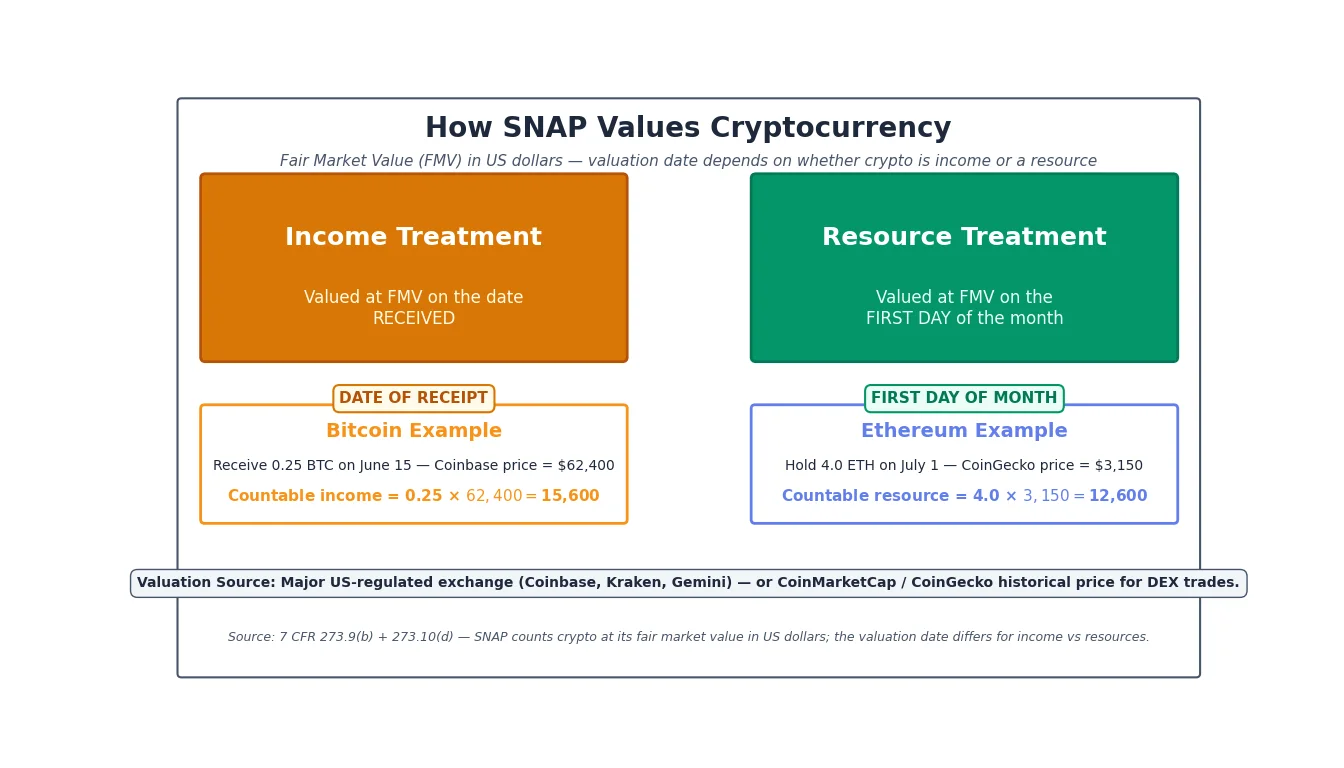
Snap caseworkers use the fair market value of crypto in US dollars on the date of valuation. For income, that date is the day you received the crypto. For resources, that date is the first day of the month for which SNAP eligibility is being determined. Because crypto prices can swing 20 percent in a week, the valuation date matters.
The standard valuation source is the exchange rate on a major US-regulated exchange like Coinbase, Kraken, or Gemini. If you use a decentralized exchange, the caseworker may accept the CoinMarketCap or CoinGecko historical price for the date in question. Keep screenshots or export your trade history so you can document the valuation method.
Stablecoins like USDC and USDT are pegged to the dollar, so their valuation is straightforward. One USDC equals one dollar for SNAP purposes. However, if a stablecoin loses its peg, as UST did in 2022, the caseworker may use the actual market value rather than the intended peg. Document everything.
Mining and Staking Income
Crypto mining is treated as self-employment income. The value of the coins you mine counts as gross income on the day you receive them. Your deductible expenses include electricity, mining hardware depreciation, internet service, pool fees, and a portion of your home office if you mine at home. Mining is one of the most heavily-expensed crypto activities, so the actual expense method usually beats the 50 percent standard deduction.
Staking income, including rewards from proof-of-stake validation and liquidity provision on decentralized exchanges, is also self-employment income. The rewards are valued at fair market value on the day they are credited to your wallet. Staking has fewer deductible expenses than mining, typically just validator fees and a portion of internet and computing costs.
If you run a mining operation as a business with employees and significant revenue, you may need to provide a Schedule C and profit and loss statement. For small-scale miners, a simple log of coins mined, dates, and USD values usually suffices. The gross vs net income guide covers how SNAP calculates net self-employment income.
Crypto as a Resource
Crypto you hold in a wallet or exchange account counts as a resource for SNAP. The valuation date is the first day of the month. If you have 0.5 Bitcoin in a Coinbase account on the first of the month and Bitcoin is trading at $60,000, your countable resource is $30,000, which would put you over the resource limit for most households.
This is where many crypto holders get tripped up. They assume that because crypto is volatile and not cash, it does not count. It does. SNAP follows the IRS treatment, which considers crypto property, and property that can be readily converted to cash counts as a resource.
The resource limit is $2,750 for most households, or $3,000 with an elderly or disabled member. If your crypto holdings push you over the limit, you have the same spend-down options as with any other resource. Selling the crypto to pay bills or pay down debt removes it from your countable resources.
Reporting Crypto on Your SNAP Application
On the SNAP application, list your crypto activity in the self-employment section if you actively trade, mine, or stake. Provide an estimate of your average monthly net income after expenses. If you only hold crypto as a long-term investment, list the current value in the resources section.
If you receive a 1099-K or 1099-NEC from an exchange, bring it to your SNAP interview. Exchanges are required to issue 1099-K for transactions above certain thresholds starting in the 2025 tax year. Even if you do not receive a 1099, you are still required to report the income. The tax return income proof guide covers how SNAP uses your Schedule C and Form 1040 to verify self-employment income.
For bank statements, expect the caseworker to ask for the last 30 days of activity on any account linked to a crypto exchange. If you transfer money from Coinbase to your checking account, that deposit is visible on your bank statement. The caseworker will want to know whether it was income or a return of your own investment. Keep clear records of what each deposit represents.
Common Mistakes That Lead to Overpayment
The most common mistake is failing to report crypto income at all. Households often assume that because the income is in Bitcoin, it does not count for a US government program. It does. If SNAP later discovers the unreported income through a bank statement review or a data match, you face an overpayment notice and possible disqualification.
The second most common mistake is using the wrong valuation date. If you report the value of your crypto on the day you filled out the application instead of the first day of the month, your resource total may be off by thousands of dollars. Always use the first of the month for resource valuation.
The third mistake is commingling crypto income with personal funds in the same account. If your Coinbase withdrawals go into a checking account that also receives wages and pays rent, it is very hard to prove what portion of the balance is countable income versus a return of your own principal. Open a separate bank account for crypto activity to keep the paper trail clean.
If you receive a notice, the SNAP overpayment guide walks through how to respond. Many crypto-related overpayments are reduced or dismissed on appeal when the household can show that the deposit was a return of principal, not income.
DeFi, NFTs, and Hard-to-Value Assets
Decentralized finance activities like liquidity provision, yield farming, and lending generate income that is harder to document. The rewards may be paid in tokens that have no established US dollar market. For SNAP, you still need to assign a fair market value, typically using the rate on the decentralized exchange where the token trades.
NFT sales count as capital gains if you held the NFT as an investment, or as self-employment income if you are a creator selling your own work. The same valuation rules apply. Use the USD value on the date of sale. NFT creators often have significant deductible expenses, including platform fees, gas costs, and software.
If your crypto activity is complex enough that you use a crypto tax service like CoinTracker or Koinly, bring the generated tax report to your SNAP interview. The caseworker may not have seen one before, but the report is the clearest way to document your net income.
Final Thoughts on Crypto and SNAP
Cryptocurrency is just another form of income and resources for SNAP purposes. The rules are the same as for any other self-employment activity, with the added complexity of volatile valuation and unfamiliar documentation. The households that get in trouble are the ones that ignore their crypto activity entirely, not the ones that report it accurately.
Keep detailed records, value your crypto on the correct dates, and report it transparently. Use the SNAP eligibility calculator to estimate how your crypto income affects your benefit, and if your activity is significant, talk to an accountant who understands both crypto taxes and public benefit interactions before your recertification interview.
Want to know if your income qualifies? Use our free calculator to check your SNAP eligibility in about 90 seconds — no paperwork, no commitment, just an honest answer.
Check My EligibilitySources
- USDA Food and Nutrition Service, SNAP Self-Employment Income Guidance
- Internal Revenue Service, Notice 2014-21 (Virtual Currency Guidance)
- Internal Revenue Service, Publication 525 (Taxable and Nontaxable Income)
- Code of Federal Regulations, 7 CFR 273.9 (Income and Resources)
- Internal Revenue Service, Form 1040 Schedule C and Schedule D Instructions