A tax return is the most complete picture of a year's worth of income that exists on a single document. For SNAP purposes, that is exactly why it matters. When pay stubs are missing, when self-employment income is hard to pin down, or when the agency needs to verify income for someone who works multiple short jobs, a signed tax return often does the work of three months of bank statements.
But tax returns also have a specific weakness. They describe last year, not this year. SNAP counts current income, not historical income. So the return is useful as a supporting document, not as the only document. This guide walks through when the agency accepts a tax return, when it does not, and how to pair it with current proof so your file moves.
If you want to see where the tax return fits in the full document stack, our SNAP verification documents checklist shows the order agencies usually ask for things and which documents can substitute for each other.
Table of Contents
- 1When SNAP accepts a tax return as income proof
- 2When a tax return is not enough on its own
- 3Self-employment income and the Schedule C
- 4What the caseworker actually reads on the return
- 5How prior-year tax returns interact with current income
- 6Amended returns and what they mean for SNAP
- 7Extensions and unfiled returns
- 8Tax returns and household composition
- 9Filing status and how it affects SNAP
- 10Joint custody and dependents on the return
- 11What the agency cannot ask about your tax return
- 12How tax returns interact with other income sources
- 13Keeping your tax return current for recertification
- 14The short version
- 15Frequently asked questions
- 16Can I use my tax return as the only income proof for SNAP?
- 17Which line on the tax return does SNAP use for self-employment income?
- 18What if my current income is lower than what my tax return shows?
- 19Do I need to have filed taxes to qualify for SNAP?
- 20Wasim Akram
When SNAP accepts a tax return as income proof
The most common scenario is self-employment. If you run a small business, work as an independent contractor, or earn income from a side gig that you report on Schedule C, the agency treats your most recent tax return as the starting point for verifying that income. The return shows your gross receipts, your business expenses, and your net profit, which is the number SNAP actually counts.
For self-employed SNAP applicants, the return is not the only acceptable proof, but it is the one that requires the least additional work. A Schedule C with a net profit line gives the caseworker a clean number to work with. If you do not have a return yet because your business is new, the agency falls back to bank statements and a profit-and-loss statement you prepare yourself.
The other scenario where a tax return carries weight is irregular W-2 income. If you worked four different jobs last year and have already quit two of them, a W-2 from any of those jobs shows the agency what your earning pattern looked like. The return is not used as current income, but it gives the caseworker a baseline to compare against your current pay stubs.
When a tax return is not enough on its own
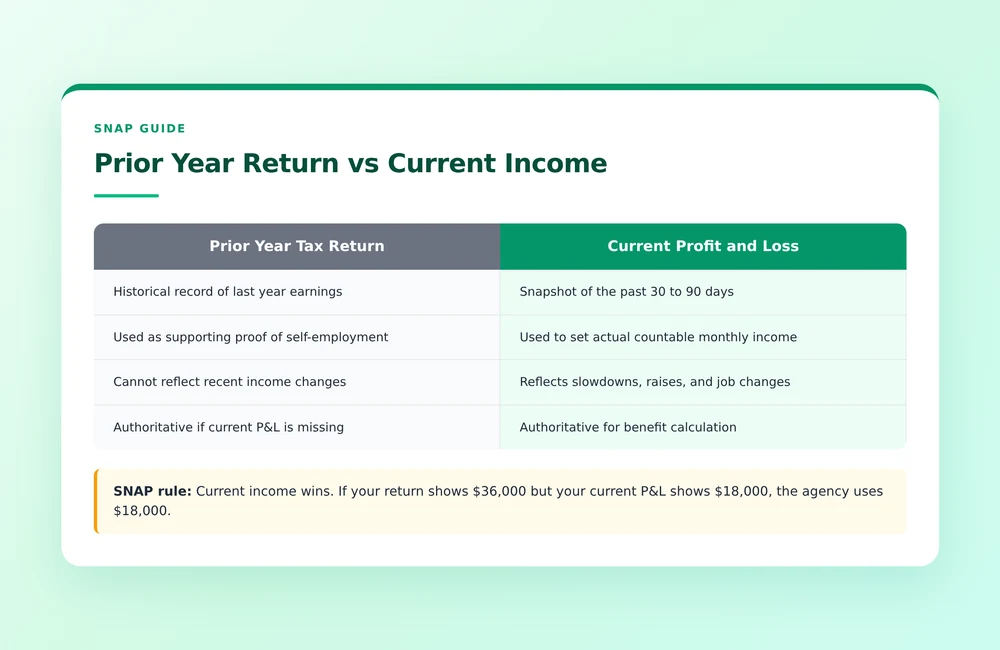
Snap counts anticipated income, meaning what you expect to earn in the current month and the near future. A tax return describes income that has already been earned and is closed. If you file a return showing $36,000 in self-employment income last year, but your business has slowed down and you are on pace for $18,000 this year, the agency cannot use the $36,000 figure as your current income.
This is where current documentation comes in. The caseworker will ask for the tax return as proof of your self-employment history, plus a current profit-and-loss statement covering the past 30 to 90 days. The current P&L is what determines your countable monthly income. The return is the supporting document that confirms the P&L is plausible.
If you have not yet filed taxes for the most recent year, the agency falls back to the prior year's return. If you have never filed because your income has always been below the filing threshold, you tell the caseworker that in writing. SNAP does not penalize you for being a non-filer if your income was genuinely below the IRS threshold.
Self-employment income and the Schedule C
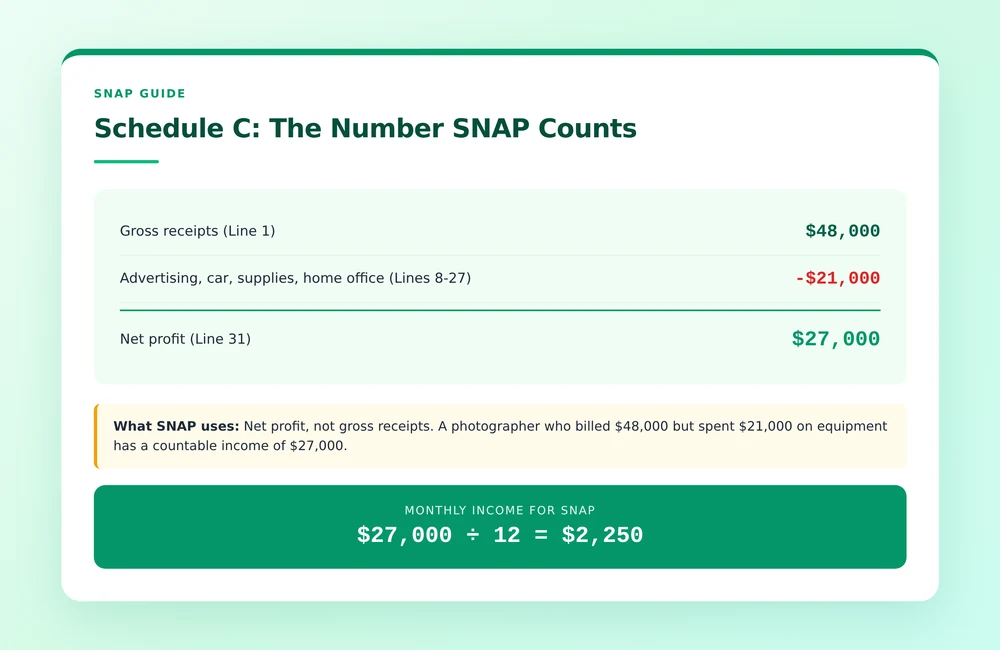
The Schedule C is the part of the tax return that matters most for SNAP. It shows total revenue, expense categories, and the net profit that flows to your 1040. The caseworker takes the net profit number, divides it by 12, and uses that as your average monthly self-employment income.
That division matters. A net profit of $24,000 on the Schedule C becomes $2,000 a month for SNAP purposes. If your current P&L shows you are now earning $1,200 a month because work has slowed, the caseworker can use the lower current number. But if the current P&L shows $2,800 a month, the agency uses the higher current figure, not the older return number.
The gross versus net income guide explains why this distinction matters so much. SNAP counts net self-employment income after business expenses, not gross revenue. A photographer who billed $50,000 last year but spent $30,000 on equipment, studio rent, and software has a net profit of $20,000, and that is the number the agency works with.
What the caseworker actually reads on the return
The caseworker does not read your entire return. They look at specific lines depending on your situation.
- Line 12 on Form 1040 shows business income from Schedule C. This is the number used for sole proprietors and single-member LLCs.
- Line 1 on Form 1040 shows W-2 wages. If you have both W-2 and self-employment income, the caseworker adds them together.
- Schedule SE shows self-employment tax. SNAP does not count this as income, but it confirms the Schedule C number is real.
- Schedule E covers rental income and partnership income. If you own rental property, this is where it shows up.
- Schedule F covers farm income. If you operate a farm, the agency uses this schedule the same way they use Schedule C for other businesses.
The caseworker may also look at the side hustle income reported on your return. If you have a W-2 job and also drive for Uber on weekends, the Uber income shows up on Schedule C, and the agency counts it.
How prior-year tax returns interact with current income
SNAP policy in most states says current income is what matters. If your current income has dropped from what the tax return shows, you tell the caseworker, and you provide current proof. The return stays in the file as historical reference, but it does not set your benefit.
This is the rule that protects people who had a good year last year and a bad year this year. A freelancer who earned $75,000 in 2025 but is on pace for $30,000 in 2026 does not have to live with the 2025 number. The agency uses current proof, and the return becomes background context.
The reverse is also true. If your income has gone up, the agency expects you to report it. A non-filer last year who suddenly has a $50,000 W-2 job needs to tell the agency, even if no tax return exists yet for the current year. Failing to report an income increase is the most common trigger for a SNAP overpayment, and our page on what happens when you receive a SNAP overpayment notice walks through how the agency discovers the discrepancy and what your repayment options are.
Amended returns and what they mean for SNAP
If you amended your tax return after filing, the agency wants the amended version, not the original. An amended return shows up as a 1040-X, which lists the original numbers, the corrected numbers, and the reason for the change.
Amended returns are common for self-employed people who file early and then receive a corrected 1099 from a client. They are also common for people who missed a deduction the first time around. The caseworker treats the amended return as the authoritative document.
If you are in the middle of amending a return when you apply for SNAP, tell the caseworker. The agency can proceed with the original return and update the file when the amendment is final. What you do not want is for the agency to discover the amendment later and treat it as undisclosed income.
Extensions and unfiled returns
If you filed for an extension and have not yet submitted your return, the agency falls back to the prior year's return, plus current proof. An extension is not a red flag. It is a normal part of tax filing for self-employed people and small business owners.
If you have not filed at all and the agency asks, you have a few options. You can file the return quickly, which is the cleanest path. You can provide a written statement explaining why you have not filed, such as being below the filing threshold. Or you can provide a current P&L and bank statements in lieu of a return, which most agencies accept for self-employed applicants.
What you cannot do is ignore the question. SNAP applications have a 30-day processing window, and a missing tax return can extend that window or trigger a denial for incomplete documentation. If your application gets denied for this reason, our guide on how to reapply for SNAP after being denied covers the appeal process.
Tax returns and household composition
Your tax return also tells the agency who is in your household. The dependents you claim on the 1040 are assumed to live with you, and the agency counts them as part of your SNAP household unless evidence shows otherwise.
This matters for benefit calculation because SNAP counts household size, not just income. A single person with a $1,500 monthly net income gets a different benefit than a family of three with the same income. The SNAP benefit calculation formula page walks through how household size changes the standard deduction and the maximum allotment.
If your household has changed since you filed taxes, tell the caseworker. A new baby, a parent moving in, a child aging out, or a divorce all change the household size and need to be documented separately. The tax return is a starting point, not the final word.
Filing status and how it affects SNAP
Your tax filing status does not directly determine your SNAP household. Married couples who file separately for tax purposes are still one SNAP household if they live together. Two unrelated roommates who file as single are separate SNAP households if they purchase and prepare food separately.
The SNAP household definition is based on who lives together and shares meals, not on tax status. The SNAP for roommates and shared households page explains this distinction in detail, including how the agency tests whether two people living together count as one household or two.
For married couples, the rule is straightforward. If you live with your spouse, you are one SNAP household regardless of how you file taxes. If you are separated and living apart, you may be able to file as separate households, but you need documentation of the separation.
Joint custody and dependents on the return
If you share custody of a child and both parents claim the child on alternating tax years, the SNAP agency uses current custody, not tax claiming, to decide which household includes the child. The child counts in the household where they sleep the majority of nights.
This can create a mismatch. You might have claimed the child on last year's tax return, but if the child currently lives primarily with the other parent, the child does not count in your SNAP household. The SNAP and joint custody page covers this scenario in more depth, including what documentation the agency accepts to confirm the current custody arrangement.
What the agency cannot ask about your tax return
SNAP is not the IRS. The caseworker can ask about income, but they cannot audit you. They cannot demand to see receipts for every line on your Schedule C. They cannot question whether a deduction was legitimate. The IRS handles tax compliance, not SNAP.
What the caseworker can do is ask whether the return reflects your current situation. If you wrote off $15,000 in vehicle expenses last year and you no longer have a vehicle, the agency can ask how your business operates now. The answer is not that you owe SNAP money. The answer is that your current P&L should reflect the change.
How tax returns interact with other income sources
If you receive income from sources beyond work, the tax return often captures them in one place. A 1099 for unemployment benefits, a 1099-R for pension distributions, a 1099-INT for interest income, and a 1099-DIV for dividends all show up on your 1040.
SNAP counts most of these as income, but with different rules. Unemployment benefits count as unearned income. Pensions count as unearned income. Child support payments you receive do not count as income for SNAP, even though they may appear on your return. Our SNAP and child support page covers how these payments are treated.
Alimony is more complicated. For divorces finalized before 2019, alimony is taxable income and shows up on the return. For divorces finalized after 2018, alimony is not taxable and does not appear. SNAP counts alimony as income either way, so the agency may ask for the divorce decree if alimony does not show on the return.
Keeping your tax return current for recertification
SNAP recertification happens every 6 to 24 months depending on your state and household composition. At recertification, the agency asks for fresh proof of income, which often includes your most recent tax return if you are self-employed.
If you filed a return since your last recertification, bring it. If you have not filed yet because the tax deadline has not arrived, your prior year's return plus a current P&L is usually enough. The SNAP recertification documents page walks through the full document stack you will need at renewal time.
For recipients who have a change in self-employment income mid-certification period, the rule is the same as at application. Report the change, provide current proof, and let the agency recalculate. Our page on unreported SNAP changes penalties covers what happens if you skip that step.
The short version
A tax return is the most reliable single document for verifying self-employment income, but it is always paired with current proof because SNAP counts current income, not historical income. If you are self-employed, bring your most recent return plus a current profit-and-loss statement. If you are a W-2 worker with multiple jobs, bring your return plus your most recent pay stubs. If your income has changed since you filed, say so in writing and provide the current numbers.
Do not try to use a tax return to hide a current income increase. The agency will find out, and the overpayment process is more painful than simply reporting the change when it happens. Do use your tax return to demonstrate your earning pattern, especially if your income is irregular or seasonal. The return gives the caseworker context that pay stubs alone cannot provide, and that context often makes the difference between a smooth application and a stalled one.
Frequently asked questions
Can I use my tax return as the only income proof for SNAP?
No. SNAP counts current income, and a tax return describes last year. The return is used as supporting proof, especially for self-employed applicants, but it must be paired with a current profit and loss statement or recent bank statements.
Which line on the tax return does SNAP use for self-employment income?
The caseworker looks at Schedule C net profit, which flows to Line 12 of Form 1040. That number is divided by 12 to get the average monthly self-employment income.
What if my current income is lower than what my tax return shows?
Tell the caseworker in writing and provide a current profit and loss statement. SNAP uses current income, not historical income, so the lower current number applies as long as you can document it.
Do I need to have filed taxes to qualify for SNAP?
No. SNAP does not penalize non-filers whose income was below the IRS filing threshold. If you have never filed because your income was always below the threshold, tell the caseworker in writing and provide current income proof.
Wasim Akram
Founder & Lead Researcher · Food Stamp Eligibility Calculator
Wasim Akram is an independent web publisher and digital entrepreneur with over 8 years of experience in SEO, web publishing, technical research, and building digital products. Since 2018, he has been creating niche websites, online tools, custom CMS platforms, and WordPress products. He founded Food Stamp Eligibility Calculator in 2026 after seeing firsthand how difficult it was for ordinary families to get a straight answer about whether they qualified for food assistance. Every article on this site is researched, written, and reviewed against primary government sources including USDA Food and Nutrition Service manuals, state SNAP policy manuals, the Federal Register, and official state agency guidance.