If you're receiving Social Security Disability Insurance (SSDI) and stretching every dollar at the grocery store, you've probably wondered whether you can still get SNAP. The short answer is yes — SSDI doesn't disqualify you. But SSDI isn't invisible to SNAP either. It counts as income, and that income runs through the SNAP math the same way wages would. This guide walks through which deductions wipe out part of your SSDI and how to keep your benefit as high as the rules allow.
SNAP treats SSDI as unearned income, so every dollar counts toward your gross monthly income. That's different from SSI, which is excluded under a special rule we'll cover later. Disabled and elderly households get a bigger menu of deductions than a working household gets. Our page on SNAP benefits for disabled Americans breaks down every special rule.
Key takeaway: SSDI counts as income for SNAP, but the medical expense deduction and the Medicare premium deduction can shrink your countable income and push your monthly benefit up by hundreds of dollars a year.
Table of Contents
- 1What Is SSDI?
- 2Does SSDI Count as Income for SNAP?
- 3How SSDI Affects Your SNAP Benefit Amount
- 4The Medical Expense Deduction: Your Secret Weapon
- 5The Medicare Premium Deduction
- 6SSDI vs SSI: Which Is Better for SNAP?
- 7Real Example: A Disabled Worker on $1,400 SSDI
- 8How to Apply for SNAP When You Receive SSDI
- 9Reporting SSDI Changes to SNAP
- 10Common Mistakes That Cost You Benefits
- 11Sources
What Is SSDI?
SSDI is a federal insurance program run by the Social Security Administration. It pays monthly benefits to people who've earned enough Social Security credits — usually 40 — and who can no longer work because of a disability the SSA considers severe enough to last at least 12 months or end in death. The average SSDI check in 2026 runs around $1,696, though it can range from under $100 to over $3,800.
SSDI is paid out of the Social Security trust fund, the same pool that pays retirement benefits. That's the key difference from SSI, which is needs-based and has strict asset limits. SSDI doesn't have an asset test. You can have $50,000 in the bank and still collect.
People confuse SSDI with three other programs. Retirement benefits are what you get at full retirement age. SSI is the needs-based program for low-income disabled people. VA disability compensation is what veterans receive. Each is treated differently by SNAP. Our page on Social Security retirement and SNAP covers the retirement side.
Does SSDI Count as Income for SNAP?
Yes. SSDI is unearned income under 7 CFR 273.9(b), and SNAP counts every dollar of it toward your household's gross monthly income. There's no exclusion, no disregard, no partial exclusion. If your SSDI check is $1,400, your SNAP gross income starts at $1,400 for the month — full stop.
SNAP has a gross income test for most households. In 2026, a one-person household has to stay under $1,696 in gross monthly income, and a two-person household under $2,215. Households with an elderly or disabled member — including anyone on SSDI — get to skip the gross income test, but they still have to clear the net income test. See our breakdown of gross vs net SNAP income for the line-by-line math.
The practical takeaway: your SNAP benefit is calculated off your net income, not your gross. The real question isn't whether SSDI counts — it does. The real question is how big the deductions are.
How SSDI Affects Your SNAP Benefit Amount
SNAP uses a four-step formula. Start with gross income, subtract the standard deduction, subtract the 20% earned income deduction (which doesn't apply to SSDI), subtract your excess shelter deduction, subtract your medical expense deduction if you qualify, and what's left is your net income. That net gets multiplied by 30% to find your expected family contribution, which is subtracted from the maximum monthly allotment for your household size.
The trick for SSDI recipients is the deductions. The standard deduction is automatic, but the shelter and medical deductions require you to claim them. If you pay $850 in rent and you're disabled, the $672 shelter cap that limits non-disabled households doesn't apply. And anything over $35 a month in out-of-pocket medical comes off your net income. Our page on the SNAP benefit calculation formula walks through every step.
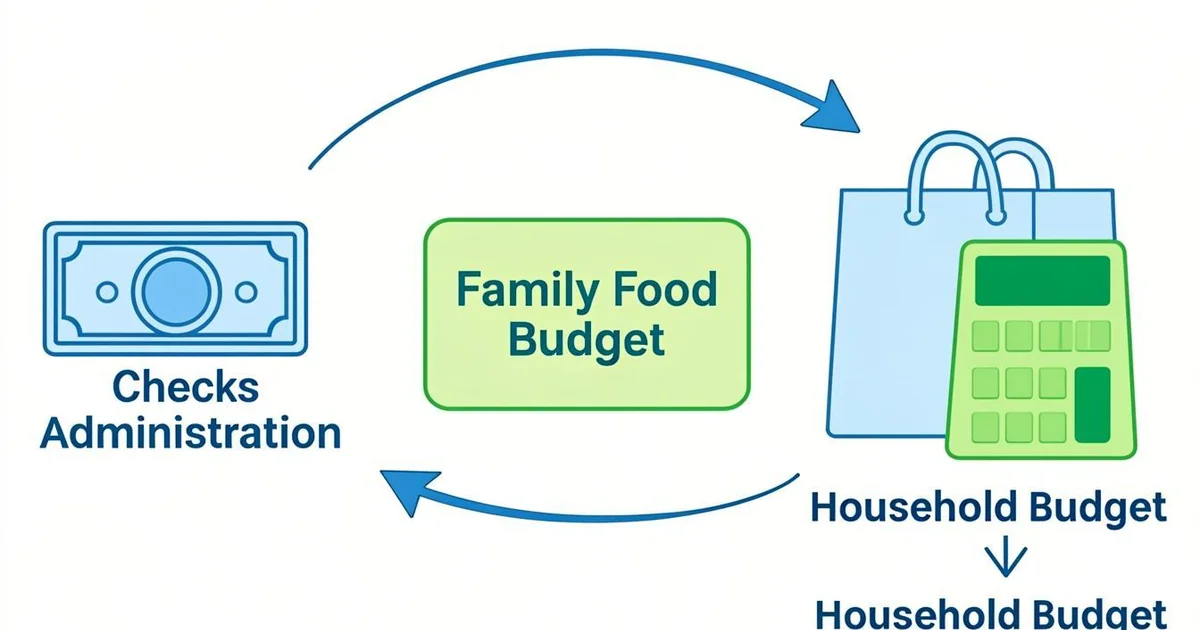
How SSDI flows into the SNAP calculation — gross income, deductions, and net income.
The Medical Expense Deduction: Your Secret Weapon
The medical expense deduction (MED) is the most under-claimed deduction in SNAP, and disabled households are the only ones who can use it. If your household includes someone who's elderly or disabled — SSDI automatically makes you disabled under SNAP rules — you can deduct out-of-pocket medical expenses that exceed $35 per month.
What counts? Medicare premiums (Parts B, C, and D), prescription copays, doctor visit copays, dental work, eyeglasses, hearing aids, in-home care, and mileage to medical appointments at the IRS rate. Most recipients only claim the Medicare premium because it shows up on their Social Security statement, and they leave the copays and prescriptions on the table.
Here's the math. Medicare Part B: $185. Part D: $30. Copays: $50. Total countable medical: $265. Subtract the $35 threshold: $230 deduction. At the 30% benefit reduction rate, that's about $69 a month in extra SNAP — or $828 a year. Our medical expense deduction guide lists every eligible expense. The rules in our elderly and disabled medical expense guide apply the same way to SSDI recipients.
The Medicare Premium Deduction
Almost every SSDI recipient is on Medicare after the 24-month waiting period. In 2026, the Part B premium is $185 per month for most beneficiaries. Higher-income recipients pay more through the income-related monthly adjustment amount, or IRMAA. Either way, the full premium is a countable medical expense for SNAP — as long as your household meets the elderly or disabled test.
The Part B premium is auto-deducted from your SSDI check before it lands in your bank account, so most people never see it as a separate payment. That's why it gets missed on the SNAP application. Pull your Social Security benefit statement, find the line that says "Medicare premium deducted," and put that exact number on the SNAP application. Do the same with Part D. Our page on how Medicare premiums interact with SNAP covers IRMAA and other edge cases.
SSDI vs SSI: Which Is Better for SNAP?
SSDI and SSI sound similar but they're completely different programs. SSI payments are excluded from SNAP gross income under 7 CFR 273.9(b)(7)(ii), so an SSI recipient starts with $0 in unearned income from their SSI check. SSDI is fully countable. That sounds like a big advantage for SSI, but SSDI recipients have advantages SSI recipients don't.
First, SSDI recipients usually get Medicare, which gives them a built-in $185 a month in countable medical expenses. SSI recipients in most states get Medicaid, which has no premium to deduct. Second, SSDI recipients tend to have higher shelter costs because the benefit is much larger than the SSI federal benefit rate of $943 per month in 2026. Third, SSDI recipients don't face SSI's $2,000 asset limit, so they can hold savings that would disqualify them from SSI.
Neither is "better" for SNAP. If you receive both SSI and SSDI, the SSI portion is excluded and the SSDI portion is countable. Our companion page on SSI and SNAP interaction covers the SSI side.
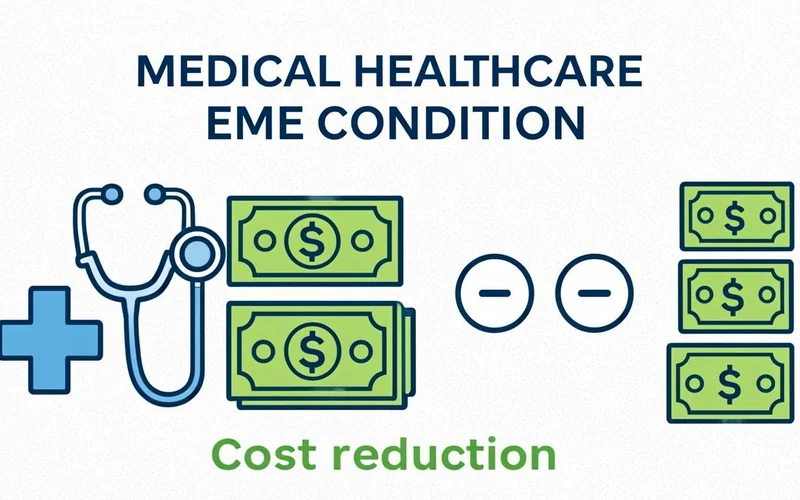
The medical expense deduction offsets the bite SSDI takes out of your SNAP benefit.
Real Example: A Disabled Worker on $1,400 SSDI
Let's run the SNAP calculation for a single disabled worker on SSDI. Maria is 52, lives alone, and receives $1,400 a month in SSDI. Her rent is $850, she pays $185 for Medicare Part B, $30 for Part D, and $50 a month in prescription copays. Her state uses a standard utility allowance by state, and she claims $120 a month in actual utility costs.
- Gross income: $1,400 SSDI. Disabled households skip the gross income test.
- Standard deduction: $199 for one person in 2026. Income: $1,201.
- Medical expense deduction: $185 + $30 + $50 = $265. Subtract $35 = $230. Income: $971.
- Excess shelter deduction: $850 rent + $120 utilities = $970. Half of $971 = $485.50. Excess = $484.50. Disabled households have no $672 cap, so full $484.50 deducted. Income: $486.50.
- Expected contribution: 30% of $486.50 = $146.
- SNAP benefit: $292 max minus $146 = $146/month.
Notice what happens if Maria forgets the medical expense deduction. Her net income would have been $716.50, her contribution would jump to $215, and her SNAP benefit would drop to $77. Claiming the deduction more than doubled her monthly benefit — $828 a year.
How to Apply for SNAP When You Receive SSDI
Applying for SNAP when you're on SSDI uses the same application as any other household. Because you're disabled or elderly, you may qualify for the simplified application, which is shorter and skips the interview in some states.
- Gather your documents: SSA-1099 benefit letter, Medicare premium deduction page, lease, utility bills, prescription receipts, photo ID.
- File online or in person: Use your state SNAP portal or the office in your county.
- Claim every deduction on the form: List the Medicare Part B premium, Part D premium, copays, and any medical mileage. Don't assume your caseworker will find them.
- Submit medical proof if asked: Your Social Security benefit letter showing the Medicare deduction usually covers the premium.
- Wait for the approval letter: Most SNAP applications are decided within 30 days. Disabled households can sometimes get expedited 7-day processing.
Our verification documents checklist walks through everything your caseworker can ask for. See our guide to the elderly or disabled simplified SNAP application for the shorter form, and the SNAP application guide for the full process.
Reporting SSDI Changes to SNAP
Once your SNAP case is open, you have to report changes — including SSDI changes. Most states run a 6-month or 12-month reporting cycle, and a few run "change reporting" where you have to report certain changes within 10 days. Read your approval letter to see which rule applies to you.
What counts as a reportable change? Any change in your SSDI benefit amount — including the January COLA, any change in Medicare premiums when IRMAA brackets shift, any change in household composition, shelter costs, or out-of-pocket medical expenses if you claimed the medical expense deduction. The COLA catches the most people, because it raises both your SSDI and your Medicare Part B premium.
If you miss a reporting deadline, you could face an overpayment, a benefit reduction, or a case closure. SSDI recipients who get a COLA-related Medicare premium increase often see their SNAP benefit stay roughly the same. See our SNAP recertification guide at renewal.
Common Mistakes That Cost You Benefits
Most SSDI recipients leave SNAP money on the table because of a handful of avoidable mistakes.
1. Forgetting the Medicare premium deduction.
The Part B premium is auto-deducted from your SSDI check, so it never shows up as a separate payment. You still have to list it on the SNAP application — all $185 in 2026.
2. Not keeping prescription and copay receipts.
Those $5 and $10 copays add up. Spend $50 a month on prescriptions and that's $46 of deduction (after the $35 threshold), worth about $14 a month in extra SNAP.
3. Missing the COLA reporting deadline.
The January COLA bumps your SSDI up. If you're on change reporting and don't report it within 10 days, your caseworker can hit you with an overpayment later.
4. Skipping the excess shelter deduction.
Disabled households have no $672 cap on the shelter deduction. Our shelter deduction cap page explains the difference, and our page on how housing costs affect SNAP covers what counts.
Two more deductions worth checking: if you receive LIHEAP along with SNAP, that utility assistance changes your shelter math. With Section 8 housing, your countable shelter is the portion you pay. SSDI households with multiple SNAP deductions stacked often max out.
Sources
- USDA Food and Nutrition Service — SNAP Income Eligibility Standards (2026 fiscal year)
- 7 CFR 273.9 — SNAP Income Deductions
- 7 CFR 273.10(d) — Medical Expense Deduction for Elderly or Disabled
- SSA POMS — SSDI definition and benefit calculation
- CMS — 2026 Medicare Part B Premium Announcement
- SSA — Annual Statistical Supplement on SSDI benefit amounts