Most SNAP applicants can guess whether they will qualify, but almost no one can predict the exact dollar amount that will land on their EBT card each month. The benefit figure feels like a black box. A neighbor with the same income gets a different number.
A cousin in another state gets more. A raise at work cuts the benefit by an amount that does not seem to match the raise. This 2026 guide opens that black box and shows you every step SNAP uses to turn your income, deductions, and household size into a specific monthly benefit.
The formula itself is public, written into federal law at 7 CFR 273.10, and it has not changed in structure for decades. What changes each October is the dollar figures plugged into that formula: the maximum monthly allotment, the standard deduction, the shelter cap, and the income limits.
Once you understand the structure, you can recalculate your benefit any time your situation changes and predict the impact before your caseworker does.
This walkthrough uses the 2026 fiscal year figures that took effect October 1, 2025 and run through September 30, 2026. We will follow a real-world example household through every step, so you can see how each piece moves the final number. If you want to skip ahead to your own numbers, you can use the free SNAP eligibility calculator on our homepage and we will run this math for you.
Table of Contents
- 1The Five Steps SNAP Uses to Calculate Your Benefit
- 2The Five-Step SNAP Formula
- 3Step 1: Determine Your Household Size
- 4Step 2: Add Up Gross Monthly Income
- 5Step 3: Apply the Allowable Deductions
- 6Step 4: Find Your Net Monthly Income
- 7Step 5: Apply the 30 Percent Rule
- 8Why Two Households With the Same Income Get Different Benefits
- 9How to Estimate Your Own SNAP Benefit
- 10Common Mistakes That Throw Off the Calculation
- 11What Happens After Your Benefit Is Calculated
- 12How to Check Your Benefit and Balance
- 13Quick Reference: 2026 Maximum Monthly Allotments (48 States and DC)
- 14Final Thoughts
- 15Frequently Asked Questions
The Five Steps SNAP Uses to Calculate Your Benefit
Every SNAP case in the country follows the same five-step calculation. The steps happen in order, and each step depends on the one before it. Skipping a step or running them out of order is the most common reason people get the wrong number when they try to estimate their own benefit.
The Five-Step SNAP Formula
- Determine household size — who buys and prepares food together.
- Add up gross monthly income — all earned and unearned income before deductions.
- Apply allowable deductions — standard, earned income, dependent care, medical, excess shelter.
- Find net monthly income — gross income minus deductions.
- Apply the 30 percent rule — subtract 30 percent of net income from the maximum allotment.
Each step has rules that can shift your benefit by hundreds of dollars, so it pays to understand them in detail. We will walk through each one below using a working example: a household of three in Ohio with one full-time worker, one part-time worker, and one child in daycare.
Step 1: Determine Your Household Size
A SNAP household is not the same as a family. The SNAP definition is functional: a household is everyone who lives together and buys or prepares food together. A married couple is one household. Three roommates who each buy their own groceries are three separate households. A grandparent who eats separately from the rest of the family can sometimes be their own household.
Household size matters because it sets two of the biggest numbers in the formula: the maximum monthly allotment and the gross income limit. A household of one in 2026 has a maximum allotment of $292 per month in the 48 contiguous states.
A household of three has a maximum of $768. A household of four has a maximum of $973. The numbers step up sharply with each added person, which is why getting your household size right is the single most important first step.
There are special rules for elderly and disabled members, boarders, foster children, and residents of group homes.
If your household includes someone who is 60 or older or who receives disability benefits, that person can be a separate household if it helps with eligibility, and special deductions become available. Our guide to SNAP eligibility for disabled Americans walks through those rules in detail.
Step 2: Add Up Gross Monthly Income
Gross income is everything your household earns or receives before any taxes or deductions. SNAP counts two types of income: earned income from working, and unearned income from other sources. Both go into the same pot for the gross income test.
Earned income includes wages, salaries, tips, commissions, and net self-employment income. If you are self-employed, SNAP allows you to subtract business expenses from your gross revenue before counting the income, which can significantly lower your countable earnings. Our guide to SNAP for self-employed workers explains which expenses are deductible and how to document them.
Unearned income includes Social Security retirement and disability benefits, SSI, unemployment compensation, workers compensation, veterans benefits, pension payments, alimony, child support received, and rental income.
SNAP also counts cash gifts above a small threshold and lottery or gambling winnings above a certain amount. Our page on how Social Security payments affect SNAP covers the most common unearned income source in detail.
Some income does not count at all. Federal energy assistance (LIHEAP), federal work-study payments, loans you have to repay, and most in-kind benefits like free school lunches are excluded. The SNAP and LIHEAP interaction matters here because LIHEAP payments not only do not count as income but also can boost your shelter deduction through the standard utility allowance.
For our example household of three in Ohio, suppose the full-time worker earns $2,400 per month and the part-time worker earns $900 per month. There is no unearned income. Gross monthly income is $3,300.
Example household snapshot
Household size: 3 • State: Ohio • Gross monthly income: $3,300 • Earned income share: 100%
Step 3: Apply the Allowable Deductions
Deductions are where the SNAP formula gets generous. Congress built six deductions into the law to make sure the math reflects what a household can actually afford to spend on food, not just what comes in as income. Each deduction lowers your net income, which in turn raises your final benefit.
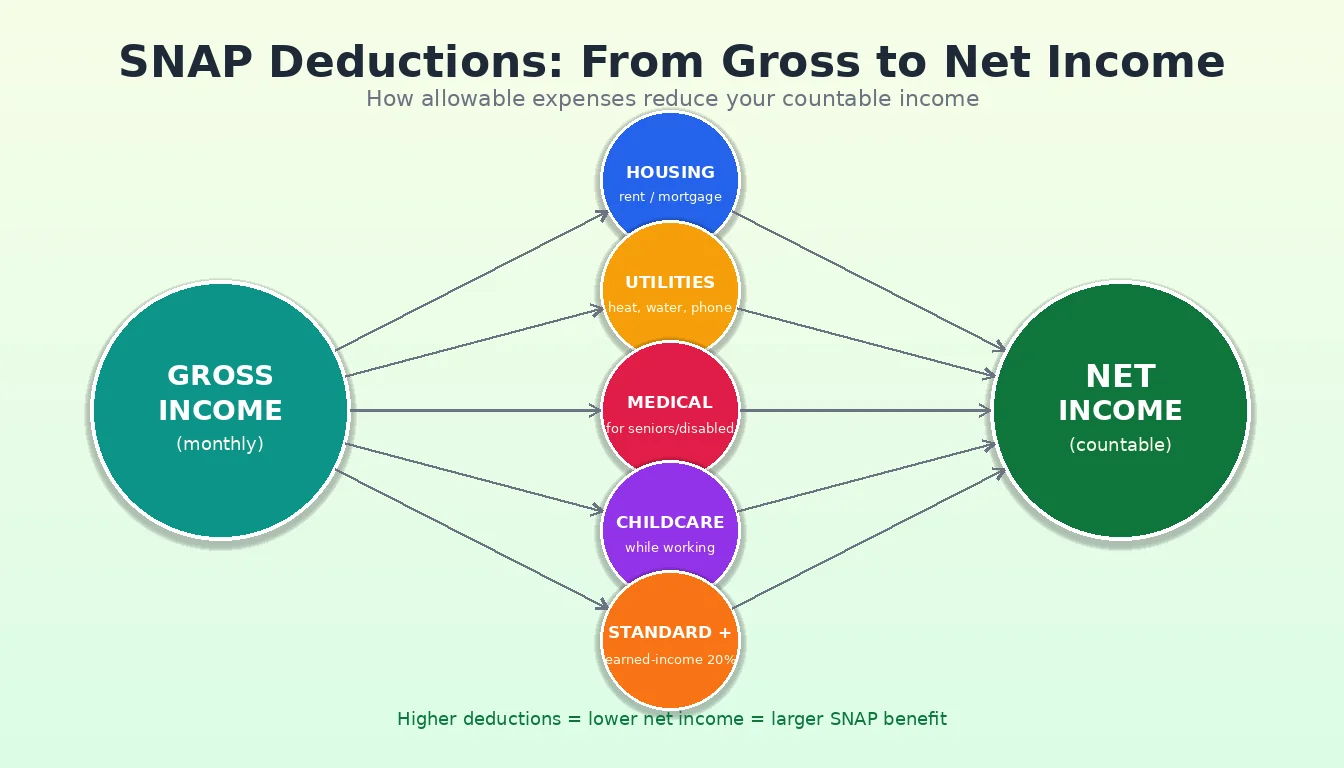
The standard deduction is a flat amount that every SNAP household gets based on household size and state. For the 48 states and DC in 2026, the standard deduction is $204 per month for households of 1 to 3 people, and steps up for larger households. No documentation is required because the deduction is automatic.
The 20 percent earned income deduction is the second automatic deduction. SNAP subtracts 20 percent of your gross earned income from your countable income. This deduction recognizes the costs of working — transportation, work clothes, taxes — that unearned income does not have. For our example household, 20 percent of $3,300 in earned income is $660.
The dependent care deduction covers out-of-pocket costs for childcare or adult care that lets a household member work, look for work, or attend training. If you pay a daycare $400 a month so you can work, that $400 comes off your countable income. Our SNAP childcare costs deduction guide has the full rules.
The medical expense deduction is available only to households with an elderly or disabled member. Out-of-pocket medical costs above $35 per month are deductible. This includes Medicare premiums, prescriptions, dental work, eyeglasses, and mileage to medical appointments. Our SNAP medical expense deduction guide walks through which expenses qualify and how to document them.
The excess shelter deduction is the deduction that helps the most households. It covers rent or mortgage, property taxes, home insurance, and utility costs that exceed 50 percent of your household income after the other deductions.
There is a cap on this deduction for most households, but no cap if your household includes an elderly or disabled member. The 2026 cap for the 48 states and DC is $712 per month.
The standard utility allowance, often called the SUA, is a flat monthly amount that states set to cover utility costs without making you save every electric bill. Claiming the SUA is usually worth more than itemizing utility bills, and it is what makes the shelter deduction so powerful for renters and homeowners alike. Our SNAP deductions cheat sheet lists the current SUA for every state.
Step 4: Find Your Net Monthly Income
Net income is what is left after every allowable deduction has been applied to your gross income. The formula is mechanical: start with gross income, subtract each deduction in order, and the result is net income. Net income is the number that goes into the final benefit calculation.
For our Ohio household of three with $3,300 in gross earned income, the math looks like this. Subtract the $204 standard deduction. Subtract the $660 earned income deduction (20 percent of $3,300). Subtract $400 in daycare costs. Now the household is at $2,036 in countable income before shelter.
If rent and utilities total $1,300, the excess shelter calculation takes 50 percent of $2,036 — which is $1,018 — and subtracts it from $1,300 to find $282 in excess shelter. But the 2026 cap is $712, so the full $282 is allowed.
After the shelter deduction, net income lands at $1,754 per month. That number is below the 2026 net income limit of $2,888 for a household of three, so the household passes the net income test and moves to the final step. Our guide to gross versus net income for SNAP covers the limits and tests in more detail.
Quick math for the example household
Gross $3,300 − standard $204 − earned income $660 − childcare $400 − excess shelter $282 = $1,754 net monthly income
Step 5: Apply the 30 Percent Rule
The 30 percent rule is the heart of the SNAP benefit formula. Congress wrote into law the expectation that households spend about 30 percent of their own net income on food. SNAP then covers the gap between that expected contribution and the maximum monthly allotment for the household size.
The formula is simple. Take your net monthly income, multiply it by 0.30, and subtract the result from the maximum allotment for your household size. The number you get is your monthly SNAP benefit. If the math produces a number smaller than the minimum benefit, you get the minimum instead, which is $23 per month in 2026 for one- and two-person households.
For our Ohio household of three, the maximum monthly allotment in 2026 is $768. Thirty percent of $1,754 net income is $526.20. Subtract $526.20 from $768 and you get $241.80, which rounds to $242. That is the monthly SNAP benefit the household will receive on their EBT card.
Final benefit for our example household
$768 maximum − $526 (30% of $1,754) = $242 per month
That $242 lands on the household's EBT card each month on the day set by the state's payment schedule. Ohio uses a case-number-based schedule, so the household can predict the exact deposit day using our SNAP payment schedule by state guide. Once the money is on the card, the household can spend it at any authorized retailer following the rules in our SNAP-eligible grocery list.
Why Two Households With the Same Income Get Different Benefits
The formula is the same nationwide, but the inputs vary. The two biggest swing factors are shelter costs and household composition. A household in San Francisco paying $2,800 a month in rent will have a much larger shelter deduction than a household in rural Alabama paying $600, even with identical incomes.
The California household ends up with lower net income and a higher SNAP benefit, even though both households appear identical on paper.
Household composition matters because elderly and disabled members unlock deductions that other households cannot claim. A two-person household where one member is 65 and pays $200 a month in Medicare premiums and $150 in prescriptions gets a $315 medical expense deduction (the first $35 is waived).
That same household without the elderly member would not get the deduction, and their benefit would be tens of dollars lower every month.
State-level variation also plays a role. The maximum allotment is higher in Alaska, Hawaii, Guam, and the Virgin Islands to reflect higher food costs. Some states have waived the asset test entirely under broad-based categorical eligibility, which means a household with savings can still qualify. Our SNAP benefits by state guide lists the maximum allotment and key rules for every state.
How to Estimate Your Own SNAP Benefit
You can run this formula yourself in about ten minutes if you have your income and expense numbers ready. Start by listing every source of income your household receives in a typical month. Add them up to get gross income.
Then list every deduction that applies: the standard deduction is automatic, the earned income deduction is automatic, and you will need receipts or bills for childcare, medical, and shelter costs.
Apply the deductions in the order listed above, find your net income, multiply by 0.30, and subtract from the maximum allotment for your household size. The result is your estimated monthly benefit. Our SNAP income limits guide lists the current gross and net income limits by household size, and our SNAP application guide shows what documents to gather before you apply.
If your situation is complex — self-employment income, a household member in a nursing home, a foster child, an immigrant sponsor — you may want to skip the manual math and use our free SNAP eligibility calculator. It runs the same formula but handles the edge cases automatically and gives you an answer in under two minutes.
Common Mistakes That Throw Off the Calculation
The SNAP formula is straightforward, but small mistakes in the inputs produce big mistakes in the output. The most common error is forgetting to count unearned income.
People remember their wages but forget the $200 monthly Social Security payment or the $150 in unemployment. SNAP counts both, and missing them on the application can trigger an overpayment notice months later when the agency catches the discrepancy.
The second most common mistake is underestimating shelter costs. Many applicants list rent but forget utilities, or list the electric bill but forget water, sewer, trash, and gas.
SNAP lets you bundle utilities through the standard utility allowance, which is almost always worth more than itemizing. Claiming the SUA instead of itemizing can add $200 or more to your shelter deduction and a corresponding bump to your monthly benefit.
The third mistake is missing the medical expense deduction for elderly or disabled household members. Even small recurring costs like a $45 Medicare Part B premium, $30 in co-pays, and $20 in over-the-counter medications add up to $95 a month.
After the $35 disregard, that is a $60 deduction every month, or about $18 a month in additional benefits. Over a year, that is $216 in food the household would otherwise miss.
The fourth mistake is treating the gross income test as the only test. Some households assume they do not qualify because their gross income exceeds 130 percent of the federal poverty line, but households with an elderly or disabled member only have to pass the net income test. Our SNAP for seniors guide covers this exception and several others that affect households with older members.
What Happens After Your Benefit Is Calculated
Once your caseworker runs the formula and approves your application, your benefit amount is locked in for your certification period.
Most households are certified for 12 months, but households with elderly or disabled members can be certified for 24 months, and households with all elderly or disabled members can be certified for 36 months. During that period your monthly benefit stays the same unless you report a change.
Changes that must be reported include a change in household income of more than a small threshold, a change in household composition, a change in address, and a change in shelter costs. Failing to report these changes can result in an overpayment that the agency will recover from future benefits. Our guide to SNAP unreported changes penalties covers what must be reported and when.
If your circumstances change and you want to recalculate your benefit before your recertification, you can request a mid-period recalculation by contacting your caseworker. Most states also let you report changes through an online portal. The new benefit takes effect the month after you report. Our SNAP recertification guide explains how to keep benefits flowing without interruption.
If your application is denied because the formula produced a benefit below the minimum, you have the right to appeal. The denial notice will explain why, and you can request a hearing within 90 days. Many denials are reversed at the hearing because the caseworker missed a deduction or applied the wrong income figure. Our SNAP denial appeal guide walks through the hearing process step by step.
How to Check Your Benefit and Balance
Once benefits start, the easiest way to track them is through your state's EBT portal or mobile app. You can see your current balance, recent transactions, and the date of your next deposit. Most states also offer text or email alerts when a deposit lands or when your balance drops below a threshold you set. Our EBT balance check guide lists the portal and phone number for every state.
If your benefit amount does not match what the formula predicted, call your caseworker. Small differences usually come from rounding or from a deduction that was applied differently than you expected.
Large differences can indicate a calculation error or a misreported figure on your application. Either way, you have the right to ask for a written explanation of how the agency arrived at the number.
If your benefit suddenly drops between certifications, look first at your income. A small raise at work can push your net income high enough to reduce your benefit by a noticeable amount. Our guide to why SNAP benefits go down covers the most common causes and what to do if the drop feels wrong.
Quick Reference: 2026 Maximum Monthly Allotments (48 States and DC)
| Household Size | Maximum Allotment | Gross Income Limit | Net Income Limit |
|---|---|---|---|
| 1 | $292 | $1,696 | $1,305 |
| 2 | $536 | $2,215 | $1,763 |
| 3 | $768 | $2,888 | $3,483 |
| 4 | $973 | $3,483 | $2,500 |
| 5 | $1,155 | $3,807 | $2,929 |
| 6 | $1,386 | $4,675 | $3,357 |
| 7 | $1,532 | $4,920 | $3,786 |
| 8 | $1,751 | $5,477 | $4,513 |
| Each additional | $219 | $557 | $429 |
These figures are in effect from October 1, 2025 through September 30, 2026. Alaska, Hawaii, Guam, and the Virgin Islands have higher limits. Households with an elderly or disabled member only need to meet the net income limit, not the gross income limit. The full set of state-by-state figures is in our SNAP income limits guide.
Final Thoughts
The SNAP benefit formula is not a mystery. It is a five-step calculation that takes your income, applies six deductions, and uses the result to find a benefit amount that fits your household.
Once you understand the steps, you can predict how a raise, a move, a new baby, or a medical bill will change your monthly benefit. That predictability is what makes the difference between feeling stuck and feeling in control of your household budget.
If you are ready to apply, the fastest path is to use our free SNAP eligibility calculator to get an estimate, then follow our step-by-step SNAP application guide to submit your paperwork. If you are already receiving benefits and want to understand why the number is what it is, this guide gives you every tool you need to do the math yourself.
SNAP is one of the most reliable anti-hunger programs in the United States. Understanding the formula helps you make the most of it, plan around it, and spot errors when they happen. Keep this guide bookmarked for the next time your circumstances change.