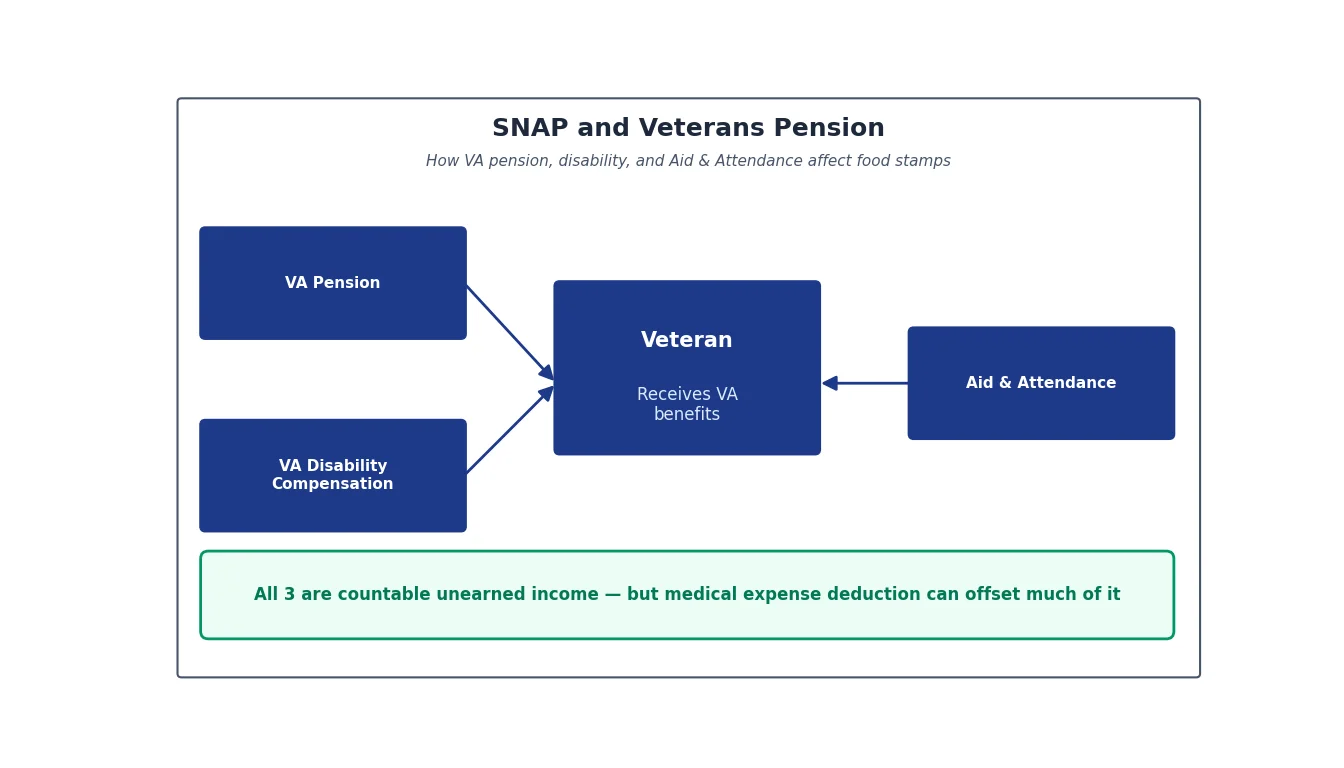
Veterans who receive VA pension or disability compensation often assume that those payments automatically disqualify them from SNAP. They do not. VA payments have specific rules for how they interact with SNAP, and in some cases a portion of the payment is excluded entirely. Veterans who understand the rules can receive both VA benefits and SNAP simultaneously, sometimes adding 200 to 300 dollars a month in food assistance.
This guide covers the three main VA payment types — VA pension, VA disability compensation, and Aid and Attendance — and how each one is treated for SNAP purposes. It also covers the special rules for veterans who are 60 or older or who have a service-connected disability rating, both of which unlock additional SNAP deductions.
Table of Contents
- 1The Three Main VA Payment Types
- 2How SNAP Treats VA Pension
- 3How SNAP Treats VA Disability Compensation
- 4Aid and Attendance: A Special Case
- 5The Special Monthly Pension and Housebound Benefits
- 6Calculating Countable Income: Two Worked Examples
- 7Documenting VA Payments for SNAP
- 8Documenting Medical Expenses for the Deduction
- 9Reporting VA Payment Changes to SNAP
- 10How VA Payments Interact With Other Benefits
The Three Main VA Payment Types
The Department of Veterans Affairs pays veterans through three main programs that interact with SNAP differently. VA pension is a need-based payment for wartime veterans with limited income who are 65 or older or who are permanently and totally disabled. VA disability compensation is a payment for veterans with service-connected disabilities, regardless of income or age. Aid and Attendance is an additional amount paid on top of VA pension for veterans who need help with activities of daily living or who are housebound.
Each of these is treated differently for SNAP purposes. The classification matters because it determines whether the payment is countable income, whether it is earned or unearned, and whether it qualifies the veteran for additional SNAP deductions. The general pension income guide covers how non-VA pensions interact with SNAP.
How SNAP Treats VA Pension
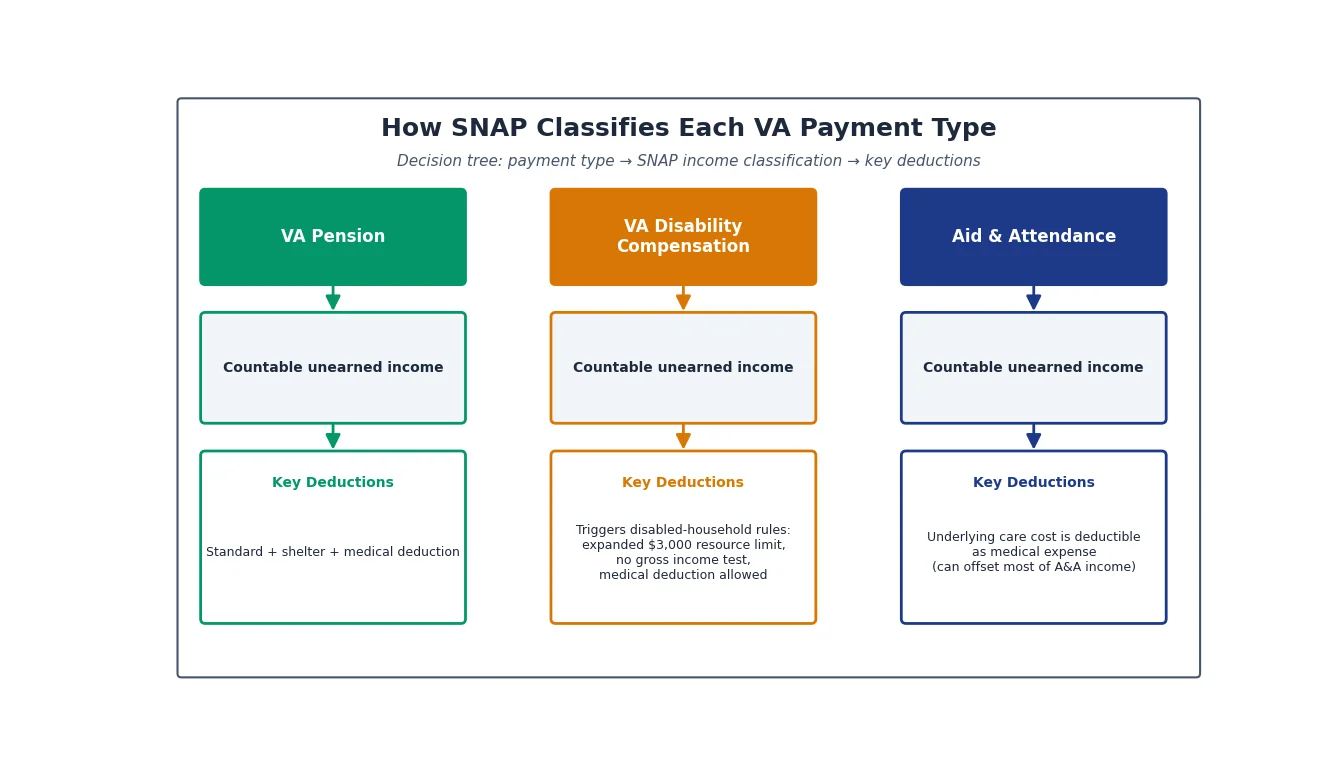
VA pension is countable unearned income for SNAP. The full monthly amount is added to the household's income calculation. There is no portion excluded. However, the veteran can claim the standard SNAP deductions — the standard deduction, the earned income deduction (if the veteran also works), the shelter deduction, and the excess medical expense deduction — against this income.
The critical deduction for many VA pension recipients is the excess medical expense deduction. Veterans on VA pension often have significant out-of-pocket medical costs that the VA does not cover, including dental care, hearing aids, transportation to medical appointments, and over-the-counter medications. Any unreimbursed medical expense over 35 dollars a month for households with an elderly or disabled member is deductible.
The medical expense deduction guide covers the documentation needed and how the calculation works. Many veterans miss this deduction because they assume VA-covered care means no out-of-pocket costs.
How SNAP Treats VA Disability Compensation
VA disability compensation is also countable unearned income for SNAP. The full monthly amount is added to the household's income calculation. The payment is not reduced by any exclusion. However, a veteran receiving VA disability compensation is considered disabled for SNAP purposes, which triggers several important rules.
First, the household may be eligible for the expanded resource limit of 3,000 instead of the standard 2,750. This is the elderly or disabled household resource limit. The SNAP asset limits guide covers the resource limits in detail.
Second, the household is exempt from the SNAP gross income test. The net income test still applies, but the gross income test, which limits households to 130 percent of the federal poverty line before deductions, does not apply to households with an elderly or disabled member.
Third, the household can claim the excess medical expense deduction, even if the only medical expense is the Medicare Part B premium or supplemental insurance premiums. Many veterans on VA disability compensation also have Medicare, and the Part B premium alone is enough to trigger the deduction.
Aid and Attendance: A Special Case
Aid and Attendance is an increased pension amount paid to veterans who need help with activities of daily living, such as bathing, dressing, eating, and using the toilet. It is also paid to veterans who are bedridden or who are patients in a nursing home. The payment is added on top of the base VA pension.
For SNAP purposes, Aid and Attendance is countable unearned income, the same as the base VA pension. However, the cost of the care that the Aid and Attendance payment is used for is often deductible as a medical expense. If the veteran pays a home health aide 2,000 dollars a month and receives 1,500 dollars a month in Aid and Attendance, the 2,000 dollar payment is a deductible medical expense, and the 1,500 dollar Aid and Attendance payment is countable income.
This interaction can significantly reduce the countable net income for SNAP purposes. A veteran receiving VA pension plus Aid and Attendance who is paying for in-home care may have a countable net income near zero, which means the SNAP benefit would be at the maximum level for the household size.
The Special Monthly Pension and Housebound Benefits
VA Special Monthly Pension is a broader category that includes Aid and Attendance and Housebound benefits. Housebound benefits are paid to veterans who are substantially confined to their home due to a permanent disability. The classification rules for SNAP are the same as for Aid and Attendance — countable unearned income, but the cost of the underlying care is deductible as a medical expense.
The SNAP rules do not distinguish between Aid and Attendance, Housebound, and other Special Monthly Pension subtypes. All are treated as unearned income, all trigger the disabled-household rules, and all allow the corresponding medical expense deduction if the care is paid out of pocket.
Calculating Countable Income: Two Worked Examples
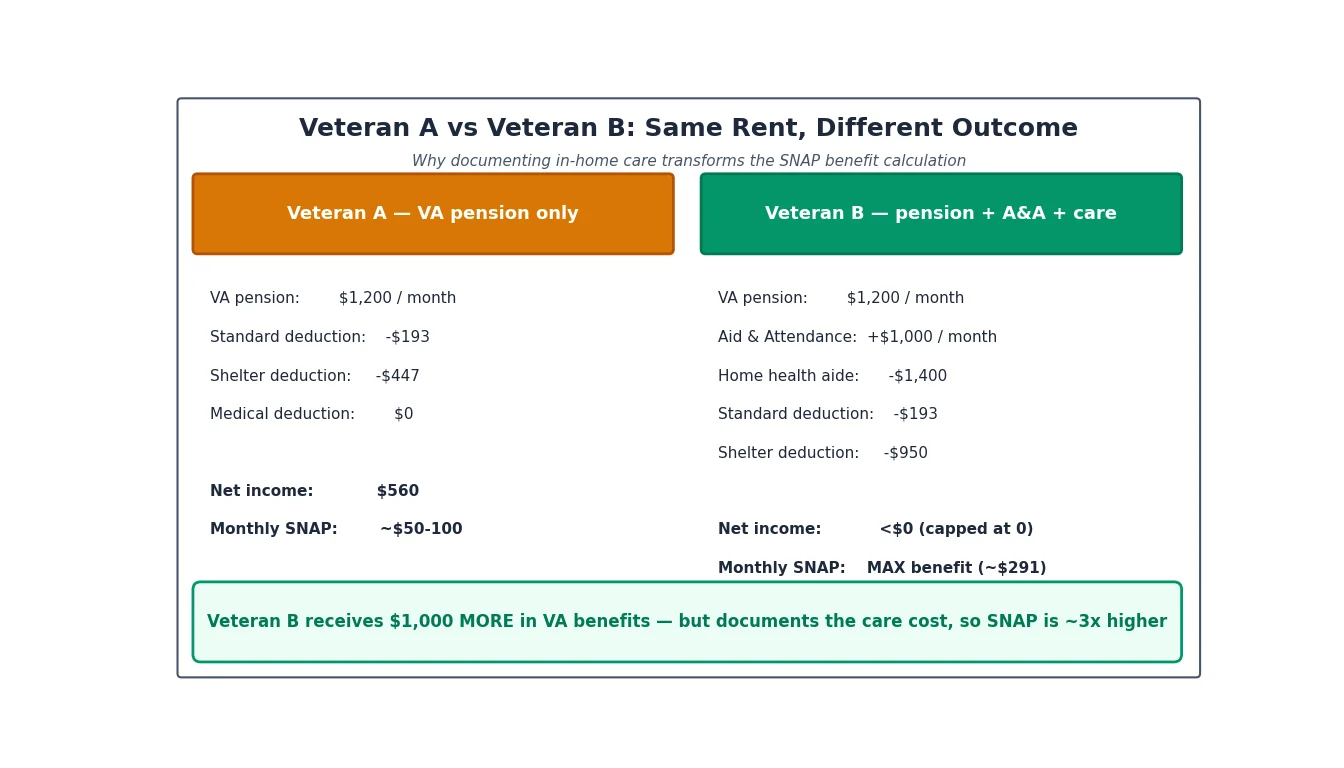
Consider two single veterans, both 70 years old, both living in the same apartment with rent of 800 dollars and utilities of 150 dollars. Veteran A receives VA pension of 1,200 dollars a month and has no other income. Veteran B receives VA pension of 1,200 dollars a month plus Aid and Attendance of 1,000 dollars a month, and pays 1,400 dollars a month for a home health aide.
For Veteran A, countable income starts at 1,200 dollars. He takes the standard deduction for a one-person elderly household (around 193 dollars), and the shelter deduction. His shelter costs are 950 dollars a month. Half of his income after the standard deduction is about 503 dollars, so his excess shelter is 950 minus 503, or 447 dollars. Net income is 1,200 minus 193 minus 447, or 560 dollars. He would receive a SNAP benefit of around 50 to 100 dollars a month.
For Veteran B, countable income starts at 2,200 dollars (1,200 plus 1,000). He takes the standard deduction of 193 dollars. He has a medical expense of 1,400 dollars a month for the home health aide, which exceeds the 35 dollar threshold, so the full 1,400 is deductible. His shelter costs are 950 dollars. His excess shelter deduction is capped because his net income after the standard and medical deductions is already low — around 607 dollars before the shelter deduction. The cap on the shelter deduction for elderly or disabled households is the full shelter cost, so 950 dollars. Net income becomes negative, which means SNAP sets net income to zero, and he receives the maximum SNAP benefit for a one-person household.
The difference is striking. Veteran B receives 1,000 dollars more in VA benefits, but because of the medical expense deduction, his SNAP benefit is significantly higher than Veteran A's. The key is documenting the home health aide payment.
Documenting VA Payments for SNAP
SNAP requires verification of all countable income, including VA payments. The easiest verification is the VA award letter, which is sent annually to every VA beneficiary. The award letter lists each payment the veteran receives, the amount, and the effective date. SNAP caseworkers accept the award letter as proof of income.
If the veteran has lost the award letter, a benefits summary can be downloaded from the VA.gov website under the veteran's account. The summary shows the same information and is acceptable to SNAP. Veterans without internet access can call the VA at 1-800-827-1000 and request a duplicate award letter by mail.
For Aid and Attendance and Housebound benefits, the award letter shows the breakdown of the base pension and the additional amount. SNAP caseworkers need to see this breakdown to understand which portion of the payment is the base pension and which is Aid and Attendance, though for SNAP purposes both are counted as unearned income.
Documenting Medical Expenses for the Deduction
To claim the excess medical expense deduction, the veteran must provide documentation of each expense. Acceptable documents include receipts from doctors and pharmacies, bank statements showing recurring payments to home health agencies, insurance premium statements, and receipts for transportation to medical appointments. The bank statements verification guide covers how caseworkers review bank statements during the application.
The medical expense must be unreimbursed — meaning the veteran or a third party has actually paid it, and no insurance or other program has covered it. VA-covered care is not deductible because the veteran did not pay for it out of pocket. Medicare-covered care is also not deductible for the portion that Medicare paid. The deductible amount is what the veteran actually pays after insurance.
For recurring expenses like home health aide payments or insurance premiums, a single document showing the recurring amount is enough. For one-time expenses, a receipt is required. Veterans should keep a folder of medical receipts throughout the year to make SNAP recertification easier.
Reporting VA Payment Changes to SNAP
VA payment changes — annual cost-of-living adjustments, changes in Aid and Attendance status, or termination of benefits — must be reported to SNAP, but the timing depends on the household's reporting status. Most elderly or disabled households are on simplified reporting, which means they only report changes at recertification and when household income exceeds 200 percent of the federal poverty line.
VA cost-of-living adjustments, which typically take effect in December, do not need to be reported mid-year under simplified reporting. They will be picked up at the next recertification. Households on change reporting, which is rare for elderly or disabled households, must report changes within 10 days.
The unreported changes penalties guide covers what happens when changes are not reported on time. The penalties are typically limited to overpayment recovery, not disqualification, for elderly or disabled households.
How VA Payments Interact With Other Benefits
Veterans receiving VA pension or disability compensation often qualify for other benefit programs that interact with SNAP. Social Security payments, including retirement, survivors, and disability benefits, are countable income for SNAP and stack with VA payments. SSI payments are also countable income. Medicaid eligibility is separate from SNAP eligibility, but many veterans qualify for both.
The LIHEAP program provides utility assistance to low-income households, including many veterans. LIHEAP payments are not countable income for SNAP, and LIHEAP receipt can qualify the household for the standard utility allowance, which increases the shelter deduction.
For veterans who are also seniors, the SNAP elderly simplified application can streamline the application process. This simplified application skips the interview in many states and reduces the documentation burden.
State Variations and Veteran-Specific Programs
Some states have obtained waivers to expand SNAP eligibility for veterans beyond the federal rules. A handful of states have veteran-specific outreach programs that help veterans apply for SNAP and other benefits. The state SNAP agency or the state Department of Veterans Affairs can provide information on these programs.
Several nonprofit organizations also help veterans navigate SNAP applications. Veterans of Foreign Wars, the American Legion, and the Disabled American Veterans all have service officers who can help with SNAP paperwork at no cost. These service officers are particularly useful for veterans who have difficulty navigating online applications or who need help gathering documentation.
The intersection of VA benefits and SNAP is generous for veterans who know the rules. VA pension and disability compensation are countable income, but the medical expense deduction can offset much of that income, particularly for veterans with significant care costs. The combination of VA pension plus Aid and Attendance plus the medical expense deduction can produce a SNAP benefit close to the maximum for the household size, even when the gross VA payment is several thousand dollars a month.