When you apply for SNAP, the caseworker reviewing your file will almost always ask for your most recent bank statements. For a lot of applicants, this is the moment the whole process feels invasive. You are handing a stranger a window into every dollar that came in and went out of your life for the past 30 days, sometimes 90.
Here is what actually happens with those statements, what the caseworker is trained to look for, and how to prepare them so your application does not stall.
This guide focuses on bank statements specifically. If you want the full list of every document SNAP may ask for, our SNAP verification documents checklist walks through pay stubs, leases, utility bills, and ID requirements side by side.
Table of Contents
- 1Why SNAP asks for bank statements in the first place
- 2How many months of statements you actually need
- 3What caseworkers actually look for on the page
- 4Deposits that match your stated income
- 5Unexplained cash deposits
- 6Account balances and the resource question
- 7Transfers between your own accounts
- 8What if you do not have a bank account
- 9How to handle cash deposits and side income
- 10Red flags that delay your approval
- 11How to prepare your statements before submitting
- 12Privacy concerns and what caseworkers cannot ask
- 13What happens if your statements show overdrafts
- 14What to do if your application gets denied anyway
- 15After approval: keeping your statements current
- 16One last thing before you submit
- 17Frequently asked questions
- 18How many months of bank statements does SNAP ask for?
- 19Do cash deposits disqualify me from SNAP?
- 20What if I do not have a bank account?
- 21Can the caseworker see my purchases on the statement?
- 22Wasim Akram
Why SNAP asks for bank statements in the first place
SNAP is a means-tested program. That phrase gets thrown around in policy documents, but the plain English version is this: the program is only for people who fall below a certain income and resource threshold. To prove you fall below it, the agency needs a paper trail.
Bank statements are the cleanest paper trail available because they come from a third party. A pay stub can be faked. A letter from an employer can be vague. A bank statement, printed or downloaded directly from your bank's portal, shows money moving in real time. The caseworker is not trying to catch you in a lie. They are trying to confirm that the income number you wrote on the application matches what the bank actually received.
Statements also serve a second purpose. They show the agency whether you have countable resources sitting in an account. Most households no longer face a strict asset test, but a few states still apply one, and cash in a checking or savings account is the most common resource the agency can see. If you want to understand where your state stands on this, the SNAP income limits guide breaks down gross income, net income, and asset thresholds by household size.
How many months of statements you actually need
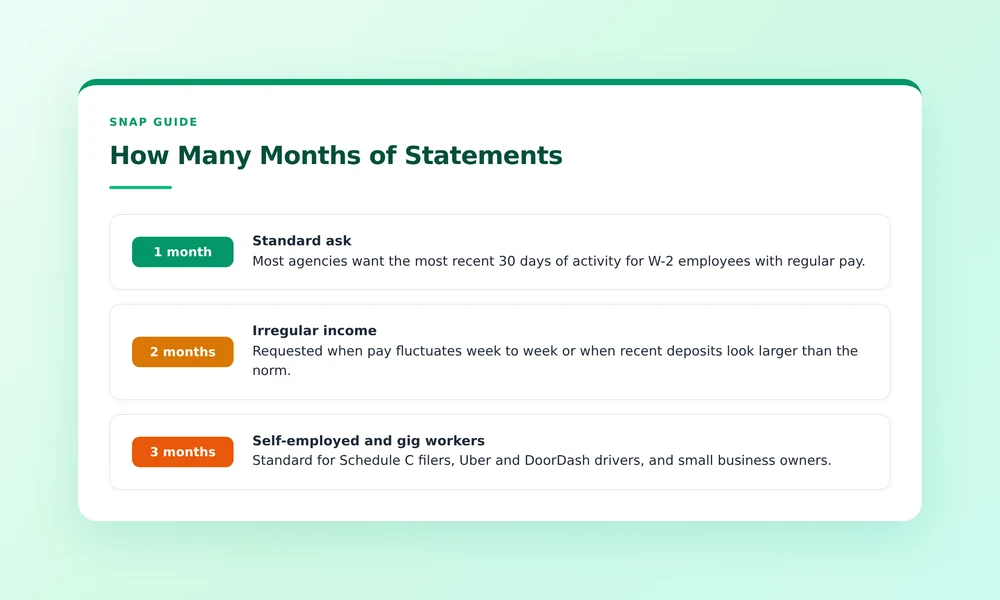
The default ask is one full month. Most agencies want the most recent 30 days of activity, which usually means one statement cycle. If your bank sends statements on the 15th of every month and you apply on August 5, the caseworker typically wants the statement that closed on July 15, plus any activity from July 16 through August 4.
Some states ask for two or three months. This is more common when your income is irregular, when you are self-employed, or when a recent deposit looks larger than your normal pattern. If you drive for Uber or run a small Etsy shop, expect the agency to want a longer window so they can average your income.
For self-employed SNAP applicants, three months of statements is close to standard. The same is true for gig workers like DoorDash and Instacart drivers, whose deposits bounce around week to week.
What caseworkers actually look for on the page
Deposits that match your stated income
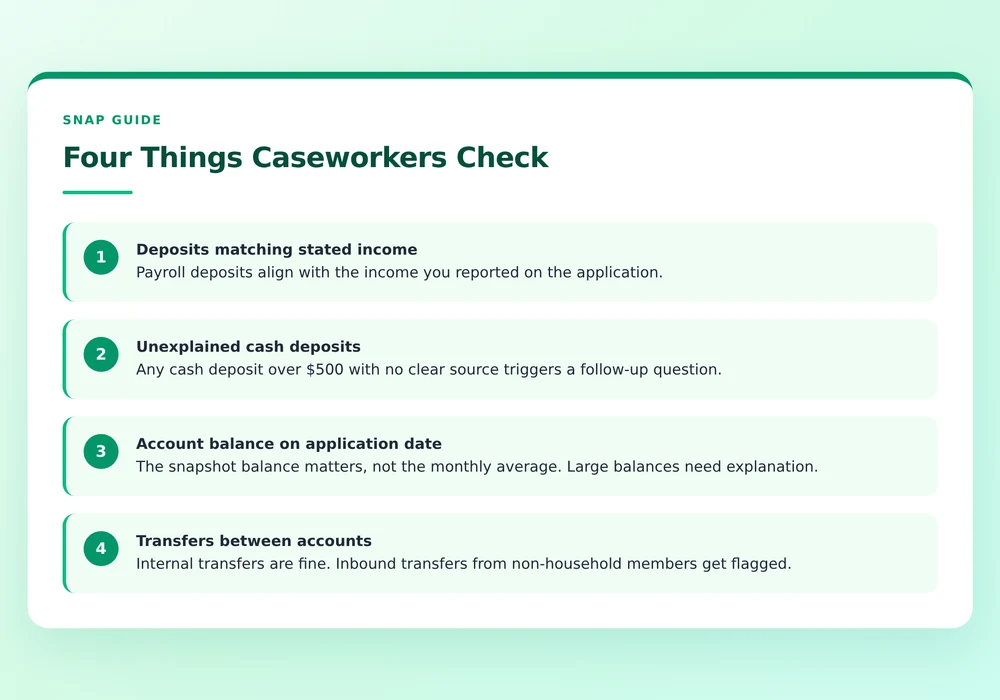
This is the first thing checked. If you wrote on the application that you earn $2,400 a month from a W-2 job, the caseworker scans the statement for two deposits of roughly $1,200 each, or one deposit of around $2,400, arriving on dates that line up with a regular pay schedule. If the deposits match, income verification is essentially done.
Unexplained cash deposits
This is the one that gets people in trouble. If you deposited $600 in cash two weeks before applying and you did not list it anywhere on the application, the caseworker has to ask what it was. It might have been a birthday gift from your mom. It might have been a side job you forgot to mention. Either way, it has to be explained in writing.
Cash deposits are not automatically disqualifying. The problem is that they slow the file down. If you know a cash deposit is going to show up, write a short note on a separate sheet explaining where it came from and attach it to the statement. If the deposit was from a side gig, our guide on how side hustle income affects your benefits explains how that money gets counted and what deductions you can claim against it.
Account balances and the resource question
The caseworker notes your ending balance. For most households, this is a non-issue because the federal asset limit was raised significantly and many states waived it entirely through broad-based categorical eligibility. But if you live in a state that still applies the asset test, a balance over the limit can pause your application until you provide a written explanation of where that money is going.
One thing people miss: the agency cares about the balance on the day you applied, not the average balance across the month. If your account briefly held $5,360 because you cashed out a 401k to pay for a roof repair, but the money was gone three days later, you will need to show receipts for the repair. The balance snapshot on the application date is what gets recorded.
Transfers between your own accounts
If you move money from savings to checking, or from a joint account with your spouse to your individual account, the caseworker sees it as a transfer, not as new income. This is fine. The problem only comes up when money lands in your account from someone outside your household with no explanation. A parent paying you back for groceries is not income, but you may need to write a short note saying so.
What if you do not have a bank account
A lot of SNAP applicants are unbanked, and the program does not penalize you for it. If you cash your paychecks at a check-cashing service or load them onto a prepaid card, you can verify income with pay stubs alone. The caseworker will ask how you pay rent and bills, and the honest answer is usually cash, money order, or a prepaid card.
Prepaid cards like Cash App, Venmo, and Chime do count as financial accounts for SNAP purposes. If your paycheck loads onto Cash App, the caseworker can ask for a transaction history from the app. Most prepaid services let you export a PDF of the last 30 days from inside the app.
How to handle cash deposits and side income
If you regularly receive cash income, do not try to hide it. SNAP penalties for false statements are real, and the agency can pursue an overpayment claim years later. Our page on what happens when you receive a SNAP overpayment notice walks through how those clawbacks work and what your options are.
The safer path is to deposit cash income into your bank account consistently, so your statements tell an honest story. If you do lawn care on weekends for $80 cash, deposit that $80 each week. At the end of the month, your statement shows roughly $320 in cash deposits, and you can attach a short note saying "weekly cash income from lawn service, approximately $80 per week." The caseworker counts it as self-employment income, but you also get to claim business expense deductions against it, which often brings your countable income back down.
The math on this matters. SNAP counts net self-employment income, not gross. If you made $320 from lawns but spent $60 on gas and mower blades, your countable income is $260. The gross versus net income guide explains this distinction in more detail.
Red flags that delay your approval
Some patterns on a bank statement almost guarantee a follow-up question from the caseworker. None of these are automatic denials, but each one adds days to your processing time.
- Large deposits with no clear source. Anything over $500 that is not a payroll deposit will get a question.
- Round-number transfers from another person. A $1,000 deposit labeled "Zelle from John Smith" looks like income even if it was a loan.
- A second checking account you did not disclose. The agency does not have a database of your accounts, but if a transfer reveals one, they will ask for statements from that account too.
- Negative balances or overdraft fees. These do not disqualify you, but the caseworker may ask whether you have an outstanding payday loan or recurring overdraft that counts as a debt.
- Gambling app deposits or withdrawals. Even small ones get flagged. If you use a betting app, be ready to explain it.
How to prepare your statements before submitting
Download the PDF directly from your bank's website. Do not screenshot the mobile app. Screenshots crop off the date range, the bank's logo, and your account number, and caseworkers are trained to treat incomplete statements as unverified.
Make sure the PDF shows your name, the account number with the last four digits visible, the statement period, and every transaction in that period. If your bank's default export does not include your name, print the first page of the statement too, which usually has your address and name on it.
Highlight anything you want to explain. If your mom transferred you $300 for your kid's birthday, circle it and write a one-line note in the margin. Caseworkers appreciate this. A clean statement with notes attached takes five minutes to review. A statement with mystery deposits and no notes can sit in a queue for a week.
Privacy concerns and what caseworkers cannot ask
It is reasonable to feel uncomfortable handing over 30 days of transactions. SNAP is administered under federal privacy rules that limit how your information can be shared. Your bank statements are used only for eligibility verification. They cannot be shared with immigration enforcement, your landlord, your employer, or debt collectors.
The caseworker can ask about specific transactions on the statement. They cannot ask about purchases you made, only about money coming in. If they ask why you spent $40 at a liquor store, that is out of bounds. If they ask why $1,200 was deposited by a company you did not list as an employer, that is a fair question.
What happens if your statements show overdrafts
Overdrafts do not count against you. In fact, a recurring overdraft pattern can sometimes help your case because it shows the agency that your expenses regularly exceed your income, which is exactly the situation SNAP is designed to help with.
What can happen is the caseworker asks whether the overdrafts are caused by a payday loan or recurring debt payment. If yes, that debt payment may count as a deduction. If the overdraft is just from spending more than you earn, no deduction applies, but it does not hurt your eligibility.
What to do if your application gets denied anyway
Bank statement issues are one of the most common reasons SNAP applications get delayed or denied. If the denial letter says your income could not be verified, or that you failed to provide required documents, you have 90 days to appeal and resubmit. Our guide on how to reapply for SNAP after being denied walks through the appeal timeline and what new evidence to bring.
If the denial was because the caseworker counted income that you believe should not have been counted, you can also request a state hearing. A hearing officer reviews the statements fresh and can overturn the denial. About 60 percent of SNAP appeals that go to hearing result in some change to the original decision.
After approval: keeping your statements current
SNAP is not a one-time verification. Most recipients have to complete an interim report halfway through their certification period, and a full recertification at the end. Both of those checkpoints can ask for fresh bank statements. If your income changes between reports, you are required to report it, and updated statements are how the agency records the change.
The interim report is shorter than the recertification packet, but the bank statement rules are the same. Our SNAP interim report form guide shows you exactly which fields matter and which ones you can skip.
If you do not report a change and the agency finds out later, you can face penalties ranging from a written warning to a permanent disqualification. The unreported SNAP changes penalties page explains the tiers and what triggers each one.
One last thing before you submit
The single best thing you can do before handing over your statements is to read them yourself, the way a stranger would. Sit with a pen and circle every deposit that is not a paycheck. For each one, write one sentence explaining what it was. That is the entire preparation. A statement annotated this way moves through the agency faster than any other format, and it gives the caseworker nothing to follow up on.
If you want to understand how the income number on your statement translates into a benefit amount, the SNAP benefit calculation formula page walks through the standard deduction, shelter deduction, and the 30 percent multiplier step by step.
Frequently asked questions
How many months of bank statements does SNAP ask for?
Most agencies ask for one full month, usually the most recent 30 days. Self-employed applicants and gig workers are typically asked for three months so the agency can average irregular income.
Do cash deposits disqualify me from SNAP?
No, but any cash deposit over $500 with no clear source will trigger a follow-up question. Write a short note explaining where each cash deposit came from and attach it to your statement.
What if I do not have a bank account?
SNAP does not penalize unbanked applicants. You can verify income with pay stubs alone. If you use a prepaid card like Cash App or Venmo, the agency can ask for a transaction history export from the app.
Can the caseworker see my purchases on the statement?
No. SNAP caseworkers can only ask about money coming in, not about what you spent. They cannot question your purchases, only unexplained deposits.
Wasim Akram
Founder & Lead Researcher · Food Stamp Eligibility Calculator
Wasim Akram is an independent web publisher and digital entrepreneur with over 8 years of experience in SEO, web publishing, technical research, and building digital products. Since 2018, he has been creating niche websites, online tools, custom CMS platforms, and WordPress products. He founded Food Stamp Eligibility Calculator in 2026 after seeing firsthand how difficult it was for ordinary families to get a straight answer about whether they qualified for food assistance. Every article on this site is researched, written, and reviewed against primary government sources including USDA Food and Nutrition Service manuals, state SNAP policy manuals, the Federal Register, and official state agency guidance.