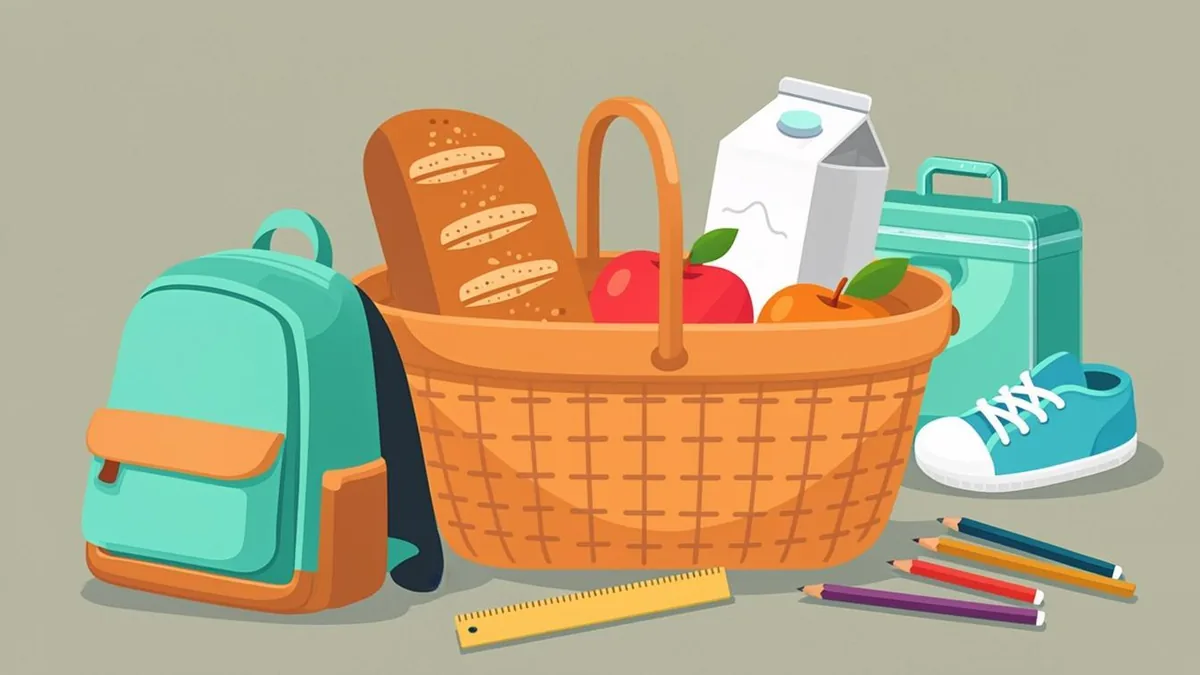
The scene repeats at checkout counters every September. A cart of groceries, a binder and a backpack riding on top, and then the register splits the order because the card in hand is food-only.
The direct answer: no, SNAP cannot buy school supplies - not backpacks, not pencils, not shoes, not laptops. The program's law covers food and food-producing plants, and that is the entire list. The useful part of the answer is what comes next: SNAP covers more of the school year than most families realize, and free supplies have real, reliable sources that never require a benefits card at all.
Table of Contents
- 1Quick Answer: The Line and the Workarounds
- 2Why the Card Declines: Food-Only Is the Law
- 3What SNAP Does Cover During the School Year
- 4A School-Month Grocery Split
- 5Where Free School Supplies Actually Come From
- 6The Myths Worth Busting
- 7A Note on Timing and the Year-Round Cycle
- 8The Classroom Snack Strategy
- 9If Money Is That Tight: The Bigger Lever Is the Case Itself
- 10The One-Paragraph Version
Quick Answer: The Line and the Workarounds
- SNAP buys food, seeds, and plants - everything else declines, by federal law
- School breakfasts and lunches are already free for most SNAP households through direct certification
- Groceries for breakfasts, dinners, weekend meals, and backpack snacks are exactly what SNAP is for
- Free supplies come from school counselors, 211, the Salvation Army, churches, and thrift stores - not from any benefits program
Why the Card Declines: Food-Only Is the Law
SNAP's eligible list, maintained at the USDA's eligible foods page, covers fruits and vegetables, meat, dairy, bread and grains, snack foods, seeds, and plants that grow food at home. Every category on the list is something you eat or grow to eat.
The exclusion is equally clean: no household supplies, no hygiene items, no pet food, no paper goods, no medicine, and no school materials. The rule follows the item, not the store - so even a supermarket that accepts EBT for the grocery half of your cart will decline the supply half.
Understanding the boundary saves an awkward register moment, but the real value is knowing which programs handle which need. Food money has a program. Supplies have different ones.
What SNAP Does Cover During the School Year
The school-year grocery list is where EBT earns its keep, and most of it hides in plain sight.
Breakfasts eaten before the bus - eggs, oatmeal, fruit, milk. Weeknight dinners that stretch across leftovers. Weekend meals when the cafeteria closes. And the quiet hero: backpack snacks. Granola bars, crackers, cheese sticks, fruit cups, and shelf-stable milk all qualify, and a drawer of grab-and-go snacks solves more morning chaos than any supply list.
Seeds and starter plants count too - a windowsill herb pot or a tomato plant is an eligible purchase with a semester of returns. Our what SNAP buys guide walks the full category list, and the EBT spending guide covers where the card works, from farmers markets to online grocers.
One more school-year stack worth repeating: children in SNAP households are directly certified for free school meals, no paperwork, every year. Our back-to-school guide explains how the meal side of the year runs itself.
A School-Month Grocery Split
Money stretched across a school month behaves differently from a summer month, and a quick split shows where the cafeteria quietly carries weight. Take a family of four at the FY2026 maximum of $994 - about $228 a week.
On school weeks, weekday breakfasts and lunches for two children - roughly 40 meals - come from the building free. That leaves your allotment buying dinners, weekend meals, and morning food for the adults: about 45 to 50 meals a week across the household. On summer weeks, the same $228 was buying all 84.
The strategic move is reallocation, not celebration. Households that keep spending as if summer never ended - convenience formats, individual packaging, ready snacks - burn the surplus on autopilot. Households that shift the cart toward bulk staples, family-pack proteins, and freezer restocking bank the difference into December, when the schools close for two straight weeks and every meal returns at once.
Eligibility questions about specific items - energy drinks, hot deli food, gift baskets - all resolve on the USDA eligible foods list, the single page worth bookmarking for the school year.
Where Free School Supplies Actually Come From
The supply gap is a solved problem in most communities - the trick is knowing which door to knock on first.
Need | Where to go | How it works |
|---|---|---|
Full supply list | School counselor or front office | Districts keep supply closets and run backpack drives; one quiet request covers the list |
Everything, locally | United Way 211 | Call or search 211.org for school supply drives by ZIP code |
Backpacks and basics | Salvation Army community centers | Annual back-to-school events distribute packed backpacks, usually July-September |
Supplies plus clothes | Churches and faith pantries | Collection drives through August; most ask no proof of income |
Anything cheap | Thrift stores | Binders, lunch boxes, and backpacks for pocket change; cash or card, not EBT |
The school counselor is the highest-leverage call on the list. Counselors see the drives, hold the closets, and flag families quietly - asking early in the year beats asking in October when the drives have packed up.
The 211 network is the fastest search tool: one call or ZIP-code search returns every registered drive nearby, along with clothing programs and fee waivers. And the Salvation Army's back-to-school events have run for decades in most metro areas, typically with registration windows in late summer.
Weekend feeding runs through food banks and their school partners, and knowing the mechanics helps families ask for it early. A typical program packs shelf-stable kits - cereal, shelf-milk, pasta, fruit cups, granola bars - into plain bags that slip into backpacks on Fridays without fanfare.
Enrollment is usually one conversation with the school counselor, who coordinates with the local food bank and protects privacy - most programs hand bags out discreetly, often inside the regular backpack. Slots exist for far more families than apply, because hesitation, not capacity, is the limit.
The same network runs the bigger seasonal pieces: holiday meal boxes in November and December, school-break distributions, and summer meal sites when the cafeterias close. One registration in September quietly connects a family to the whole year's calendar, and the Feeding America locator maps the local bank that runs all of it.
The Myths Worth Busting
Two circulate every fall, and both cost families money or data.
The first is the "EBT cash-out" offer - websites or messages claiming to convert food benefits into spendable cash for supplies. No such conversion exists anywhere in the program, and every version of the pitch is a scam harvesting card numbers. Card details handed to one of these sites mean benefits drained before the next deposit.
The second is the "school supply supplement" - a rumored extra benefit for supplies. There is no federal or state SNAP category that adds supply money, and the rumor survives because the need is real. The honest path remains the counselor, 211, and the drives above.
If a site ever asks for your EBT number, PIN, or a "verification fee" to release benefits, close the tab. Legitimate programs never need your PIN for anything.
A Note on Timing and the Year-Round Cycle
Supply season peaks before the first bell, but the help does not evaporate in October. School counselors restock closets all year, 211 refreshes listings continuously, and churches run drives on their own calendars - so a family that misses August still has moves in November.
The better frame is the cycle itself. Food support runs year-round - SNAP monthly, school meals daily, food banks seasonally - while supplies spike twice a year, before fall and spring terms. Households that map their local version of each, one call at a time in September, spend the rest of the year responding instead of searching.
And each September the same question resurfaces about the card itself, so here is the standing answer in one line: EBT buys the food that fuels the school year, the school buys the meals, and the community network buys the backpacks. Three systems, three doors, no overlap needed.
The Classroom Snack Strategy
One budget pattern earns its own section, because it solves two problems at once. Classrooms increasingly ask families to contribute shared snacks on a rotation, and bulk SNAP purchases turn that obligation into a non-event.
A warehouse-sized box of crackers or a big bag of clementines costs a fraction per serving of the single-serve versions, and one bulk buy covers a month of rotation turns. Splitting bulk purchases with another family - one buys crackers, one buys fruit - halves the register shock for both.
The same logic covers the after-school appetite window that hits most kids around four o'clock. A prepared snack station, stocked from SNAP groceries rather than vending machines, costs cents on the dollar across a school year. Nobody needs a special program for it - just the eligible-foods list and a shelf the kids can reach.
If Money Is That Tight: The Bigger Lever Is the Case Itself
Sometimes the supplies are a symptom, and the honest conversation is about the food budget underneath. If back-to-school month is breaking the grocery math, three levers matter more than any supply drive.
First, make sure the SNAP case reflects reality. Income that dropped, a new household member, rent that went up - each one changes the benefit math, and reporting the change mid-certification can raise the allotment. The card you have is not the card you are stuck with.
Second, claim every deduction the household earns - utilities, childcare, medical costs for anyone 60-plus or disabled. The deduction stack is where benefits grow, and undocumented expenses are simply money the program cannot count.
Third, remember the school-food layer is already yours. Direct certification, CEP buildings, and after-school suppers are described in our back-to-school guide - families sometimes chase supply drives while leaving the meal programs, worth hundreds of dollars a month, unclaimed.
And the summer money question that follows this topic every year: SUN Bucks grocery benefits follow the same food-only rules. If summer funds are still sitting on a card, spend them on September groceries - the balance, and its rules, are explained in our SUN Bucks guide.
The One-Paragraph Version
SNAP will never buy a backpack, because the law that funds your groceries draws a hard food-only line. The card's school-year job is breakfasts, dinners, weekend food, and backpack snacks - and free meals at school come with the household's SNAP enrollment automatically. Supplies belong to a different network: the school counselor, 211, the Salvation Army, church drives, and a two-dollar thrift-store binder.
Split the needs, use both networks, and skip anyone offering to convert food money into supply cash - that offer is the only thing on this list that is definitely a scam.