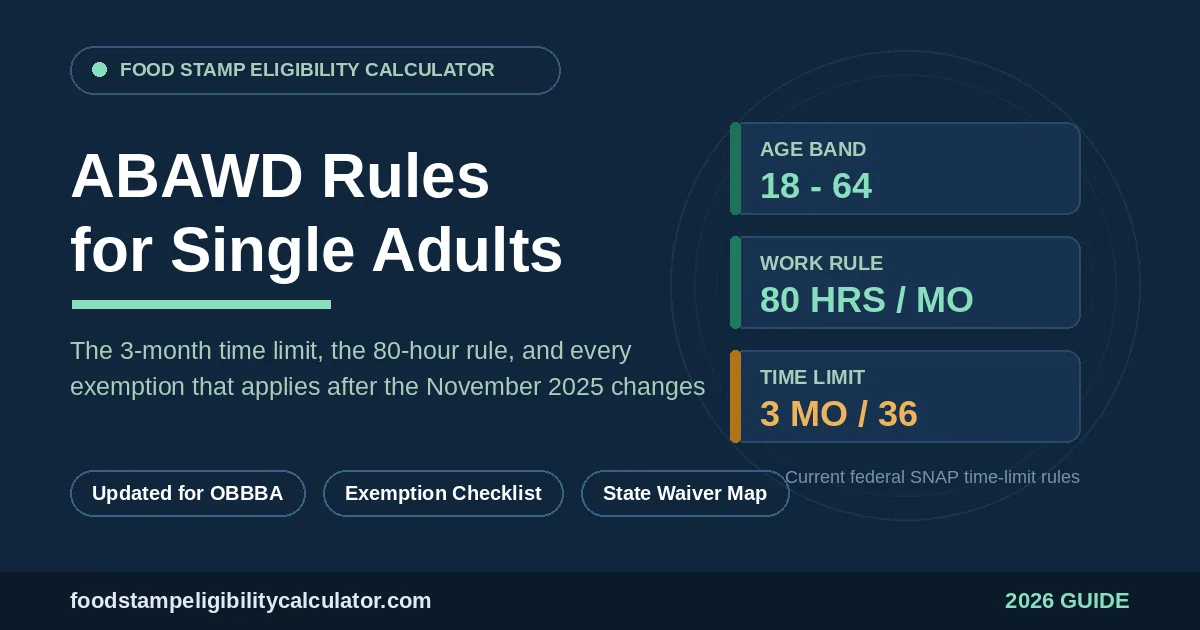
Single adults between 18 and 64 with no children face the strictest SNAP rules in the program. These rules are known as ABAWD, short for Able-Bodied Adults Without Dependents. They cap how long you can receive food benefits unless you work, train, or qualify for an exemption.
Many people lose benefits under these rules because they misread the system, not because they are ineligible. This guide explains every ABAWD rule in effect for 2026, including the sweeping changes that arrived on November 1, 2025.
Table of Contents
- 1What Does ABAWD Mean?
- 2The 3-Month Time Limit Explained
- 3Who Is Exempt from ABAWD Time Limits
- 4What Changed on November 1, 2025
- 5The ABAWD Work Requirement: What Counts
- 6State Waivers: Where ABAWD Rules Don't Apply
- 7What Happens When Your 3 Months Run Out
- 8Strategies for Single Adults to Maintain SNAP Benefits
- 9ABAWD Rules and Unemployment Benefits
- 10Common Myths About ABAWD Rules
- 11Getting Help with ABAWD Requirements
- 12Frequently Asked Questions
- 13Related SNAP Guides
What Does ABAWD Mean?
ABAWD stands for Able-Bodied Adult Without Dependents. It is the label federal SNAP law places on adults who are considered ready for work and free of young dependents.
You fall into this group if you are between 18 and 64 and able to work. You also must not be pregnant and must have no child under 14 living in your household. If that describes you, a separate set of time limits applies to your benefits that does not affect other SNAP applicants.
The ABAWD rule dates back to the 1996 welfare reform law, and Congress has tightened it several times since. The current rules live in Section 6(o) of the Food and Nutrition Act. The Fiscal Responsibility Act of 2023 raised the upper age from 49 to 54.
The One Big Beautiful Bill Act of 2025 went much further and pushed the age band to 64, effective November 1, 2025. Adults aged 55 to 64 who were never subject to these rules before now face the three-month clock unless an exemption protects them.
The 3-Month Time Limit Explained
The core of the ABAWD rule is the 3-month time limit. In any 36-month period, you can receive benefits for only 3 months unless you meet the ABAWD work requirement or qualify for an exemption.
A single adult between 18 and 64 with no young children therefore loses benefits after 3 countable months of neither working nor training. The clock keeps running whether you realize it or not.
Here is a concrete example. Say you apply in January, get approved, and are neither working nor training. You would receive benefits for January, February, and March.
Come April, your benefits would stop until you start meeting the work requirement or your 36-month window resets.
Only certain months actually count against your limit, and prorated months never do. A month where you missed hours for good cause doesn't count either — illness, a household emergency, or lost transportation all qualify under 7 CFR 273.24.
The money at stake is real. In fiscal year 2026, a single person can receive up to $298 per month. Exhausting your window can therefore cost close to $900 in food benefits.
How the 36-Month Period Works
States track your 36-month window in one of two ways, and the choice matters. A state can run a fixed clock that turns over for everyone at once. Or it can run a rolling clock that starts the first month you personally receive benefits.
Federal regulation at 7 CFR 273.24 lets each state agency pick its own method. With a fixed clock, many states align the three-year window to the federal fiscal year, so a fresh window opens on October 1. Once your 3 months are spent inside a window, you either wait for the reset or regain eligibility sooner by meeting the work requirement.
Who Is Exempt from ABAWD Time Limits
Not everyone who is single and childless is subject to the time limit. Several exemptions can shield you completely, and a single qualifying exemption stops the three-month clock. These are the categories that count after the November 2025 changes:
1. People with Disabilities
If you have a physical or mental condition that seriously limits your ability to work, you're exempt from ABAWD rules. This includes people receiving SSI, SSDI, veterans disability compensation, or other federal disability benefits.
It also covers people who are clearly unable to work even without an official disability determination, because your SNAP caseworker can assess this directly. Conditions like severe depression, chronic pain, mobility limitations, and substance use disorders can all qualify.
2. Pregnant Women
If you're pregnant at any stage of your pregnancy, you're exempt from ABAWD time limits. Documentation may be requested, but the exemption applies regardless of how far along you are. Once the pregnancy ends, you may still be protected while caring for the child.
3. Parents and Caregivers of Young Children
A parent or household member responsible for a child under 14 is exempt, even if that child isn't eligible for benefits themselves. This threshold dropped from 18 to 14 on November 1, 2025. A parent whose only child is 14 or older now faces the time limit unless another exemption applies.
Care for an incapacitated person also protects you. If you spend substantial hours caring for a disabled or elderly relative, tell your caseworker, because this protection survived the 2025 changes.
4. People Excused from the General Work Requirements
Federal rules excuse certain adults from the general SNAP work requirements, and that excuse carries over to ABAWD. You qualify if you already work 30 or more hours a week.
The same holds if you receive unemployment benefits while meeting their work rules. Participating in a drug or alcohol treatment program or studying at least half-time also counts.
5. American Indians and Alaska Natives
The 2025 law added an exemption for Indians and Urban Indians, as defined in the Indian Health Care Improvement Act. California Indians under section 809(a) are covered too. Tell your caseworker if this applies to you, because it is the newest category and often gets overlooked.
6. People in Areas with Waived Time Limits
If you live in an area where the state holds an approved waiver, the time limit doesn't apply to you at all. Waiver rules tightened in 2025, and only areas with sustained unemployment above 10 percent can now qualify. We break down the details below.
What Changed on November 1, 2025
The One Big Beautiful Bill Act of 2025 produced the biggest overhaul of ABAWD rules in decades. Millions of single adults who were previously protected now face the time limit. The table below shows exactly what switched on November 1, 2025.
| Rule | Before November 2025 | After November 2025 |
|---|---|---|
| Age range subject to time limit | 18 to 54 | 18 to 64 |
| Caregiver exemption | Child under 18 | Child under 14 |
| Veteran exemption | All veterans exempt | Removed |
| Homelessness exemption | Exempt | Removed |
| Foster youth exemption (18-24) | Exempt through age 24 | Removed |
| Waiver criteria | High unemployment or insufficient jobs | Unemployment above 10 percent only |
| American Indian exemption | None | Added |
Adults aged 55 to 64 absorbed the largest single change. The Center on Budget and Policy Priorities projects more than a million losses in this age group as the new rules settle in.
Veterans without a service-connected disability and adults without stable housing lost their protections on the same day.
State agencies began enforcing the new standards between November 2025 and early 2026, according to the Department of Agriculture work requirements page.
One safeguard survived in the statute. States may exempt up to 8 percent of their time-limit caseload each year from a discretionary pool. Some people therefore keep benefits through state-level decisions.
Ask your caseworker whether your state is using this flexibility.
The ABAWD Work Requirement: What Counts
If you're subject to the time limit and want benefits beyond 3 months, you must meet the work requirement. The standard is 80 hours per month, which averages out to about 20 hours per week. You don't need a traditional job to get there, because several activities count:
| Activity | How It Counts Toward 80 Hours |
|---|---|
| Paid work | Full-time, part-time, seasonal, or self-employed hours, averaged monthly |
| Work program | SNAP E&T, WIOA programs, Trade Adjustment Assistance, or state-approved training |
| Combination | Mix work hours and program hours to reach 80 total for the month |
| Workfare | Hours your state assigns each month based on your benefit amount |
Paid Employment
The most straightforward path is paid employment, including full-time, part-time, seasonal, and self-employed work. Gig platforms like Uber, DoorDash, and freelance assignments count the same way as payroll jobs. States look at your monthly average, and 80 hours at the $7.25 federal minimum wage works out to roughly $580 a month.

Unpaid Work Experience or Community Service
If you can't find paid employment, you can meet the work requirement through unpaid work experience or community service. Many states operate work experience programs, sometimes called WEP, that place ABAWDs in unpaid positions at non-profits and government agencies.
You must work the same 80 hours per month, but you don't need to be paid. This is essentially volunteering in exchange for maintaining your SNAP benefits.
Job Training and Education Programs
Participation in certain job training programs counts toward the work requirement. This includes SNAP Employment and Training (E&T), Trade Adjustment Assistance programs, and other state-approved workforce programs.
Some states also count community college or vocational school attendance when the program leads directly to employment. The key is that the program must be approved by your state SNAP agency, because not all education counts.
Volunteering That Qualifies
Volunteering can count toward your work requirement, but there is a catch: it must be verifiable and done through an approved program. Simply volunteering at your local food bank on your own may not count.
It needs to be part of a formal SNAP E&T program or state-approved work activity. Always check with your caseworker before assuming that your volunteer hours will satisfy the requirement.
State Waivers: Where ABAWD Rules Don't Apply
States can request waivers from USDA to suspend the time limit in hard-hit areas, but that power shrank sharply in 2025. Waivers based on insufficient jobs ended on November 2, 2025, about a month after federal guidance went out. Only areas with a persistent unemployment rate above 10 percent can still receive a waiver.
How Waivers Work Now
Approved waivers typically cover specific counties or groups of counties and run for set periods. California, for example, lists waived counties such as Imperial, Merced, and Monterey for the period running through late 2026. Texas publishes its own county waiver list each January.
A waived area means no time limit and no work requirement for anyone living there. Your county's status can change from year to year, so confirm it before you count on it.
Alaska and Hawaii play by slightly different rules. As noncontiguous states, they can qualify when their unemployment runs at 1.5 times the national rate. That flexibility was written into the 2025 law and expires on December 31, 2028.
Some states have also used broad-based categorical eligibility, known as BBCE, to shield many single adults from the time limit. Uptake varies widely by state, so the safest move is to ask your local office directly whether your county is currently waived.
What Happens When Your 3 Months Run Out
If you use up your 3 months of SNAP benefits without meeting the work requirement and you're not exempt, your benefits will be terminated. Here's what that process looks like and what you can do about it:
Notification and Appeal Rights
Before termination, your state SNAP agency must send a notice explaining that you've reached the ABAWD time limit. The notice should explain how to regain eligibility and your right to a fair hearing. If you believe an exemption was missed or your months were miscounted, file a SNAP appeal before your termination date.
Regaining Eligibility
You can regain eligibility by working, participating in a work program, or combining both for 80 hours within any 30 consecutive days. Report the hours to your caseworker, and your benefits restart. Federal regulation places no limit on how many times you can regain eligibility this way, which matters if your work situation keeps shifting.
There is also a one-time safety valve. If you regain eligibility and later lose the work requirement again, you can receive 3 consecutive months of benefits. That protection works only once per 36-month period.
Practical Steps If You're About to Lose Benefits
If your three-month clock is nearly exhausted, act immediately. These steps give you the fastest routes to protection:
- Check whether any exemption applies that you haven't claimed, because many people qualify without realizing it.
- Ask your caseworker about SNAP E&T programs that help you meet the work requirement.
- Look for paid employment, even part-time, that would satisfy the 80-hour standard.
- Explore community service or workfare options through approved programs.
- If you believe the state misclassified you, file an appeal before your termination date.
Strategies for Single Adults to Maintain SNAP Benefits
Keeping benefits under the 2026 rules takes proactive planning. These strategies protect single adults from avoidable terminations:
Document Everything
Keep detailed records of your work hours, volunteer hours, job search activities, and any medical conditions that might qualify you for an exemption. Pay stubs, timesheets, volunteer supervisor signatures, and doctor's notes are all critical documentation.
Don't rely on your caseworker to keep track, because mistakes happen. Your own documentation can protect you if there is ever a dispute about whether you met the work requirement.
Explore All Exemption Categories
Many ABAWDs qualify for exemptions without knowing it. If you have any condition that limits your ability to work, tell your caseworker even without formal disability paperwork.
If you care for a family member or a young child, ask about caregiver rules. If you're a veteran with a service-connected disability, document it, because disability rather than veteran status alone now drives the exemption.
Combine Activities to Reach 80 Hours
You don't have to get all 80 hours from a single activity. You can combine paid work with job training, volunteer hours, or work experience programs to reach the total.
For example, working 15 hours per week at a retail job gives you about 65 monthly hours. Adding 5 volunteer hours per week through an approved program pushes you past the threshold.
Know Your State's Specific Rules
States have significant flexibility in how they implement ABAWD rules. Some offer robust E&T programs with extensive support services, while others provide minimal assistance.
Some enforce time limits aggressively, while others move slowly. Check your state's SNAP website or ask your caseworker about local resources before you assume the worst.
ABAWD Rules and Unemployment Benefits
Many single adults who receive SNAP also receive unemployment benefits. Unemployment benefits count as unearned income for SNAP purposes, so they're included in your income calculation.
However, receiving unemployment doesn't automatically satisfy the ABAWD work requirement. You still need a qualifying activity for 80 hours per month unless an exemption covers you.
Some states count unemployment program activities, such as required job search or reemployment services, toward the ABAWD work requirement. Ask your caseworker whether your activities can be applied.
For the full picture, see our guide on SNAP and unemployment benefits. It covers income rules, reporting duties, and timing conflicts between the two programs.
Common Myths About ABAWD Rules
A lot of misinformation circles around ABAWD rules. Let's clear up the most common myths:
Myth: "ABAWD rules mean you can't get SNAP if you're single"
False. Single adults can absolutely receive SNAP benefits. The ABAWD rule only limits how long you can receive benefits without meeting work requirements. If you're working 20 hours per week or are exempt, there is no time limit on your benefits.
Myth: "You need to work full-time to keep SNAP"
False. You only need to work or participate in qualifying activities for 80 hours per month, which is roughly 20 hours per week. A part-time job at minimum wage satisfies this requirement.
Myth: "If you lose SNAP once, you can never get it back"
False. You can regain eligibility by completing 80 hours of work or program activity within 30 days. There is no limit on how many times you can do that. You also regain access when a new 36-month window begins.
Myth: "ABAWD rules apply in every state exactly the same way"
False. Waived areas, discretionary exemption pools, and BBCE policies create real differences between states. The November 2025 changes narrowed these protections, but state-level variation still matters.
Myth: "Veterans are always exempt from ABAWD rules"
False since November 2025. Veterans without a qualifying disability or a child under 14 must now meet the same 80-hour rule as everyone else. A service-connected disability rating can still open the medical exemption.
Getting Help with ABAWD Requirements
If you're struggling with ABAWD rules, there are resources available. Legal aid organizations in many states provide free help to SNAP recipients facing benefit terminations.
Your local SNAP office can connect you with E&T programs and other resources. Community organizations, food banks, and social services agencies can also help you navigate the system. Don't try to figure this out alone, because plenty of people are paid to help you keep your benefits.
For a broader understanding of SNAP work rules that may apply to you, visit our full overview of SNAP work requirements. If you're not sure whether you qualify based on your income, check our guide to SNAP income limits by state. And when you're ready to apply, use our SNAP application guide to get started.
Frequently Asked Questions
Can I get SNAP benefits if I'm single with no kids and not working?
Yes, you can receive SNAP for up to 3 months in any 36-month period. After that, you must meet the ABAWD work requirement of 80 hours a month or qualify for an exemption. Current exemptions include medical unfitness, pregnancy, a child under 14 at home, and Native American status — veteran or homelessness alone no longer protects you.
Does gig work like Uber or DoorDash count toward the ABAWD work requirement?
Yes, self-employment including gig work counts toward the 80-hour monthly requirement. Keep detailed records of when you work, including app screenshots, mileage logs, and tax documents. As long as you average 80 hours per month across all your platforms, you satisfy the rule.
What if my state has a waiver - do I still need to meet work requirements?
If you live in a waived area, the time limit and work requirement don't apply to you. Waivers now only cover areas with unemployment above 10 percent, because the broader waivers ended in November 2025. Check with your local SNAP office periodically, since waivers expire and the covered counties change.
I lost my SNAP benefits after 3 months. How do I get them back?
Work, join a work program, or combine both for 80 hours within any 30 consecutive days, then report the hours to your caseworker. Federal rules place no limit on how many times you can regain eligibility this way. There is also a one-time grace period of 3 consecutive months, available once per 36-month period.
What does ABAWD mean in SNAP?
ABAWD stands for Able-Bodied Adult Without Dependents. It describes adults between 18 and 64 who can work, are not pregnant, and have no child under 14 at home. This group faces the strictest SNAP rule: benefits stop after 3 countable months in any 36-month period.
How many hours a month do I have to work to keep SNAP?
You need 80 hours a month, which averages 20 hours a week. Paid work, approved training programs, and community service all count, and you can combine them to reach the total. Eighty hours at the $7.25 federal minimum wage equals about $580 a month.
What are the ABAWD exemptions in 2026?
The current exemptions: under 18 or 65 and older, medically unfit for work, pregnant, or a parent of a child under 14. People excused from the general work requirements, American Indians and Alaska Natives, and residents of waived areas also qualify. The veteran, homelessness, and foster youth exemptions were removed on November 1, 2025.
Does volunteering count toward the 80 hours?
Yes, unpaid and volunteer work counts when your state can verify it. Volunteering connected to a SNAP E&T or state-approved program counts most reliably. Random unpaid work at a local charity may not qualify, so confirm with your caseworker before counting those hours.
Related SNAP Guides
- SNAP Work Requirements: complete rundown
- SNAP Income Limits Explained
- How to Apply for SNAP Benefits
- SNAP and Unemployment Benefits
- Step-by-step SNAP application walkthrough
- How to appeal a SNAP denial
- SNAP overpayment notices explained
- What you can buy with SNAP benefits