When a family takes in a roommate or charges a non-relative rent for a room, the cash that changes hands raises an immediate question for SNAP households: does that money count against the food stamp budget, and if so, how much? The answer is not as simple as adding the rent to your paycheck. SNAP has a specific boarder income rule that excludes half of what a boarder pays, treats certain boarders as separate economic units, and applies only when the arrangement meets a two-meal test. Getting this wrong can either understate income and trigger an overpayment later, or overstate income and cost a household hundreds of dollars in monthly benefits.
This guide walks through the federal boarder income rule, the household composition test, the meal requirement, the calculation, and the reporting rules. It also covers the most common mistakes caseworkers see, including treating a boarder as a household member when they should be separate, counting the full rent instead of 50 percent, and forgetting that boarder income is unearned for SNAP purposes.
Table of Contents
- 1What Counts as a Boarder for SNAP
- 2Household Composition: When a Boarder Is Separate
- 3The 50 Percent Boarder Income Exclusion
- 4Calculating Countable Boarder Income: A Worked Example
- 5Reporting Boarder Income to SNAP
- 6Common Mistakes That Cost Families Money
- 7How Boarder Income Interacts With Other SNAP Rules
- 8Special Situations
- 9Documenting the Boarder Arrangement
What Counts as a Boarder for SNAP
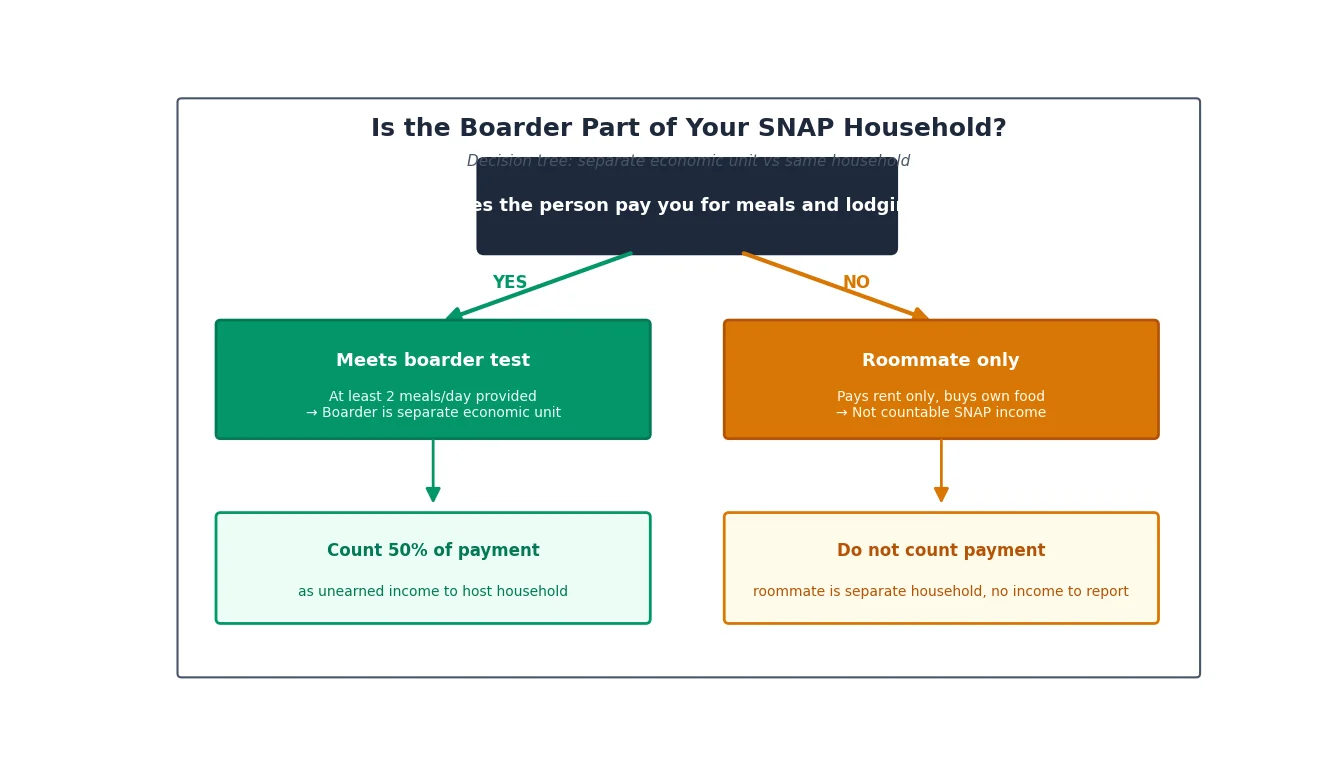
A boarder is a person who pays a SNAP household for lodging and meals. The defining feature is the meal component. If a person pays only for rent and buys or prepares their own food, they are a roommate, not a boarder, and the SNAP rules treat them differently. The roommate and shared household guide covers that scenario in detail.
The federal rule at 7 CFR 273.1(a)(1) requires that a boarder arrangement include the provision of meals. The USDA Food and Nutrition Service gives states latitude to define the meal threshold, and most states adopt a two-meals-per-day minimum for the arrangement to qualify as a boarder situation. If the person pays for rent plus fewer than two meals a day, they are treated as a roommate and the rent payment is not countable income to the SNAP household at all.
The boarder can be anyone — a friend, a non-relative, or even a relative who is not part of the SNAP household. The key is the economic arrangement, not the family relationship. If your adult child moves back home and pays you for food and lodging, that is a boarder arrangement for SNAP purposes, and the income rules below apply.
Household Composition: When a Boarder Is Separate
The boarder income rule only matters when the boarder is a separate economic unit from the SNAP household. If the boarder is part of the household, there is no boarder income to count because all the money stays inside the same SNAP unit.
SNAP uses the concept of purchasing and preparing food together. People who buy and prepare food separately are separate economic units, even if they live under the same roof. The boarder, by definition, pays someone else to provide meals, so the boarder is presumed to be a separate economic unit. This is why the boarder's payment counts as income to the host household.
There are exceptions. Children under 22 who live with their parents are always part of the parents' SNAP household, regardless of how they eat. Spouses who live together are always part of the same household. And adults who are 60 or older and unable to purchase and prepare their own food because of disability may be a separate household even if they eat with the host family, provided the host family's income is below 165 percent of the federal poverty line.
The 50 Percent Boarder Income Exclusion
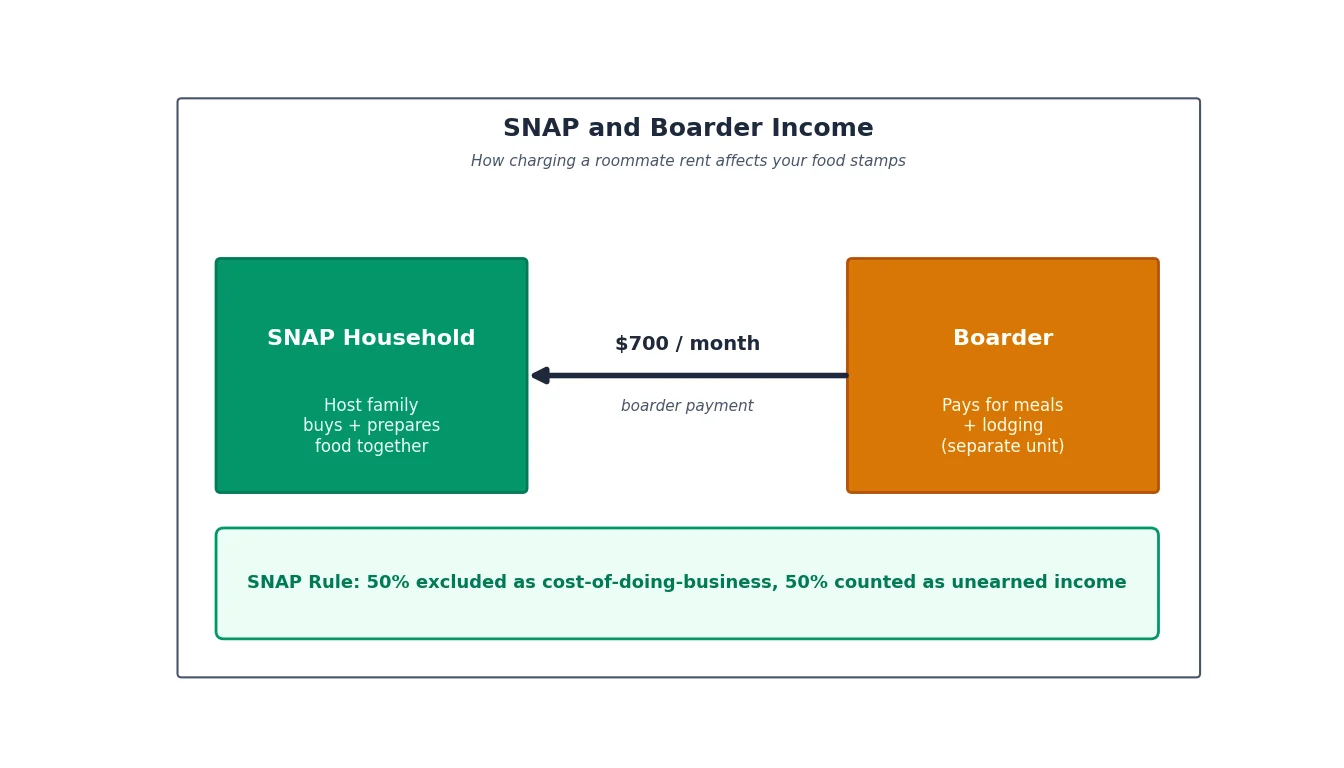
Once you confirm the boarder is a separate economic unit and meets the meal test, the next step is calculating the countable income. SNAP excludes 50 percent of the boarder payment as a cost-of-doing-business allowance, then counts the remaining 50 percent as unearned income to the host household.
The exclusion is flat. It does not matter whether the boarder pays 200 dollars or 1,200 dollars a month. Half is excluded, half is counted. The rationale is that the host household incurs costs to provide meals and lodging, and the 50 percent exclusion approximates those costs without requiring itemized receipts.
Some states allow the household to itemize actual costs if those costs exceed 50 percent of the payment. This is rare in practice because most households cannot document food and utility costs attributable to the boarder with the precision SNAP requires. The flat 50 percent exclusion is almost always the better path.
Calculating Countable Boarder Income: A Worked Example
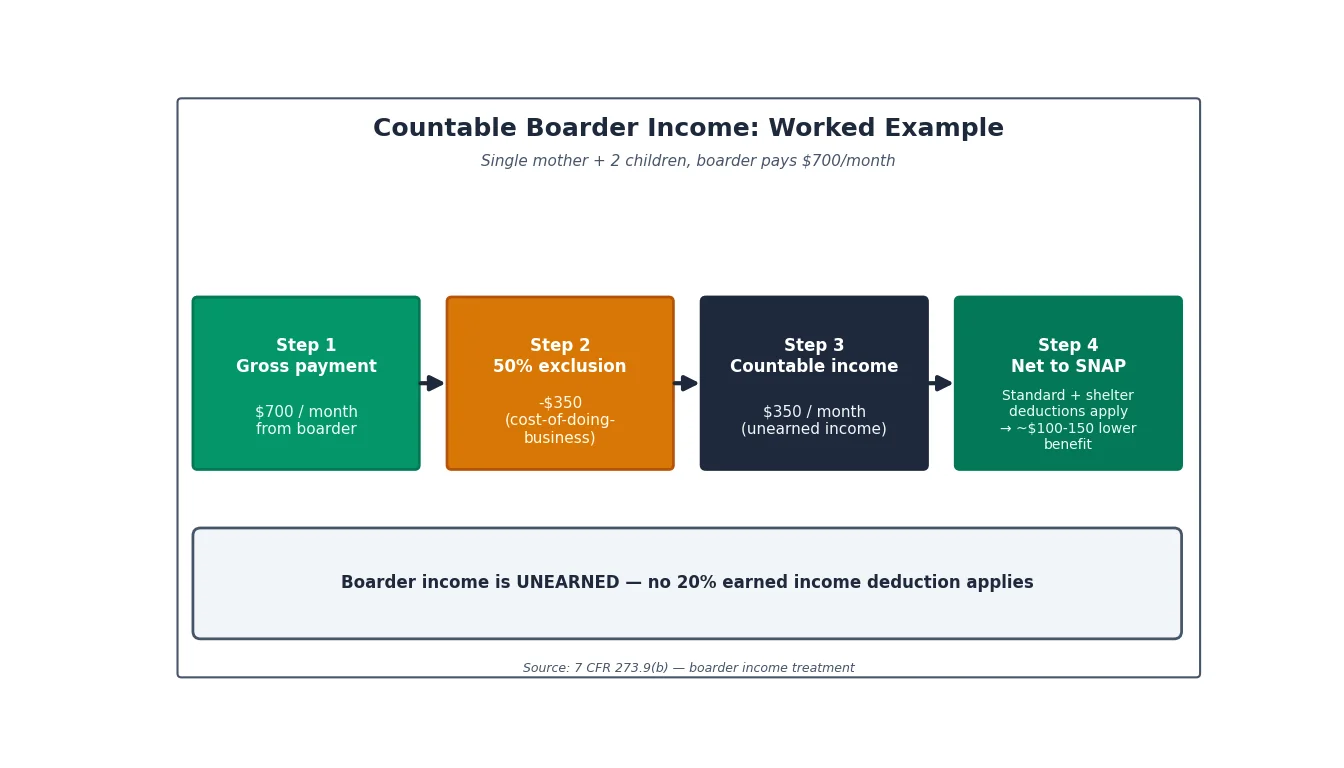
Suppose a single mother on SNAP with two children takes in an elderly boarder who pays 700 dollars a month for a bedroom and two meals a day. The household has no other countable income. The calculation runs as follows.
Start with the gross monthly boarder payment of 700 dollars. Apply the 50 percent exclusion, which removes 350 dollars. The countable boarder income is 350 dollars. Because boarder income is unearned, no 20 percent earned income deduction applies. The household then takes the standard deduction, the shelter deduction, and any applicable excess medical or dependent care deductions to arrive at net income.
Without the boarder, this three-person household would have zero countable income and would receive the maximum SNAP benefit. With the boarder, the countable 350 dollars reduces the benefit, but typically only by about 100 to 150 dollars a month. The boarder arrangement still leaves the household significantly better off financially.
Reporting Boarder Income to SNAP
Boarder income must be reported to SNAP, but the timing depends on the household's reporting status. Most SNAP households are on simplified reporting, which means they only report changes at recertification and when income drops below the SNAP gross monthly income limit. A new boarder arrangement is not a reportable change under simplified reporting until the next recertification, unless household income rises above 130 percent of the federal poverty line.
Households on change reporting, which is rare and applies mainly to households with an elderly or disabled member, must report a new boarder within 10 days of the arrangement starting. The unreported SNAP changes guide covers the penalties for missing a 10-day report.
At application and recertification, the household must list the boarder payment on the application form, usually under "other income." The caseworker will ask for the monthly amount, what the payment covers (meals and lodging, or lodging only), and the boarder's name. The caseworker does not need to verify the boarder's separate household status unless something suggests the boarder is actually purchasing and preparing food with the host family.
Common Mistakes That Cost Families Money
The first common mistake is treating a roommate as a boarder. If the person pays only rent and buys their own food, the rent is not countable income. Some households report this rent thinking they have to, and the caseworker incorrectly counts it because both sides misunderstand the meal requirement. Always confirm the meal arrangement before reporting.
The second mistake is counting the full boarder payment instead of 50 percent. Caseworkers occasionally enter the full amount as unearned income, which overstates countable income and reduces the benefit more than the rules allow. If your benefit drops sharply after starting a boarder arrangement, ask the caseworker to confirm the 50 percent exclusion was applied.
The third mistake is forgetting that boarder income is unearned. The 20 percent earned income deduction does not apply. Households sometimes calculate their expected benefit assuming the deduction applies and are surprised when the actual benefit is lower.
How Boarder Income Interacts With Other SNAP Rules
Boarder income counts toward the gross income test, the net income test, and the benefit calculation. It does not affect the resource limit because income and resources are separate concepts in SNAP. The money the household receives from the boarder becomes a resource only if it is still in the bank account at the end of the month in which it was received.
If the household also receives housing assistance or LIHEAP, the boarder payment does not reduce those benefits directly, but it may affect eligibility thresholds for programs that look at total household income. SNAP and LIHEAP coordination is common because both programs consider utility costs, and a boarder's presence may shift how utility costs are allocated.
For households with child support obligations, the boarder income is added to the household budget but does not change the child support order. Child support is a separate legal obligation governed by family court, not by SNAP rules.
Special Situations
If the boarder is a foster child, the household can choose whether to include the foster child in the SNAP household. The foster care payment is excluded from income if the foster child is included, and the foster child's income is excluded if they are not included. This is one of the few situations where household composition is a household choice.
If the boarder is a non-citizen, the boarder's immigration status does not affect how the host household reports the boarder payment. The payment is countable income to the host household regardless of the boarder's status. The boarder themselves may or may not be SNAP-eligible separately, depending on their own status under the green card holder rules.
If the boarder is a college student, the student's eligibility for their own SNAP benefits is governed by the college student rules, which generally require 20 hours of work per week or an exemption. The boarder payment does not change the student's eligibility, but it does count as income to the student if they apply for SNAP separately.
Documenting the Boarder Arrangement
SNAP does not require a written boarder agreement, but having one makes life easier. A simple one-page document stating the monthly payment, what it covers (meals and lodging), and the start date is enough. Keep copies of any rent receipts or bank deposits that show the payment. If the boarder pays in cash, write out a receipt each month and have both parties sign it.
At recertification, the caseworker may ask for the last two or three months of boarder payments to confirm the amount is stable. If the payment varies, the caseworker will average it over the prior three months and use that as the monthly amount going forward. Sudden drops in the boarder payment should be reported if the household is on change reporting, but can wait until recertification for simplified reporting households.
The bank statements verification guide explains how caseworkers review deposits during recertification. Boarder payments will show up as recurring deposits, and the caseworker may ask about any large cash deposits that match the boarder pattern.
Boarder arrangements are a legitimate way for SNAP households to stretch tight budgets, and the rules are designed to recognize that providing meals and lodging has real costs. Understanding the meal test, the 50 percent exclusion, and the household composition rules lets you take in a boarder with confidence that your food stamp benefit will be calculated correctly.