If you just got a Pell Grant and you're stretching a part-time paycheck to cover groceries, you're probably wondering whether the grant messes with your SNAP. Short answer: it doesn't. The Pell Grant itself doesn't count as income, and how student financial aid affects food stamps is something most students misunderstand.
The longer answer is the annoying one. The moment you accept a Pell Grant and enroll at least half-time, you fall under a separate SNAP rule called the "student eligibility rule." That rule says most college students can't get food stamps unless they fit one of a handful of exemptions. So the grant isn't your problem — your student status is.
The good news is most Pell Grant recipients who need food stamps can clear one of those exemptions. SNAP benefits for college students are reachable if you know which exemption fits. This guide covers the income side, the student side, and the work-arounds.
Key takeaway: A Pell Grant does not count as income for SNAP, but enrolling half-time or more triggers the student eligibility rule — and you must meet one of six exemptions to keep your food stamps.
Table of Contents
- 1What Is a Pell Grant?
- 2Does a Pell Grant Count as Income for SNAP?
- 3The Student Eligibility Trap
- 4The Six Exemptions That Let Students Qualify for SNAP
- 5Pell Grant + SNAP: The Income Side
- 6Real Example: A Community College Student with a $4,000 Pell Grant
- 7FAFSA and SNAP: What to Report
- 8How to Apply for SNAP as a Pell Grant Recipient
- 9Common Mistakes Students Make on SNAP Applications
- 10Reporting Changes When Your Pell Grant Renewal Comes In
- 11Sources
What Is a Pell Grant?
A Pell Grant is federal need-based aid that doesn't have to be repaid. The Department of Education awards it to undergrads who haven't finished a bachelor's degree and show exceptional financial need. For 2025-26, the maximum Pell Grant is $7,395; 2026-27 holds at $7,395. Most full-time students get between $4,000 and the full $7,395.
The amount you get depends on your Student Aid Index (SAI), which replaced the old Expected Family Contribution (EFC) in the 2024-25 FAFSA redesign. An SAI of $0 (or a negative SAI down to -$1,500) auto-qualifies you for the maximum Pell Grant — the same as the old EFC $0. About 80% of recipients get the max.
Pell money usually arrives at the start of each semester. Any amount left over after tuition and fees gets refunded to your bank account for books, rent, and food. That refund is what trips students up at the SNAP office.
Does a Pell Grant Count as Income for SNAP?
No. Federal SNAP rules at 7 CFR 273.9(d)(3) explicitly exclude "any educational assistance that is provided under any federal program" from countable SNAP income. Pell Grants are Title IV federal student aid, so they're categorically excluded. A $7,395 Pell Grant doesn't push you over the SNAP income limit, and the leftover refund you use for groceries doesn't reduce your benefit.
This is true whether the grant pays tuition directly or refunds to your bank account. The money is treated as a resource for education, not income. The same exclusion covers FSEOG, TEACH Grants, federal work-study wages, and most state need-based grants.
That's the clean part of the rule. The mess starts when SNAP looks at whether you're a "student" — and that's where Pell Grant SNAP eligibility gets tangled.

Pell Grant refunds do not count as SNAP income — but they can change your student status.
The Student Eligibility Trap
Here's the trap. If you're enrolled at least half-time in an institution of higher education, you're subject to the SNAP student rule at 7 CFR 273.5. That rule says you cannot receive SNAP unless you also meet at least one of several exemptions. Half-time is usually 6 credit hours per term for undergrads, though your school may define it differently.
The same enrollment that earns your Pell Grant also blocks your SNAP, unless you can check one of the exemption boxes. Pell Grant eligibility alone isn't an exemption. A lot of students get denied here and assume the grant disqualified them. It didn't. The enrollment did.
The student rule applies only while you're enrolled half-time or more. Drop below and the rule disappears — but that usually kills your Pell Grant and full-time aid, so it's rarely the right move. The better path is to qualify under one of the six exemptions below.
The Six Exemptions That Let Students Qualify for SNAP
If you're enrolled half-time or more, you need to meet one of these exemptions. Our college student SNAP exemptions guide has the long version; here's the short one.
- Work 20 hours per week: Paid work at least 20 hours per week (or 80 hours per month) clears the rule. Wages still count as SNAP income, so factor that into your estimate.
- Approved work-study: A federal or state work-study assignment, even if you haven't started yet, qualifies you. Tell your caseworker you have an approved work-study award.
- Parent of a child under 12: A student who is a parent of a child under 12 living in the household is exempt. Single and married students can both use this.
- Receiving TANF cash assistance: If you or your household gets TANF, you're exempt. Most college parents on TANF clear this one.
- Disabled or unable to work: Receiving SSI, SSDI, Railroad Retirement disability, or a veteran's disability benefit at a certain rating counts. SNAP for disabled Americans explains this path.
- Enrolled in a SNAP E&T program: Active participation in a state SNAP Employment and Training program counts.
If none of those six fit, look at the narrower exemptions: students under 18 or over 50, in on-the-job training, caring for an incapacitated household member, or former foster youth up to age 24. The former foster youth SNAP rules are worth checking if you aged out of the system.

Pell Grants and SNAP run on two separate rulebooks.
Pell Grant + SNAP: The Income Side
Even with the student rule cleared, your other income still has to fit the SNAP limits. For a one-person household in 2026, the gross monthly limit is around $1,696 (130% of the poverty line), and the net limit is around $1,305. If your gross wages are under $1,696 a month, you're in the ballpark — up to the $292 maximum allotment.
Pell Grant money is excluded, but other income isn't. Wages count. Unemployment counts. Veterans' benefits count. Child support counts. What doesn't: federal student aid under Title IV (Pell, FSEOG, work-study, federal student loans — yes, student loan money is excluded too), GI Bill housing, and most state grants tied to tuition.
If you've got a side gig driving Uber or delivering groceries, those earnings count as self-employment income. SNAP for gig workers walks through how to report irregular income without tanking your benefit. Short version: report average monthly earnings, and keep your logs if your caseworker asks.
Real Example: A Community College Student with a $4,000 Pell Grant
Take Maria, 22, a full-time student at a community college in Ohio. She gets a $4,000 Pell Grant for the year, split into two $2,000 disbursements. After tuition, she gets about $1,400 back per semester. She also works 22 hours a week at a coffee shop at $9 an hour — $858 gross a month.
Here's how her SNAP file looks. Pell Grant refund: not counted. Gross wages: $858 a month, well under the $1,696 limit. Student exemption: 22 hours a week, so she clears the 20-hour bar. Rent: $650. Utility allowance: around $400. Net income after deductions puts her near the $292 maximum for one person in 2026.
Maria gets approved for $250 to $292 a month in food stamps. Her Pell Grant never enters the income calculation. Her enrollment just forced her to prove the 20-hour exemption, which her pay stubs handle.
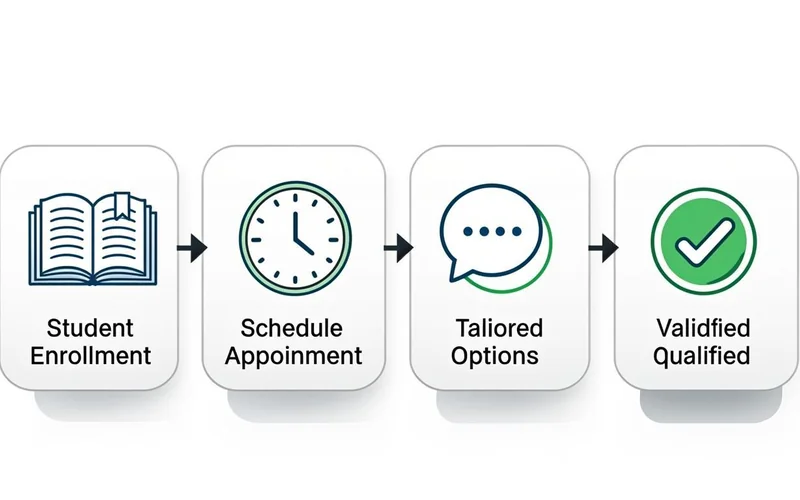
Working 20 hours a week is the cleanest exemption for most Pell recipients.
FAFSA and SNAP: What to Report
The FAFSA and your SNAP application are two separate systems. Your FAFSA doesn't get sent to the SNAP office, your Student Aid Index doesn't appear on your SNAP file.
What you have to report on your SNAP application is your household income, composition, housing costs, and student status. When the form asks about income, list your wages and any non-excluded income. Don't list your Pell Grant. Don't list your federal student loans. If your caseworker asks about "educational assistance," say it's a federal Pell Grant and cite 7 CFR 273.9(d)(3) — that exclusion saves a denial letter.
You also have to tell them you're a student enrolled half-time or more, and document which exemption you fit. For a full list, the SNAP verification documents checklist covers the standard set. As a student, add your class schedule or registrar letter, your aid award letter, your pay stubs if using the 20-hour exemption, and your work-study letter if using that path.
How to Apply for SNAP as a Pell Grant Recipient
Applying as a student is no different from anyone else, except for one extra hoop. You can apply online through your state's portal, by phone, by mail, or in person. Takes 20 to 40 minutes if you have your documents ready.
Follow the step-by-step SNAP application guide. When the form asks if anyone is a student, mark yes and provide your enrollment details. When it asks about income, don't list Pell Grant. When the caseworker calls for your interview, mention up front that you have a Pell Grant and meet one of the student exemptions — that conversation goes smoother when you say it first.
The 30-day processing clock starts the day you submit a signed application. If your income is very low and resources are under $100, ask about expedited SNAP — benefits on your EBT card within 7 days.
Common Mistakes Students Make on SNAP Applications
The number one mistake is listing your Pell Grant refund as income on the application. That inflates your income by thousands and triggers a denial. If you already made this mistake, appeal — bring the award letter showing it's a federal Pell Grant and request a hearing.
The second mistake is failing to mention student status, hoping the office won't notice. They will, and the omission can be treated as a SNAP application mistake that triggers an overpayment later. Always disclose enrollment up front.
The third mistake is assuming you can't work 20 hours a week as a student. Many already do, and the exemption is automatic once your pay stubs are in the file. If you can't, look at work-study (counts even at 5 to 10 hours a week), SNAP E&T, or the parent-of-a-child-under-12 exemption if it fits.
A fourth mistake is forgetting that SNAP income limits are gross and net — net income after deductions sets your benefit. Claim every deduction: housing, utility allowance, child care, and the 20% earned income deduction. Asset limits are usually a non-issue for students because of broad-based categorical eligibility.
Reporting Changes When Your Pell Grant Renewal Comes In
Your Pell Grant renews every academic year. When the new award letter arrives, you don't need to report it to SNAP — it's not income. But the renewal often coincides with an enrollment change — say, dropping from 12 to 9 credits. If you stay at half-time or above, the student rule still applies.
If you drop below half-time, the student rule falls away, and your SNAP eligibility depends on plain income and household composition. Report that change within the window your state uses (10 days in most states).
If your wages change — more hours, or work-study ends — report it. Income changes during the certification period can change your benefit. SNAP work requirements for non-students differ from the 20-hour student exemption, so if you graduate and lose student status, the ABAWD rule may kick in. The single-adult ABAWD rules limit benefits to 3 months in 3 years unless you keep working 20 hours a week or meet another exemption.
If you're self-employed through a freelance or gig setup, income reporting has its own pattern — usually a 12-month average. Students returning to school can use the SNAP back-to-school guide to plan the transition.
Sources
- USDA FNS — SNAP Student Eligibility (7 CFR 273.5)
- USDA FNS — SNAP Recipient Eligibility (7 CFR 273.9)
- Federal Student Aid — Federal Pell Grant Program
- CFR — 7 CFR 273.9, SNAP Income Deductions and Exclusions
- CFR — 7 CFR 273.5, SNAP Student Eligibility