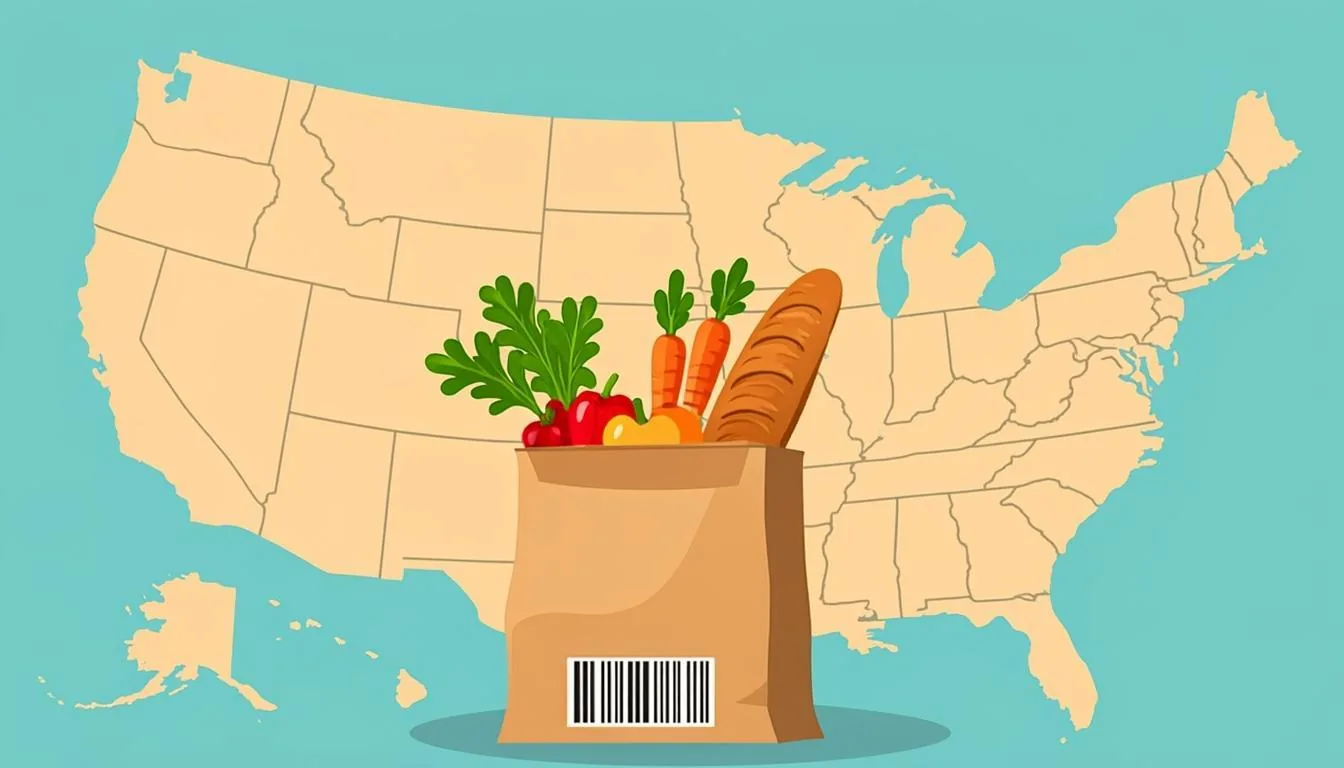
Most states now run SNAP under broad-based categorical eligibility, better known as BBCE. USDA's official chart lists 46 of 53 jurisdictions using it as of June 2026. Most of them raise the income limit well above the standard federal cap.
In plain terms, BBCE lets a state raise SNAP's gross income limit far above the usual $1,696 for one person. Twenty-eight states and the District of Columbia set the limit at the maximum: 200% of the federal poverty level. That equals $2,610 a month for one person, or $5,360 for a family of four, in FY2026.
Most BBCE states also remove the SNAP asset test entirely. That change matters just as much as the income raise, because savings or a reliable car no longer disqualify you.
This guide lists every BBCE state with its exact limit, shows the dollar figures, and explains the fine print. You can also check your household in about two minutes with our free SNAP eligibility calculator.
Table of Contents
- 1What Broad-Based Categorical Eligibility Actually Means
- 2What BBCE changes for your household
- 3What BBCE does not change
- 4The Complete BBCE State List for 2026
- 5States with the 200% gross income limit
- 6States with lower limits or special rules
- 7States that do not use BBCE
- 8What the 200% SNAP Limit Means in Dollars
- 9What the difference means for real households
- 10Alaska and Hawaii use higher figures
- 11Dollar limits for states below 200%
- 12Why Removing the Asset Test Matters So Much
- 13Where the asset test disappears entirely
- 14BBCE Does Not Guarantee Approval
- 15Did Recent Rule Changes End BBCE?
- 16How to Check Your State and Apply
- 17The Bottom Line
- 18Related SNAP Guides
What Broad-Based Categorical Eligibility Actually Means
Regular SNAP rules put two financial hurdles in front of every household. Gross monthly income must sit at or below 130% of the poverty line, per USDA's SNAP eligibility rules.
Countable resources cannot exceed $3,000. Households with a member who is 60 or older or disabled get a higher $4,500 resource cap instead.
BBCE works through a side door. A state links a small non-cash TANF or state-funded benefit, such as a brochure, referral, or services notice, to SNAP. Receiving that benefit makes a household categorically eligible, and categorical households follow the state's BBCE rules instead of the federal caps.
What BBCE changes for your household
Two things change, and both help working families. The gross income limit can rise from 130% up to 200% of poverty, which is the maximum federal law allows. The state can also lower or remove the asset test, so bank balances and vehicle value stop blocking eligibility.
What BBCE does not change
You still must pass the net income test after deductions, and your stated expenses decide how far your income drops. A household can clear the higher gross limit and still get a $0 benefit. Deductions must pull net income below the limit before any amount is payable.
Work rules apply too. Most adults aged 18 to 64 must now meet work requirements unless an exemption fits. That means 80 hours a month of work or training to keep benefits past three months.
The Complete BBCE State List for 2026
Everything below comes from USDA's official BBCE chart, which the agency last updated on June 29, 2026. The chart covers 46 jurisdictions: 43 states, the District of Columbia, Guam, and the U.S. Virgin Islands.
States with the 200% gross income limit
Twenty-eight states and DC set the BBCE limit at the full 200% for all households. Every one of them also dropped the asset test. Find your state in the table below.
State | Gross income limit | Asset test |
|---|---|---|
Alaska | 200% | None |
Arizona | 200% | None |
California | 200% | None |
Colorado | 200% | None |
Connecticut | 200% | None |
Delaware | 200% | None |
District of Columbia | 200% | None |
Florida | 200% | None |
Hawaii | 200% | None |
Kentucky | 200% | None |
Louisiana | 200% | None |
Maine | 200% | None |
Maryland | 200% | None |
Massachusetts | 200% | None |
Michigan | 200% | None |
Minnesota | 200% | None |
Montana | 200% | None |
Nevada | 200% | None |
New Hampshire | 200% | None |
New Mexico | 200% | None |
North Carolina | 200% | None |
North Dakota | 200% | None |
Oregon | 200% | None |
Pennsylvania | 200% | None |
Virginia | 200% | None |
Washington | 200% | None |
West Virginia | 200% | None |
Wisconsin | 200% | None |
States with lower limits or special rules
The other 18 jurisdictions use BBCE with lower income caps, asset limits, or pathways that cover only some households. Read the details closely, because Arkansas and New York split their rules by household type.
State or territory | Gross income limit | Asset limit | Who it covers |
|---|---|---|---|
Alabama | 130% | None | All households |
Arkansas | 165% | $5,500 (first 12 months) | Households with a member 60+ or disabled |
Arkansas | 130% | $5,500 (first 12 months) | All other households |
Georgia | 130% | None | All households |
Guam | 165% | None | All households |
Idaho | 130% | $5,360 | All households |
Illinois | 165% | None | All households |
Indiana | 130% | $5,360 | All households |
Iowa | 160% | None | All households |
Nebraska | 165% | $25,000 liquid assets | All households |
New Jersey | 185% | None | All households |
New York | 200% | None | Households paying dependent care costs |
New York | 150% | None | Households with earned income |
Ohio | 130% | None | All households |
Oklahoma | 130% | None | All households |
Rhode Island | 185% | None | All households |
South Carolina | 130% | None | All households |
Texas | 165% | $5,000 (one vehicle up to $22,000 excluded) | All households |
Vermont | 185% | None | All households |
U.S. Virgin Islands | 175% | None | All households |
Arkansas' $5,500 resource limit applies for a 12-month stretch and can be granted only once every five years. After that window, the regular $4,500 cap returns for elderly or disabled households and $3,000 for everyone else.
States that do not use BBCE
Seven states skip BBCE entirely and apply regular federal limits: Kansas, Mississippi, Missouri, South Dakota, Tennessee, Utah, and Wyoming. Gross income must stay at or below 130% of poverty. Countable resources cannot exceed $3,000, or $4,500 with a senior or disabled member.
Residents there still have routes to qualify. Households with an elderly or disabled member skip the gross income test under federal rules. Our FY2026 SNAP income eligibility chart shows every threshold by household size.
Keep one more thing in mind about this map. States can adopt or drop BBCE at any time, so the list is never frozen. Any switch shows up first on USDA's chart, which is why the June 2026 update date matters.
What the 200% SNAP Limit Means in Dollars
USDA's FY2026 income table lists official dollar limits for both the standard 130% test and the 200% BBCE test. The figures below cover the 48 contiguous states and the District of Columbia.
Household size | Gross limit at 130% | BBCE gross limit at 200% |
|---|---|---|
1 person | $1,696 | $2,610 |
2 persons | $2,296 | $3,526 |
3 persons | $2,897 | $4,442 |
4 persons | $3,484 | $5,360 |
5 persons | $4,080 | $6,276 |
6 persons | $4,675 | $7,192 |
7 persons | $5,271 | $8,108 |
8 persons | $5,866 | $9,024 |
Each additional person | +$596 | +$916 |
What the difference means for real households
Here is what that gap means in practice. A family of four in Michigan earning $4,600 a month fails the regular $3,484 gross test. Michigan's BBCE limit of $5,360 lets them continue.
They must still pass the net income test, where housing and utility deductions do much of the work. The same income can fail just one state over.
A family of four earning $4,600 a month also fails Texas' 165% limit of about $4,421. Texas keeps a $5,000 asset rule on top. That single percentage difference is why checking your own state's column matters.
Alaska and Hawaii use higher figures
Alaska and Hawaii run their own poverty guidelines, so their dollar limits sit higher than the table above. Alaska's 200% BBCE limit starts at about $3,260 a month for one person, while Hawaii's published BBCE table begins at $3,000.
Both states removed the asset test for BBCE households. Our Hawaii SNAP eligibility guide walks through the state's full table. Alaska residents should use their agency's published figures rather than the contiguous ones.
Dollar limits for states below 200%
States using 185%, 165%, 160%, or 150% caps calculate limits from the 2025 federal poverty guidelines. That baseline is $15,650 for one person or $32,150 for four.
The table below shows approximate monthly figures. States round slightly differently, so treat these as estimates and confirm with your agency.
Gross income limit | 1 person | Family of 4 |
|---|---|---|
185% — New Jersey, Rhode Island, Vermont | About $2,413 | About $4,957 |
165% — Illinois, Nebraska, Texas | About $2,152 | About $4,421 |
160% — Iowa | About $2,087 | About $4,287 |
150% — New York (earned income) | About $1,957 | About $4,019 |
Why Removing the Asset Test Matters So Much
The asset test is where many households quietly fail SNAP. Under regular rules, countable resources above $3,000 disqualify you no matter how little you earn. The cap rises to $4,500 for households with a senior or disabled member.
Countable resources include cash, bank balances, and, in most states, vehicles above a value threshold. Retirement accounts and your primary home usually do not count, but an emergency savings fund absolutely does.
Where the asset test disappears entirely
In most BBCE states there is no resource test for these households at all. A retired couple in Pennsylvania with $9,000 in savings fails the regular asset cap.
Under Pennsylvania's BBCE rules they qualify, assuming they pass the income tests. Our guide to SNAP for elderly couples covers this situation in detail.
BBCE Does Not Guarantee Approval
The biggest BBCE misconception is that 200% means automatic benefits. Gross income only opens the door, and the net income test plus deductions decide the actual benefit.
Net income is gross income minus deductions like the 20% earned income exclusion, the standard deduction, shelter costs, and child care. A family that clears 200% gross with high housing costs may still qualify, while a low-expense household at 180% may not. Our gross versus net income guide breaks down the math.
Time limits apply to some adults as well. The ABAWD rules now cover ages 18 to 64. Most adults in that range need 80 hours of work or training a month unless an exemption fits.
Did Recent Rule Changes End BBCE?
No. BBCE took heavy political fire in 2019, when USDA proposed restricting categorical eligibility to households receiving substantial TANF benefits. The agency formally withdrew that proposal in June 2021, and the rule never took effect.
The 2025 federal law changed SNAP in major ways, including expanded work requirements and narrower non-citizen rules effective April 1, 2026. It left BBCE untouched.
Two 2026 updates are worth knowing. The Food and Nutrition Service became the Food and Nutrition Administration on June 1. Its BBCE state chart was then refreshed on June 29, 2026 with all 46 jurisdictions still listed.
How to Check Your State and Apply
Start with USDA's BBCE chart for your state's exact limit and asset rules, then confirm the details with your state agency. The USDA state directory lists every office's contact information.
When you are ready to file, our step-by-step SNAP application guide walks through the whole process. Seniors on limited incomes may also qualify faster through the simplified elderly application.
Apply even if you are unsure about the exact numbers. The filing date protects your first payment, and the office collects verification afterward. Our SNAP verification documents checklist covers what to gather for the interview.
The Bottom Line
BBCE is the reason most working households can qualify for SNAP despite modest savings. Twenty-eight states and DC stretch the gross limit to 200% of poverty.
Most of the rest still ease the asset test, and only seven states apply strict federal rules.
Numbers change every October, so verify your state's current limits before you apply. Two minutes with our free SNAP eligibility calculator shows whether the higher BBCE limit changes your answer.
Related SNAP Guides
These guides cover the rest of the process.