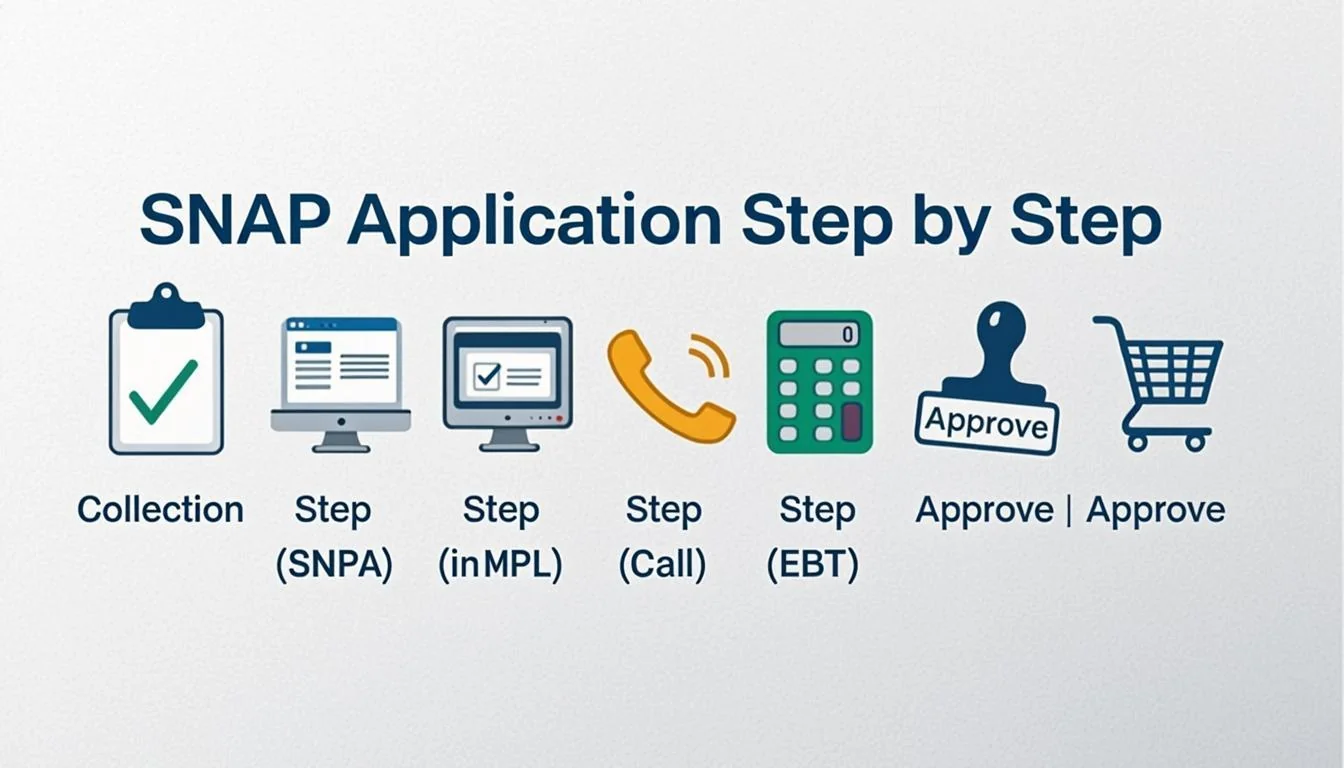
Applying for SNAP feels overwhelming if you don't know what happens after you hit submit. You fill out the form, and then what? A caseworker reviews it, someone calls you for an interview, and eventually an EBT card shows up in the mail. But the steps in between matter. Missing a document or misunderstanding a question can add weeks to your wait. This guide walks through every stage of the SNAP application process, from the moment you start gathering paperwork to the day your benefits load onto your card, using the federal timelines that state agencies must follow under USDA rules.
The SNAP application process has seven distinct stages: document preparation, application submission, the eligibility interview, verification and calculation, the approval or denial decision, EBT card issuance, and the first benefit deposit. Each stage has its own deadline under 7 CFR 273.2. Knowing those deadlines helps you follow up at the right time and catch problems before they turn into denials. If you want to understand the income side of the process, our page on SNAP gross versus net income explains how caseworkers calculate your benefit.
Key takeaway:A standard SNAP application must be processed within 30 days. Expedited cases must be processed within 7 days. The clock starts the day your state agency receives your application, and you can track your case at every stage.
Table of Contents
- 1Stage 1: Gather Your Documents Before You Apply
- 2Stage 2: Submit Your Application
- 3Stage 3: The Eligibility Interview
- 4Stage 4: Verification and Benefit Calculation
- 5Stage 5: The Approval or Denial Decision
- 6Stage 6: Receive and Activate Your EBT Card
- 7Stage 7: First Benefit Deposit and Ongoing Requirements
- 8How to Track Your Application at Every Stage
- 9Special Application Paths
- 10Related SNAP Guides
Stage 1: Gather Your Documents Before You Apply
The biggest mistake people make is starting the application without their documents ready. You don't need everything on day one, but having your paperwork organized cuts the processing time significantly. Your caseworker will ask for proof of four things: identity, income, housing costs, and household composition. If you plan to claim deductions for medical expenses, child care, or child support, you need proof for those too.
For identity, a driver's license, passport, or birth certificate works for each household member. For income, bring your last 30 days of pay stubs, a Social Security award letter, unemployment benefits statement, or self-employment tax records. For housing, a lease agreement, mortgage statement, or a letter from your landlord showing what you pay. For utilities, recent bills for electricity, gas, water, or phone service. OurSNAP verification documents checklistlists every acceptable document by category.
Some states participate in broad-based categorical eligibility, which means the asset test is waived and the gross income limit is raised to 200% of the federal poverty level. In those states, the income threshold for a single person is $2,610 per month and $5,360 for a family of four, based on the FY2026 poverty guidelines published by the U.S. Department of Health and Human Services. OurSNAP income limits pageshows the exact numbers by household size.
Stage 2: Submit Your Application
You have three ways to submit a SNAP application: online through your state's portal, in person at a local Department of Social Services office, or by mail or fax using a paper form. Most states now prefer online applications because they process faster. Our guide toapplying for SNAP onlinehas direct links to every state's application portal.
Under federal law, your application is considered received the day it reaches the state agency. If you apply online, that's the moment you hit submit. If you mail it, it's the date the agency receives the envelope, not the date you dropped it in the mailbox. Keep a copy of your submission confirmation, whether that's a screenshot of the confirmation page, a fax confirmation sheet, or certified mail receipt. You'll need it if your case gets delayed and you need to prove when you applied.
Your application only needs your name, address, and signature to be valid. The USDA explicitly states that state agencies must accept incomplete applications and give you time to provide the remaining information. If a caseworker tells you to come back with all your documents before they'll accept the application, that's a violation of federal rules.
Stage 3: The Eligibility Interview
After you submit your application, your state agency will contact you to schedule an interview. The interview is mandatory. If you miss it without rescheduling, your application will be denied. Most states conduct interviews by phone, but some require an in-person visit or offer video calls. The interview usually happens within the first 7 to 14 days after you apply.
The caseworker will go through your application line by line. They'll confirm who lives with you, verify your income sources, ask about your housing situation, and check whether you have any deductible expenses. They're not trying to find reasons to deny you.
They need accurate information to run the SNAP benefit calculation correctly. Common questions include whether anyone in your household is disabled or elderly, whether you pay child support, and whether your utility costs are included in your rent. OurSNAP interview guidecovers the full list of questions and how to prepare.
If you can't make the scheduled time, call your caseworker or the office immediately to reschedule. Missing the interview is one of the most common reasons applications get denied, and it's entirely avoidable. Some of themost common SNAP application mistakesare simple oversights like this one.
Stage 4: Verification and Benefit Calculation
After the interview, the caseworker verifies the information you provided. They'll check your income against pay stubs or employer verification forms, confirm your rent with a lease or landlord statement, and review any deduction claims with the appropriate documentation.
The verification process is where most delays happen. If the caseworker sends you a request for additional information and you don't respond within 10 days, your case can be closed.
Once verification is complete, the caseworker runs the SNAP benefit formula. The formula starts with your gross monthly income, subtracts the standard deduction, subtracts 20% of any earned income, subtracts your shelter costs, and subtracts any other deductions you qualify for like medical expenses or child care. The result is your net monthly income.
Your net income is multiplied by 30% to find your expected family contribution, which is subtracted from the maximum monthly allotment for your household size. OurSNAP benefit calculation formulapage walks through real examples with actual numbers.
The maximum monthly allotment for FY2026 ranges from $292 for a single-person household to $1,586 for a household of eight. The exact amount you receive depends on your net income after all deductions. OurSNAP allotment chartshows the maximum benefit by household size.
Stage 5: The Approval or Denial Decision
For a standard application, your state agency must notify you of the decision within 30 days of receiving your application. For expedited cases, the deadline is 7 days. The notification comes in the mail as a formal notice. If you're approved, the notice will state your monthly benefit amount, the certification period (how long your benefits last before you need to recertify, which is typically 6 to 12 months), and the date your EBT card will be mailed.
If you're denied, the notice must explain the specific reason for the denial and tell you how to appeal. The most common denial reasons include exceeding the income limit, failing the interview, not providing requested verification, or having assets above the limit in states that still use an asset test.
Our page oncommon SNAP application denial reasonsexplains each one and what to do about it. You have 90 days to request a fair hearing, and ourSNAP denial appeal guidecovers the process step by step.
If your household has very low income and high expenses, you may qualify for expedited benefits. Under 7 CFR 273.10, your household qualifies for expedited service if your monthly gross income is below $150 and your liquid assets are $100 or less, or if your rent and utilities exceed your gross income plus liquid assets. Ourexpedited SNAP benefits guideexplains the full criteria.
Stage 6: Receive and Activate Your EBT Card
If you're approved, your state will mail you an EBT card within a few days of the approval notice. Some states issue the card at the office during your interview. The card arrives in a plain envelope and looks like a debit card. You need to activate it by calling the phone number on the back and setting a four-digit PIN. Do not write your PIN on the card or keep it in the same place as the card.
Once activated, your monthly benefit will be loaded onto the card on a set schedule. Each state has its own deposit schedule, which is typically based on the last digit of your case number or the first letter of your last name. OurSNAP EBT payment schedule by stateshows exactly when benefits load in every state.
Use the card at any store that displays the Quest or EBT logo. You can buy eligible food items including bread, cereal, fruits, vegetables, meat, dairy products, and seeds or plants that produce food. You cannot buy alcohol, tobacco, pet food, household supplies, vitamins, or hot prepared food. Some states participate in the Restaurant Meals Program, which lets elderly, disabled, or homeless recipients use their EBT card at approved restaurants.
Stage 7: First Benefit Deposit and Ongoing Requirements
Your first benefit deposit happens on or after your approval date, depending on your state's schedule. You do not get back-pay for the days between your application date and your approval date, except in specific circumstances like a delayed processing error. Once your benefits are loading, you need to meet ongoing requirements to keep them active.
Most able-bodied adults without dependents between the ages of 18 and 54 must meet work requirements. This means working at least 80 hours per month, participating in a qualifying work program, or a combination of both. States can also impose additional requirements through their SNAP Employment and Training programs. OurSNAP work requirements pageexplains the ABAWD rules in detail.
Before your certification period ends, you'll receive a recertification notice. You must complete the recertification process, which is similar to the original application but usually shorter, to keep receiving benefits. Missing your recertification deadline means your benefits stop. OurSNAP recertification guidewalks through the renewal process. You can check your case status at any time through your state's online portal or by calling your local office. Our guide on how tocheck your SNAP application statusexplains every method.
How to Track Your Application at Every Stage
Most states now offer an online portal where you can track your SNAP case. You can see whether your application is pending, whether the interview has been scheduled, and whether a decision has been made. Some states also send text or email notifications at each stage. If your state doesn't have online tracking, call your caseworker or the local office and ask for a status update. Have your case number or application date ready.
If your application is taking longer than 30 days and you haven't received a decision, that's a problem. Contact your state agency immediately and ask for an explanation. If they can't resolve it, you have the right to request a fair hearing. Federal law requires that states process applications within the 30-day window, and consistent delays can indicate systemic problems at the local office.
Special Application Paths
Not everyone goes through the standard application process. Seniors aged 60 and older who have no earned income may qualify for the SNAP Elderly Simplified Application, which is a shorter form with fewer verification requirements. Ourelderly simplified application guideexplains who qualifies and how the process differs. Disabled households also have access to additional deductions like the medical expense deduction, which can significantly increase their benefit amount.
Related SNAP Guides
How to Apply for SNAP Online: State-by-State Application Links
SNAP Verification Documents Checklist: Exactly What to Bring