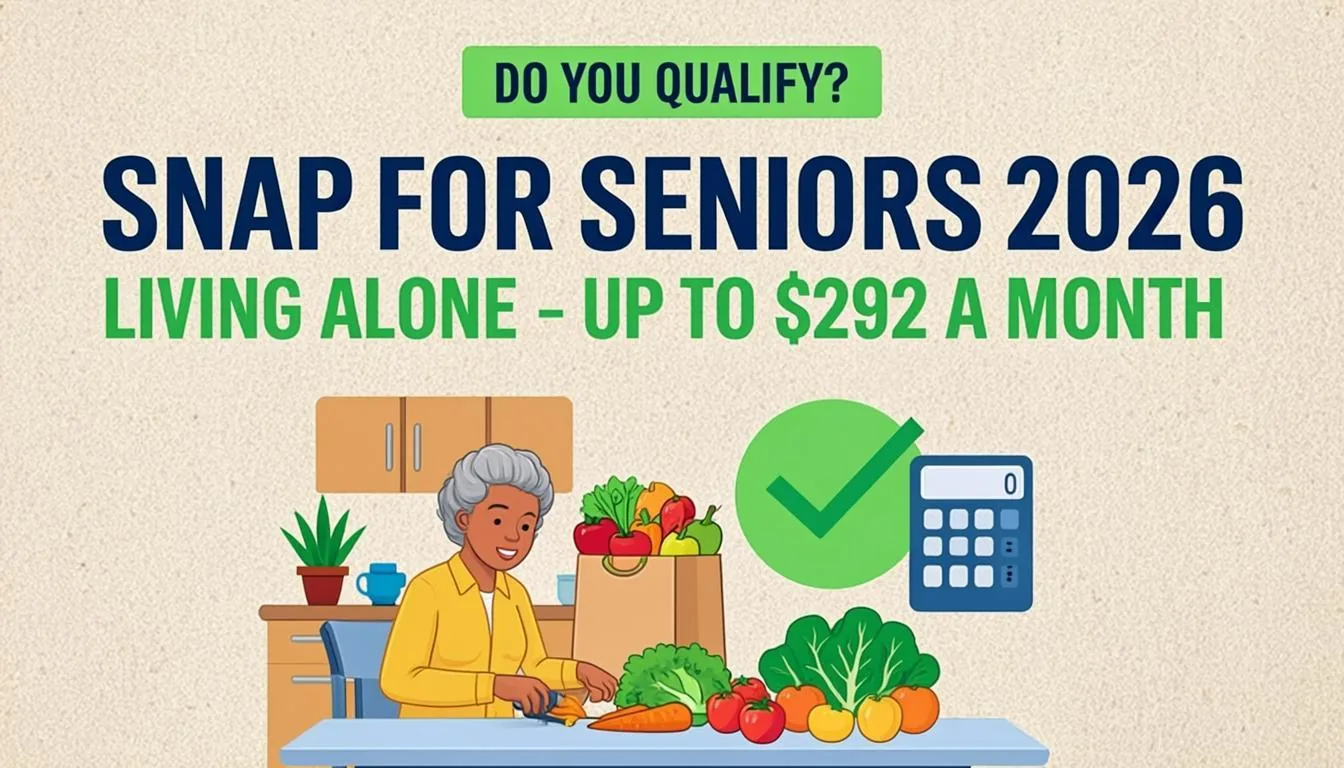
If you are 60 or older and live alone, SNAP can put $298 a month back in your pocket for groceries. The program is underused by seniors: only about 42 percent of eligible older adults are enrolled, according to the USDA Food and Nutrition Service. Most either think they do not qualify because they own their home, or they underestimate how much the medical expense deduction can add to their monthly benefit. This guide walks through the 2026 income limits, the special rules that apply only to elderly households, and the exact steps to apply.
The most important thing to know up front: SNAP for seniors is not the same as SNAP for working-age adults. If you are 60 or older, you get three breaks that younger applicants do not. Your gross income limit is higher under BBCE. Your assets are counted differently. And you can deduct out-of-pocket medical expenses over $35 a month, which can raise your benefit by $7 to $69 a month depending on your state.
Here is the quick answer: if your monthly income from Social Security, a pension, or part-time work is under $2,610 and you live alone, you likely qualify. Even if your income is above that, the medical expense deduction might still bring your net income below the eligibility line. The only way to know for certain is to apply through your state benefits portal or use our free SNAP eligibility calculator to check your numbers first.
One more thing before we get into the details: you do not have to give up your home, your car, or your retirement savings to qualify. SNAP for seniors has special asset rules that protect most of what you own. The asset limit for elderly households is $4,500, and in BBCE states that test is waived entirely.
Table of Contents
- 12026 Income Limits for Seniors Living Alone
- 2The Medical Expense Deduction: How It Adds $7 to $69 a Month
- 3Asset Limits for Elderly Households
- 4The Simplified Elder Application
- 5How SSI Recipients Get Automatic Eligibility
- 6Step-by-Step: Applying for SNAP as a Senior Living Alone
- 7Common Mistakes Seniors Make When Applying
- 8What Can You Buy with SNAP as a Senior?
- 9Other Programs Seniors Should Know About
- 10Frequently Asked Questions
2026 Income Limits for Seniors Living Alone
SNAP uses two income tests: gross income (before deductions) and net income (after deductions). For elderly households, the rules are slightly different than for the general population.
Under standard federal SNAP rules, the gross income limit is 130 percent of the Federal Poverty Level. For fiscal year 2026, that works out to $1,696 a month for a one-person household. But most states have adopted Broad-Based Categorical Eligibility (BBCE), which raises the gross income ceiling to 200 percent of poverty. For a senior living alone in a BBCE state, that ceiling is $2,610 a month.
| Household Size | 130% FPL (Standard) | 200% FPL (BBCE States) | Net Income Limit (100% FPL) |
|---|---|---|---|
| 1 person | $1,696/month | $2,610/month | $1,305/month |
| 2 people | $2,292/month | $3,526/month | $1,763/month |
| 3 people | $2,888/month | $4,442/month | $2,221/month |
| 4 people | $3,483/month | $5,360/month | $2,680/month |
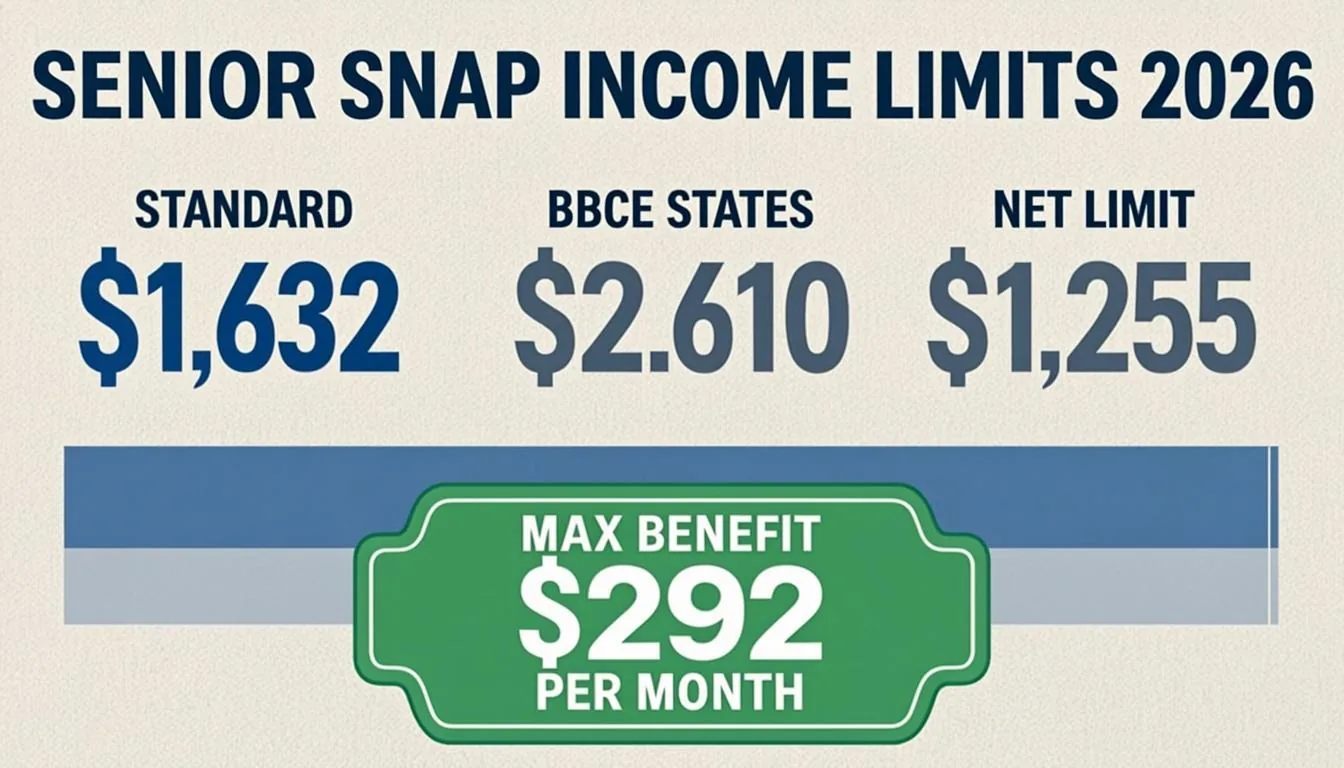
The net income limit is what matters after deductions. For a one-person senior household, net income must be at or below $1,305 a month. Deductions like the standard deduction, the shelter deduction, and the medical expense deduction all reduce your net income, which can pull you below the limit even if your gross income looks too high.
For a deeper dive into how gross and net income tests work, including which deductions apply to elderly households, read our complete guide to SNAP gross versus net income calculations.
The Medical Expense Deduction: How It Adds $7 to $69 a Month
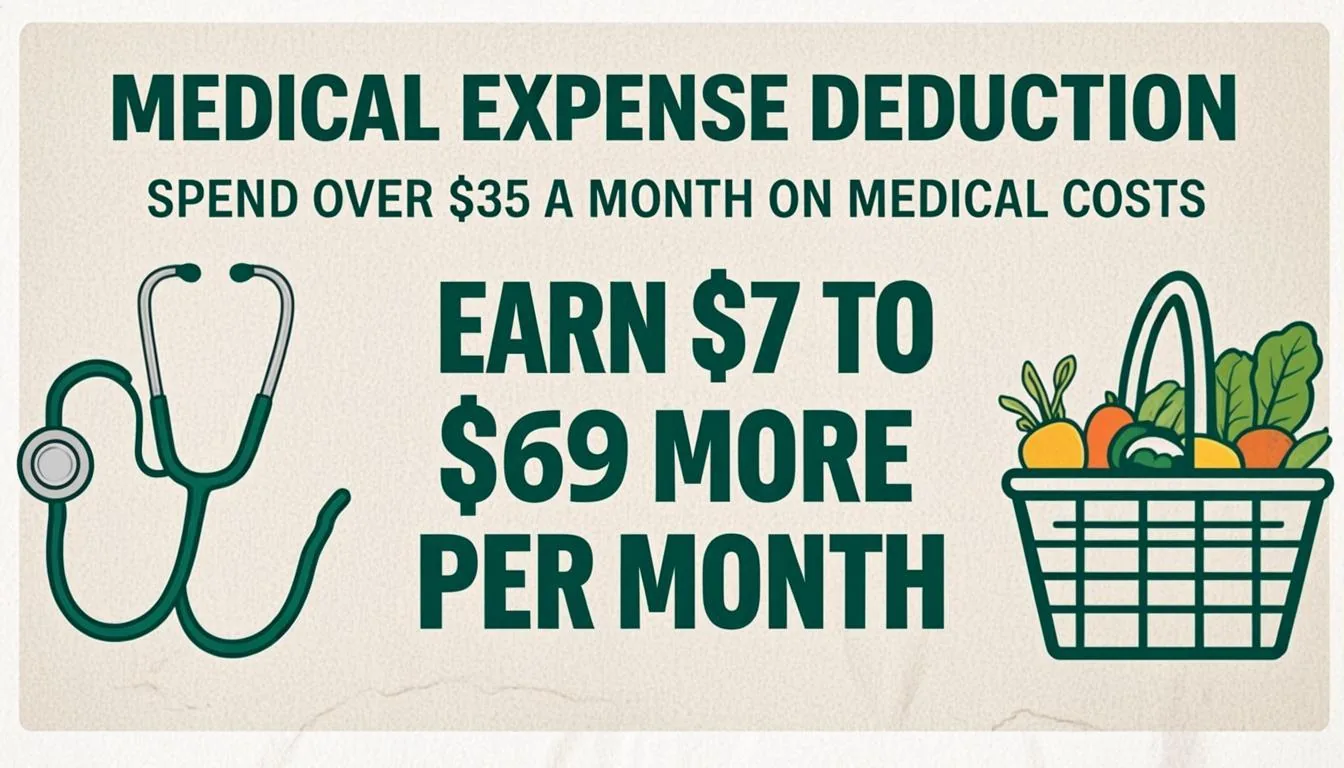
This is the deduction most seniors leave on the table. If you are 60 or older, you can deduct out-of-pocket medical expenses that exceed $35 a month from your net income. The deduction reduces your net income, which increases your SNAP benefit.
The math works like this: for every $100 in deductible medical expenses, your SNAP benefit goes up by about $30 a month. The Center on Budget and Policy Priorities found that a senior living alone who claims $50 to $200 in medical expenses typically sees their monthly benefit increase by $7 to $69.
Qualifying medical expenses include:
- Medicare Part B premiums ($174.70/month in 2026 for most beneficiaries)
- Medicare Part D premiums (varies by plan, typically $20-$80/month)
- Medicare Supplement (Medigap) premiums
- Prescription drug copayments (the amount you pay after insurance)
- Dental care not covered by Medicare
- Vision care including eyeglasses and eye exams
- Hearing aids and batteries
- Medical transportation (mileage to and from doctor appointments)
- In-home care services not covered by insurance
- Over-the-counter medications prescribed by a doctor
Notice what is on that list that most seniors forget: Medicare premiums. Your Part B premium of $174.70 a month is a deductible medical expense. That alone puts you well past the $35 threshold, which means your SNAP benefit goes up.
Let us walk through a concrete example. Say you are 68, living alone, with $1,400 a month from Social Security. Your rent is $700, your Medicare Part B premium is $174.70, and you spend about $60 a month on prescription copays. Here is how the caseworker calculates your benefit.
First, your gross income of $1,400 is under the BBCE ceiling of $2,610, so you pass the gross income test. Next, deductions: the standard deduction is $204 for a one-person household. Your shelter costs are $700 rent plus roughly $200 in utilities, so $900 total. After subtracting the standard deduction from your income, you have $1,196. Half of that is $598. Your shelter costs ($900) minus that $598 is $302 in excess shelter deduction. Now the medical deduction: $174.70 Part B plus $60 prescriptions equals $234.70, minus the $35 threshold gives you $199.70. Subtract all deductions from gross income, and your net income is roughly $590. That is well below the $1,305 limit, which means you qualify for the maximum benefit of $298 a month.
Asset Limits for Elderly Households
For most SNAP households, the asset limit is $2,750. But if anyone in the household is 60 or older, the limit is higher: $4,500. In BBCE states, the asset test is waived entirely, which means your savings account, retirement fund, and home equity do not count against you.
What counts as an asset? Cash, money in checking and savings accounts, stocks, bonds, and certificates of deposit. What does not count? Your primary home, your car (in most states), your retirement accounts (if you cannot access the money without penalty), and the cash value of a life insurance policy.
This is a common reason seniors do not apply: they think their $10,000 in savings disqualifies them. It might in a non-BBCE state, but in most states with BBCE, savings are not counted at all. To find out whether your state has BBCE, see our state-by-state SNAP eligibility directory which lists BBCE status for all 50 states.
The Simplified Elder Application
Many states offer a shorter application form for households where everyone is 60 or older. The simplified application, sometimes called the Elderly Simplified Application Project (ESAP), skips the standard 16-page form and uses a 2- to 4-page version that focuses on income, housing costs, and medical expenses.
States that offer a simplified elder application include Florida, Illinois, Massachusetts, Michigan, New York, Ohio, Pennsylvania, and several others. Check with your local SNAP office to see if your state has an ESAP program.
The simplified application also comes with a few other benefits: the interview may be waived if you cannot leave your home, and recertification is extended from 12 months to 24 or 36 months in some states. That means once you are approved, you do not have to reapply as often.
How SSI Recipients Get Automatic Eligibility
If you receive Supplemental Security Income (SSI), you may qualify for SNAP through categorical eligibility. This means you skip the gross income test and the asset test entirely. You still need to apply, but the process is shorter because your SSI status already proves you meet the income requirements.
In some states, including California (where SNAP is called CalFresh and SSI recipients were historically excluded), SSI recipients can now receive both benefits. If you receive SSI and live alone, your SNAP benefit is calculated based on your SSI payment minus your deductions.
Step-by-Step: Applying for SNAP as a Senior Living Alone
The application process for seniors is the same as for any other household, with one exception: you can request a phone interview instead of an in-person visit.
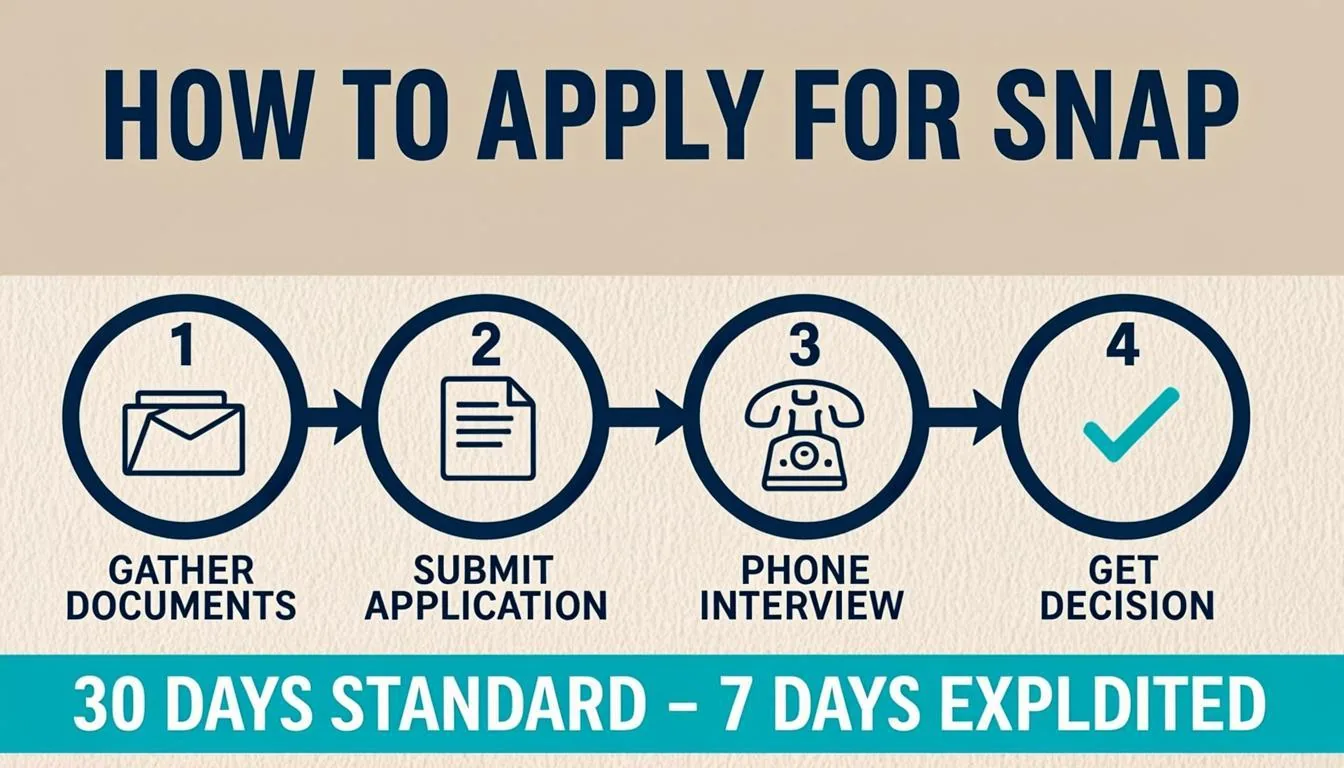
- Gather your documents: Social Security card, photo ID, proof of income (Social Security award letter, pension statement, pay stubs if working), proof of housing costs (lease or mortgage statement), proof of medical expenses (Medicare premium statements, pharmacy receipts, medical bills), and proof of utility costs.
- Submit your application online through your state benefits portal. Most states accept applications through their online system, which is faster than paper. You can also apply by phone by calling your local SNAP office.
- Complete the phone interview. A caseworker will call you within 7 to 10 days of submitting your application. The interview takes about 20 minutes. Have your documents ready so you can read off the numbers.
- Submit verification documents. The caseworker will ask you to send proof of your income, housing costs, and medical expenses. You can usually upload these through the state portal, fax them, or mail them.
- Wait for the decision. Standard applications are processed within 30 days. If your income is below $150 a month and you have less than $100 in cash, you qualify for expedited SNAP, which is processed within 7 days.
- Receive your EBT card. If approved, your EBT card arrives by mail within 5 to 7 business days. Call the number on the back to activate it and choose your PIN.
For a more detailed walkthrough of the application process, including what to do if your application is denied, see our step-by-step SNAP application guide.
Common Mistakes Seniors Make When Applying
After working with SNAP applicants for years, I see the same mistakes over and over. Here are the five most common ones, and how to avoid them.
Mistake 1: Not claiming the medical expense deduction. This is the biggest one. Seniors often do not realize that Medicare premiums, prescription copays, and even mileage to doctor appointments are deductible. Bring receipts and premium statements to your interview. Even $50 a month in documented medical expenses can add $7 to your benefit.
Mistake 2: Assuming you earn too much. Many seniors on Social Security assume their $1,500 monthly benefit disqualifies them. Under BBCE, the gross income limit for one person is $2,610. Even without BBCE, the standard 130 percent limit is $1,696. If your income is close to either number, deductions can still pull your net income below the limit.
Mistake 3: Not applying because you own your home. Your primary residence does not count as an asset for SNAP. Neither does your car in most states. Do not let homeownership stop you from applying.
Mistake 4: Missing the interview. The caseworker will call you for a phone interview. If you miss the call, you get one more chance. Miss that, and your application is denied. Add your county SNAP office number to your contacts so you recognize the call.
Mistake 5: Not recertifying on time. SNAP benefits are not permanent. You must recertify every 12 months (or every 24 to 36 months in ESAP states). If you miss the recertification deadline, your benefits stop. Mark the date on your calendar the day you are approved.
For more on what goes wrong during the application process and how to fix it, see our guide to common mistakes that delay SNAP applications.
What Can You Buy with SNAP as a Senior?
SNAP benefits can be used to buy most food items at grocery stores, supermarkets, farmers markets, and online retailers like Amazon and Walmart. Eligible items include bread, cereal, rice, pasta, fruits and vegetables (fresh, frozen, and canned), meat, poultry, fish, dairy products, eggs, cooking oil, snacks, and non-alcoholic beverages.
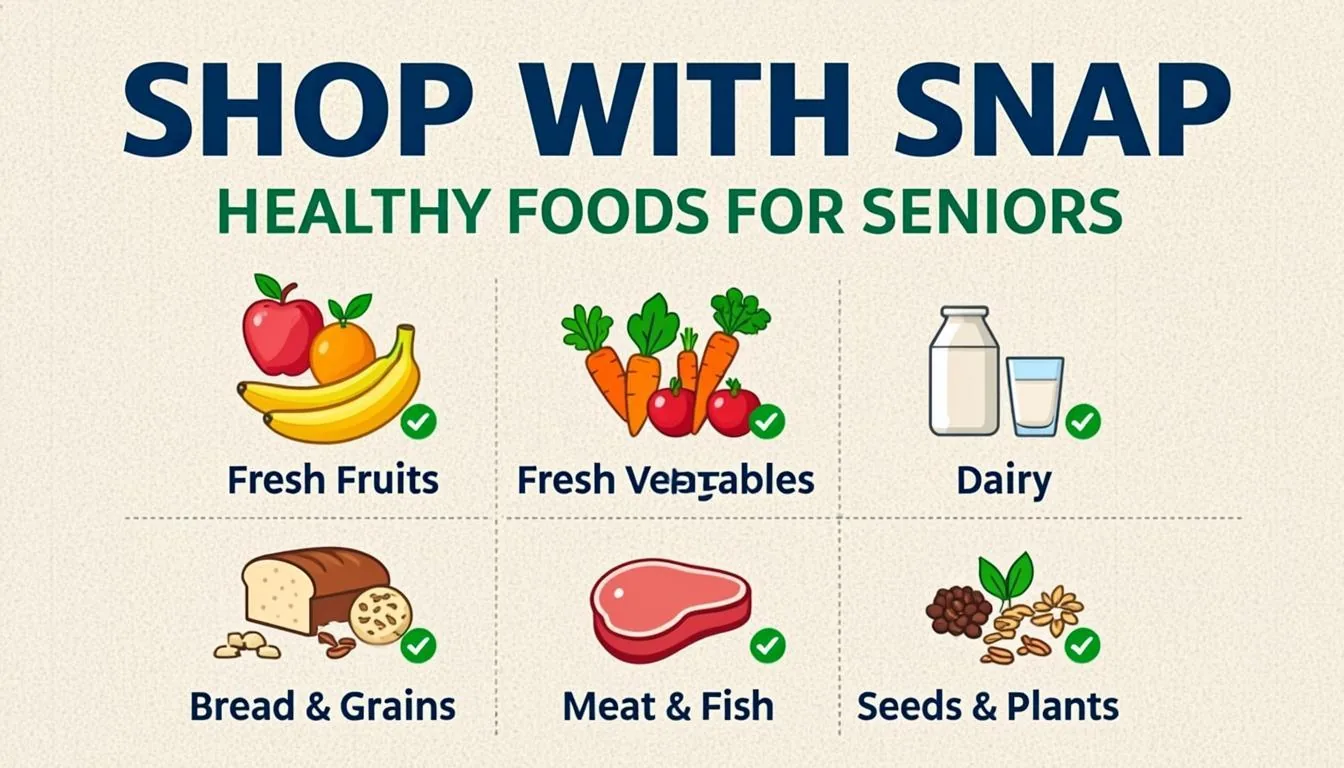
You cannot buy alcohol, tobacco, vitamins, hot prepared foods (like a rotisserie chicken from the deli), household supplies, or pet food. However, many farmers markets double the value of SNAP benefits through programs like Double Up Food Bucks, so $10 in SNAP gets you $20 worth of fresh produce.
Other Programs Seniors Should Know About
If you qualify for SNAP, you likely qualify for several other programs that can help stretch your budget:
- LIHEAP (Low Income Home Energy Assistance Program): helps pay heating and cooling bills. Income limits are similar to SNAP.
- Medicare Extra Help (Low-Income Subsidy): reduces Medicare Part D prescription drug premiums and copays. If you qualify for SNAP, you likely qualify for Extra Help.
- Senior Farmers Market Nutrition Program: gives eligible seniors $50 in vouchers each summer for fresh produce at approved farmers markets.
- Commodity Supplemental Food Program (CSFP): provides a monthly box of nutritious food to low-income seniors aged 60 and older.
These programs are separate from SNAP, but the income eligibility is often the same. If you are already approved for SNAP, applying for these programs is usually just a matter of filling out a one-page form.
Frequently Asked Questions
Can a senior living alone get food stamps?
Yes. If you are 60 or older and live alone, you can apply for SNAP. The income limit for a one-person household is $2,610 a month under BBCE (200% of the Federal Poverty Level) or $1,696 under standard rules (130% FPL). The asset limit is $4,500 for elderly households, and in BBCE states the asset test is waived entirely. Most seniors who apply qualify for the maximum monthly benefit of $298.
How much does a single senior get in SNAP benefits?
The maximum SNAP benefit for a one-person household in 2026 is $298 a month. Most seniors who have no earned income receive the full amount. If you have income from Social Security or a pension, your benefit may be lower, typically between $100 and $250. The medical expense deduction can increase your benefit by $7 to $69 a month depending on your out-of-pocket costs.
Does Social Security count as income for SNAP?
Yes. Social Security retirement benefits, SSDI, and SSI are all counted as unearned income for SNAP. However, you can deduct out-of-pocket medical expenses over $35 a month, including Medicare Part B premiums, prescription copays, and medical transportation. These deductions reduce your net income, which can increase your SNAP benefit.
Can I get SNAP if I own my home?
Yes. Your primary residence does not count as an asset for SNAP. Neither does your car in most states, and in BBCE states, the asset test is waived entirely. Homeownership does not disqualify you from SNAP benefits.
What is the medical expense deduction for SNAP seniors?
Seniors aged 60 and older can deduct out-of-pocket medical expenses that exceed $35 a month from their net income for SNAP. Qualifying expenses include Medicare Part B premiums ($174.70/month in 2026), Medicare Part D premiums, prescription copays, dental and vision care, hearing aids, and medical transportation. The deduction can increase your SNAP benefit by $7 to $69 a month.
How do I apply for SNAP if I am homebound?
If you cannot leave your home, you can apply for SNAP by phone or online, and request a phone interview instead of an in-person visit. Most states allow authorized representatives to apply on your behalf if you cannot do it yourself. Contact your local SNAP office or Area Agency on Aging for assistance with the application.