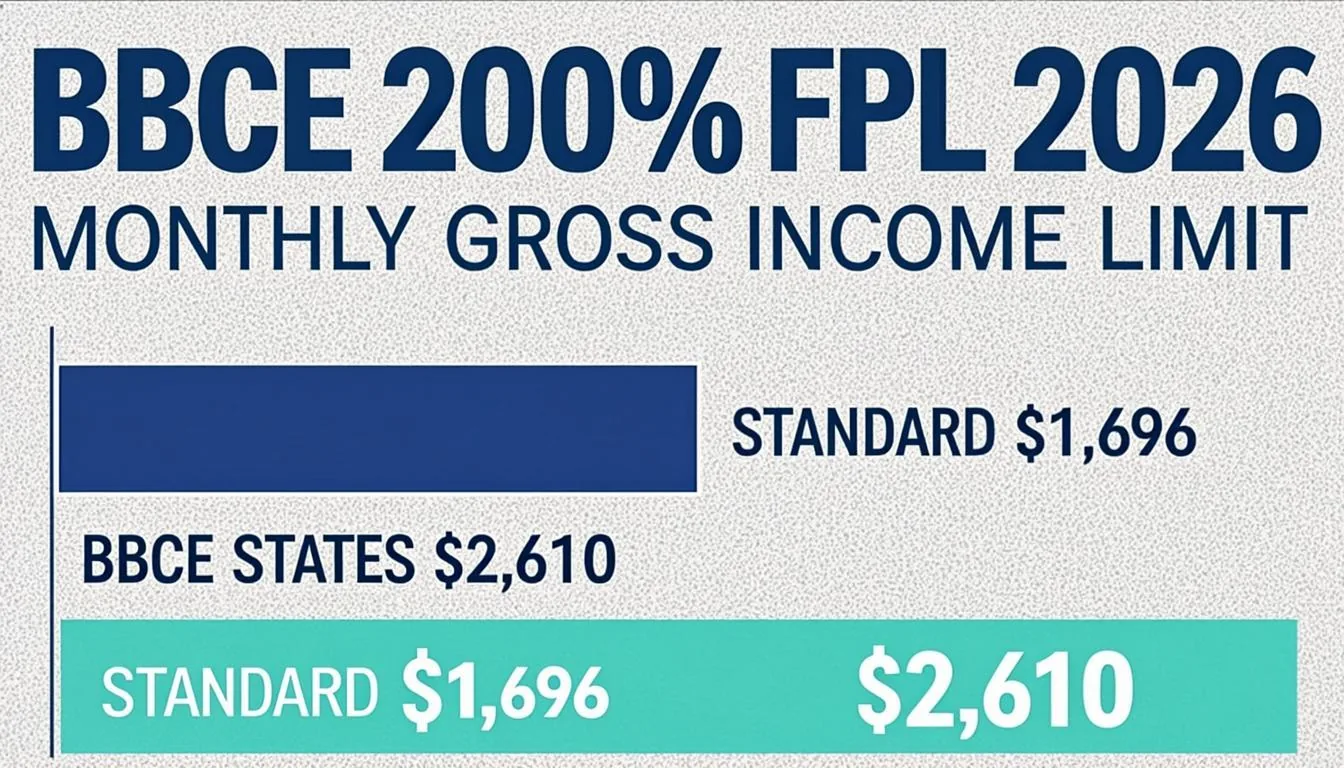
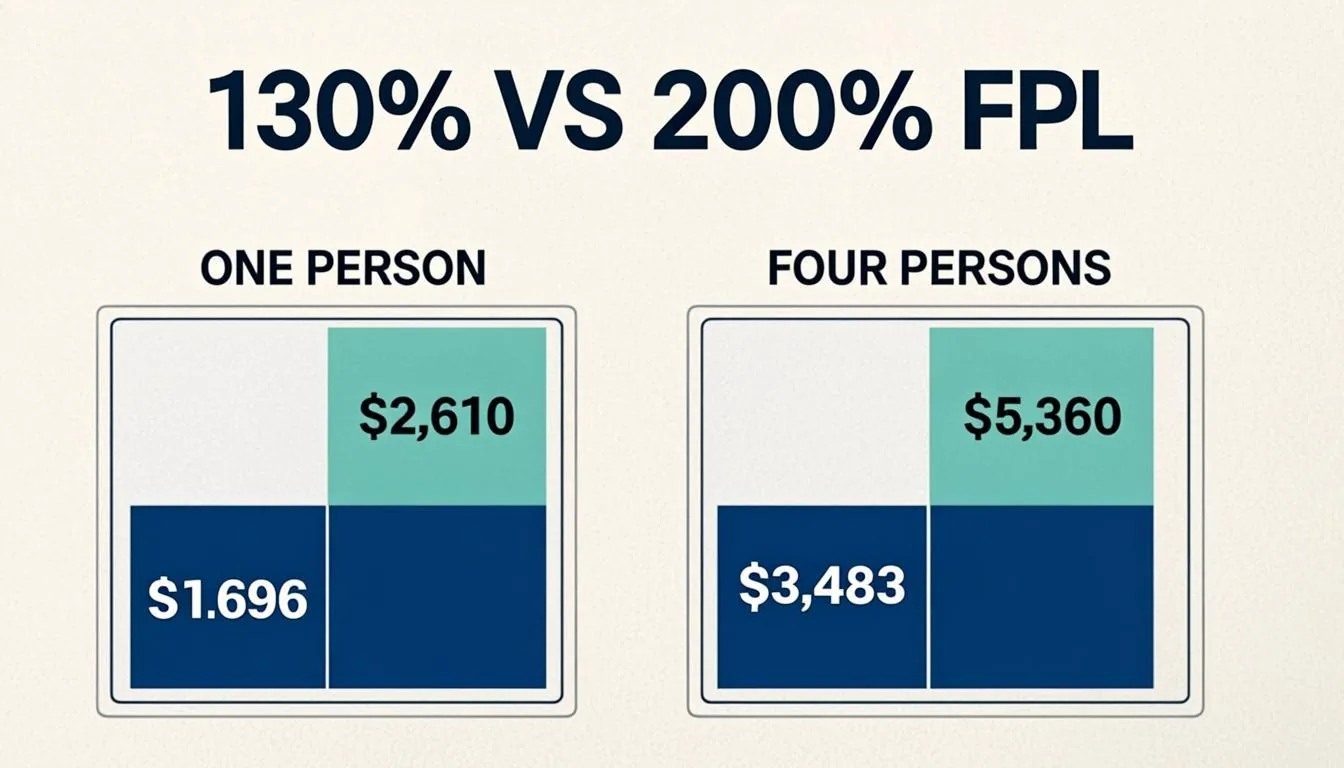
If you have ever used a SNAP eligibility calculator, been told your income is too high, and then heard that a neighbor with the same income gets food stamps anyway, the reason is almost certainly BBCE. Broad-Based Categorical Eligibility is a state option that raises the gross income limit for SNAP — in most adopting states, all the way to 200% of the federal poverty level. For a single person in the 48 contiguous states in 2026, that is $2,610 per month instead of the standard $1,696. For a family of four, it is $5,360 per month instead of $3,483.
Those higher numbers are not a loophole and they are not a mistake. They come from a real policy that 46 states and territories had in place as of the USDA's June 2026 chart, and they exist so that working households do not lose food assistance the moment a paycheck grows past an arbitrary line.
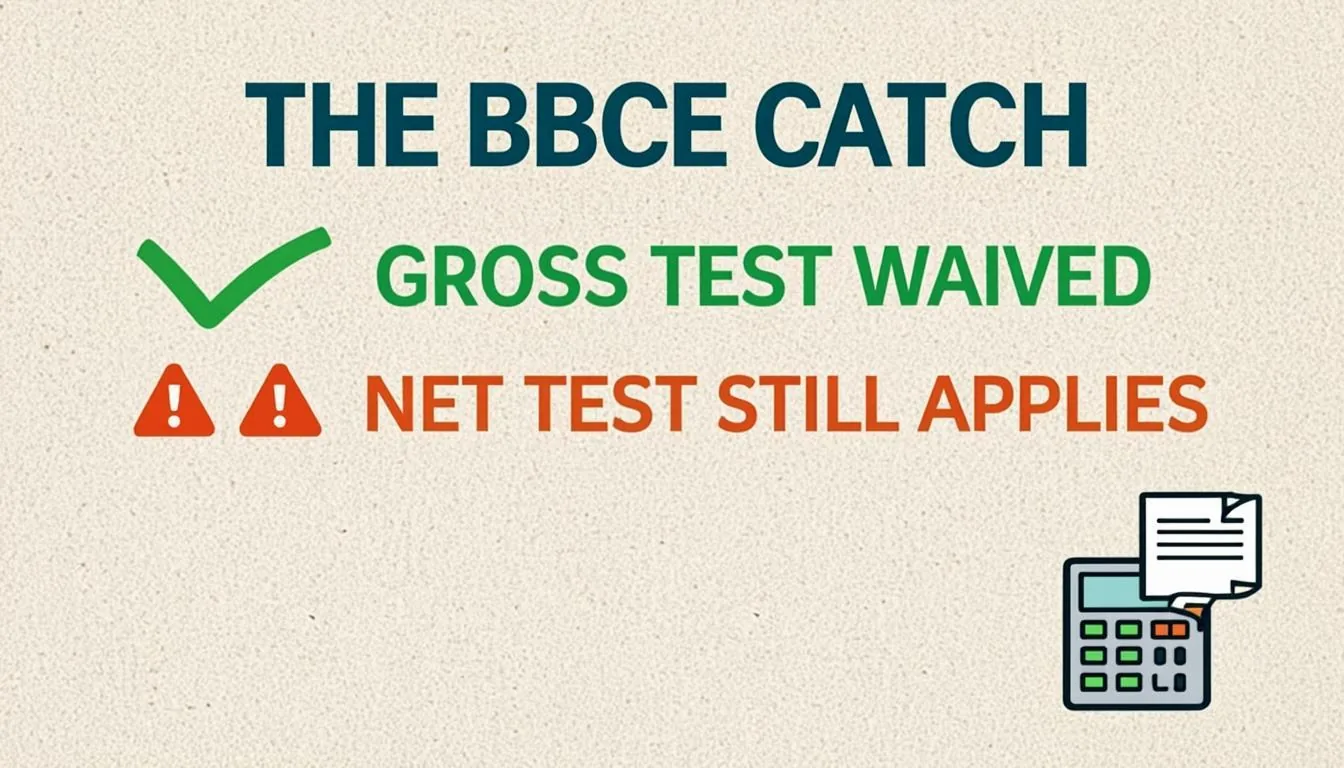
The catch — and it is a big one that most summaries skip — is that clearing 200% of the poverty level does not guarantee you benefits. Your income after deductions still has to fall under the net income limit, which is 100% of the poverty line.
This guide walks through what BBCE actually is, the full 200% FPL chart for every household size, which states use which income tier, how the asset test disappears, and the net income math that decides whether you really qualify.
If you only need the standard thresholds, the full FPL chart with all three income thresholds covers those. If you want to know why someone earning $2,400 a month can qualify in one state and get rejected in another, keep reading.
Table of Contents
- 1What Is BBCE? Broad-Based Categorical Eligibility in Plain English
- 2The 200% FPL Chart: BBCE Income Limits by Household Size
- 3How BBCE Actually Works: The TANF Link
- 4Not Every BBCE State Uses 200%: The Six Income Tiers
- 5Seven States Have No BBCE at All
- 6The Asset Test Disappears (Mostly)
- 7The Catch: The Net Income Test Still Applies
- 8Three Real Examples: Who Qualifies and Who Does Not
- 9What BBCE Does Not Do
- 10Seniors and Disabled Households Already Skip the Gross Test
- 11How to Check Your State and Apply
- 12The Bottom Line
What Is BBCE? Broad-Based Categorical Eligibility in Plain English
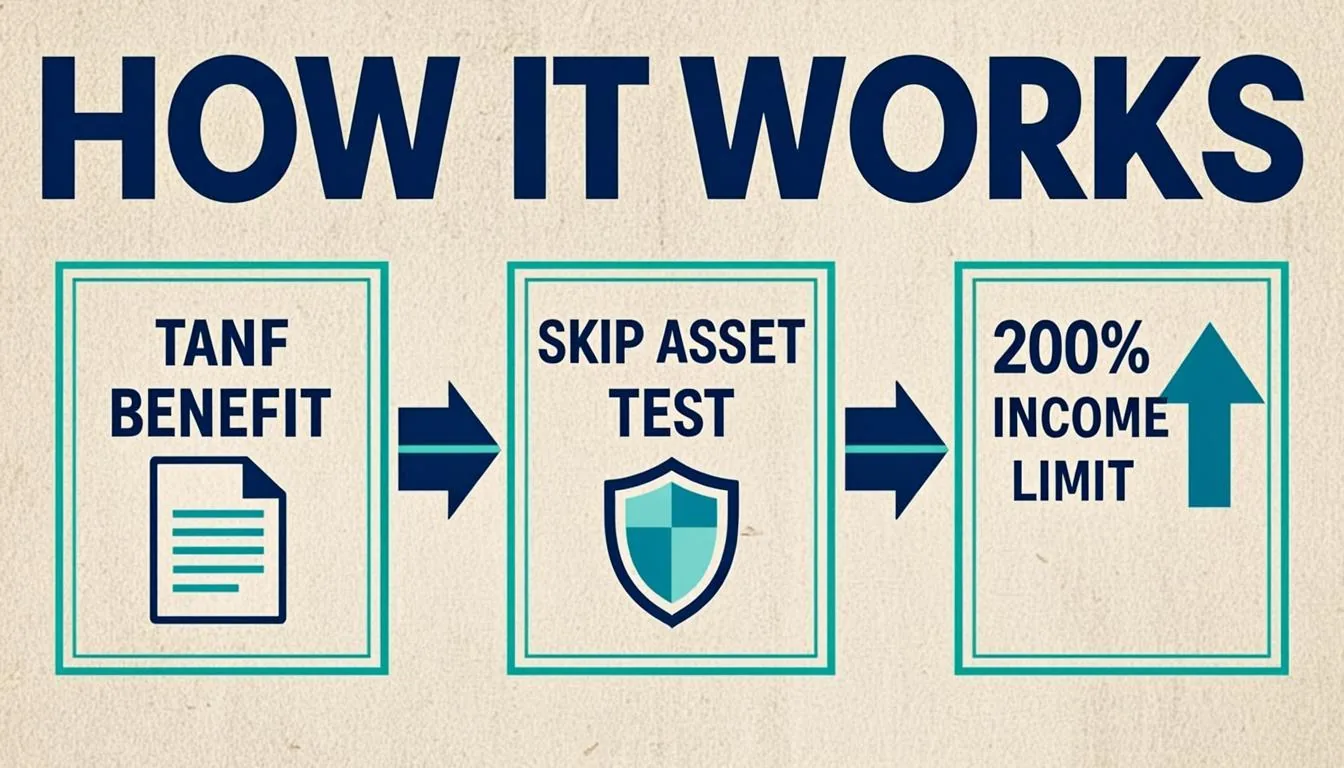
BBCE stands for Broad-Based Categorical Eligibility. The name is a mouthful, but the idea is simple: when a household receives a benefit funded by Temporary Assistance for Needy Families (TANF) money, the whole household is treated as "categorically eligible" for SNAP.
That status strips away two of the standard eligibility screens — the asset test and the standard 130% gross income limit.
Here is the part that surprises people. The TANF-funded benefit that triggers this does not have to be a cash payment. In most BBCE states, it is something as light as a printed brochure, a referral to a hotline, or a notice included with your application.
Lawmakers have argued for years about whether a brochure should count as a benefit, and BBCE has faced repeated attempts to end it in Congress. As of the USDA chart updated June 29, 2026, it is still standing, and 46 states and territories still operate it.
Why would a state want this? Because the standard rules punish households at the edge. A parent working 35 hours a week at $16 an hour can earn just over the gross limit for her household size while paying rent that eats half her paycheck.
BBCE lets the caseworker look past the gross number and test whether the household's income after real expenses — rent, utilities, childcare — still leaves them near the poverty line. It smooths the benefit cliff for people moving up from very low wages, which is why states of every political stripe have adopted it.
The 200% FPL Chart: BBCE Income Limits by Household Size
These are the monthly gross income limits for the 48 contiguous states and DC for fiscal year 2026, which runs October 1, 2025 through September 30, 2026. The middle column is the BBCE ceiling used by states at the 200% tier — the largest group.
The net income limit in the last column is the one that decides whether you actually receive benefits, and it applies in nearly every BBCE state.
Household Size | Standard Gross Limit (130% FPL) | BBCE Limit (200% FPL) | Net Income Limit (100% FPL) |
|---|---|---|---|
1 person | $1,696 | $2,610 | $1,305 |
2 persons | $2,292 | $3,526 | $1,763 |
3 persons | $2,888 | $4,442 | $2,221 |
4 persons | $3,483 | $5,360 | $2,680 |
5 persons | $4,079 | $6,276 | $3,138 |
6 persons | $4,675 | $7,192 | $3,596 |
7 persons | $5,271 | $8,110 | $4,055 |
8 persons | $5,867 | $9,026 | $4,513 |
Each additional person | +$596 | +$918 | +$459 |
Alaska, Hawaii, Guam, and the U.S. Virgin Islands use higher poverty guidelines, so their dollar limits are higher even when the percentage tier is the same. A single person in Alaska at the 200% tier has a ceiling well above $3,200 a month, for example, because Alaska's poverty line itself is much higher. The percentages stay the same; only the dollars move.
One more thing worth knowing about these numbers: they are the gross income test only. Gross income is your household's total income before any deductions — paychecks, Social Security, unemployment, child support received, self-employment profit.
The BBCE ceiling replaces the 130% test for households that receive the state's TANF-funded benefit, which in most BBCE states means all applicants.
How BBCE Actually Works: The TANF Link
The legal engine behind BBCE is categorical eligibility, a concept Congress wrote into welfare law decades ago.
If every member of a household already receives certain means-tested benefits — SSI, TANF cash assistance, or state general assistance — the household can skip the SNAP income and asset screens that apply to everyone else.
The logic is that one program's eligibility check already proved the household is poor.
In the late 1990s and 2000s, states started extending that same shortcut to households receiving a much lighter TANF-funded service: a brochure about state programs, a 2-1-1 referral, or a notice printed on the SNAP application itself.
That is the "broad-based" part. The benefit conferring eligibility is available broadly, not just to families receiving cash welfare.
The USDA's chart lists exactly what each state uses — everything from a "Help for People in Need brochure" in Connecticut to "Job Net Services language on approval notices" in Wisconsin.
Two consequences follow from that design, and both matter for applicants. First, categorical eligibility cannot be used to deny you: the USDA's own guidance says BBCE cannot limit eligibility, so if you do not qualify for the TANF-funded service, the state must simply evaluate you under regular SNAP rules. Second, the gross income number listed for each state's TANF program in the USDA chart is the ceiling for the categorical-eligibility pathway — which is how a state ends up with a 200%, 185%, or 165% limit in the first place.
A small historical note that affects how you read older articles on this topic: the Food and Nutrition Service (FNS), the USDA agency that runs SNAP, was renamed the Food and Nutrition Administration on June 1, 2026. You will see both names — FNS and FNA — on official pages and in citations during the transition, and they refer to the same agency.
Not Every BBCE State Uses 200%: The Six Income Tiers
This is where most BBCE explainers go wrong. The "200%" number that dominates search results describes the largest group of states, but it is not a national rule. Each state picks the gross income ceiling for its own TANF-funded benefit, and the USDA's chart shows six different tiers in force right now.
BBCE Gross Income Tier | States and Territories (June 2026 USDA chart) |
|---|---|
200% FPL | Alaska, Arizona, California, Colorado, Connecticut, Delaware, DC, Florida, Hawaii, Kentucky, Louisiana, Maine, Maryland, Massachusetts, Michigan, Minnesota, Montana, Nevada, New Hampshire, New Mexico, North Carolina, North Dakota, Oregon, Pennsylvania, Virginia, Washington, West Virginia, Wisconsin — plus New York for households with dependent care expenses |
185% FPL | New Jersey, Rhode Island, Vermont |
175% FPL | U.S. Virgin Islands |
165% FPL | Arkansas (elderly or disabled households), Guam, Illinois, Nebraska, Texas |
160% FPL | Iowa |
150% FPL | New York (households with earned income) |
130% FPL (BBCE without an income bump) | Alabama, Arkansas (other households), Georgia, Idaho, Indiana, Ohio, Oklahoma, South Carolina |
Read that last row carefully, because it is the detail that trips people up. Eight states keep BBCE but set their TANF benefit's income ceiling at the same 130% of poverty as the standard SNAP test. For those states, BBCE's practical effect is limited to waiving the asset test — the gross income bar does not move at all. A four-person household earning $4,000 a month is over the limit in Ohio and South Carolina just as surely as in a state with no BBCE.
New York deserves its own note because it runs two tiers at once: 200% for households paying dependent care costs, and 150% for households with earned income. Texas sits at 165%, which for a family of four works out to roughly $4,422 a month. California, Pennsylvania, Michigan, and Florida sit at the full 200%. If you want to run your numbers against your own state's tier, our Texas eligibility calculator and California eligibility calculator pages are good places to start, and the state-by-state rules comparison covers all fifty.
Seven States Have No BBCE at All
Seven states have declined BBCE entirely: Kansas, Mississippi, Missouri, South Dakota, Tennessee, Utah, and Wyoming. In these states, every applicant faces the standard SNAP screens — the 130% gross income test, the net income test, and the asset limits of $3,000 for most households or $4,500 for households with a member who is 60 or older or disabled.
The practical difference is easy to see with a single number. A single person working full time at $16 an hour earns about $2,770 a month. In Missouri or Tennessee, that income fails the $1,696 gross test outright. In a 200% BBCE state, the application proceeds to the deductions and the net income test instead. Same worker, same paycheck, opposite outcomes — purely because of the state line.
A caution for researchers: many articles still circulate a stale list of non-BBCE states that includes Idaho and Indiana. Those two states appear in the USDA's June 2026 chart with BBCE at the 130% tier — they waive part of the asset test but offer no income expansion. If you see a list that does not match the seven states above, it is built on old data.
The Asset Test Disappears (Mostly)
In standard SNAP rules, your countable resources matter: bank balances, stocks, bonds, and some vehicle value count against limits of $3,000 or $4,500. In a BBCE state, that test simply does not apply. A family with $12,000 in savings is not screened out in Michigan or Pennsylvania, no matter how much is in the account.
A handful of BBCE states attach an asset limit to the TANF-funded benefit itself, so the test shrinks rather than vanishes. Nebraska caps liquid assets at $25,000. Idaho and Indiana use $5,000.
Texas uses $5,000 with its own vehicle-value formula, and Arkansas allows $5,500 under a rule that runs for 12 months at a time and can only be used once every five years — after that period, Arkansas households fall back to the standard $3,000 or $4,500 limits. These are generous compared to the federal defaults, but they are not unlimited.
For most households the distinction hardly matters, since few families near the poverty line carry five figures in savings.
It matters most for seniors with retirement-adjacent savings, and for families in the middle of a transition — an insurance payout, a modest inheritance, a tax refund sitting in checking. If that describes you, our guides on what counts as an asset for SNAP and how vehicle value affects eligibility go deeper on the exceptions.
The Catch: The Net Income Test Still Applies
Here is the sentence that saves people the most disappointment: passing the 200% gross test does not mean you will receive SNAP. In nearly every BBCE state, your household still has to clear the net income test — income after deductions must come in at or below 100% of the poverty line.
For one person that is $1,305 a month in 2026; for a family of four, $2,680. A few states go further and waive the net test for categorically eligible households, but you should never assume your state is one of them.
Net income is gross income minus a fixed stack of deductions: 20% off earned income, a standard deduction that ranges from $209 to $299 depending on household size, dependent care costs, court-ordered child support paid out, medical expenses over $35 a month for elderly or disabled members, and excess shelter costs above half your adjusted income, capped at $744 for households without an elderly or disabled member.
The difference between gross and net income is where most eligibility decisions actually happen, and the seven deductions that lower your countable income are worth knowing cold before you apply.
The deduction stack is why BBCE is not just a handout to higher earners. A family earning $4,000 a month with $1,800 in rent and utilities has real expenses, and the net income math accounts for that. The same family living rent-free with relatives would have a much higher net income and might genuinely not qualify. The 200% tier widens the door; the deductions and the net limit decide who walks through it.
Three Real Examples: Who Qualifies and Who Does Not
The fastest way to understand BBCE is to run the numbers on realistic households. All three examples below use the 2026 limits for the 48 contiguous states.
Example 1: A family of four earning $4,000 a month
The Garcias live in Pennsylvania with two school-age children. Both parents work, and together they earn $4,000 a month gross, with $1,800 in rent and utilities.
Step | Calculation | Running Total |
|---|---|---|
Gross monthly income | Combined paychecks | $4,000 |
Earned income deduction (20%) | $4,000 − $800 | $3,200 |
Standard deduction (4-person household) | $3,200 − $223 | $2,977 |
Excess shelter deduction | $1,800 shelter − $1,488.50 (half of adjusted income) | −$311.50 |
Net monthly income | $2,977 − $311.50 | $2,665.50 |
The Garcias pass Pennsylvania's 200% gross test easily ($4,000 is under $5,360), and their net income of $2,665.50 lands just under the $2,680 net limit. Their monthly benefit: the $994 maximum allotment for a family of four, minus 30% of their net income, which comes to about $194 per month. In Kansas, the same family would be rejected before the deductions were ever calculated, because $4,000 exceeds the $3,483 standard gross limit.
Example 2: The same family in Ohio
Now move the Garcias across the border into Ohio, a BBCE state that keeps its ceiling at 130% of poverty. Their $4,000 gross income is over Ohio's $3,483 limit, so the application stops there. BBCE's only gift to them in Ohio is the waived asset test — which they did not need. This is the example to remember when someone says "my state has BBCE" as if that automatically means 200%.
Example 3: Two single workers in California
Maria earns $1,800 a month and pays $1,000 in rent and utilities. Her gross income is over the standard $1,696 limit but under California's $2,610 BBCE ceiling. After the 20% earned income deduction ($360), the $209 standard deduction, and her excess shelter deduction ($384.50), her net income lands at $846.50 — well under the $1,305 net limit. Her benefit: $298 minus 30% of her net income, or about $44 a month. Small, but real, and it re-evaluates automatically if her hours get cut.
James earns $2,400 a month with the same housing costs. He passes the gross test too — $2,400 is under $2,610. But his net income works out to $1,566.50 after the same deductions, which is over the $1,305 net limit. James is denied, despite clearing the BBCE ceiling. That is the net income test doing exactly what it is designed to do, and it is why the 200% number should be read as "allowed to apply," not "guaranteed benefits."
If you want to trace these calculations with your own numbers, the full SNAP benefit formula with worked examples shows every step, and the free eligibility calculator runs the arithmetic for your state automatically.
What BBCE Does Not Do
BBCE changes two screens: the asset test and the gross income limit. Everything else about SNAP stays exactly the same, and a surprising number of denials happen on those unchanged grounds.
It does not waive work requirements. Under the 2025 federal budget law, able-bodied adults aged 18 through 64 must document at least 80 hours of work, training, or qualifying activity per month, subject to limited exemptions.
Those hours are checked the same way in a 200% BBCE state as in Wyoming. It does not change citizenship or immigration-status rules, which apply to SNAP independently of state options.
It does not change how much you receive if you are approved — the benefit formula, the maximum allotment for your household size, and the 30% net income contribution are federal and identical everywhere in the 48 states.
And it does not skip the process. Every applicant still files a full application, completes an interview, and verifies income, shelter costs, and household composition. Expedited service (available within 7 days for households with very little income or resources) is also unchanged. If someone tells you BBCE means "automatic approval," they are confusing a wider doorway with a shorter line.
Seniors and Disabled Households Already Skip the Gross Test
Households that include a member who is 60 or older, or who receives certain disability benefits, are exempt from the gross income test in every state — that is a federal rule, not a BBCE feature.
For those households, only the net income test matters, which is why many seniors with $1,400 to $1,800 in monthly Social Security income still qualify once medical and shelter deductions are applied. Our guide to SNAP for seniors living alone works through those numbers in detail.
Where BBCE still matters for seniors is the asset side. In the seven non-BBCE states, a senior with more than $4,500 in countable resources can be denied even with modest income. In a BBCE state, that savings balance is never counted. For elderly applicants sitting on a small emergency fund, the state line can matter more than the income math.
How to Check Your State and Apply
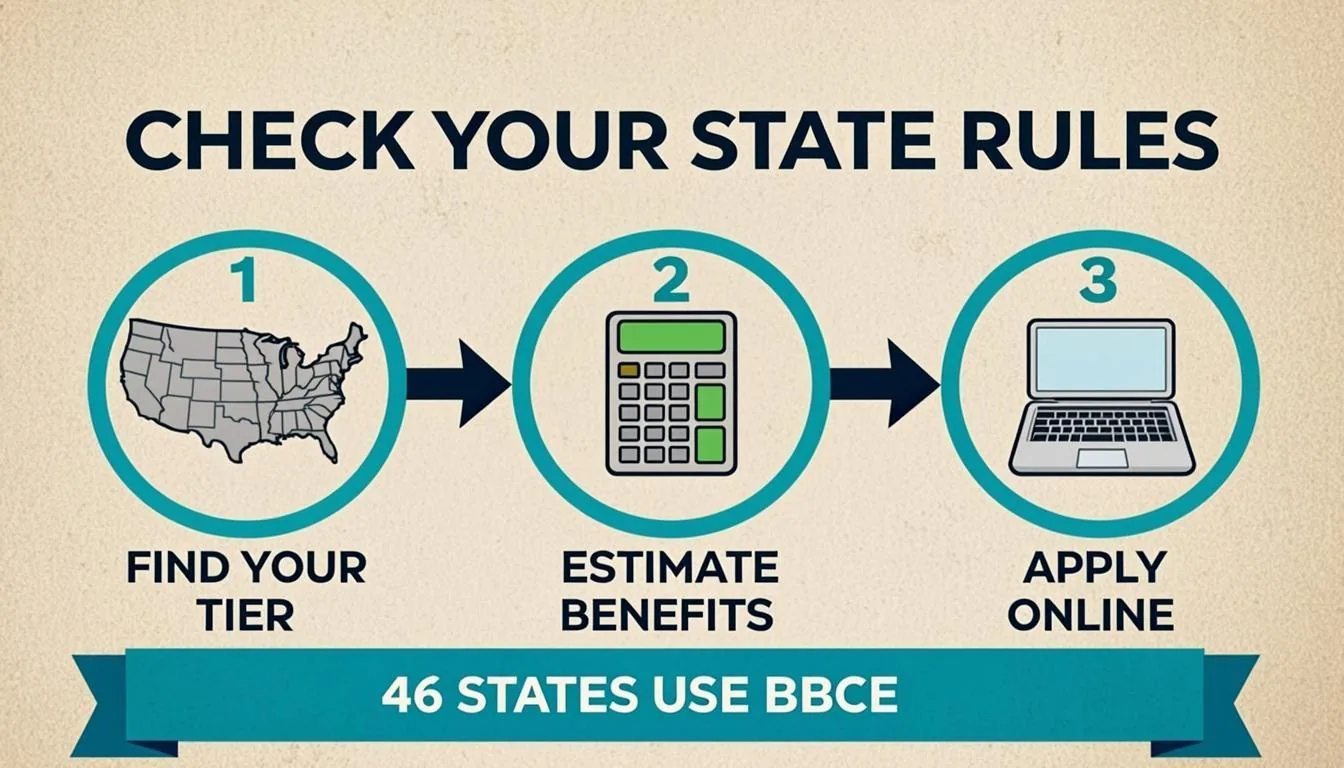
Step one: find your state's tier. Start with the tier table above, then confirm on your state agency's SNAP page, because states adjust these policies periodically. Step two: run your household's numbers — gross income against your state's ceiling, then the full deduction stack against the net limit — before you spend an hour on an application.
Our eligibility calculator applies your state's tier automatically. Step three: file. Most states take online applications, and you can apply for SNAP online in your state in roughly 20 to 30 minutes with pay stubs, rent receipts, and utility bills at hand.
Two timing details worth knowing. Your eligibility is tested against the limits in force on the day you apply, so the October 1 annual adjustment matters if you are applying near the fiscal year boundary.
And if you are denied, ask specifically which test you failed — gross, net, or a state asset rule — because that answer tells you exactly what would need to change, and denial letters can be appealed within 90 days.
The Bottom Line
BBCE is the reason income limits seem to change when you cross a state line. In 29 states and territories — including California, Pennsylvania, Florida, and Michigan — a household can earn up to 200% of the poverty level and still have its SNAP application evaluated: $2,610 a month for one person, $5,360 for a family of four. Six more tiers operate between 130% and 185%, and seven states offer no BBCE at all.
The asset test disappears in most BBCE states, but the net income test survives almost everywhere, so the 200% ceiling is best understood as the right to a full calculation rather than a promise of benefits. Run your numbers with your state's tier in mind, and you will know where you stand before the caseworker does.