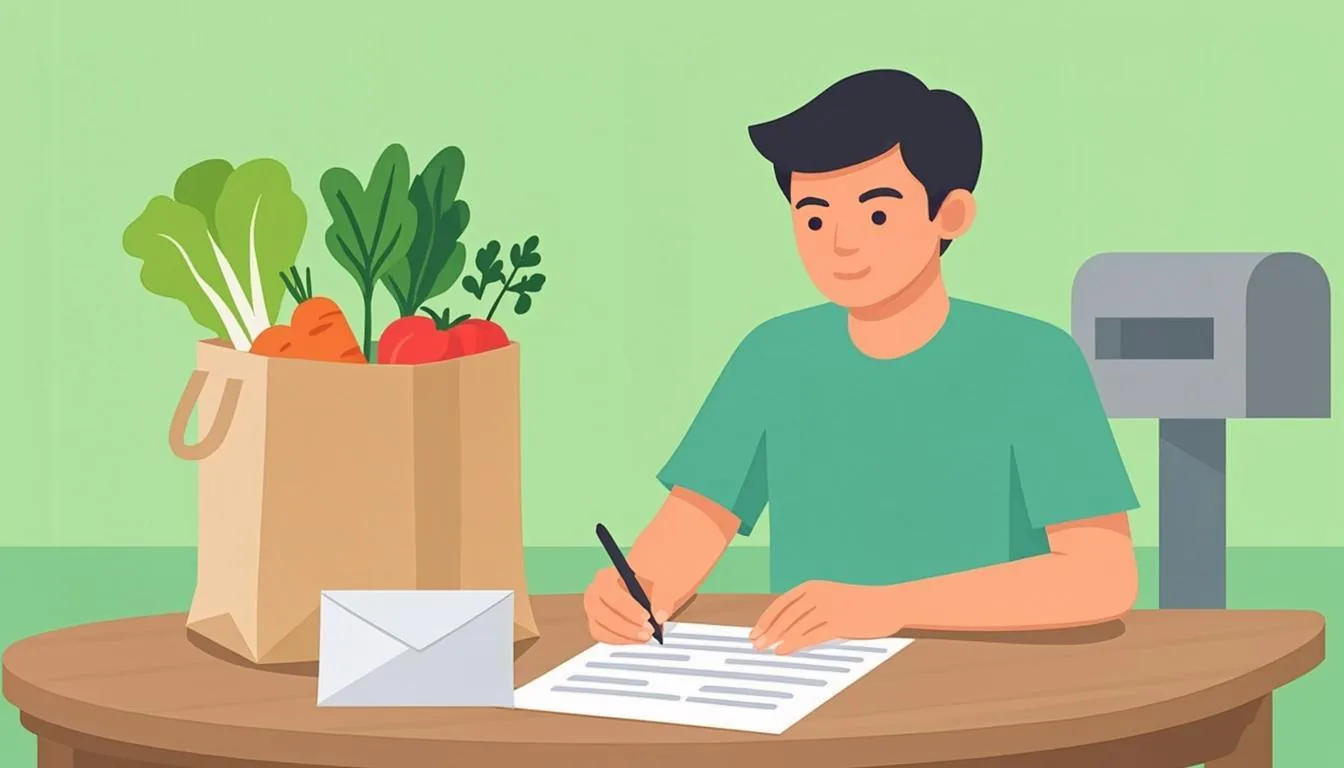
A paper application is still one of the fastest ways to start SNAP in 2026. Every state agency must accept it, and you never need a computer, an email address, or internet access. For seniors, people without reliable internet, and anyone who prefers writing by hand, the paper route works exactly like any other.
The process has three parts. Get the right form for your state, fill it out and sign it, then submit it by mail or in person. Federal rules give your office 30 days to decide, and households facing an emergency get a decision within seven days.
Here is the detail most guides skip: you can submit a partially filled form and still lock in your filing date. Under federal rules, a page showing your name, address, and signature counts as a filed application. That date protects your first payment from being calculated late.
This guide covers where to get the form, how to fill each section, and how to submit it safely. For a quick budget check first, our free SNAP eligibility calculator shows your likely benefit in about two minutes.
Table of Contents
- 1What Is the SNAP Paper Application?
- 2How to Get the Paper SNAP Application Form
- 3Download and print it from your state website
- 4Call and have one mailed to you
- 5Pick one up at your county office
- 6Ask a food bank, legal aid office, or senior center
- 7What to Have Ready Before You Start
- 8How to Fill Out the SNAP Application Step by Step
- 9Your household members
- 10Income for each person
- 11Expenses and deductions
- 12Sign and date the form
- 13The Filing Date Rule That Protects Your Benefits
- 14How to Submit the Form: Mail, In Person, or Fax
- 15Mailing your application safely
- 16Handing it in at the office
- 17Fax and secure drop boxes
- 18What Happens After You Submit
- 19The 30-day rule and the 7-day rule
- 20The interview and verification stage
- 21Paper vs Online: Which Should You Choose?
- 22Common Paper Application Mistakes to Avoid
- 23If You Hear Nothing or Get Denied
- 24The Bottom Line
- 25Related SNAP Guides
What Is the SNAP Paper Application?
The paper application is the same official form your state SNAP office uses for every application. Only the format changes. Whether you apply online, by phone, or on paper, your household answers the same questions and receives the same decision.
Each state prints its own form, so there is no single national PDF. Some states use one combined form for food, cash, and medical assistance. Others keep SNAP on a shorter standalone document.
Federal regulations at 7 CFR 273.2 require every state agency to accept paper applications. The same rules force offices to mail you a form the same day you request one. Nobody can legally refuse you a paper form or charge you for it.
How to Get the Paper SNAP Application Form
You can get the form four ways, and none of them cost money. Pick whichever fits your situation best.
Download and print it from your state website
Every state agency posts its current application as a free PDF download. Search your state name plus "SNAP application," or use the official USDA state directory to jump straight to the right office. Print the form at home, a library, or a senior center.
Call and have one mailed to you
Call your local SNAP office and ask them to mail an application. Federal rules require the office to send it the same day you request it. Save the envelope or note the date, because the mailing timeline can matter if your case is ever disputed.
Pick one up at your county office
Walk into your county assistance office and take a form from the reception desk. Many offices let you fill it out on site and hand it back the same visit. Staff must help you complete it if you ask, and interpreter help is free.
Ask a food bank, legal aid office, or senior center
Food banks, legal aid offices, and senior centers keep blank forms on hand. Many community organizations will sit with you and fill it in together. Application help from these organizations is free, and you should never pay anyone to submit a SNAP form.
What to Have Ready Before You Start
You do not need documents to apply, because those come later during verification. You only need information you already know. Gathering five things first makes the form much faster to finish.
- Names, dates of birth, and Social Security numbers for everyone in your household
- Monthly income for each member, before taxes, including wages, benefits, and child support received
- Rent or mortgage amount, plus utility bills like electricity, gas, and water
- Child care costs, child support you pay, and medical bills for seniors or disabled members
- Bank balances for checking and savings accounts
A full document list lives in our SNAP verification documents checklist, so bookmark it for the interview stage. For now, honest estimates written on the form are perfectly acceptable. Caseworkers verify the real numbers later.
How to Fill Out the SNAP Application Step by Step
The form looks intimidating, but it repeats one simple pattern on every page. It asks who lives with you, what they earn, and what they pay. Answer every question that applies and write N/A where it does not, because blank fields cause most processing delays.
Your household members
List everyone who lives with you and buys or prepares food together. Include children, spouses, and roommates who share meals. If someone lives with you but buys food separately, ask the office how to count them before you file.
Income for each person
Report gross monthly income, which means money before taxes, for every working member. Count wages, self-employment, Social Security, unemployment, pensions, and child support received. Our SNAP income limits chart lists the FY2026 thresholds for every household size.
Expenses and deductions
Expenses lower your countable income, so this section directly raises your benefit. Fill in shelter costs, utilities, dependent care, and child support you pay. Households with a member who is 60 or older or disabled should also list out-of-pocket medical costs.
Sign and date the form
The signature line is the most important line on the form. An unsigned application is not valid, and offices mail unsigned forms back. Check whether every adult household member must sign, because some states require more than one signature.
The Filing Date Rule That Protects Your Benefits
Here is the move that fixes most paper problems. Submit the form as soon as it is signed, even if whole sections are still blank. Federal rules say the filing date is the day your office receives a form showing your name, address, and signature.
That date matters because your 30-day processing clock starts at filing, not at approval. It also sets your prorated first payment, which our first month proration guide explains with worked examples. Finishing the remaining details by phone or at your interview is completely fine.
In practice, write "more information available upon request" next to any section you cannot finish. Then call your office the same week to fill the gaps. This one habit prevents the most common reason households lose a month of benefits.
How to Submit the Form: Mail, In Person, or Fax
Your completed form goes to your county or regional SNAP office, not to USDA. The federal agency publishes the rules but does not process individual cases. Use the state directory linked above to find your office's exact mailing address and phone number.
Mailing your application safely
Mail a photocopy and keep the original at home. Offices lose mail rarely, but original documents are painful to replace. Write the office address exactly as printed, add your return address, and consider paying a small fee for tracking.
Handing it in at the office
Walking the form to the office is the strongest paper option. Ask the reception desk to date-stamp your copy before you leave. That stamped copy is proof of your filing date if any timeline question comes up later.
Fax and secure drop boxes
Many offices list a fax number on the application instructions, and a fax confirmation sheet works as proof of delivery. Some counties also keep 24-hour secure drop boxes outside the building. Call first to confirm which options your office accepts.
What Happens After You Submit
Two things should happen within days of your form arriving. The office screens it for expedited service, then schedules your eligibility interview. If you hear nothing after a week, call and ask for your case number.
The 30-day rule and the 7-day rule
Federal law gives states 30 days from your filing date to approve or deny regular applications, per USDA processing rules. Households with almost no income or resources must receive benefits within seven days under expedited service. Both deadlines apply no matter how you applied.
Expedited screening uses fixed federal thresholds, not a caseworker's judgment. A household with under $150 in monthly gross income and $100 or less in cash or bank accounts qualifies automatically. Migrant and seasonal farmworker households also qualify while their resources stay low.
The interview and verification stage
Most interviews happen by phone, so answer unknown numbers during the weeks after you apply. The interviewer reviews your form and lists which proofs they need. Verification normally happens after the filing date, so missing papers do not erase the date you already locked in.
Send copies of every document and keep your own set. Write your case number on each page. If a requested proof seems impossible to get, tell your caseworker, because agencies must help you obtain verification.
Recertification later works the same way, with a form followed by an interview. Our SNAP recertification timeline shows when to expect that paperwork. Keeping your paper copies from this application makes the next round faster.
Paper vs Online: Which Should You Choose?
Both paths reach the same caseworkers and produce the same decision. Paper wins on accessibility and proof of filing, while online wins on speed and built-in error checks. Choose paper if you lack internet access, want a stamped filing record, or find long forms easier by hand.
Factor | Paper application | Online application |
|---|---|---|
Best for | No internet, mail preference, stamped proof | Speed and error prompts |
Filing proof | Date-stamped or mailed copy | Confirmation screen or email |
Typical start | Same day at the office, days by mail | Immediately |
Decision deadline | 30 days, or 7 days expedited | 30 days, or 7 days expedited |
If you already filed on paper, do not start a second online application. Duplicates can delay your case file. Our online SNAP application walkthrough explains the portal if you would rather use it for recertification later.
Common Paper Application Mistakes to Avoid
Paper applications fail for predictable reasons, and every one of them is avoidable. These six errors cause most of the delays offices see.
- Missing signature. An unsigned form is not valid, and the office will mail it back. Sign every copy your state requires before sealing the envelope.
- Blank income sections. Write $0 or N/A instead of leaving fields empty. Blank fields read as missing information, not zero income.
- Mailing originals. Send photocopies and keep the originals at home. Replacing lost documents can take weeks you do not have.
- No phone number. Interview calls can come from numbers you do not recognize. A missing number makes you much harder to reach.
- Wrong office address. Forms sent to a state headquarters can sit in mail rooms for weeks. Always use your county office address from the USDA directory.
- Ignoring office letters. Interview and verification notices arrive by mail with deadlines. Missing one can close your case without a decision.
One more habit protects every applicant. Keep a complete copy of everything you send, and photograph each page with your phone before submission. Households with copies settle any dispute about their case far faster.
If You Hear Nothing or Get Denied
Silence past 30 days breaks federal timeliness rules, so treat it as a problem to fix now. Call your office, give your name and filing date, and ask for the status in writing. Keep notes of every call with the date and the staff name you spoke to.
A denial letter must list the reason and your appeal rights. You generally have 90 days to request a fair hearing, and our SNAP fair hearing process guide walks through the request. If approved instead, your benefits arrive on an EBT card and count back to your filing date.
The Bottom Line
The paper SNAP application remains a full, official path to benefits in every state. Get the form from your state office, fill what you can, sign it, and submit it as early as possible. Your filing date starts working for you the moment the office touches the form.
Before you mail anything, spend two minutes with our free SNAP eligibility calculator to estimate your benefit. The FY2026 gross income screen is $1,696 a month for one person and $3,484 for four in the 48 states. Many BBCE states stretch that to $5,360, so check the numbers before you assume you earn too much.
Related SNAP Guides
Ready for the next step? These guides cover the rest of the process.