If you are experiencing homelessness and applying for SNAP, the program rules quietly include a benefit boost that many people miss. Known as the SNAP homeless deduction, it adds a flat $156.81 to your monthly shelter costs before the SNAP math runs. That single line item can turn a small food benefit into a meaningful one, and in some households it pushes the monthly payment to the maximum amount for a one-person household.
The deduction exists because people who lack stable housing still incur shelter costs, just in ways that are harder to document. A family sleeping in a motel pays nightly. Someone staying in a shelter may pay nothing directly, but still loses income to transportation, storage, and the basic cost of staying alive outdoors. Congress wrote the homeless deduction into law so caseworkers would not have to demand receipts that homeless applicants simply cannot produce.
This guide walks through who qualifies, how the $156.81 figure is calculated, how it interacts with the SNAP shelter deduction maximum, and how to make sure your caseworker actually applies it. We will also cover the most common reasons the deduction gets missed and what to do if your approval notice shows a smaller benefit than you expected.
Key takeaway: The SNAP homeless deduction is automatic only if your caseworker knows you are homeless. You have to tell them, and you have to use the right words on the application.
Table of Contents
- 1What Is the SNAP Homeless Deduction?
- 2Who Qualifies for the Homeless Deduction?
- 3How the $156.81 Deduction Works in the SNAP Math
- 4Homeless Deduction vs. Standard Shelter Deduction
- 5Common Reasons the Homeless Deduction Gets Missed
- 6How to Claim the Deduction at Application
- 7How to Fix a Missed Deduction
- 8Homeless Deduction and Other SNAP Deductions
- 9Special Rules for Specific Groups
- 10Frequently Asked Questions
- 11The Bottom Line
What Is the SNAP Homeless Deduction?
The SNAP homeless deduction is a fixed monthly shelter allowance of $156.81 that the USDA adds to the shelter side of the SNAP math for households that meet the program's homeless definition. It is not a cash payment. It is a number that gets plugged into the SNAP benefit calculation formula so your countable shelter costs are not zero, even when you do not have a rent receipt to hand over.
The figure of $156.81 took effect on October 1, 2024, when the USDA updated its annual inflation adjustments. It replaces the older $143 figure that had been in place since 2009. The amount is reviewed each federal fiscal year and typically rises in small steps to track shelter inflation.
It is important to understand that this deduction is separate from the standard utility allowance. The homeless deduction covers shelter only. If you also pay utilities separately, you may qualify for both, but you cannot stack the homeless deduction with the standard shelter deduction cap. The homeless deduction is added first, then the excess shelter test runs against it.
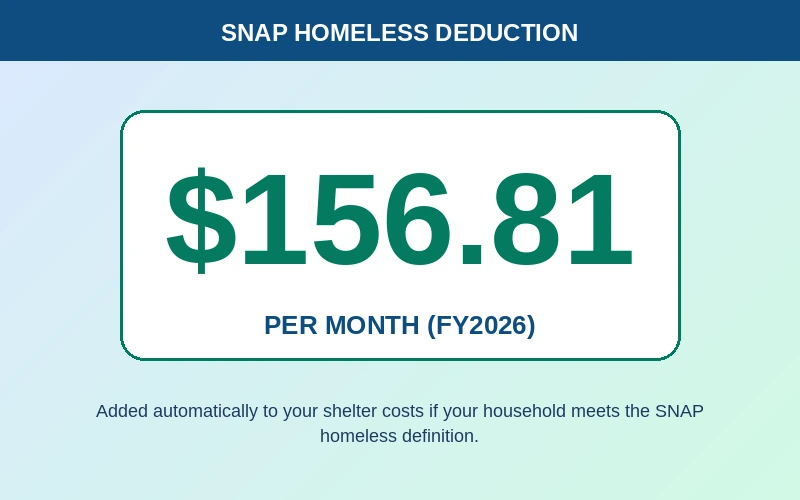
The $156.81 homeless deduction is added to your shelter side of the SNAP math, even without receipts.
Who Qualifies for the Homeless Deduction?
To receive the $156.81 deduction, your household must meet the SNAP homeless definition, which is narrower than the definition used by HUD or by schools for the McKinney-Vento Act. Under SNAP rules, you qualify if you meet any of these three conditions:
- No fixed nighttime residence: You do not have a regular place to sleep at night.
- Supervised shelter: Your primary nighttime residence is a supervised publicly or privately operated shelter, including congregate shelters, transitional housing, or a halfway house.
- Not designed for sleeping: Your residence is a place not designed for sleeping, such as a car, an abandoned building, a bus station, or a campground.
Some states interpret this definition more generously than others. California, New York, and Massachusetts have all issued guidance that extends the homeless deduction to people in transitional housing and rapid rehousing programs during the first six months. If you are unsure whether your situation qualifies, ask your caseworker directly: "Do I meet the SNAP homeless definition in this state?"
How the $156.81 Deduction Works in the SNAP Math
Here is the part most recipients never see. The SNAP benefit formula runs in seven steps, and the homeless deduction plugs in at step four. Here is the full sequence:
- Calculate gross monthly income. Add all countable income for the month.
- Apply the standard deduction. This is a flat amount based on household size.
- Apply the earned income deduction. Subtract 20% of earned income.
- Add shelter costs. This is where the homeless deduction lands — it adds $156.81 to your shelter side automatically.
- Subtract 50% of net income from shelter costs. The result is your "excess shelter."
- Cap the excess shelter at the current maximum ($672 in most states), unless your household includes an elderly or disabled member, in which case there is no cap.
- Final benefit = net income − excess shelter, run through the SNAP allotment table.
For a homeless individual with zero income, the math is simple. Net income is $0. The homeless deduction adds $156.81 in shelter. Excess shelter equals $156.81 minus $0, which is $156.81. That figure then flows into the allotment table, which for a one-person household in 2026 yields the maximum monthly benefit of $292.
The math in plain English: If you have no income and you are homeless, the deduction is what pushes you to the maximum SNAP benefit for your household size.
Homeless Deduction vs. Standard Shelter Deduction
A common point of confusion is how the homeless deduction relates to the standard shelter deduction. The two are mutually exclusive in any given month. If you have actual shelter costs that you can document — say, $400 in rent and a $200 utility bill — your caseworker will use those numbers, and the standard shelter deduction math will apply. The homeless deduction only kicks in when you cannot document shelter costs.
This is also why the excess shelter costs calculation sometimes produces a larger benefit than the homeless deduction. Households paying high rent in expensive cities like San Francisco or Boston often see $500 or $600 in excess shelter, well above the $156.81 flat figure. The homeless deduction is essentially a safety net for people who cannot document any shelter costs at all.
If your housing situation changes mid-certification period — for example, you move from a shelter into an apartment — you should report the change within 10 days. Your caseworker will switch you from the homeless deduction to your actual shelter costs, which may increase or decrease your benefit depending on the new numbers.
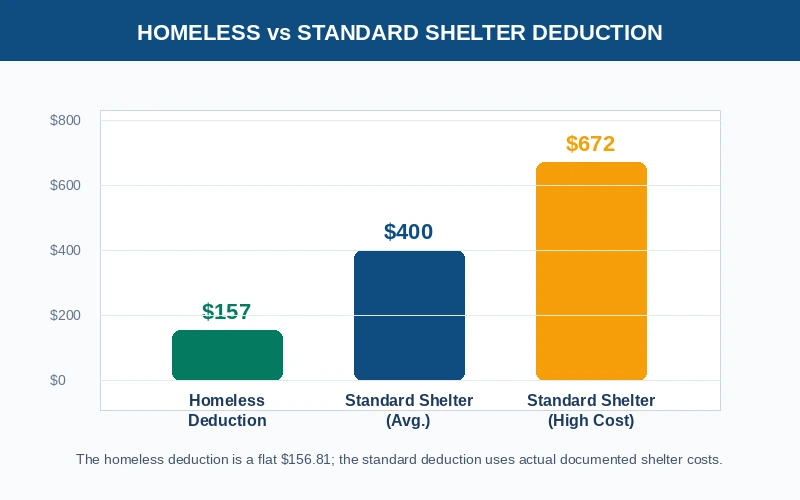
The homeless deduction is a flat $156.81, while the standard shelter deduction uses your actual documented costs.
Common Reasons the Homeless Deduction Gets Missed
Despite being federal policy, the homeless deduction is missed on a meaningful share of approvals. Here are the four most common reasons we see in SNAP fair hearing records:
- The applicant never told the caseworker they were homeless. SNAP applications ask about housing, but they do not always use the word "homeless." If you wrote "staying with friends" or "in a motel," the caseworker may have coded you as housed.
- The caseworker applied the standard deduction by mistake. Some caseworkers default to the standard shelter deduction when shelter fields are blank, rather than triggering the homeless code.
- State-specific verification steps were skipped. California, Washington, and New York have additional verification steps for homeless applicants that can cause the deduction to be skipped if those steps are not completed.
- The applicant was approved for expedited SNAP, and the full shelter review was deferred. Expedited approvals process income and identity first, then complete the shelter review within 30 days. If you never returned for the full interview, the homeless deduction may never have been added.
How to Claim the Deduction at Application
To make sure the homeless deduction is applied, take these steps during your SNAP application:
- Use the word "homeless" on the application form. Do not write "couch surfing" or "between addresses." The form's keyword matching looks for the word "homeless" to trigger the deduction.
- Bring a letter from a shelter, church, or social worker if you have one. It is not required, but it shortens the verification window.
- Ask the caseworker directly during the interview: "Will the homeless deduction be applied to my case?"
- Request a written notice of your benefit calculation. The notice must list your shelter deduction line item. If it shows $0 for shelter and you told them you were homeless, file a fair hearing request within 90 days.
How to Fix a Missed Deduction
If you have already been approved and your benefit seems too low, you can request a correction. Here is the sequence:
- Call your caseworker and ask them to add the homeless deduction retroactively to your application date.
- Follow up in writing. A short letter works better than a phone call because it creates a paper trail.
- If the caseworker refuses, file a fair hearing request. Most states allow you to file online, by fax, or by mail. The hearing is informal and is conducted by phone.
- If you win the hearing, the state must issue back benefits going back to your application date, plus interest in some states.
For households that have been on SNAP for years without the homeless deduction, the back benefits can add up to thousands of dollars. We have seen cases where a missed deduction was worth more than $3,000 over a two-year period.
Homeless Deduction and Other SNAP Deductions
The homeless deduction stacks with most other SNAP deductions, but there are some interactions to know about:
- Medical expense deduction for elderly: Stacks fully. Elderly homeless households can claim both.
- Child care expense deduction: Stacks fully. Homeless parents paying for child care can claim both.
- Standard utility allowance: Does NOT stack. If you claim the standard utility allowance, you must use actual shelter costs, which disqualifies the homeless deduction.
- Earned income deduction: Stacks fully. The 20% earned income deduction applies before the shelter test, so it actually increases the homeless deduction's impact by lowering net income.
Special Rules for Specific Groups
Certain groups have additional considerations when it comes to the homeless deduction:
Elderly and Disabled Homeless Individuals
Elderly and disabled households are exempt from the shelter deduction cap. This means the full $156.81 flows through to the benefit calculation without being capped. For these households, the homeless deduction can be especially valuable, since it interacts with the medical expense deduction for elderly to produce the maximum benefit.
Homeless Veterans
Veterans experiencing homelessness often qualify for both SNAP and VA benefits. The VA pension and SNAP interaction is complex, but the homeless deduction itself works the same way. Veterans should make sure to identify as homeless on the SNAP application even if they are receiving VA supportive services.
Homeless Families with Children
Families with children often qualify for expedited SNAP, which provides benefits within 7 days. The homeless deduction is applied at the expedited stage if the caseworker knows the family is homeless. Make sure to mention homelessness during the expedited screening call.
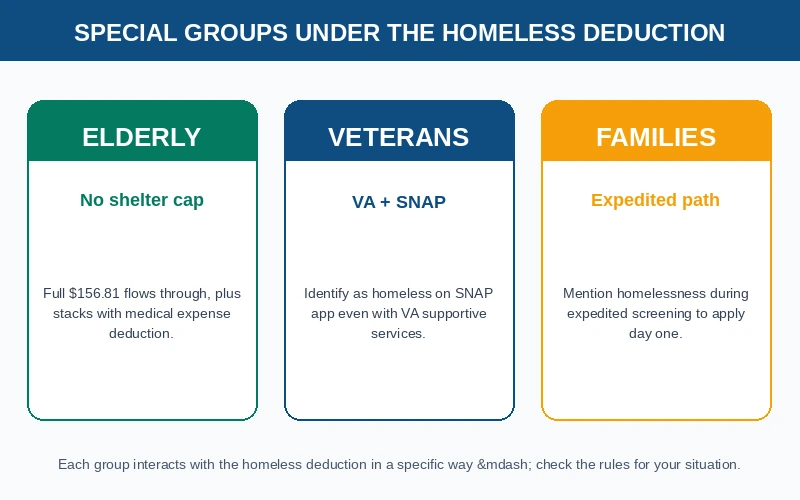
Elderly, veterans, and families with children each have special considerations under the homeless deduction.
Frequently Asked Questions
Is the $156.81 homeless deduction per person or per household?
It is per household. Whether you are a one-person or four-person household, the deduction is a single $156.81 monthly figure added to your shelter side of the math.
Does the homeless deduction change my SNAP income limit?
No. The SNAP income limits are set federally and updated each October. The homeless deduction only affects the shelter side of the calculation.
Can I get the homeless deduction if I live in a motel?
Yes, if you are paying nightly or weekly and the motel is not your permanent residence. Bring receipts if you have them, but the deduction applies even without receipts.
What if my housing situation changes mid-month?
Report the change within 10 days. Your caseworker will adjust your shelter deduction for the following month. Most states do not adjust mid-month.
Will the homeless deduction affect my Medicaid or SSI?
No. The homeless deduction is a SNAP-specific calculation. It does not appear on any other benefit calculation.
The Bottom Line
The SNAP homeless deduction is one of the most underused benefit boosts in the entire program. A flat $156.81 per month, automatically added for households that meet the SNAP homeless definition, it can push your benefit to the maximum for your household size and create hundreds of dollars in additional food assistance over a year.
The key is making sure your caseworker knows you are homeless, in those exact words, on the application. From there, the deduction is automatic. If it was missed, you have 90 days from any decision to request a fair hearing, and back benefits are available going back to your application date.
If you are navigating the broader SNAP process for the first time, our complete SNAP application guide walks through each step in detail. If you are already approved but your benefit feels low, request a written benefit calculation and check the shelter line. A missing homeless deduction is the most common error we see, and it is the easiest to fix.