If you pay rent, a mortgage, property taxes, or utility bills, the SNAP program gives you a benefit boost that can be worth hundreds of dollars a month. The boost is called the excess shelter deduction, and understanding how it is calculated is the single most useful thing you can do to estimate your monthly food benefit accurately.
The calculation is not complicated, but it has several moving parts. You need to know your countable shelter costs, your net income after other SNAP deductions, and whether your state's shelter cap applies to your household. Once you have those three numbers, the math takes about 30 seconds with a calculator.
This guide walks through the excess shelter costs calculation step by step, with three worked examples covering a low-income renter, an elderly homeowner, and a family in a high-cost city. We will also explain how the shelter deduction maximum caps the deduction for most households, and how elderly and disabled households bypass that cap entirely.
Key takeaway: Excess shelter equals your countable shelter costs minus 50% of your net income after other deductions. If the result is negative, your excess shelter is $0.
Table of Contents
- 1What Counts as Shelter Costs for SNAP?
- 2The Excess Shelter Formula
- 3Example 1: Low-Income Renter in Ohio
- 4Example 2: Elderly Homeowner in Florida
- 5Example 3: Family in High-Cost San Francisco
- 6How the Shelter Cap Works in 2026
- 7How to Know if Your Shelter Deduction Was Applied
- 8Special Situations
- 9Tips to Maximize Your Shelter Deduction
- 10Frequently Asked Questions
- 11The Bottom Line
What Counts as Shelter Costs for SNAP?
Before you can calculate excess shelter, you have to know which expenses SNAP counts as shelter. The USDA groups shelter costs into four categories:
- Rent or mortgage payments. This includes lot rent for a mobile home, condo fees, and cooperative housing charges. If you own your home outright and have no mortgage, your shelter cost in this category is $0.
- Property taxes and insurance. Homeowners can count annual property taxes and homeowners insurance, divided by 12 to get a monthly figure. Renters cannot count renter's insurance here because it is covered under a separate test.
- Utility costs. You can either claim actual utility costs with receipts, or use the standard utility allowance for your state. The standard allowance is almost always larger, so most households use it.
- Repairs for disaster damage. If your home was damaged by a federally declared disaster and you are paying for repairs out of pocket, those costs count as shelter. This is rare but useful after hurricanes and wildfires.
What does NOT count as shelter:
- Furniture or appliance purchases
- Moving costs
- Home improvements that are not disaster-related
- Late fees on rent
- Security deposits (unless forfeited)
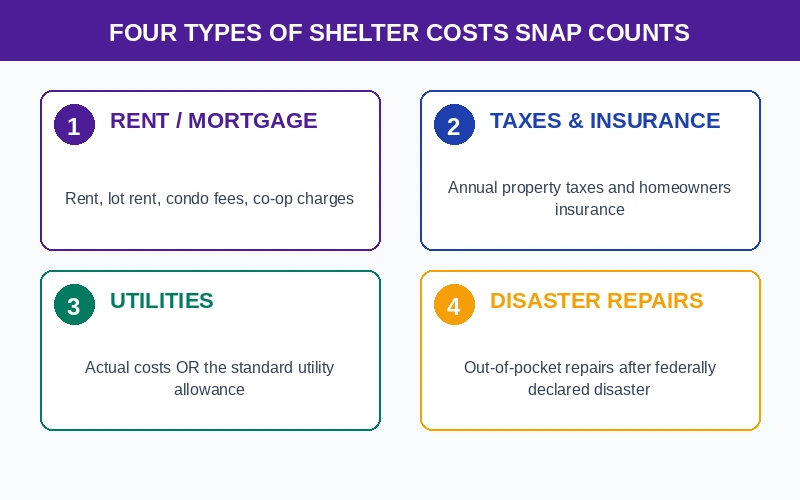
SNAP counts four types of shelter costs in the excess shelter calculation.
The Excess Shelter Formula
The SNAP excess shelter formula has three steps. Here is the exact calculation:
Step 1: Total shelter costs = rent + taxes/insurance + utilities + repair costs
Step 2: Half of net income = (gross income − standard deduction − earned income deduction − dependent care deduction − medical deduction − child support deduction) ÷ 2
Step 3: Excess shelter = Step 1 − Step 2 (if negative, excess shelter = $0)
The result is then capped at the current shelter deduction maximum, which is $672 per month for most households in 2026. If your household includes someone who is elderly or disabled, there is no cap — the full excess shelter amount flows through.
Let us run through three examples to see how this works in practice.
Example 1: Low-Income Renter in Ohio
Maria is a single mother in Columbus, Ohio, with one child. She works part-time at a grocery store earning $1,400 a month. She pays $900 in rent and uses the standard utility allowance for Ohio, which is $463.
Step 1 — Total shelter costs:
- Rent: $900
- Standard utility allowance: $463
- Total: $1,363
Step 2 — Half of net income:
- Gross income: $1,400
- Standard deduction (2-person household): $204
- Earned income deduction (20% of $1,400): $280
- Net income: $1,400 − $204 − $280 = $916
- Half of net income: $458
Step 3 — Excess shelter:
- $1,363 − $458 = $905
- Cap for non-elderly households: $672
- Capped excess shelter: $672
Maria's benefit is then calculated using the allotment table. Her net income of $916 with a $672 shelter deduction produces a monthly SNAP benefit calculation result of approximately $345.
Why the cap matters: Without the cap, Maria would get a $905 shelter deduction. With the cap, she loses $233 in deductible shelter costs. That cap costs her roughly $87 per month in lost benefits.
Example 2: Elderly Homeowner in Florida
Robert is a 72-year-old widower in Tampa, Florida, living alone. He receives $1,200 in Social Security and $300 from a small pension, for a total income of $1,500. His home is paid off, so he has no mortgage. He pays $2,400 a year in property taxes and $1,800 a year in homeowners insurance. He uses the standard utility allowance for Florida, which is $401. He also has $85 in monthly medical expenses (Medicare premiums and prescription copays).
Because Robert is elderly, the shelter cap does NOT apply to him. This is a major advantage.
Step 1 — Total shelter costs:
- Property taxes (monthly): $200
- Homeowners insurance (monthly): $150
- Standard utility allowance: $401
- Total: $751
Step 2 — Half of net income:
- Gross income: $1,500
- Standard deduction (1-person household): $204
- Medical expense deduction for elderly: $85 (over the $35 threshold, so $50 deductible)
- Net income: $1,500 − $204 − $50 = $1,246
- Half of net income: $623
Step 3 — Excess shelter:
- $751 − $623 = $128
- No cap applies (elderly household)
- Final excess shelter: $128
Robert's SNAP benefit is calculated using his $1,246 net income and $128 excess shelter. His monthly benefit is approximately $83. Even though the deduction is small, it pushes him above the $0 minimum benefit threshold and unlocks SNAP benefits for seniors that he would otherwise be denied.
Example 3: Family in High-Cost San Francisco
The Chen family is a four-person household in San Francisco. Both parents work, with a combined gross income of $3,800 per month. They pay $2,800 in rent and use California's standard utility allowance of $532.
Step 1 — Total shelter costs:
- Rent: $2,800
- Standard utility allowance: $532
- Total: $3,332
Step 2 — Half of net income:
- Gross income: $3,800
- Standard deduction (4-person household): $236
- Earned income deduction (20% of $3,800): $760
- Child care expense deduction: $400 (after-school care)
- Net income: $3,800 − $236 − $760 − $400 = $2,404
- Half of net income: $1,202
Step 3 — Excess shelter:
- $3,332 − $1,202 = $2,130
- Cap for non-elderly households: $672
- Capped excess shelter: $672
The Chen family's $2,130 in actual excess shelter is reduced to $672 by the cap. Without the cap, their SNAP benefit would be roughly $510. With the cap, it drops to approximately $230. The cap costs them $280 per month.
This example is why the shelter deduction maximum is one of the most debated pieces of SNAP policy. Critics argue that households in high-cost cities bear a disproportionate share of the cap's bite.
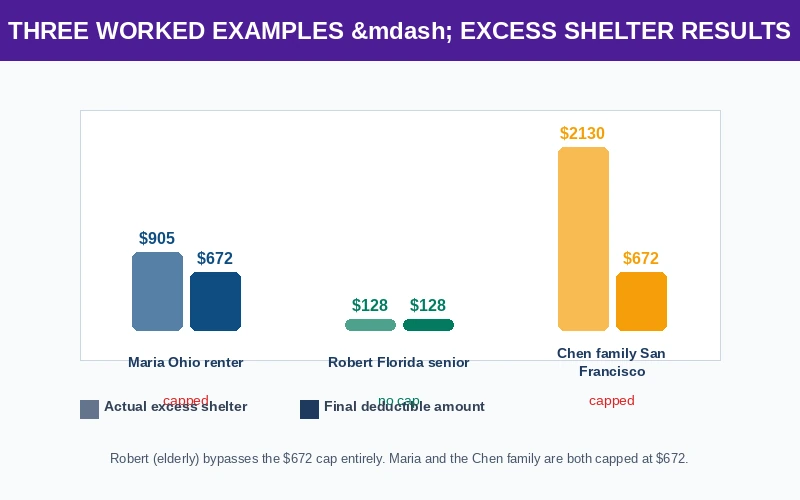
Three real households, three different excess shelter results — including one that bypasses the cap.
How the Shelter Cap Works in 2026
The shelter deduction cap is set annually by the USDA. For the federal fiscal year that runs from October 1, 2025 through September 30, 2026, the cap is:
- $672 per month for households in the 48 contiguous states and D.C. that do NOT include an elderly or disabled member
- No cap for households that include at least one member who is 60+ or receives disability benefits
- $1,034 per month for households in Alaska (varies by region)
- $866 per month for households in Hawaii
The cap was $597 as recently as October 2023. The October 2025 increase to $672 reflects two years of shelter inflation in the CPI-U shelter index.
How to Know if Your Shelter Deduction Was Applied
If you have already been approved for SNAP, you can verify your shelter deduction by reading your approval notice. The notice must list:
- Your countable shelter costs (line item)
- Your net income after deductions
- Your excess shelter amount
- The cap applied (if any)
If your notice shows $0 for shelter and you pay rent, your caseworker missed the deduction. File a fair hearing request within 90 days to get it corrected. Most states will issue back benefits going back to your application date.
Special Situations
Homeless Households
If you are homeless, you do not need receipts to claim a shelter deduction. The program provides a flat $156.81 monthly homeless deduction that takes the place of actual shelter costs. This is significantly smaller than what housed households receive, but it ensures homeless applicants are not penalized for lacking documentation.
Shared Housing
If you rent a room in someone else's home and pay rent to that person, your rent counts as shelter. If you live with another family and split rent, only your share counts. The SNAP roommates rules apply here.
Section 8 Housing Voucher Holders
If you have a Section 8 voucher and pay a reduced rent, your tenant share of rent is what counts as shelter for SNAP. The HUD subsidy does not count as shelter, and it does not count as income either.
Households in Public Housing
Rent in public housing is typically set at 30% of income. The rent you pay counts as shelter for SNAP, even though it is already income-adjusted.
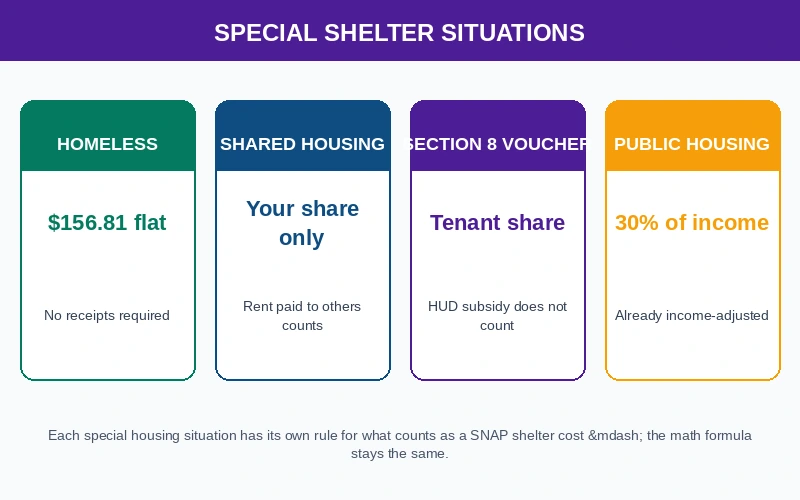
Each special housing situation has its own rule for what counts as shelter.
Tips to Maximize Your Shelter Deduction
If you want to make sure you are getting the largest shelter deduction allowed by law:
- Always use the standard utility allowance unless your actual utility costs are higher. The standard allowance is recalculated each year and usually beats actual costs.
- Count property taxes and insurance if you own your home. Many homeowners forget these.
- Document disaster repairs if you are recovering from a hurricane, wildfire, or flood.
- Keep rent receipts for at least the past 12 months. Caseworkers sometimes ask for them during recertification.
- Report rent increases within 10 days of the change. Higher rent can mean a higher deduction.
Frequently Asked Questions
Can I deduct my internet bill as a shelter cost?
No. Internet service is not a SNAP-eligible shelter cost, even though it is increasingly necessary. SNAP shelter costs are limited to rent/mortgage, taxes, insurance, utilities (heat, electricity, water, sewage, gas, basic phone service), and disaster repairs.
Does my car payment count as shelter?
No. Vehicle payments, insurance, and gas are not shelter costs. They are not deductible under SNAP at all.
What if my rent is paid by a third party?
If a nonprofit, family member, or government program pays your rent directly to your landlord, that payment does not count as shelter for you because you are not the one paying it. The SNAP and housing assistance rules treat this differently depending on who pays.
Can I claim the shelter deduction if I live with my parents?
Yes, if you pay rent to your parents and you are considered a separate SNAP household. The SNAP shared household rules determine whether you can be a separate household.
The Bottom Line
The excess shelter deduction is one of the most valuable parts of the SNAP benefit calculation. For low-income renters, it often makes the difference between a $50 monthly benefit and a $300 monthly benefit. For elderly homeowners, it can be the difference between qualifying for SNAP at all and being denied.
The formula is simple — total shelter costs minus half of net income — but the cap on the deduction limits its value for many households in 2026. If you are denied or approved for less than you expected, check your shelter line item first. Most underpayment errors trace back to a missed shelter deduction.
If you are about to apply, gather your rent receipts, property tax bills, homeowners insurance premium, and utility bills before you submit. The more documentation you provide up front, the less likely your caseworker is to miss a deduction. And if you want to estimate your benefit before you apply, our SNAP benefit calculator runs the full math for you in under a minute.