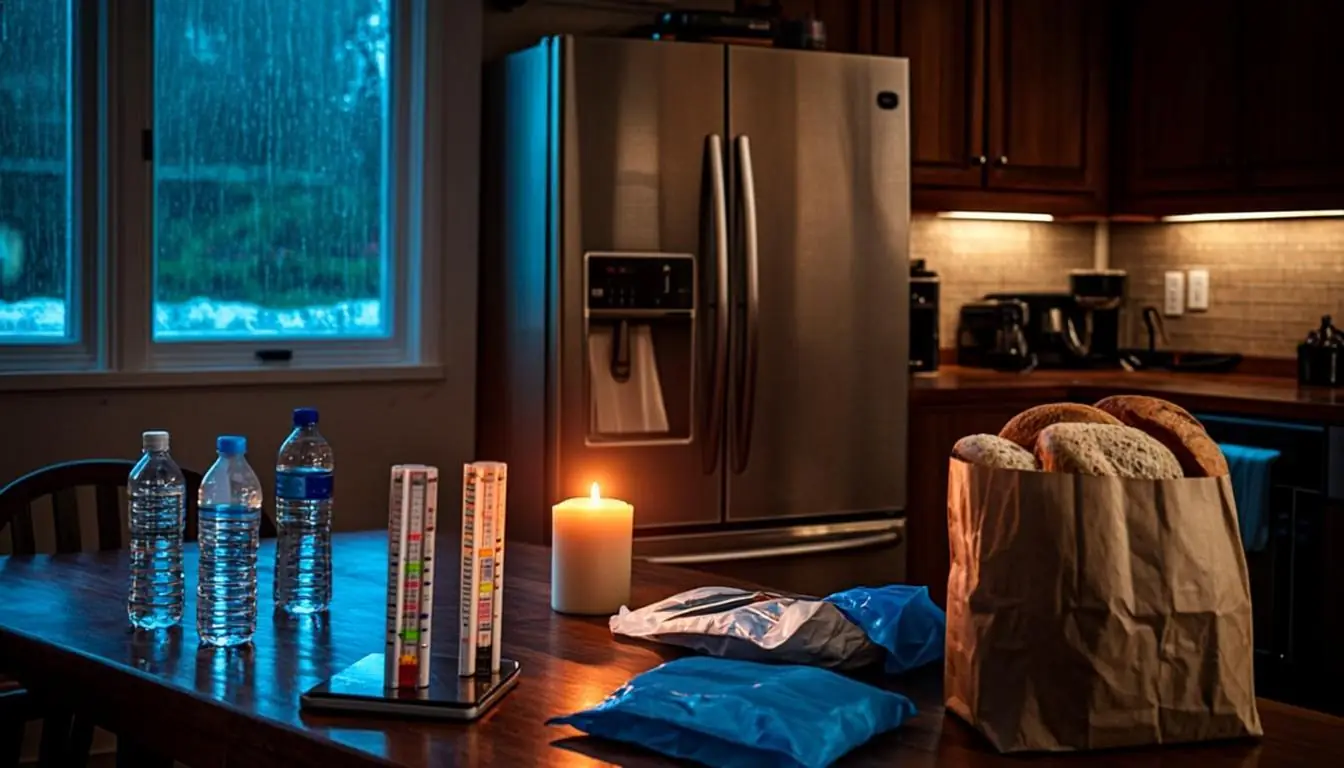
A hurricane power outage knocks the electricity off for days, and the question hits before the lights come back. Is everything in the refrigerator and freezer still safe to eat? The honest answer depends on the clock, the temperature, and whether the doors stayed shut.
A second clock runs alongside the food safety timer. Federal rules give you ten days to report food destroyed in a household misfortune so SNAP can replace it. Move on both clocks, and the outage does not have to empty your kitchen and your budget.
This guide walks the whole path in order. You will sort the safe food from the spoiled, file the report, and learn what the state will ask you to prove. You can also check your regular benefit with our free SNAP calculator before the replacement claim.
Table of Contents
- 1Is the Food in Your Fridge Still Safe?
- 2How Long Food Stays Safe Without Power
- 3What to Throw Out After the Power Fails
- 4What Usually Survives a Short Outage
- 5How SNAP Replaces Food Lost in a Power Outage
- 6The 10-Day Clock and the Two-Step Report
- 7How the State Verifies an Outage Loss
- 8The Signed Statement You Are Promising
- 9What the Replacement Does Not Cover
- 10When the Money Lands, and If It Does Not
- 11If a D-SNAP Runs Instead
- 12Prep the Freezer Before the Next Storm
- 13Related SNAP Guides
Is the Food in Your Fridge Still Safe?
Refrigerated food has the shortest survival window of anything in your kitchen. The FDA outage guidance says an unopened refrigerator keeps food cold for about four hours. After that, the temperature inside starts climbing toward the danger zone.
Freezers hold the line much longer with the door closed. A full freezer keeps food safe for approximately 48 hours, according to the FDA. A half-full freezer manages about 24 hours under the same rule.
The number that decides everything else is the 40-degree line. Perishable food held above 40 °F for more than four hours has to go. Anything that still has ice crystals or reads 40 °F or below is safe to refreeze or cook.
How Long Food Stays Safe Without Power
The windows below assume the doors stayed closed the whole time. Open the fridge once for a long stare and the four-hour cushion shrinks fast. An appliance thermometer takes the guesswork out completely.
Where the food is | Safe window | What to do next |
|---|---|---|
Refrigerator, door closed | About 4 hours | Check the temperature before trusting anything inside |
Full freezer, door closed | About 48 hours | Refreeze or cook food still at 40 °F or below |
Half-full freezer, door closed | About 24 hours | Same check, sooner deadline |
50 pounds of dry ice | About 2 days for an 18-cubic-foot full freezer | Handle with gloves and ventilate the room |
Write the outage start time on a note the moment the power fails. Your replacement claim later depends on dates you can explain calmly. A phone photo of that note costs nothing now and helps a lot later.
What to Throw Out After the Power Fails
The FDA discard list is specific, so follow it item by item. You cannot rescue spoiled items by cooking them, and you cannot rely on appearance or odor to judge food. When the checklist below applies, the food belongs in the trash.
- Meat, poultry, seafood, milk, eggs, and leftovers held above 40 °F for four hours or more
- Any perishable food that sat at room temperature for two hours, or one hour above 90 °F
- Anything touched by flood water that is not in a waterproof container
- Cardboard juice, milk, or baby formula boxes and home-canned foods exposed to flood water
Flood water gets its own rule because hurricanes bring it indoors. Undamaged all-metal cans and retort pouches can be saved after a thorough wash and disinfection. Everything else that flood water touched belongs in the trash, not on the table.
What Usually Survives a Short Outage
Food that never needed refrigeration shrugs off an outage. Sealed pantry goods, bottled drinks, and unopened canned foods sit through a dark kitchen without complaint. Save your worry budget for the refrigerator and freezer instead.
Frozen food deserves a real check before you grieve it. Anything with ice crystals still on it, or a thermometer reading of 40 °F or below, is safe to refreeze or cook. Plan to cook any thawed meat thoroughly the day you use it.
How SNAP Replaces Food Lost in a Power Outage
Now for the recovery side. Federal regulation 7 CFR 274.6(a) requires states to replace food bought with SNAP benefits that a household misfortune destroyed. A multi-day power outage is one classic household misfortune, as our guide to SNAP replacement benefits explains.
The math is simple and generous enough to matter. Your replacement equals the value of the food you lost, up to a maximum of one month's allotment. A household of four receiving the FY2026 maximum allotments of $994 could claim up to that amount.
Report the loss orally or in writing within ten days of the date the food was destroyed. Federal rules also set no limit on how many misfortune replacements a household may request. Misfortune replacements differ from stolen-benefit claims, which our stolen EBT card guide explains.
The 10-Day Clock and the Two-Step Report
Two deadlines run back to back, and both start from events you control. The first is the report itself, which must reach the state within ten days of the loss. Make it orally or in writing, and note the date and time you did it.
The second deadline belongs to the paperwork. The state needs a signed statement of loss within ten days of your report, per the same regulation. If the tenth day lands on a weekend or holiday, the next business day still counts.
Missing either window usually sinks the claim, so file the report even if the form is not ready. Our walkthrough of the SNAP replacement affidavit shows what the form asks for. States may request to extend the ten-day requirement after a declared disaster, which the FNS disaster factsheet confirms.
Claim step | Deadline | Rule that sets it |
|---|---|---|
Report the loss, orally or in writing | Within 10 days of the date food was destroyed | 7 CFR 274.6(a)(3) |
Submit the signed statement of loss | Within 10 days of your report | 7 CFR 274.6(a)(4) |
Replacement issued | 10 days after the report, or 2 working days after the statement, whichever is later | 7 CFR 274.6(a)(5) |
Disaster extension | States may request more time after a declared disaster | FNS disaster factsheet |
How the State Verifies an Outage Loss
The state cannot take every claim at face value, so the regulation lists its verification options. Staff may use a collateral contact, documentation from a community agency, or a home visit. Fire departments and the Red Cross are the regulation's own examples of community agencies.
An outage brings verification sources those examples barely need. Utility outage maps, restoration notices, and dated news coverage all tie your claim to a real event. Your own photos finish the picture.
Photograph the refrigerator and freezer interiors before you throw anything away. Then keep the photos with your claim notes so the dates and the damage line up. Tossing first and wishing later is the most expensive sorting order there is.
The Signed Statement You Are Promising
The signed statement is not a formality, and it pays to read it before signing. It attests that food bought with your benefits was destroyed and states the reason for the replacement. It also confirms you understand the penalties for intentional misrepresentation, up to a perjury charge.
Households that cannot reach the office can mail the statement instead. The regulation allows that for members blocked by age, handicap, or distance when no authorized representative is available. The office keeps the statement in your case file, so ask for a copy if you want one.
What the Replacement Does Not Cover
The rule replaces food bought with SNAP benefits, and only that. Groceries you paid for with cash or another card sit outside the claim. Non-food purchases such as coolers, flashlights, or generator fuel do not qualify either.
Benefits you already spent before the storm are gone for claim purposes. The state can only replace the value of the food the misfortune actually took. That is why the loss amount you report should match what your kitchen really held.
Keep your EBT purchase history in mind when you size the claim. The signed statement asks for the value of the food you lost. Request an amount the records would back up, not the biggest number you can imagine.
When the Money Lands, and If It Does Not
Timing follows a clear federal pattern. Replacement issuances must go out within ten days after your report of loss. The second clock runs two working days from the date the state receives your statement, whichever is later.
A request can be denied or delayed when documentation suggests fraud. The regulation also guarantees you a fair hearing to contest a denial or delay. No replacement goes out while that appeal is pending, so bring your strongest evidence to the hearing.
If a denial letter lands, do not let it sit. Our guide to appealing a SNAP denial lays out the request window and the paperwork that helps. The SNAP payment schedule guide explains how regular benefits arrive while the claim settles.
If a D-SNAP Runs Instead
After a presidentially declared disaster, your state may open D-SNAP rather than handle case-by-case replacements. D-SNAP pays one month of benefits equal to the maximum allotment for your household size. Losing food to a power outage counts among the disaster expenses that can qualify you, per the FNS factsheet.
Here is the rule that surprises people. A household eligible for a disaster allotment cannot receive both that payment and a replacement for the same misfortune. The federal regulation says so in plain terms, so pick the path that fits your loss.
Some disaster areas skip individual claims through mass replacements. Under that waiver, a portion of current households' allotments is replaced automatically, per the FNS factsheet. Our guide to D-SNAP disaster benefits explains the full program, and our emergency SNAP benefits guide covers the expedited lane.
Prep the Freezer Before the Next Storm
A little prep turns the next outage from a loss into an inconvenience. Keep appliance thermometers in both compartments so you can read facts, not guess. The FDA suggests freezer temperatures at or below 0 °F and refrigerator settings at or below 40 °F.
Stock the cold reserves before hurricane season arrives. Freeze water bottles and gel packs, and group food together in the freezer so it stays cold longer. Know in advance where dry or block ice is sold near you.
Fifty pounds of dry ice holds an 18-cubic-foot, fully stocked freezer for about two days by FDA math. That is real protection for a household with a packed freezer. Our hurricane season prep guide pulls the full before-the-storm checklist together.
Related SNAP Guides
These guides cover the questions households raise most when the power goes out and the food warms up. Every link opens a complete guide updated for 2026.
- how the SNAP benefit calculator works
- how to check your EBT balance
- how long SNAP benefits last between deposits
- the complete SNAP application walkthrough
- SNAP asset limits and what you can own
- using EBT for online grocery orders
A power outage steals your cold chain, not your benefits. Sort the food by temperature, report the loss inside ten days, and sign the statement with confidence. You can also estimate your household's regular benefit in the calculator while the replacement claim moves through.