Getting a SNAP denial letter in the mail is frustrating, especially when you were counting on those benefits to cover groceries this month. The good news is that most denials are not permanent. They happen for predictable reasons, and almost every one of them is fixable if you understand what went wrong and what to do next.
This guide walks through the ten most common reasons SNAP applications get denied in 2026. For each reason, you will see why it happens, what you can do to fix it before reapplying, and where to get free help if you want to fight the decision. Read the whole list once, then jump to the section that matches your denial letter so you can take action today.
Before diving in, it helps to understand the bigger picture. SNAP is federally funded but administered at the state level, which means each state runs its own application portal, sets its own interview scheduling rules, and handles fair hearing requests slightly differently. If you have not already, skim our step-by-step SNAP application guide so you know what a complete application looks like. That context makes the denial reasons below much easier to understand.
One quick note: this article focuses on denials at the application stage. If your benefits were approved and then reduced or stopped, the rules are different — read our guide to why SNAP benefits go down instead. Likewise, if you are dealing with an overpayment demand, see our SNAP overpayment what to do walkthrough.
Now let us look at the ten reasons that account for the large majority of SNAP denials each year.
Table of Contents
- 11. Your Income Is Above the SNAP Limit
- 22. Missing or Incomplete Documents
- 33. You Missed the SNAP Interview
- 44. The Application Form Was Incomplete
- 55. Your Assets Exceed the SNAP Limit
- 66. Work Requirements Were Not Met
- 77. Citizenship or Immigration Status Was Not Verified
- 88. College Student Rules Were Not Satisfied
- 99. A Duplicate Application Was Filed
- 1010. You Failed to Report a Change
- 11What to Do After a SNAP Denial
- 12Special Situations That Affect Denials
- 13Programs That Can Help While You Wait
- 14Frequently Asked Questions
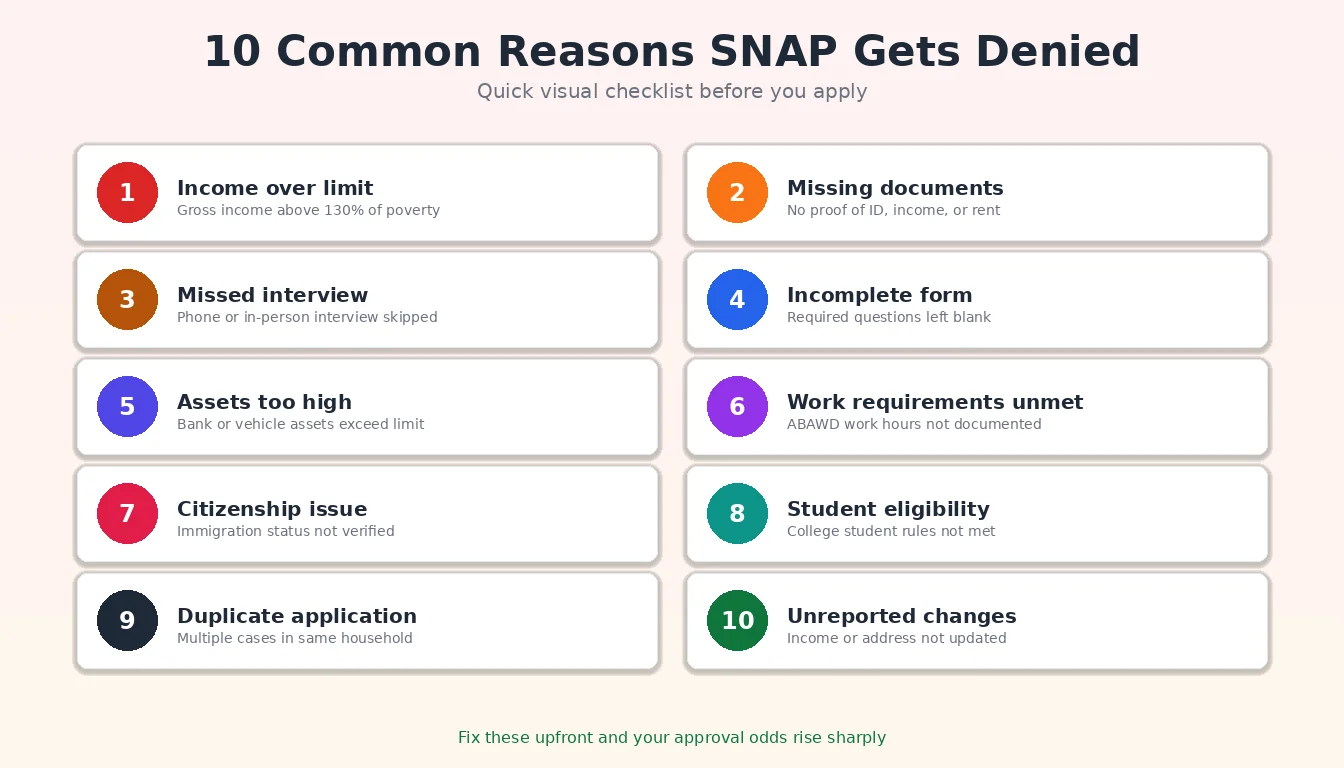
1. Your Income Is Above the SNAP Limit
Income is the single biggest reason SNAP applications get denied. Most households must stay under the gross monthly income limit, which is 130 percent of the federal poverty line, and the net income limit after deductions. If your pay stubs show income above those thresholds, your caseworker has little flexibility.
The fix starts with knowing the exact cutoff for your household size. Our SNAP income limits guide lays out the 2026 monthly limits for households of one through eight plus, and explains how the limits change with each additional person. Compare your gross income against that table before you reapply.
Many denied applicants also forget that SNAP counts income after certain deductions, not before. Read our guide to gross versus net income for SNAP and our SNAP deductions cheat sheet to see which expenses can lower your countable income. Housing costs, child support payments, and dependent care can all reduce the income number your caseworker actually uses.
Reason #1
Income above the SNAP gross or net monthly limit for your household size
2. Missing or Incomplete Documents
SNAP requires proof of identity, income, housing costs, and sometimes medical expenses. If you submit the application but skip the verification step, the state will deny the case even if you would have qualified on paper.
The most commonly missing documents are pay stubs from the past 30 to 60 days, a current lease or rent receipt, and a photo ID. If you are self-employed, you will also need a profit-and-loss statement. Our SNAP for self-employed workers guide explains exactly which records to bring.
Households with elderly or disabled members often forget to submit medical bills, which can unlock a higher deduction. The SNAP medical expense deduction guide lists the qualifying expenses and how to document them. Gathering every relevant document before reapplying is the fastest way to flip a denial into an approval.
3. You Missed the SNAP Interview
Every SNAP applicant must complete an interview, usually by phone, before benefits can be approved. If your caseworker calls at the scheduled time and you do not pick up, the application will be denied for failure to complete the interview.
The fix is simple but time-sensitive. Call your local office the same day you realize you missed the appointment and ask to reschedule. Most caseworkers will give you a second slot if you respond quickly. Our SNAP interview guide walks through what questions to expect, what documents to have ready, and how to handle a phone interview without freezing up.
Before you reapply
Always answer calls from unknown numbers during your application window, even if you do not recognize the area code. Many state SNAP offices use third-party call centers, and a missed call can mean a missed interview. Save your caseworker's direct line if they leave it in a voicemail.
4. The Application Form Was Incomplete
A surprisingly large share of SNAP denials come from blank fields on the application itself. Caseworkers are not allowed to fill in the gaps for you. If questions about household composition, income sources, or shelter costs are left empty, the application is treated as incomplete and denied.
The most often-skipped sections are the questions about anyone who lives with you but is not applying, the questions about child support paid out, and the questions about utility costs. Each of these can affect your benefit amount, so leaving them blank is not just a paperwork problem — it can shrink your eventual benefit too.
Before you submit a new application, sit down with a printed checklist and walk through every question. The step-by-step SNAP application guide includes a section-by-section breakdown of what each question is really asking, so nothing gets skipped.
5. Your Assets Exceed the SNAP Limit
Some states still apply an asset test, which means your bank balances, vehicles, and other resources cannot exceed a set dollar amount. If you have money in savings that pushes you over the limit, your application can be denied even if your monthly income is low.
The asset rules vary by state, and many states have eliminated the test entirely through broad-based categorical eligibility. Our SNAP asset limits guide shows which states still apply the test, what counts as an asset, and how retirement accounts are treated.
If you live in a state with an asset test and your savings are over the limit, the fix usually involves documenting that the money is earmarked for something specific, such as a moving expense or a self-employment startup cost. A caseworker can walk you through what documentation is acceptable.
Reason #5
Bank accounts, vehicles, or other resources above the state asset limit
6. Work Requirements Were Not Met
Adults between the ages of 18 and 54 without dependents, often called ABAWDs, must meet work requirements to keep SNAP beyond three months in a 36-month period. If you cannot show 80 hours of work, training, or volunteer time per month, your application can be denied at the outset.
There are exceptions for people who are pregnant, caring for a child under 18, medically unfit to work, or in a work program. Our SNAP work requirements guide explains who counts as an ABAWD, which activities qualify, and how to log your hours correctly.
If you fall into the ABAWD category, also read our SNAP for single adults under ABAWD rules article. It walks through the time-limit rules and the waiver areas where the work requirement is currently relaxed.
7. Citizenship or Immigration Status Was Not Verified
SNAP is available to most US citizens and to many lawfully present non-citizens, but the documentation rules are strict. If you cannot verify your status, or if you apply for someone in your household who is not eligible, the case can be denied.
Lawful permanent residents usually need to wait five years before they qualify, with exceptions for refugees, asylees, and certain children. Our SNAP immigrants eligibility guide breaks down the rules by status, including which documents satisfy the verification step.
Mixed-status households can still apply for eligible members. Children who are citizens can receive benefits even if their parents are not. A caseworker or a SNAP outreach worker can help you structure the application so eligible family members are not denied because of an ineligible relative in the home.
Public charge note
Receiving SNAP does not make you a public charge under current federal rules. Many families skip SNAP for this reason and end up denied help they were entitled to. See our snap public charge explainer for the details if this concern applies to you.
8. College Student Rules Were Not Satisfied
Students enrolled at least half-time in college face extra SNAP eligibility rules. Most are denied unless they work 20 hours per week, participate in a work-study program, or meet one of several exemptions such as parenting a young child or receiving TANF.
If you applied as a student and were denied, the denial letter usually cites the student rule. Our SNAP benefits for college students guide lists every exemption and explains which forms of work and work-study count toward the 20-hour requirement.
The fix is often as simple as documenting an existing exemption you did not realize you had. For example, students with a documented disability, students parenting a child under 12, and students in certain state-funded training programs all qualify automatically.
9. A Duplicate Application Was Filed
Submitting two applications for the same household in the same month almost always triggers a denial. This usually happens when one spouse applies online and the other applies in person, or when a family member reapplies while a previous application is still being processed.
The fix is to coordinate before submitting. Talk to everyone in your household and pick one person to act as the applicant. If a previous application is already pending, do not file a new one — call the office and ask for an update instead. You can check the status of an open application using our guide to checking your SNAP application status.
10. You Failed to Report a Change
If you already receive SNAP and you failed to report a change in income, address, or household composition, your recertification can be denied. This is one of the most common reasons people lose benefits at renewal time, and it is fully avoidable.
Most states require you to report changes within 10 days of when they happen. Our guide to SNAP unreported changes penalties explains which changes count, how to report them, and what happens if you forget.
If your recertification was denied for this reason, the path forward is to report the change now, then reapply. Read our SNAP recertification guide for the exact steps and timelines. Acting quickly can keep the gap in your benefits short.
Reason #10
Failure to report income, address, or household changes during a certification period
What to Do After a SNAP Denial
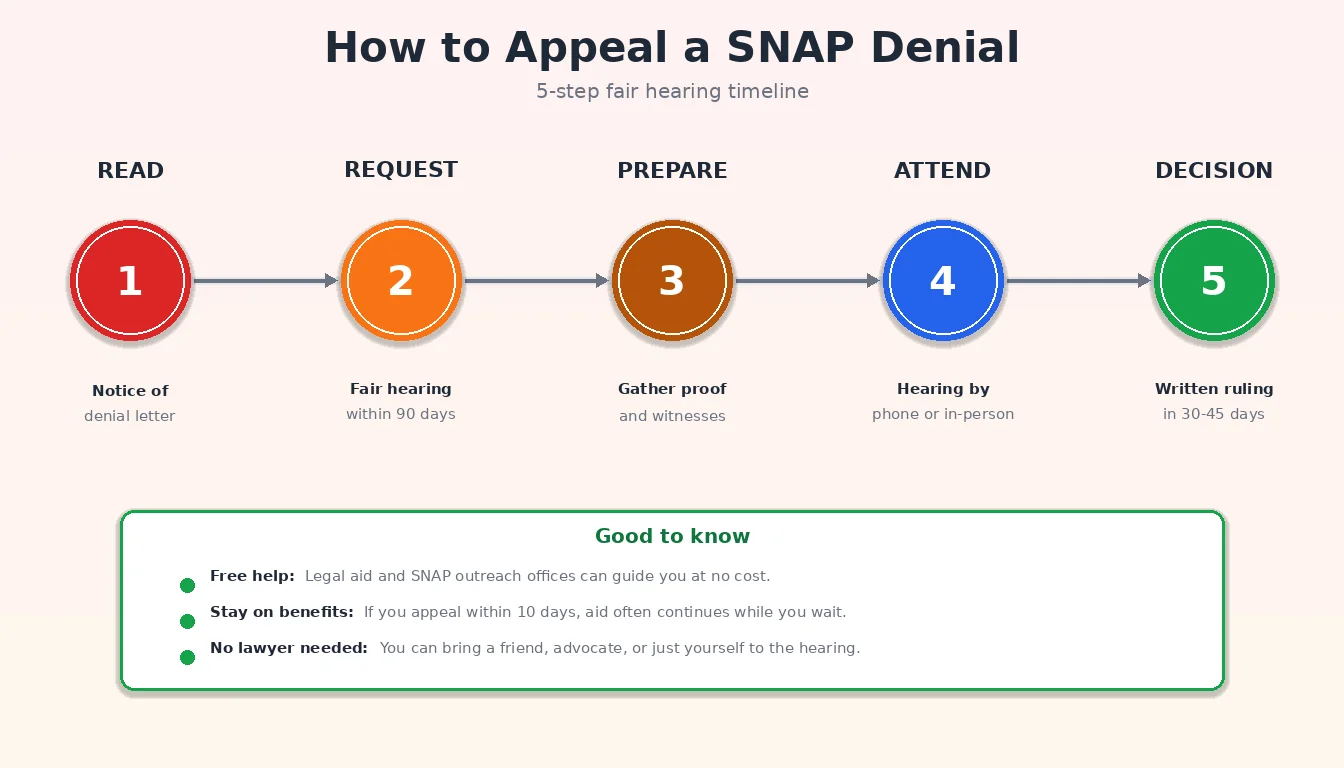
Once you know which of the ten reasons above matches your denial letter, the next step is choosing between two paths: reapply with corrected information, or file a fair hearing appeal if you believe the denial was wrong.
If your situation has changed — say, your income dropped or you gathered the missing documents — reapplying is usually faster than appealing. Most states process new applications within 30 days, and expedited SNAP can get you benefits in as little as 7 days. Read our emergency SNAP expedited benefits guide to see if you qualify for the faster timeline.
If you believe the denial was a mistake, the appeal route is the right move. You have 90 days from the date on your denial notice to request a fair hearing, and benefits can often continue while you wait if you appeal within 10 days. Our how to appeal a SNAP denial guide walks through the entire fair hearing process step by step.
Special Situations That Affect Denials
Certain household types have their own denial patterns. Seniors often get denied because they forget to claim medical expense deductions, which can lower their net income and unlock benefits. If this sounds familiar, our SNAP for seniors guide shows the deduction strategy that works.
Disabled applicants face a similar pattern. Many disabled households are denied because they apply under standard rules instead of the more generous elderly or disabled household rules, which have higher net income limits and no gross income test in most states. The SNAP benefits for disabled Americans guide covers the differences in detail.
Families with children usually get denied for childcare deduction mistakes. If you pay for daycare so you can work, those costs can be deducted from your income. Our SNAP childcare costs deduction guide walks through what counts and how to document it.
Programs That Can Help While You Wait
If your SNAP denial leaves you short on groceries, several other programs can fill the gap. SNAP and LIHEAP interaction explains how the low-income energy assistance program can free up grocery money by covering utility bills. SNAP and Medicaid coordination shows how qualifying for one often helps with the other.
Housing costs are another angle. Our SNAP and housing article explains how a higher shelter deduction can lower your net income and tip you back under the SNAP limit. For a state-by-state view of benefit levels, see our SNAP benefits by state page.
Once your application is finally approved, the next step is understanding when your benefits will load. Our SNAP payment schedule by state guide shows the deposit windows for every major state, so you know exactly when to check your EBT card. For that, the EBT balance check guide walks through every method, and the SNAP-eligible grocery list tells you what counts as a covered purchase.